More and more office spaces are trying to become more playful, offering employees a way to destress and/or get more creative. Usually that takes the form of having ping pong tables or video game consoles set up for breaks, but more and more offices are adding slides, swing sets, picnic tables, or other more active and engaging apparatus. They are also bringing in more greenery for workers.
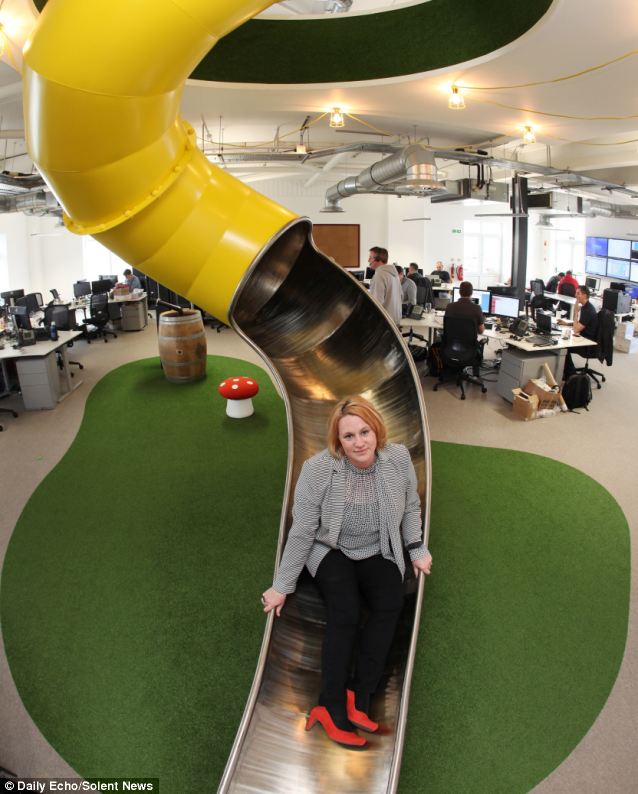
This office may be the most fun in Britain as it comes kitted out with a giant helter skelter slide, a tree house and even a pub.
The unique workplace also boasts a pool table, a putting green, a giant swing and a cinema.
Office designers Space & Solutions were tasked with turning a former pub in Southampton into the home for IT company, Peer 1 Hosting.
‘If you don’t feel comfortable sitting at a desk you can sit on a picnic bench. The reality is that you can do your work from anywhere.’
The article points out that some people may find all this fun a little distracting to actually work around. Some kinds of play are probably great at cutting stress but may be more of a time suck than creativity inducer. I’m curious what readers think. Are you one of those people who does their best work sitting on a couch, or heck, a swing? Do you prefer quiet and focus without any noise? Do you have a toy or plant on your desk you fiddle with when you’re trying to think or just need to destress?
Another question; do you actually use the toys and playful apparatus in the office? The office I currently work in has a ping pong and air hockey table, but only two people ever use the ping pong table, and I have only seen the air hockey table turned on once for a promo video.
Since 2004 IBM conducts every two years a Global CEO Survey among global business and public sector leaders to research what keeps them busy (at night in bed). The survey consists of in-person interviews with (in 2012) over 1700 CEO’s worldwide.
More than half of all CEO’s see Human Capital, Customer Relationships and Innovation as key sources of sustained economic value (report 2012).
The findings (2010 & 2012) show a fast growing need for some critical capabilities of employees, in order to deal with the complexity of operating in an increasingly volatile and uncertain world. These include; creativity and creative leadership, collaborativeness, connectedness, communication and flexibility.
To foster these capabilities “CEO’s are creating more Open & Collaborative cultures – encouraging employees to connect, learn from each other and thrive in a world of rapid change. The emphasis on Openness is even higher among Outperforming organizations(*) – and they have the changemanagement-capabilities to make it…
This article in the NYTimes really drives home for me the need to let everyone learn how to play and create on their own. The thesis of the article and the book it’s reviewing is basically that the next generation of workers will need to be able to identify needs and figure out how they can fill those needs, and monetize it.
“Today,” [book author Tony Wagner] said via e-mail, “because knowledge is available on every Internet-connected device, what you know matters far less than what you can do with what you know. The capacity to innovate — the ability to solve problems creatively or bring new possibilities to life — and skills like critical thinking, communication and collaboration are far more important than academic knowledge. As one executive told me, ‘We can teach new hires the content, and we will have to because it continues to change, but we can’t teach them how to think — to ask the right questions — and to take initiative.’ ”
Ok, so how do we teach kids to be innovative? Play! Play play play! Creativity! The opportunity for boredom, as one study recently found, and free play. Letting kids be kids! Letting them take stuff apart and put it back together. Letting them get messy and innovative!
So let your kids, and yourself, have some unstructured play time. It’s good for your brain, and will help you keep your job, or find or even make a new one.
OpenIDEO asks how do we promote wellness in the workplace. (Photo credit: Wikipedia)
Wow, OpenIDEO is on a role lately with their challenges that get my creative juices rolling and my passions up, in a good way! This latest challenge is about wellness in the workplace:
Together with Bupa and the International Diabetes Federation, we’re asking our global community to help us explore how people can best be supported in the workplace to make positive changes to their health and wellness – and what skills and tools are needed to pass these positive changes onto their networks of co-workers, family and friends.
As the Chair of the Wellness Committee at my job for just under a year, we tried out a lot of different wellness incentives, some with better results than others. I feel very passionately about offices promoting and encouraging wellness; we spend the majority of our waking lives there, it’s cheaper in the long run for companies to have healthy and happy workers, and it promotes productivity and dedication from employees.
What are your ideas? Add them to the inspiration. I’ll have to share some of my ideas for this challenge on the blog, as well as my ideas from the previous OpenIDEO challenge I mentioned, which is currently in the concepting phase.
What does it take to reduce on-the-job depression and create an overall happier work environment? (Photo credit: Modern_Language_Center)
A recent study of health factors and their associated costs at seven companies, published in the journal Health Affairs, found that “depression is the most costly among 10 common risk factors linked to higher health spending on employees.”
The analysis, found that these factors — which also included obesity, high blood sugar and high blood pressure — were associated with nearly a quarter of the money spent on the health care of more than 92,000 workers.
First the employees were assessed for health risks, then researchers tracked their medical spending from 2005 through 2009.
The average medical spending for each employee was $3,961 a year. In total, $82 million, or 22 percent, of the $366 million annually spent on health care for the workers was attributed to the 10 risk factors, the study found.
The relationship between higher spending and depression was the strongest, with 48 percent more spending for workers with a propensity for that widespread problem.
Now, to be fair, this is a fairly small study of just seven companies, and the article didn’t say how many employees worked at these companies. However, this is definitely a trend that has been spotted at least anecdotally by many HR managers, so it’s nice to see that there is some “official” analysis being done on the issue.
So what can employers do about this? My fear is that employers would discriminate, unintentionally or intentionally, against people who suffer from depression. But these days many people will be diagnosed with depression due to a temporary life situation such as a death in the family, or their jobs, so being fired for temporary sadness is probably not a good idea for companies.
Instead, my hope is that companies would invest more on making people’s job satisfaction higher. As of two years ago, Americans reported the lowest job satisfaction ever recorded. That means employers can be doing A LOT more to improve their employees’ lives at work. And a lot of that has to do with feeling supported by their managers, and feel like they are heard and respected and overall a part of the team. A lot of that comes from having fun at work.
This philosophy has been spouted in several different books and magazines, and has been shown to work well in classrooms as well, referred to as the “Responsive Classroom” approach.
The Responsive Classroom approach centers on several ostensibly mundane classroom practices. Each morning students form a circle, greet one another, share bits of news, engage in a brief, fun activity and review the day’s agenda. The idea is to build trust, ensure a little fun (which adolescents crave) and confront small problems before they become big. Students might welcome one another with salutations from a foreign language. An activity might involve tossing several balls around a circle in rapid succession. Students share weekend plans or explore topics like bullying before lessons begin. (New York Times)
This approach could very easily be applied to a business setting, in fact it sounds like a team kick-off meeting one might see in a corporate environment. Taking time to connect with other coworkers and laugh a little before diving in to the day’s work has been shown to work wonders for productivity and boost morality in both school and work settings.
There is definitely a drive and expectation in many industries to work longer, faster, harder hours, and be available and working at all hours. But that drive is unsustainable, demonstrated by the low job satisfaction and high burnout rates in many industries, from high-tech to physicians. Taking time to play a little bit at work, or just connect with coworkers, is being shown as an effective way to reduce depression related to work and job burnout, increase productivity, and create a more cohesive company with more loyalty overall to the company’s mission.
So long story short: remember to bring the koosh ball to your next meeting.
You temperature impacts your perceptions and job performance (Photo credit: Wikipedia)
The rain, wind, and falling leaves make it feel like fall is officially upon us in most of the United States (although some regions are still experiencing an Indian Summer). This makes many of us think of warm beverages and sweaters, unless you work in an office that turns the heat up WAY too high all winter long. In fact, working in a space that is either too hot or too cold can effect productivity:
One of the painful ironies of office life is that we can never quite get the temperature right. We spend our summers shivering in meat lockers and our winters sweating in saunas.
Central air hasn’t made us comfortable, so much as made us uncomfortable in a different way.
The experience isn’t simply unpleasant. It comes with a real financial cost… [according to one study], when temperatures were low 68 degrees, employees committed 44% more errors and were less than half as productive as when temperatures were warm a cozy 77 degrees.
Cold employees weren’t just uncomfortable, they were distracted. The drop in performance was costing employers 10% more per hour, per employee. Which makes sense. When our body’s temperature drops, we expend energy keeping ourselves warm, making less energy available for concentration, inspiration, and insight.
This importance of creating comfortable work environments is interesting to me. I know a lot of freelance workers that have a favorite coffee shop to camp out in, often one of the criteria being it’s warm and cozy in the fall and winter.
I also vaguely recall a couple of studies that found play did not occur for animals outside of certain temperature ranges. (If anyone can find one of the studies please let me know).
As humans, we are adaptable to almost all climates from the Arctic to the Serengeti. So I think it is surprising to people to discover just how fragile we are.
Speaking of fragile, the article also mentions the connection between feeling cold and feeling lonely:
In a fascinating study reported in the prestigious journal Science, psychologists uncovered a link between physical and interpersonal warmth. When people feel cold physically, they’re also more likely to perceive others as less generous and caring.
When we’re warm, on the other hand, we let our guard down and view ourselves as more similar to those around us. A forthcoming paper from researchers at UCLA even shows that brief exposure to warmer temperatures leads people to report higher job satisfaction.
The unconscious desire for physical warmth is thought to be the reason lonely people bathe longer, more frequently, and use higher temperatures.
We often describe people as “cold” or “warm,” so it makes sense our perceptions would match our physical sensations. I wonder if this has anything to do with the reported “Seattle Freeze” phenomenon and in contrast the southern United States’ reputation for being open and hospitable.
While the article in Fast Company focused on job productivity, I think this is an interesting observation into overall well-being and improving environments in general.
Do you find you perform better at certain temperatures? Is one temp better for working over playing? For example, I like it to be warm but not hot while doing non-creative work, but if I’m doing an art or construction project or something creative I actually like it a little bit warmer. Leave your complaints or comments below.
We have all experience an “aha!” moment, but how often is that moment at work? People with “creative” jobs talk all the time about the struggle to create on a deadline or within parameters (I’m currently procrastinating on another writing assignment by working on this blog post).
The book explores where innovative thoughts originate and explains how some companies are now working to create environments where they’re more likely to occur.
“Moments of insight are a very-well studied psychological phenomenon with two defining features,” Lehrer tells Fresh Air‘s Dave Davies. “The answer comes out of the blue – when we least expect it. … [And] as soon as the answer arrives we know this is the answer we’ve been looking for. … The answer comes attached with a feeling of certainty, it feels like a revelation. These are the two defining features of a moment of insight, and they do seem to play a big role in creativity.”
Scientists have determined that people in a relaxed state and a good mood are far more likely to develop innovative or creative thoughts. And companies are now taking advantage of this fact. Lehrer points to 3M, which started out making packaging tape and has now expanded into other sectors including electronics and pharmaceutical delivery.
Companies like 3M and Google encourage their employees to take time to be creative and work on other side projects. What else works? Read the rest of the article on NPR, and the book.
Most of us these days work in a cubicle, although the past ten years have really seen a transformation of space and place at the workplace in order to create happier, and therefore more productive, workers. This article in the NYTimes focused on some organizations in Seattle that have embraced a more open work floor plan:
Is this your idea of a perfect work environment?
MARTHA CHOE’S ideal working space is not her private office, nice though it is, but rather a long, narrow table in the vast atrium of the Bill & Melinda Gates Foundation headquarters here.
Ms. Choe, a former member of the City Council here, is the foundation’s chief administrative officer, and she had considerable input in the building’s design. One objective from the start was to give the 1,000 employees a variety of spaces to accommodate different kinds of work. “There’s a recognition that we work in different modes, and we’ve designed spaces to accommodate them,” she says. “I think one of the lessons is to understand your business, and understand what your people need to do their best work.”
The building was designed by NBBJ, a 700-employee architecture firm whose largest operation is in Seattle. The structure is a culmination of ideas about the 21st-century workplace that NBBJ has been exploring in corporate office designs worldwide, including its own offices here.
These are the main concepts: Buzz — conversational noise and commotion — is good. Private offices and expressions of hierarchy are of debatable value. Less space per worker may be inevitable for cost-effectiveness, but it can enhance the working environment, not degrade it. Daylight, lots of it, is indispensable. Chance encounters yield creative energy. And mobility is essential.
This isn’t a suddenly exploding trend. NBBJ’s research has found that two-thirds of American office space is now configured in some sort of open arrangement. But even as these designs save employers space and money, they can make office workers feel like so many cattle. So how to humanize the setting?
SEATTLE serves as a test tube because of several converging factors: There’s a lot of money here to experiment with projects. The work force is relatively young and open to innovation. And the local culture places a high value on informality, autonomy and egalitarianism. People will put in long hours under high pressure if they feel respected, but they won’t tolerate being treated like Dilberts.
Most office workers in Seattle and elsewhere labor in environments much less inspiring than Ms. Choe’s. And most employers have much less to spend to make things pleasant. (Bill and Melinda Gates personally contributed $350 million of the campus’s $500 million cost.) But staying competitive requires coming up with the best ideas, and the office environment can be the incubator for them.
I am all for creating spaces that encourage collaboration and make workers feel comfortable and ready to get down to business. My only question is lack of meeting space. In my last two jobs it has been very hard to find private spaces to meet, although both were cubicle-based workspaces so that layout doesn’t necessarily solve things either. And I’m not alone in my concerns, as the article points out:
NOT all of NBBJ’s corporate clients have boarded the informality-and-buzz bandwagon. When the R.C. Hedreen Company, a real estate development firm based in Seattle, commissioned a renovation of a 10,800-square-foot floor in an old downtown office building five years ago, it specified a perimeter of private offices. Collaborative spaces are provided for creative teamwork, but the traditional offices remain the executives’ home ports.
“Individually, a lot of our workday is taken up with tasks that are better served by working alone in private offices,” says David Thyer, Hedreen’s president.
What are your thoughts on work space? Do you like having an open space to share, or do you prefer your own cubicle or booth? How do you handle the meeting privacy issues at your office? Leave your thoughts in the comments below.
I’m having quite the brain block at work today, but I did find this article helpful; in fact, I went right out and bought myself an early lunch (or late brunch) after reading this.
To help you break the busy-ness cycle and work happier, we’ve rounded up a handful of counter-intuitive ways to tweak your habits and your mindset. They range from obvious-but-oft-ignored tips to the slightly more eccentric. 1. Eat breakfast.
According to New York magazine, “between 1965 and 1991, the number of adults who regularly skip breakfast increased from 14 to 25%.” We all know that “breakfast is the most important meal of the day” but few of us act on it. The truth is there are few better one-stop options for improving general well-being. Numerous studies have linked eating breakfast with better general health, increased productivity, and a lower body mass index. If you want to feel better, look better, or just work better, there’s one simple solution: eat breakfast — preferably foods with a low glycemic index.
2. Sit less.
Most of us spend the greater part of our day sitting in front of a computer. In fact, the average person sits 9.3 hours a day — more than they sleep. All of this sedentary work is leading to increased cardiovascular disease, obesity, diabetes, and lots of other unhealthy side effects. Like death…
I wouldn’t call them counter-intuitive, per say, but definitely not the usual ideas, like getting an office pet (#4) or distancing yourself from a problem (#7). And many of them really do focus on overall well-being, not just creativity and collaboration in the workplace.
What other “odd” ways do you use to improve your well-being? Leave it in the comments.
Artist is one of the top careers associated with depression. But the most common jobs were in the "helping" professions. Image via Wikipedia
Feeling down about your job? You may not be the only one. In fact, some jobs are more prone to depression. A recent study looked at reports of depression associated with what job the individual had.
Here are 10 fields (out of 21 major job categories) in which full-time workers are most likely to report an episode of major depression in a given year. But if you want to be a nurse (No. 4), it doesn’t mean you should pick another profession.
“There are certain aspects of any job that can contribute to or exacerbate depression,” says Deborah Legge, PhD, a licensed mental health counselor in Buffalo (NY). “Folks with the high-stress jobs have a greater chance of managing it if they take care of themselves and get the help they need.”
It doesn’t give an order of which careers are the most depression-prone, but a lot of the careers on the top ten were care-giving or “helping” jobs. These jobs can be draining, don’t pay very well, and apparently there isn’t much appreciation dulled back onto these workers. A lot of them are also associated with or coordinated with government institutions, which is known for its bureaucracy. Bureaucracy can also be frustrating and make workers feel futile or helpless, another key stressor and depresser.
What are some ways to make these “giving” jobs better appreciated and less stressed? There’s a lot of hoopla right now about jobs creation, but what can be done to make the jobs we have right now better?


 Since 2004 IBM conducts every two years a Global CEO Survey among global business and public sector leaders to research what keeps them busy (at night in bed). The survey consists of in-person interviews with (in 2012) over 1700 CEO’s worldwide.


 Mental Flowers