I love this idea of essentially creating exercise Easter eggs for people around the city. It makes people think of their surroundings in totally new, possibly more sporty ways.
The UK government is backing a new fitness initiative that includes putting calorie-counting labels on staircases so people can keep track of how many calories they burn while taking the stairs.
The project, which was developed by StepJockey, includes an app and a website to help people count the calories burned when taking the stairs. The project is backed by London Mayor Boris Johnson, the Department of Health, and NHS London.
The initiative was inspired by food labels that inform people of the calories they are consuming. According to their website, the initiative is “about the other side of the equation,” which entails labeling the physical world to promote fitness and weight loss.
People can “rate” unlabeled staircases by sending enough information for StepJockey to calculate how many calories would be burned when using it. The details can then be printed on a poster that they can put up near the staircases.
I love the concept of interacting with the real world and have crowd sourced information. Plus it’s fun to see spots pop up and know you’re part of the "in crowd," plus some friendly peer pressure to get active.
Taking the arcade experience outdoors. (Photo credit: Wikipedia)
Coming soon(ish) to a street near you (if you live in Colorado):
OHY will transform a Downtown Denver street into an interactive arcade using LED screens, projections, custom games and street art.
BRINGING PLAY BACK TO THE STREET: Get ready! This summer – June & July, 2014 – Champa Street in Denver, from 14th Street to the 16th Street Mall, will be transformed into a street arcade like you’ve never seen. This isn’t your father’s old-school arcade. Powered through a combination of the Denver Theatre District’s LED screens, building projections, street art, social media and a website, this immersive arcade is going to be a gaming experience for all!
ON THE WEB: The public will be able to interact with video game characters through personalized Twitter profiles powered by local improv comedians from Bovine Metropolis.
ON THE STREET: Once you’re on Champa Street, you’ll feel it – the pulse of the arcade bringing downtown to life. To play at the arcade is to be immersed in each game. The entire two city blocks will be full of street art and custom structures that will transport players to a modern game world. The enormity and excitement is going to blow people away.
GAMES: Built by the Denver-based, award-winning creative team of Legwork Studio and Mode Set, the games will allow players to use a smart phone and their body as controllers while playing on the huge Denver Theater District LED screens, as well as projections on buildings. Microsoft Kinect devices will be utilized so participants feel like they’ve jumped right into the video games.
This sounds like a really great way to get people playing together in public spaces.
(Word to the wise, if you have a play-based Kickstarter event, toy, program, or other play-related thing you are trying to get attention for, let me know about it as it is pretty much guaranteed to get some blog time.)
How many of your virtual friends would you actually invite over for lunch? (Photo credit: Meer)
Does social media make us feel more or less connected? How does connecting and communicating in a digital space impact us differently than connecting and communicating in a physical space?
There are mixed results from various studies, but recently more studies have come out finding that we actually feel less connected to each other the more we use social media like Facebook:
Kross found that the more people used Facebook, the less happy they felt—and the more their overall satisfaction declined from the beginning of the study until its end. The data, he argues, shows that Facebook was making them unhappy.Research into the alienating nature of the Internet—and Facebook in particular—supports Kross’s conclusion. In 1998, Robert Kraut, a researcher at Carnegie Mellon University, found that the more people used the Web, the lonelier and more depressed they felt. After people went online for the first time, their sense of happiness and social connectedness dropped, over one to two years, as a function of how often they used the Internet.Lonelier people weren’t inherently more likely to go online, either; a recent review of some seventy-five studies concluded that “users of Facebook do not differ in most personality traits from nonusers of Facebook.”
But, as with most findings on Facebook, the opposite argument is equally prominent. In 2009, Sebastián Valenzuela and his colleagues came to the opposite conclusion of Kross: that using Facebook makes us happier. They also found that it increases social trust and engagement—and even encourages political participation. Valenzuela’s findings fit neatly with what social psychologists have long known about sociality: as Matthew Lieberman argues in his book “Social: Why Our Brains are Wired to Connect,” social networks are a way to share, and the experience of successful sharing comes with a psychological and physiological rush that is often self-reinforcing. The prevalence of social media has, as a result, fundamentally changed the way we read and watch: we think about how we’ll share something, and whom we’ll share it with, as we consume it. The mere thought of successful sharing activates our reward-processing centers, even before we’ve actually shared a single thing.
Virtual social connection can even provide a buffer against stress and pain: in a 2009 study, Lieberman and his colleagues demonstrated that a painful stimulus hurt less when a woman either held her boyfriend’s hand or looked at his picture; the pain-dulling effects of the picture were, in fact, twice as powerful as physical contact.
So what does this all mean? That we are complicated. And so is how we use social media.
“What makes it complicated is that Facebook is for lots of different things—and different people use it for different subsets of those things. Not only that, but they are also changing things, because of people themselves changing,” said Gosling. A 2010 study from Carnegie Mellon found that, when people engaged in direct interaction with others—that is, posting on walls, messaging, or “liking” something—their feelings of bonding and general social capital increased, while their sense of loneliness decreased. But when participants simply consumed a lot of content passively, Facebook had the opposite effect, lowering their feelings of connection and increasing their sense of loneliness.
I have seen forums used to create physical communities (I don’t want to say “real world” because virtual is real, it’s really happening) and create friendships that crossed continents, but I have also heard of and seen virtual bullying that in some very sad cases led to a person’s death. We can be cruel to others by hiding behind that veil of anonymity, or even just by creating a lack of physical presence which also creates a mental separation which makes it easier for us to feel isolated or intentionally isolate others. But we also want to share and connect with others, even if we can’t be physically near them, and share very intimate details with people we may not otherwise have given the time of day, which can be a good or bad thing depending on the context and situation.
How do you use social media? Does it make you feel more connected to your tribe, or do you feel left out or perhaps even more isolated? Do you bridge the gap between your virtual world and physical world, or does the slogan “What happens in Vegas stays in Vegas” also apply to your social media and physical lives? Leave your thoughts in the comments below.
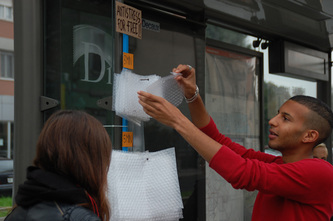
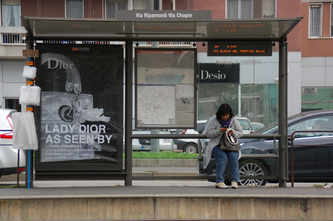
Augusto Pirovano, in Milan, Italy with 2 other friends we made a project called Critical City Upload:
A game of urban transformation that uses a web platform and asks its players to perform creative missions. So far CCU is not very different from Edgeryders, the fact is that the missions are – instead of stories and reflections to write and share with others as it is on Edgeryders – creative actions that are generally performed in the public spaces of cities. The player picks the mission, shuts down the computer, gets out on the street, plays the mission, collects the necessary proof of his experience and then, after returning home, publishes the mission attaching photos and videos. As the player gets points, he levels up until he reaches level 7 and wins the Mechanical Box (a mysterious box that is delivered at his home).
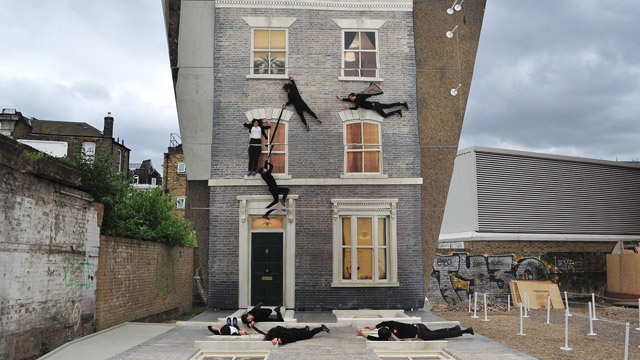
A Victorian terrace has popped up in east London that lets you swing from its ledges, run up its walls and generally defy gravity. Architecture critic Oliver Wainwright hangs loose at Dalston House, the novelty installation by Argentinian artist Leandro Erlich.
The artist talks about “enjoyable discovery” and playing with spaces that you might not otherwise think of.
I love how it is an interactive piece of art that only exists when people play with it.
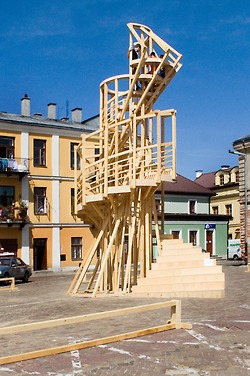
In order to celebrate its 10 years of activity, the artistic centre Lungomare in BolzanoItaly has recruited the ConstructLab/exyzt team composed by Alexander Römer, Gonzague Lacombe, Patrick Hubmann and Mattia Paco Rizzi. The result is the creation of Teatro del Mare, a wooden temporary structure, both a contemporary stage and street furniture, hosting a series of events, meetings and screenings until the end of June.
LIEU d’ÊTRE by the French Compagnie Acte is more than a performance. The project is an urban collective experience involving, both in the creation and the production of the event, professionals as well as inhabitants of a block of flats or of a whole neighbourhood. It uses the tool of dance to explore the pattern of the city.
Yes, yes, yes! Accessibility for all! Allow everyone to be able to use their environments and stay in their communities! Different generations living together in a community is better for everyone!
Yes, yes, yes! Accessibility for all! Allow everyone to be able to use their environments and stay in their communities! Different generations living together in a community is better for everyone!
Children playing outside in the snow (Photo credit: Wikipedia)
This weekend, take a look around to see if you see any kids running or biking around in your neighborhood. Children playing, or not playing, can be seen as a litmus test for overall neighborhood health. Yes physical health, but also the cultural and economic health.
Neighborhoods are suffering these days largely because children are absent. Instead of playing in their neighborhoods, they’re either staring at screens eight hours a day, according to a Kaiser Family Foundation study!, doing lots of homework, or attending numerous adult-led activities outside their neighborhoods.How are the children faring with these differently structured lives?They’re suffering, too, perhaps even worse. Pretty much every pediatrician and child psychologist will tell you that children need to play outside, every day. Without frequent outdoor play, children have been getting fatter, sadder, and less socially adept, and all that homework isn’t making them any smarter.
Children’s immediate neighborhoods—right on their block, outside their front door—are the ideal places for them to play outside. These are the safest, most comfortable places for children outside their homes because they can stay within earshot of their parents, and they can also get to know dozens of neighbors.










 Mental Flowers