
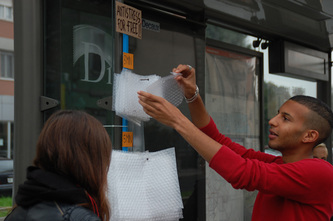
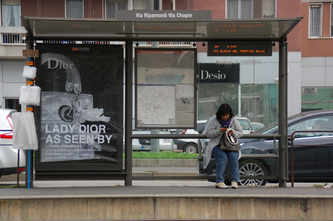
What a thoughtful, and playful, piece of public street art.
Exploring Enriching Environments

 I think I’ve talked about ALL of these tips individually on the blog before, so I’m thrilled that somebody combined them into a “Top 10 With Science!” post:
Happiness is so interesting, because we all have different ideas about what it is and how to get it. It’s also no surprise that it’s the Nr.1 value for Buffer’s culture, if you see our slidedeck about it. So naturally we are obsessed with it.
I would love to be happier, as I’m sure most people would, so I thought it would be interesting to find some ways to become a happier person that are actually backed up by science. Here are ten of the best ones I found.
1. Exercise More (7 minutes might be enough)
2. Sleep More
read all 10 Simple Things You Can Do Today That Will Make You Happier, Backed By Science – The Buffer Blog.
I particularly like suggestion #5.
So many studies have found natural spaces to be beneficial for healing and mental health, so it is crucial as we become more urbanized to allow space for nature to sneak in.
More and more Americans are working through their weekends. According to a 2010 Bureau of Labor Statistics survey, more than one-third of U.S. employees log time on the weekends, putting in an average of five and a half hours, and a whopping 81 percent of respondents in a recent GFI Software survey said they check their email on Saturdays and Sundays. But enjoying those precious two days off can actually make you more effective throughout the workweek.
"There are 60 hours between that 6 p.m. Friday beer and that 6 a.m. Monday alarm clock," Laura Vanderkam, author of 168 Hours: You Have More Time Than You Think, writes in a Fast Company blog. "That’s plenty of time for fun, relaxation and more importantly, recharging the batteries. In our competitive world, successful people know that great weekends are the secret to workday success. You want weekends that leave you refreshed, not exhausted or disappointed."
From literary icons of the past to present-day CEOs, these successful people make the most of their time off with weekend rituals and habits that don’t involve catching up on email.
http://www.huffingtonpost.com/2013/07/26/weekend-rituals-of-hig_n_3640661.html
Get the memo, America! Unplug! Relax! Recharge! Take a Sabbath, even if it’s Wednesday evening, whenever! So long as you make space for downtime and contemplation, time to reconnect with family.


Health and fitness is often focused on the young, to the point that as athletes age they often get discouraged that they can’t compete in their old sports anymore. Well fear not, young-at-heart! There is… the Senior Games, with different age brackets.
A lot of what you’d see at the National Senior Games looks familiar if you’ve ever watched the Summer Olympics: there’s track and field, basketball and swimming. At the Summer Olympics, however, you will not hear voices in the crowd cheering “Go, Grandma!”Everyone at these Games is over 50 and they play some sports that will likely never appear at the Olympics.
more via Pickleball, Anyone? Senior Athletes Play New Games And Old : NPR.
I JUST discovered the Senior Games this morning, and I’m already excited to sign up when I’m old enough to qualify – that’s only 20 years away, so I better start practicing. 🙂
But for those who already qualify, this is a great sporting event that should be shared out with more seniors. People like my dad, a lifelong athlete who tries to keep up with the young folks perhaps a bit too much, would make a killing in some of these events.

From Dodgeball to pillow fights to roller derby, adults are reclaiming time to play in their lives:
It was all fun and games until someone smacked Don Norman in the head — hard — with a feather pillow. Walking into his first two-hour “Playing in the Deep” session, a weekly organized event in Portland, Maine that engages stressed-out grownups in childlike activities, Norman, a 48-year-old database administrator, didn’t know what to expect. Then he saw the pillows, a big pile of them, stacked high. Everyone around him grabbed one and was suddenly roughhousing like over-caffeinated kids at summer camp. Someone handed him his own pillow, but he simply held on to it, too inhibited to let his freak flag fly. He considered bolting.
“And then I got hit!” Norman recalls. “I figured, ‘If they’re going to hit me, I’ll hit them!’ By the end of the night, I was running around like a madman, and I forgot all about my self-consciousness. I forgot about everything. It was liberating.”
“I’ve seen a steady increase in invitations for adult play,” says game designer and self-proclaimed “fun theorist” Bernie De Koven, author of The Well-Played Game. “Now that we no longer have the same sense of community at work or in our neighborhoods as we did twenty or thirty years ago, these opportunities for play are filling the gap.”
The events may consist of kiddie games, but there’s often a serious psychological, even spiritual purpose behind them. “People need to feel they’re connected to other people,” says Cary Umhau, the cofounder of Spacious, who says she was inspired by the adage “Love Thy Neighbor.” “Most people are trying to numb themselves out from just the pain of life. If they don’t have addictions, they spend much of their life watching TV. They need places to come together, to step out of the box and out of their social silo.”
more via Stories: Playing For Keeps – Life Reimagined.
More and more adults are understanding the psychological benefits to playing and making time to let their hair down (or pull it up into a ponytail and go hog wild!), from less sick days to a larger community to helping solve a project problem at work. Even if it’s something as small as giving the barista a silly name the next time you order coffee (I am Batman!), it’s enough to get your brain cells firing and keep it healthy.
How do you squeeze in playtime for yourself? Share your ideas in the comments below.

I spend a lot of time on this blog talking about making happy, playful spaces. But in the end the most important thing to making a space playful and happy is the people that fill that space.
According to a new study by Alex Bryson and George MacKerron, published through the Centre for Economic Performance at the London School of Economics and Political Science, of all the things we choose to do at work (other than work!), it’s casually interacting with our colleagues that makes us happiest. From the study:
The largest positive net effect of combining work and another activity on happiness relates to ‘Talking, chatting, socialising’. . . . There are clearly positive psychological benefits of being able to socialise whilst working. It is the only activity that, in combination with working, results in happiness levels that are similar to those experienced when not working.
Now, according to this same study they found the strongest correlation between reducing stress and working was watching videos (film, TV), which indicates to me the study may not be the most robust, but to be fair other studies have found a strong correlation between watching cute things and destressing and an increase in the ability to concentrate, so if these study participants were watching cute puppies and kittens then that makes perfect sense.
I certainly know that having good coworkers makes a huge difference in how much I enjoy my work (and lucky for me I’ve got great coworkers!)
What do you think? Does your personal work happiness depend on your coworkers? Share your work stories in the comments below.
Reposting this from a fantastic blog Free Range Kids, run by Lenore Skenazy, a huge advocate for letting children be children and just playing, especially outdoors:

Readers — In our desperation to create “smarter” kids, we have practically pinned them to their desks. Now educators are realizing this may be just the opposite of what is best for kids — including those with special needs, as Andrea Gordon writes in Toronto’s TheStar.com (a paper run by my favorite editor-in-chief from back when he and I were at the NY Daily News, Michael Cooke). – L.
It was a crisp March day outside Blaydon Public School when teachers discovered that 4-year-old Alex Wong could spell his name.There were no pencils or paper in sight. Everyone was bundled in winter jackets. Alex, who has autism, was in the outdoor classroom where his special-needs class played and explored for at least an hour every day, alongside 25 kids from the mainstream kindergarten class.
Teacher Sue Cooper noticed Alex march over to a pile of wood, put three sticks in a small wheelbarrow and push it to a spot on the pavement. One by one, he placed the sticks on the ground, forming the letter A. He made three more trips and came back with sticks to make three more letters, which he placed in a row: L, E and X.
Cooper’s jaw dropped. The teachers ran for a camera.
Alex is non-verbal and for a long time, his only interactions had been to throw things or hit. But in the fresh air, day after day, something started to change. Over several months Alex had watched the other children making structures. And that March morning, he was ready to take his turn.
The teachers say his is one example of how daily outdoor time is changing the way their young students — including those autism and other special needs — learn and behave.
Obviously more research needs to be done, but there has been strong correlations drawn between outdoor time and decreasing of ADD and dementia symptoms, so it makes sense that putting humans in our natural surroundings would also help other mental disabilities and ailments.
There are a growing number of outdoor preschools, and I’d argue that there should be more outdoor elementary and even middle schools.
Yes, yes, yes! Accessibility for all! Allow everyone to be able to use their environments and stay in their communities! Different generations living together in a community is better for everyone!
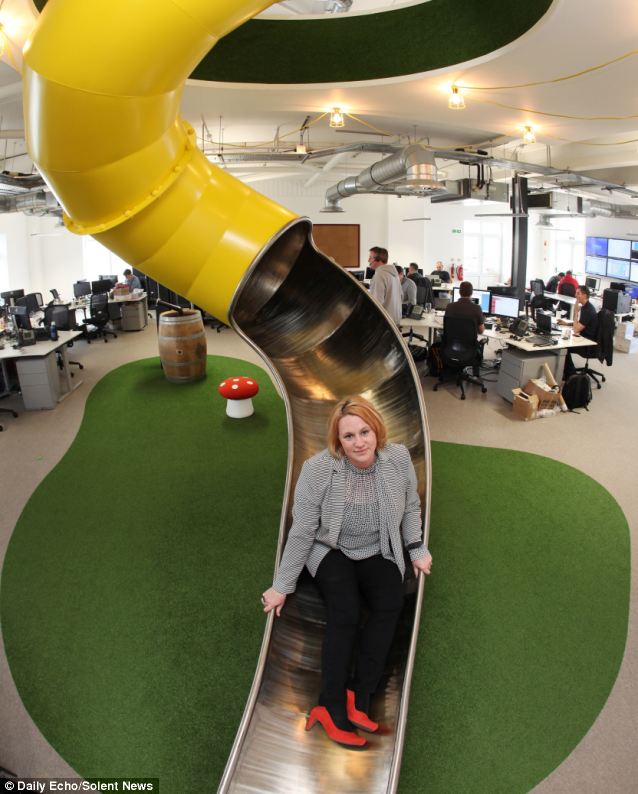
More and more office spaces are trying to become more playful, offering employees a way to destress and/or get more creative. Usually that takes the form of having ping pong tables or video game consoles set up for breaks, but more and more offices are adding slides, swing sets, picnic tables, or other more active and engaging apparatus. They are also bringing in more greenery for workers.
This office may be the most fun in Britain as it comes kitted out with a giant helter skelter slide, a tree house and even a pub.
The unique workplace also boasts a pool table, a putting green, a giant swing and a cinema.
Office designers Space & Solutions were tasked with turning a former pub in Southampton into the home for IT company, Peer 1 Hosting.
‘If you don’t feel comfortable sitting at a desk you can sit on a picnic bench. The reality is that you can do your work from anywhere.’
Read more: UK Daily Mail
The article points out that some people may find all this fun a little distracting to actually work around. Some kinds of play are probably great at cutting stress but may be more of a time suck than creativity inducer. I’m curious what readers think. Are you one of those people who does their best work sitting on a couch, or heck, a swing? Do you prefer quiet and focus without any noise? Do you have a toy or plant on your desk you fiddle with when you’re trying to think or just need to destress?
Another question; do you actually use the toys and playful apparatus in the office? The office I currently work in has a ping pong and air hockey table, but only two people ever use the ping pong table, and I have only seen the air hockey table turned on once for a promo video.
Leave your thoughts in the comments below.

 Mental Flowers