As kids my friends and I used to imagine creating electricity out of the swings or the merry-go-round. Turns out we weren’t the only geeky kids who thought up that kind of thing:
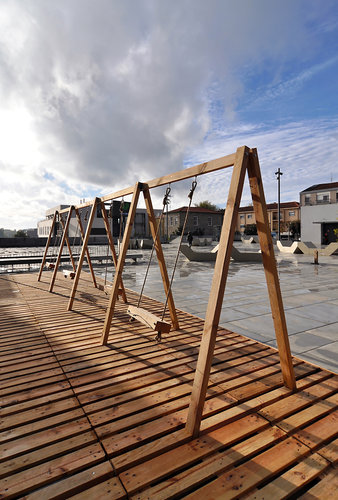
Swinging is a self-contained pleasure, an activity where the work and reward are one in the same. But for their pop-up installation outside the International Centre for the Arts in Guimarães, Portugal, the art collective Moradavaga added an unexpected twist to the childhood pastime: a little bit of light, powered solely by the motion of the swings themselves.
As a pair of European designers have demonstrated, it is in fact possible to intertwine the fun-factor of trampolines with utility. And the world is now a better place. First off is the proposed trampoline “Bridge in Paris,” a design that was put together by Atelier Zündel Cristea of AZC Architecture Studios.
His describes his floaty bridge thusly:
It appears to us that Paris has enough bridges. Our intention is to invite its visitors and inhabitants to engage on a newer and more playful path across this same water.
We propose an inflatable bridge equipped with giant trampolines, dedicated to the joyful release from gravity as one bounces above the river.
Is it dangerous? Probably. Would it ever get approved? Doubtful. But I’m still excited to see this getting so much press, since that indicates that people are interested and hungry for opportunities to get outside and play!
Dr. Thom McKenzie explains why it’s so important for children to have quality Physical Education in school and how caring adults can support it. Designed especially for parents, teachers, school board members and administrators.
I have been on vacation in California this week, playing with deer, ground squirrels, sea otters, sea lions, harbor seals, pelicans, sparrows, sheep, dogs, cats, persimmons, pomegranates, oak trees, poplars, and other assorted flora and fauna. It also means I haven’t been feeding and tending to this blog as much as I would like. So, to hold you over until I am back into my usual swing of things, I am providing a link to a collection of 10 TED talks on Creativity.
Why TED?
I like to think of TED talks as little mental snacks, so this smattering of talks about creativity, both as a blessing and a curse, when it flows and when it doesn’t, and what you can do about it if anything, are a great collection of videos for you to snack on.
Why creativity?
Because I see creativity as merely a facet of play, so any research or discussion of creativity is also beneficial for talking about play. People need creativity in order to play. Creativity is also a key element to a playful space. Writers and artists often need specific environments to create (or at least think they do). And, for some reason, I find it’s easier for academics and business types to talk about creativity than play, when in many regards they are talking about the same thing. You say tom-A-to, I say tom-au-to…
A recent article in the online magazine Co.EXIST discussed a study that found children benefit from being in natural environments, even if the environment is designed to appear natural but is actually human-made:
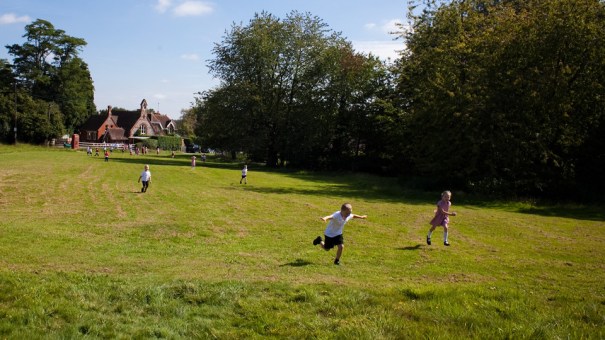
Dawn Coe, an assistant professor in the Department of kinesiology, recreation, and sport studies at the University of Tennessee spent time observing the behavior and time children spent playing on a local playground. After playground renovations added a gazebo, slides, trees, a creek, and a natural landscape of rocks, flowers and logs, Coe returned a year later to observe differences. Working with a statistician, Coe found children spent twice as much time playing in the natural landscape, and were less sedentary after the renovation and more active.“Natural playscapes appear to be a viable alternative to traditional playgrounds for school and community settings,” said Coe in a university statement. “Future studies should look at these changes long-term as well as the nature of the children’s play.”
I attended a conference a couple of years ago where playground designers were reporting discovering the exact same thing – if you give a kid a pile of dirt and tree bark to play with and a bucket of water, they will have WAY more fun, play more, and learn some things as well.
This shouldn’t come as a surprise based on previous research on us humans:
For decades, scientists have reported our species exhibits a consistent, if not quite understood, response to spending time around nature: it boosts our mental and physical well being.
The scattering of findings have held in hospital beds, public housing, and Japanese forests. A 2001 study of public housing found the mere presence of trees and grass reduced reduced reported aggression and violence. Another showed people shown a stressful movie recovered to a normal state–as measured by metrics such as heart rate, muscle tension, and blood pressure–“faster and more complete[ly]” when exposed to natural rather than urban environments.
However, a lot of cities and schools are reluctant to install these kinds of playgrounds since they are considered “untested” or approved by several school or city boards. Thankfully, according to the article, cities are beginning to adopt and install these types of playgrounds:
“Natural playscapes are part of a growing trend appearing in cities across the US including Boston, Phoenix, Chicago, New York, Auburn and others.”
I hope to see more of these pop up around major cities. Do you have a natural playscape near your home? Tell us about it in the comments below.
What does it take to reduce on-the-job depression and create an overall happier work environment? (Photo credit: Modern_Language_Center)
A recent study of health factors and their associated costs at seven companies, published in the journal Health Affairs, found that “depression is the most costly among 10 common risk factors linked to higher health spending on employees.”
The analysis, found that these factors — which also included obesity, high blood sugar and high blood pressure — were associated with nearly a quarter of the money spent on the health care of more than 92,000 workers.
First the employees were assessed for health risks, then researchers tracked their medical spending from 2005 through 2009.
The average medical spending for each employee was $3,961 a year. In total, $82 million, or 22 percent, of the $366 million annually spent on health care for the workers was attributed to the 10 risk factors, the study found.
The relationship between higher spending and depression was the strongest, with 48 percent more spending for workers with a propensity for that widespread problem.
Now, to be fair, this is a fairly small study of just seven companies, and the article didn’t say how many employees worked at these companies. However, this is definitely a trend that has been spotted at least anecdotally by many HR managers, so it’s nice to see that there is some “official” analysis being done on the issue.
So what can employers do about this? My fear is that employers would discriminate, unintentionally or intentionally, against people who suffer from depression. But these days many people will be diagnosed with depression due to a temporary life situation such as a death in the family, or their jobs, so being fired for temporary sadness is probably not a good idea for companies.
Instead, my hope is that companies would invest more on making people’s job satisfaction higher. As of two years ago, Americans reported the lowest job satisfaction ever recorded. That means employers can be doing A LOT more to improve their employees’ lives at work. And a lot of that has to do with feeling supported by their managers, and feel like they are heard and respected and overall a part of the team. A lot of that comes from having fun at work.
This philosophy has been spouted in several different books and magazines, and has been shown to work well in classrooms as well, referred to as the “Responsive Classroom” approach.
The Responsive Classroom approach centers on several ostensibly mundane classroom practices. Each morning students form a circle, greet one another, share bits of news, engage in a brief, fun activity and review the day’s agenda. The idea is to build trust, ensure a little fun (which adolescents crave) and confront small problems before they become big. Students might welcome one another with salutations from a foreign language. An activity might involve tossing several balls around a circle in rapid succession. Students share weekend plans or explore topics like bullying before lessons begin. (New York Times)
This approach could very easily be applied to a business setting, in fact it sounds like a team kick-off meeting one might see in a corporate environment. Taking time to connect with other coworkers and laugh a little before diving in to the day’s work has been shown to work wonders for productivity and boost morality in both school and work settings.
There is definitely a drive and expectation in many industries to work longer, faster, harder hours, and be available and working at all hours. But that drive is unsustainable, demonstrated by the low job satisfaction and high burnout rates in many industries, from high-tech to physicians. Taking time to play a little bit at work, or just connect with coworkers, is being shown as an effective way to reduce depression related to work and job burnout, increase productivity, and create a more cohesive company with more loyalty overall to the company’s mission.
So long story short: remember to bring the koosh ball to your next meeting.
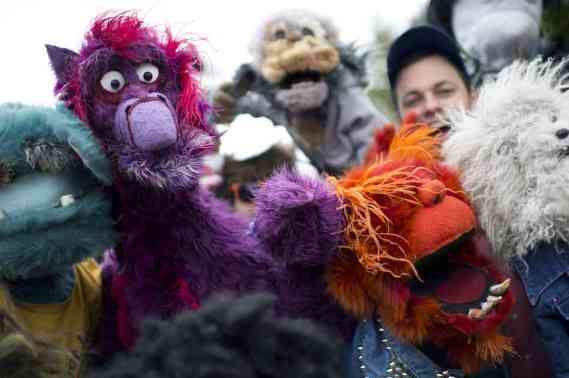
Puppets at the Million Muppet March protest this past weekend.
When presidential hopeful Mitt Romney threatened a childhood icon with funding cuts during a debate last month, people took to the streets and protested…with puppets. In what was deemed the Million Muppet March, people used puppets, marionettes, and other toys to show their unhappiness with the idea of funding for public broadcasting being cut:
Organizers say at least 600 people signed up to attend the march in person, with a few thousand more participating virtually on Facebook, Twitter and their own marches around the country. So far, the pictures on the group’s Facebook page show the marchers bundled in puppet-like hats with animal ears, carrying coffee, placards with statements like “Grouches of the World, Unite!” and, yes, more than a few puppets.
This protest is not only about supporting Public Broadcasting, but is also about play on several different levels. First, Big bird and other Sesame Street characters are a big part of many Americans’ childhoods. While imaginary, to many people these Muppets were very real and very important play characters during the formative years of their lives.
Second, the use of puppets and toys to protest politics is an age-old tradition. People in countries ranging from the England to Venezuela to Thailand have used puppets and epitaphs during protests to get a laugh out of people as well as get their attention. Even the court jester in days of old could get away with some nasty political commentary because it was said “in jest.”
Full disclosure, I am a huge Muppet fan, and am happy to see that others agree with me that Big Bird and PBS are worth funding, and I’m especially happy that people showed their support using puppets.
Kids in Halloween Costumes (Photo credit: epSos.de)
Ah, Halloween, originally considered the betwixt and between time of year when ghosts and souls past could pass over into our world and scare the crud out of their relatives.
But these days, Halloween is really a celebration of play. No, really! When else is it perfectly acceptable to dress up in funny costumes, stay up late on a week night running around banging on peoples doors, play tricks on people, and create food that looks spooky or gross but is really just lots of sugar?
The tradition of dressing up and playing for Halloween is alive and well in the tradition of Dia de los Muertos, for example. To deal with and make light of mortality, grown-ups and kids will put on make-up and costumes that represent death and the dead. They’ll make and eat sugary confections, parade down the street, play music, sing songs, and overall try to make a party out of a normally scary and sad phenomenon. Yes, there is some sadness involved, such as visiting relatives’ graves and setting up alters to reflect their passing, but for some even the act of creating the alter, i.e. being creative, is cathartic and helps with the loss of a loved one.
In the play deprived United States, Halloween has become one big kid’s night out for adults as well as kids. Children and grown-ups alike look forward to dressing up, pretending to be a character, and be silly with friends. Often the costume is a parody or commentary on something political, but that’s just as playful as covering yourself as marshmallows, although potentially socially sticky instead of just physically sticky.
That’s why it makes me sad that so many K – 12 schools have banned Halloween for fear of these socially sticky situations or fear of kids bringing weapons to school as part of their costumes, plus some religious groups find Halloween offensive. While I understand and respect all of these concerns, I disagree with the idea that we should just get rid of it outright. How are we going to learn to get along and get over differences if we just avoid them? Play and school are both supposed to be about learning, so why not turn Halloween into a learning opportunity?
As a proponent of play, I feel like Halloween is an important holiday, not because of what it originally stood for, but for what it stands for now. Being socially allowed to play and pretend, even for one day, is important for humans’ mental health. It also creates bonds between people who share in the activity, not just from sharing the experience but learning more about each other through their costumes.
I will definitely be buying candy and supporting Halloween this year, not for the sweet tooth but for the costumes. Play on!
ASLA blog The Dirt has been reporting on their annual meeting, and mentioned a talk discussing why public art is important. I couldn’t agree more!
…art occupies a unique position within the art world. In comparison with big-name gallery shows, public art is often “under appreciated” much like landscape architecture. But there’s lots to laud: “It’s free. There are no tickets. People don’t have to dress up. You can view it alone or in groups. It’s open to everyone.”
Community art can also create attachment to one’s community. According to Bach, studies have looked at the economic development benefits of art, but only just recently have there been wider examinations of the effect of art on a community’s sense of place. The Knight Foundation’s Soul of the Community initiative surveyed some 43,000 people in 43 cities and found that “social offerings, openness and welcome-ness,” and, importantly, the “aesthetics of a place – its art, parks, and green spaces,” ranked higher than education, safety, and the local economy as a “driver of attachment.” Indeed, the same story may be playing out locally in Philly: a survey of local residents found that viewing public art was the 2nd most popular activity in the city, ranking above hiking and biking.
An example of public art; “Tree Futures” by Suze Woolf. Photo from the Heaven and Earth Exhibition in Carkeek Park, Seattle, 2012.
It creates community by creating a sense of place, it is available for all to enjoy, and it makes a place more enjoyable in which to hang out. All of these are important for creating enriching environments. Also, by making the art public, people often feel they have ownership of the art, or a right to play with it. This can be good and bad; if they art is designed to be engaged with, more power to the people. However, some people do act upon the art in a destructive way, either accidentally or intentionally, which is play to them but ruins it for the rest of the public.
This brings of the life cycle of art, and it being taken care of or abandoned over time, which was also discussed at the meeting:
Bach also made a point of discussing the “afterlife of public art,” what happens once it’s out there. As an example, she pointed a work by Pepon Osorio, a pavilion at a Latino community center that features historical photos of people from the community. Today, kids from the neighborhood take photos of themselves with photos of their ancestors. Another project called Common Ground in a footprint of a church that burnt down was hosting weddings just a week after it opened. While these works became part of their communities, Bach said the group still has to work hard to ensure that all works remain relevant to their communities and aren’t “orphaned.”
Some art is meant to be abandoned; at Carkeek Park in Seattle there is an annual public art exhibit where often the installed art pieces are left at the end of the summer to decay or be destroyed by the elements.
Art installation at Carkeek Park, Seattle, 2012
Overall though I think interaction with public art is a good thing. Do you or have you ever played in fountains, posed with statues or art pieces, or altered them in some way (like the Fremont people in Seattle)? These are all forms of play inspired by public art, which I think are valuable methods of play and should be encouraged so long as it doesn’t damage the artwork.
Waiting for the Interurban is memorial to the trolley/rail line that once ran between Everett and Tacoma. Standing at the north end of the Fremont Bridge, these five aluminum commuters (and one dog) have waited since 1978 for a ride that never came. Decorating the statues with seasonal apparel, political signs and other props has become a Seattle tradition.
What is your experience with public art? Do you find it a good use of real estate? Do you have a statue or fountain or public art piece that speaks to you, that you think of as “yours”?







 Mental Flowers