community · creativity · culture · play · Social

Play-Based KickStarter: Denver’s Immersive Street Arcade by OhHeckYeah

A long exposure photograph (2.5 seconds) of th...
Taking the arcade experience outdoors. (Photo credit: Wikipedia)

Coming soon(ish) to a street near you (if you live in Colorado):

OHY will transform a Downtown Denver street into an interactive arcade using LED screens, projections, custom games and street art.

BRINGING PLAY BACK TO THE STREET: Get ready! This summer – June & July, 2014 – Champa Street in Denver, from 14th Street to the 16th Street Mall, will be transformed into a street arcade like you’ve never seen. This isn’t your father’s old-school arcade. Powered through a combination of the Denver Theatre District’s LED screens, building projections, street art, social media and a website, this immersive arcade is going to be a gaming experience for all!

ON THE WEB: The public will be able to interact with video game characters through personalized Twitter profiles powered by local improv comedians from Bovine Metropolis.

ON THE STREET: Once you’re on Champa Street, you’ll feel it – the pulse of the arcade bringing downtown to life. To play at the arcade is to be immersed in each game. The entire two city blocks will be full of street art and custom structures that will transport players to a modern game world. The enormity and excitement is going to blow people away.

GAMES: Built by the Denver-based, award-winning creative team of Legwork Studio and Mode Set, the games will allow players to use a smart phone and their body as controllers while playing on the huge Denver Theater District LED screens, as well as projections on buildings. Microsoft Kinect devices will be utilized so participants feel like they’ve jumped right into the video games.

more via OhHeckYeah: Denver’s Immersive Street Arcade by Brian Corrigan — Kickstarter.

This sounds like a really great way to get people playing together in public spaces.

(Word to the wise, if you have a play-based Kickstarter event, toy, program, or other play-related thing you are trying to get attention for, let me know about it as it is pretty much guaranteed to get some blog time.)

behavior · creativity · education · health · music · play · school

Remembering to play even as the sun goes away

Happy Friday!

Now that we’re officially into fall, with the weather getting colder and wetter by the day, and all back to school or indoors,it’s important to remind ourselves of opportunities to get out and play.

Idea is Free Museum and Park Day tomorrow; September 28: over 1500 museums, and national and state parks, are opening up their doors to the public for free!

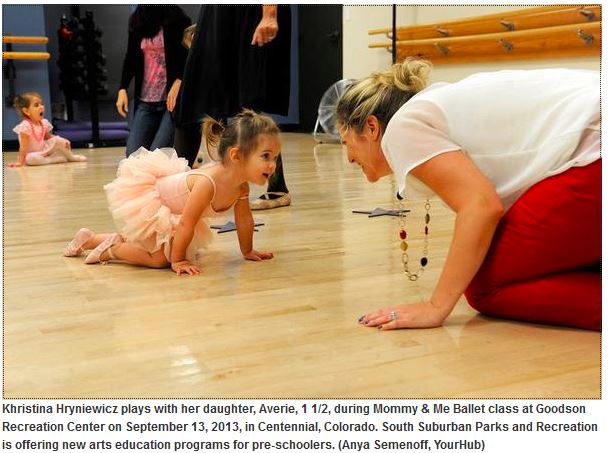
For some more structured play, there are great art, dance, and play-based programs for little and big kids. One just opened up in Colorado, and definitely understands the value of play:

dance

The Curious About Art program is just one of many preschool arts education programs the South Suburban Parks and Recreation District offers throughout the year. It’s not so much about the final product the kids create, but the journey and experiencing sensory exploration with their parents.

“It will probably look like something you expect an 18-month-old to make, something unrecognizable but still pretty wonderful,” said Vickie Willis, culture and enrichment supervisor for South Suburban.

“Everyone needs to play,” Willis said. “It makes us feel good, it unleashes possibilities in our brain, it makes us think better.”

Aside from encouraging play, the purpose of the classes is to prepare kids for a school environment by getting them socialized to being around other children, as well as developing motor skills.

“It’s to develop the motor skills, and the little ones just want to explore their world so music and art is a good way of doing that,” said Janice Schindler, the culture and enrichment coordinator at Goodson Recreation Center

more via Arts education programs in Centennial open possibilities – The Denver Post.

Seattle has a newly-minted hip-hop program for little kids that also focuses on the value of play and silliness in education:

Mini BREAKS is the original hip-hop dance class (breakin’ or “break dance”) for toddlers and preschoolers.

In this unique class, young students will have fun while they exercise, express themselves, think creatively, build self-esteem, practice respect, learn discipline and make new friends!

Outside of a dance studio, hip-hop culture (including breakin’) is not taught through choreography or 8-counts but more intuitively through interactive demonstration. Mini BREAKS focuses on encouraging young children to be creative and courageous – to come up with their own ideas and be able to express themselves by sharing those ideas with others. All children are artists – Mini BREAKS helps them remain artists as they grow up!

more via: Seattle’s Massive Monkees Open Hip-Hop Dance Studio

So remember to play and wiggle even as the weather gets cold and dark.

behavior · mental health · work

Successful People Relax and Take Time Off to Recharge!

More and more Americans are working through their weekends. According to a 2010 Bureau of Labor Statistics survey, more than one-third of U.S. employees log time on the weekends, putting in an average of five and a half hours, and a whopping 81 percent of respondents in a recent GFI Software survey said they check their email on Saturdays and Sundays. But enjoying those precious two days off can actually make you more effective throughout the workweek.

"There are 60 hours between that 6 p.m. Friday beer and that 6 a.m. Monday alarm clock," Laura Vanderkam, author of 168 Hours: You Have More Time Than You Think, writes in a Fast Company blog. "That’s plenty of time for fun, relaxation and more importantly, recharging the batteries. In our competitive world, successful people know that great weekends are the secret to workday success. You want weekends that leave you refreshed, not exhausted or disappointed."

From literary icons of the past to present-day CEOs, these successful people make the most of their time off with weekend rituals and habits that don’t involve catching up on email.

http://www.huffingtonpost.com/2013/07/26/weekend-rituals-of-hig_n_3640661.html

Get the memo, America! Unplug! Relax! Recharge! Take a Sabbath, even if it’s Wednesday evening, whenever! So long as you make space for downtime and contemplation, time to reconnect with family.

autism · behavior · brain · children · learning · mental health · Nature · play · school

Outdoor Play Helps Improve Autistic Symptoms

Reposting this from a fantastic blog Free Range Kids, run by Lenore Skenazy, a huge advocate for letting children be children and just playing, especially outdoors:

Readers — In our desperation to create “smarter” kids, we have practically pinned them to their desks. Now educators are realizing this may be just the opposite of what is best for kids — including those with special needs, as Andrea Gordon writes in Toronto’s TheStar.com (a paper run by my favorite editor-in-chief from back when he and I were at the NY Daily News, Michael Cooke). – L.

It was a crisp March day outside Blaydon Public School when teachers discovered that 4-year-old Alex Wong could spell his name.There were no pencils or paper in sight. Everyone was bundled in winter jackets. Alex, who has autism, was in the outdoor classroom where his special-needs class played and explored for at least an hour every day, alongside 25 kids from the mainstream kindergarten class.

Teacher Sue Cooper noticed Alex march over to a pile of wood, put three sticks in a small wheelbarrow and push it to a spot on the pavement. One by one, he placed the sticks on the ground, forming the letter A. He made three more trips and came back with sticks to make three more letters, which he placed in a row: L, E and X.

Cooper’s jaw dropped. The teachers ran for a camera.

Alex is non-verbal and for a long time, his only interactions had been to throw things or hit. But in the fresh air, day after day, something started to change. Over several months Alex had watched the other children making structures. And that March morning, he was ready to take his turn.

The teachers say his is one example of how daily outdoor time is changing the way their young students — including those autism and other special needs — learn and behave.

Full post.

Obviously more research needs to be done, but there has been strong correlations drawn between outdoor time and decreasing of ADD and dementia symptoms, so it makes sense that putting humans in our natural surroundings would also help other mental disabilities and ailments.

There are a growing number of outdoor preschools, and I’d argue that there should be more outdoor elementary and even middle schools.

architecture · community · creativity · design · environment · play

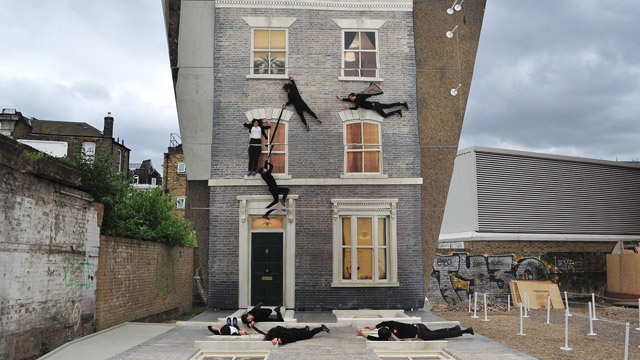
Dalston House: where every visitor becomes Spider-Man – video | Art and design | guardian.co.uk

A Victorian terrace has popped up in east London that lets you swing from its ledges, run up its walls and generally defy gravity. Architecture critic Oliver Wainwright hangs loose at Dalston House, the novelty installation by Argentinian artist Leandro Erlich.

The artist talks about “enjoyable discovery” and playing with spaces that you might not otherwise think of.

I love how it is an interactive piece of art that only exists when people play with it.

more at Dalston House: where every visitor becomes Spider-Man – video | Art and design | guardian.co.uk.

community · culture · environment · happiness · Nature · Social

Chelsea Fringe: A Garden Festival for the Masses

On a more playful note, I love the idea of having public garden festivals where everyone is invited to come out and admire and enjoy nature, and each other’s company.

Unknown's avatar

On a more playful note, I love the idea of having public garden festivals where everyone is invited to come out and admire and enjoy nature, and each other’s company.

View original post

anthropology · behavior · creativity · culture · happiness · play · Social · technology · youtube

Lolcats and the Harlem Shake: Play on the Internet


An article from the head of Google’s Agency Strategic Planning team published in Fast Company talks about why we play on the Internet; it’s a really good dive into the need and importance for play in our lives and share that playful experience with others, and how as we move towards a more digital space we are taking that need to share play with us. It is marketing/branding focused, but the message is clear; we all need play and are making space for it, at least in our Internet lives:

We [netizens] uploaded over half a million variations of Harlem Shake to YouTube in the past few months. Google searches for Cat GIFs hit an all-time high last month. And we took 380 billion photos last year–that’s 10% of all the photos taken . . . ever. But let’s be honest–these memes are fun, but they don’t matter, right? They’re pretty much a waste of time.

As the head of Google’s Agency Strategic Planning team, it’s my job to work with brands and creative agencies to help develop their ideas in the digital space. So I had to ask: Why would we be doing so much of all this “visual play” if it really means so little to us?
To get to the bottom of these memes, we assembled a team of original thinkers–anthropologists, digital vanguards, and content creators–to dig a little deeper into this “visual web.” We also spoke to gen-Cers–the people who grew up on the web or behave as though they did–and who thrive on creation, curation, connection, and community.

The research showed us that far from distracting us from more serious things, these viral pictures, videos, and memes reconnect us to an essential part of ourselves.

It may seem that all we’re doing is just capturing every mundane moment. But look closely. These everyday moments are shot, displayed, and juxtaposed in a way that offers us a new perspective. And then all of a sudden these everyday moments, places, and things look . . . fascinating.

As kids, that happens all the time because everything is new. Everything is unlike. And we aren’t constrained by the rules about what “goes together.” Why else was putting the Barbie in the toy car wash more fun than putting the car in the car wash?

Read the whole article here: Memes With Meaning: Why We Create And Share Cat Videos And Why It Matters To People And Brands

happiness · health · play

Playing with smoke rings, air rings, bubble rings…

Courtesy of Krulwich Wonders: multiple species will make their own games and toys out of thin air, literally, using a variety of different tools:

Humans do it with smoke.

A human blowing smoke rings.

Dolphins do it with air.

A beluga blowing rings.

With a little snort, dolphins can produce a nearly perfect "air" rings, (sophisticated non-dolphins called them toroidal vortices) which they turn into underwater toys.

While humans and dolphins obviously play with rings, it’s possible humpback whales do this too. The video shows humpbacks sending air rings to the ocean surface, but in one of them, the giant underwater author suddenly pops up mid-ring to take what looks like a bow in front of a boat of whale-watchers.

More…

play · youtube

Elk Puddle Hopping

Happy mid-week! Since cute things are supposed to help you concentrate, here is a cute elk calf playing in a puddle. (I’m pretty sure I already posted this about a year ago, but it’s worth it to see it again!). You’re welcome.

behavior · children

Playborhoods: Why Children Playing Street Games Is the Best Measure of a Healthy Neighborhood | Education on GOOD

English: Children playing in snow
Children playing outside in the snow (Photo credit: Wikipedia)

This weekend, take a look around to see if you see any kids running or biking around in your neighborhood. Children playing, or not playing, can be seen as a litmus test for overall neighborhood health. Yes physical health, but also the cultural and economic health.

Neighborhoods are suffering these days largely because children are absent. Instead of playing in their neighborhoods, they’re either staring at screens eight hours a day, according to a Kaiser Family Foundation study!, doing lots of homework, or attending numerous adult-led activities outside their neighborhoods.How are the children faring with these differently structured lives?They’re suffering, too, perhaps even worse. Pretty much every pediatrician and child psychologist will tell you that children need to play outside, every day. Without frequent outdoor play, children have been getting fatter, sadder, and less socially adept, and all that homework isn’t making them any smarter.

Children’s immediate neighborhoods—right on their block, outside their front door—are the ideal places for them to play outside. These are the safest, most comfortable places for children outside their homes because they can stay within earshot of their parents, and they can also get to know dozens of neighbors.

via Playborhoods: Why Children Playing Street Games Is the Best Measure of a Healthy Neighborhood | Education on GOOD.