As kids my friends and I used to imagine creating electricity out of the swings or the merry-go-round. Turns out we weren’t the only geeky kids who thought up that kind of thing:
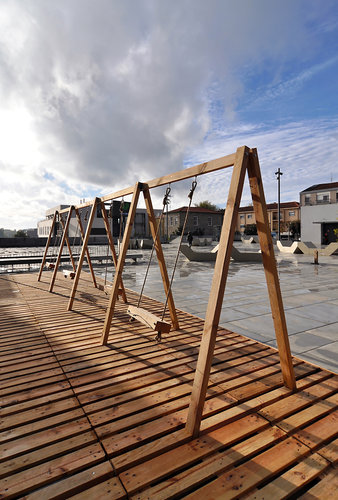
Swinging is a self-contained pleasure, an activity where the work and reward are one in the same. But for their pop-up installation outside the International Centre for the Arts in Guimarães, Portugal, the art collective Moradavaga added an unexpected twist to the childhood pastime: a little bit of light, powered solely by the motion of the swings themselves.
As a pair of European designers have demonstrated, it is in fact possible to intertwine the fun-factor of trampolines with utility. And the world is now a better place. First off is the proposed trampoline “Bridge in Paris,” a design that was put together by Atelier Zündel Cristea of AZC Architecture Studios.
His describes his floaty bridge thusly:
It appears to us that Paris has enough bridges. Our intention is to invite its visitors and inhabitants to engage on a newer and more playful path across this same water.
We propose an inflatable bridge equipped with giant trampolines, dedicated to the joyful release from gravity as one bounces above the river.
Is it dangerous? Probably. Would it ever get approved? Doubtful. But I’m still excited to see this getting so much press, since that indicates that people are interested and hungry for opportunities to get outside and play!
I have been on vacation in California this week, playing with deer, ground squirrels, sea otters, sea lions, harbor seals, pelicans, sparrows, sheep, dogs, cats, persimmons, pomegranates, oak trees, poplars, and other assorted flora and fauna. It also means I haven’t been feeding and tending to this blog as much as I would like. So, to hold you over until I am back into my usual swing of things, I am providing a link to a collection of 10 TED talks on Creativity.
Why TED?
I like to think of TED talks as little mental snacks, so this smattering of talks about creativity, both as a blessing and a curse, when it flows and when it doesn’t, and what you can do about it if anything, are a great collection of videos for you to snack on.
Why creativity?
Because I see creativity as merely a facet of play, so any research or discussion of creativity is also beneficial for talking about play. People need creativity in order to play. Creativity is also a key element to a playful space. Writers and artists often need specific environments to create (or at least think they do). And, for some reason, I find it’s easier for academics and business types to talk about creativity than play, when in many regards they are talking about the same thing. You say tom-A-to, I say tom-au-to…
A recent article in the online magazine Co.EXIST discussed a study that found children benefit from being in natural environments, even if the environment is designed to appear natural but is actually human-made:
Dawn Coe, an assistant professor in the Department of kinesiology, recreation, and sport studies at the University of Tennessee spent time observing the behavior and time children spent playing on a local playground. After playground renovations added a gazebo, slides, trees, a creek, and a natural landscape of rocks, flowers and logs, Coe returned a year later to observe differences. Working with a statistician, Coe found children spent twice as much time playing in the natural landscape, and were less sedentary after the renovation and more active.“Natural playscapes appear to be a viable alternative to traditional playgrounds for school and community settings,” said Coe in a university statement. “Future studies should look at these changes long-term as well as the nature of the children’s play.”
I attended a conference a couple of years ago where playground designers were reporting discovering the exact same thing – if you give a kid a pile of dirt and tree bark to play with and a bucket of water, they will have WAY more fun, play more, and learn some things as well.
This shouldn’t come as a surprise based on previous research on us humans:
For decades, scientists have reported our species exhibits a consistent, if not quite understood, response to spending time around nature: it boosts our mental and physical well being.
The scattering of findings have held in hospital beds, public housing, and Japanese forests. A 2001 study of public housing found the mere presence of trees and grass reduced reduced reported aggression and violence. Another showed people shown a stressful movie recovered to a normal state–as measured by metrics such as heart rate, muscle tension, and blood pressure–“faster and more complete[ly]” when exposed to natural rather than urban environments.
However, a lot of cities and schools are reluctant to install these kinds of playgrounds since they are considered “untested” or approved by several school or city boards. Thankfully, according to the article, cities are beginning to adopt and install these types of playgrounds:
“Natural playscapes are part of a growing trend appearing in cities across the US including Boston, Phoenix, Chicago, New York, Auburn and others.”
I hope to see more of these pop up around major cities. Do you have a natural playscape near your home? Tell us about it in the comments below.
What does it take to reduce on-the-job depression and create an overall happier work environment? (Photo credit: Modern_Language_Center)
A recent study of health factors and their associated costs at seven companies, published in the journal Health Affairs, found that “depression is the most costly among 10 common risk factors linked to higher health spending on employees.”
The analysis, found that these factors — which also included obesity, high blood sugar and high blood pressure — were associated with nearly a quarter of the money spent on the health care of more than 92,000 workers.
First the employees were assessed for health risks, then researchers tracked their medical spending from 2005 through 2009.
The average medical spending for each employee was $3,961 a year. In total, $82 million, or 22 percent, of the $366 million annually spent on health care for the workers was attributed to the 10 risk factors, the study found.
The relationship between higher spending and depression was the strongest, with 48 percent more spending for workers with a propensity for that widespread problem.
Now, to be fair, this is a fairly small study of just seven companies, and the article didn’t say how many employees worked at these companies. However, this is definitely a trend that has been spotted at least anecdotally by many HR managers, so it’s nice to see that there is some “official” analysis being done on the issue.
So what can employers do about this? My fear is that employers would discriminate, unintentionally or intentionally, against people who suffer from depression. But these days many people will be diagnosed with depression due to a temporary life situation such as a death in the family, or their jobs, so being fired for temporary sadness is probably not a good idea for companies.
Instead, my hope is that companies would invest more on making people’s job satisfaction higher. As of two years ago, Americans reported the lowest job satisfaction ever recorded. That means employers can be doing A LOT more to improve their employees’ lives at work. And a lot of that has to do with feeling supported by their managers, and feel like they are heard and respected and overall a part of the team. A lot of that comes from having fun at work.
This philosophy has been spouted in several different books and magazines, and has been shown to work well in classrooms as well, referred to as the “Responsive Classroom” approach.
The Responsive Classroom approach centers on several ostensibly mundane classroom practices. Each morning students form a circle, greet one another, share bits of news, engage in a brief, fun activity and review the day’s agenda. The idea is to build trust, ensure a little fun (which adolescents crave) and confront small problems before they become big. Students might welcome one another with salutations from a foreign language. An activity might involve tossing several balls around a circle in rapid succession. Students share weekend plans or explore topics like bullying before lessons begin. (New York Times)
This approach could very easily be applied to a business setting, in fact it sounds like a team kick-off meeting one might see in a corporate environment. Taking time to connect with other coworkers and laugh a little before diving in to the day’s work has been shown to work wonders for productivity and boost morality in both school and work settings.
There is definitely a drive and expectation in many industries to work longer, faster, harder hours, and be available and working at all hours. But that drive is unsustainable, demonstrated by the low job satisfaction and high burnout rates in many industries, from high-tech to physicians. Taking time to play a little bit at work, or just connect with coworkers, is being shown as an effective way to reduce depression related to work and job burnout, increase productivity, and create a more cohesive company with more loyalty overall to the company’s mission.
So long story short: remember to bring the koosh ball to your next meeting.
Playful design in an urban environment? My favorite!
Clever and talented Danish artist Jeppe Hein has been custom-making his “Modified Social Benches” for museums, arts festivals, and plazas since the mid-2000s. Most recently, he created a unique set of art you can sit on for Beaufort04, the fourth Triennial of Contemporary Art by the Sea this summer in Belgium. Kids, cool kids, and adults all seem to love playing with these.
Hein says his powder-coated aluminium “social benches” borrow their basic form from the standard park bench, but are altered to make the “act of sitting on them a conscious physical endeavor.” As they mutate, the benches become spaces to “inhabit,” rather than just places to park it and relax for a moment.
The pieces may seem like fun one-offs, but something then happens between the work and the community: “As is the case with much of Hein’s work, the Modified Social Benches on the dyke in De Haan seem to hide behind a disguise of fun and entertainment. But what they actually evoke is a process of interaction and communication that works on different levels.”
Playground doesn’t need to be fancy to be effective (Photo credit: Wikipedia)
As we head back into the academic school year, a lot of people are focused on education and making sure students get the best possible opportunity to learn and thrive. Here’s one easy way to support that: give them space and time for play!
Numerous academic studies [sources stored in a weird place, will update soon] on school-aged kids have demonstrated that recess time is valuable for learning and aids in the overall learning process. But I think it can be more powerful to hear how valuable it is from someone who actually lives with the results of life with more or less recess; the teachers.
Apart from being a fun activity, it is widely recognised that play is one of the most important ways in which brain development occurs in children.
Sadly, in some schools valuable recess and lunch time has been reduced in favour of more rigorous academic pursuit within the classroom. In other schools, running or ball games have been banned due to a perceived high injury risk factor.
As many families now choose structured and adult-directed play activities after school or on weekends, the school playground becomes one of a few outlets where children can engage in free outdoor play with their peers. More than 28 hours a week, often spent solitarily, are devoted to computers, mobile phones, television and other electronic devices. Considering that as much as 25 per cent of time spent at school is playground time, we need to rethink the benefits of play at school.
Conversely, a lack of play can result in challenging behaviour and negative performances in the classroom, according to an American educational psychologist, Anthony Pellegrini.
Also, playgrounds that lack play stimuli become spaces where children often wander around aimlessly, become frustrated and bully other children. Not many schools can afford expensive playground equipment, but the good news is that this is not needed anyway.
Professor Anita Bundy, from the Faculty of Health Sciences at Sydney University, has launched a large-scale study involving 12 primary schools in NSW, introducing simple, recycled play resources during recess, with outstanding results. This included crates, car tyres, foam pool noodles, plastic barrels, tarpaulins, foam cubes and other open-ended materials that lend themselves to creative, imaginary play.
Not only do children become physically more active, they also hone important social skills, build resilience and are encouraged to think creatively.
The entire Op-Ed is very strongly written and makes a great case for play, and it’s great to hear it from the teacher’s standpoint, so please read it and share. And be sure to support play time in school, whether it’s by voting, volunteering, donating red rubber balls, or whatever you can do.
If you’re looking for a way to mix up your commute, this might just be the ticket. From Inhabitat:
A video has been posted on YouTube of a Russian man riding what appears to be a fully working bicycle… apart from the fact it could probably fit in the rider’s pocket. It’s a good thing he’s wearing a helmet, as he doesn’t look particularly stable – the man’s feet appear to be five times bigger than the pedals!
I’ve actually seen a couple of unicycle commuters, but never a mini-bike. During the first gas price increase of recent years a couple of high school girls tried riding their horses to school, but the school wasn’t set up to stable the horses during school hours (lame!). What other fun ways have you seen people try to get to work or school?







 Mental Flowers