Snow-bunnies aren’t the only animals excited about snow; check out this great collection of photos of animals playing in the snow:


See the whole collection, including some adorable snow pouncing.
Exploring Enriching Environments

Snow-bunnies aren’t the only animals excited about snow; check out this great collection of photos of animals playing in the snow:
See the whole collection, including some adorable snow pouncing.
Surprised this is picking up so much press:
As a pair of European designers have demonstrated, it is in fact possible to intertwine the fun-factor of trampolines with utility. And the world is now a better place. First off is the proposed trampoline “Bridge in Paris,” a design that was put together by Atelier Zündel Cristea of AZC Architecture Studios.
His describes his floaty bridge thusly:
It appears to us that Paris has enough bridges. Our intention is to invite its visitors and inhabitants to engage on a newer and more playful path across this same water.

We propose an inflatable bridge equipped with giant trampolines, dedicated to the joyful release from gravity as one bounces above the river.
more via This is awesome News, Videos, Reviews and Gossip – io9.
Is it dangerous? Probably. Would it ever get approved? Doubtful. But I’m still excited to see this getting so much press, since that indicates that people are interested and hungry for opportunities to get outside and play!

Wow, OpenIDEO is on a role lately with their challenges that get my creative juices rolling and my passions up, in a good way! This latest challenge is about wellness in the workplace:
Together with Bupa and the International Diabetes Federation, we’re asking our global community to help us explore how people can best be supported in the workplace to make positive changes to their health and wellness – and what skills and tools are needed to pass these positive changes onto their networks of co-workers, family and friends.
via OpenIDEO – How might we create healthy communities within and beyond the workplace?.
As the Chair of the Wellness Committee at my job for just under a year, we tried out a lot of different wellness incentives, some with better results than others. I feel very passionately about offices promoting and encouraging wellness; we spend the majority of our waking lives there, it’s cheaper in the long run for companies to have healthy and happy workers, and it promotes productivity and dedication from employees.
What are your ideas? Add them to the inspiration. I’ll have to share some of my ideas for this challenge on the blog, as well as my ideas from the previous OpenIDEO challenge I mentioned, which is currently in the concepting phase.
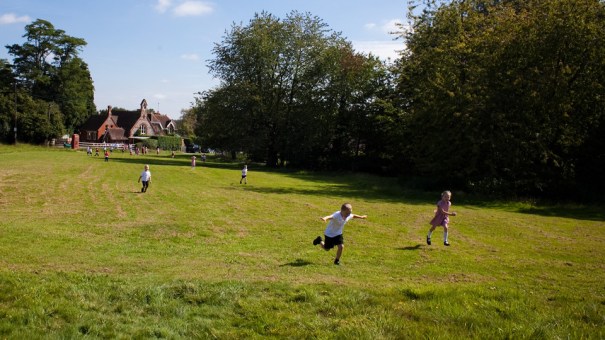
A recent article in the online magazine Co.EXIST discussed a study that found children benefit from being in natural environments, even if the environment is designed to appear natural but is actually human-made:
Dawn Coe, an assistant professor in the Department of kinesiology, recreation, and sport studies at the University of Tennessee spent time observing the behavior and time children spent playing on a local playground. After playground renovations added a gazebo, slides, trees, a creek, and a natural landscape of rocks, flowers and logs, Coe returned a year later to observe differences. Working with a statistician, Coe found children spent twice as much time playing in the natural landscape, and were less sedentary after the renovation and more active.“Natural playscapes appear to be a viable alternative to traditional playgrounds for school and community settings,” said Coe in a university statement. “Future studies should look at these changes long-term as well as the nature of the children’s play.”
via The Best Playground Is The One Nature Provided | Co.Exist: World changing ideas and innovation.
I attended a conference a couple of years ago where playground designers were reporting discovering the exact same thing – if you give a kid a pile of dirt and tree bark to play with and a bucket of water, they will have WAY more fun, play more, and learn some things as well.
This shouldn’t come as a surprise based on previous research on us humans:
For decades, scientists have reported our species exhibits a consistent, if not quite understood, response to spending time around nature: it boosts our mental and physical well being.
The scattering of findings have held in hospital beds, public housing, and Japanese forests. A 2001 study of public housing found the mere presence of trees and grass reduced reduced reported aggression and violence. Another showed people shown a stressful movie recovered to a normal state–as measured by metrics such as heart rate, muscle tension, and blood pressure–“faster and more complete[ly]” when exposed to natural rather than urban environments.
However, a lot of cities and schools are reluctant to install these kinds of playgrounds since they are considered “untested” or approved by several school or city boards. Thankfully, according to the article, cities are beginning to adopt and install these types of playgrounds:
“Natural playscapes are part of a growing trend appearing in cities across the US including Boston, Phoenix, Chicago, New York, Auburn and others.”
I hope to see more of these pop up around major cities. Do you have a natural playscape near your home? Tell us about it in the comments below.

A recent study of health factors and their associated costs at seven companies, published in the journal Health Affairs, found that “depression is the most costly among 10 common risk factors linked to higher health spending on employees.”
The analysis, found that these factors — which also included obesity, high blood sugar and high blood pressure — were associated with nearly a quarter of the money spent on the health care of more than 92,000 workers.
First the employees were assessed for health risks, then researchers tracked their medical spending from 2005 through 2009.
The average medical spending for each employee was $3,961 a year. In total, $82 million, or 22 percent, of the $366 million annually spent on health care for the workers was attributed to the 10 risk factors, the study found.
The relationship between higher spending and depression was the strongest, with 48 percent more spending for workers with a propensity for that widespread problem.
via VPR News: Depression And Health Spending Go Together.
Now, to be fair, this is a fairly small study of just seven companies, and the article didn’t say how many employees worked at these companies. However, this is definitely a trend that has been spotted at least anecdotally by many HR managers, so it’s nice to see that there is some “official” analysis being done on the issue.
So what can employers do about this? My fear is that employers would discriminate, unintentionally or intentionally, against people who suffer from depression. But these days many people will be diagnosed with depression due to a temporary life situation such as a death in the family, or their jobs, so being fired for temporary sadness is probably not a good idea for companies.
Instead, my hope is that companies would invest more on making people’s job satisfaction higher. As of two years ago, Americans reported the lowest job satisfaction ever recorded. That means employers can be doing A LOT more to improve their employees’ lives at work. And a lot of that has to do with feeling supported by their managers, and feel like they are heard and respected and overall a part of the team. A lot of that comes from having fun at work.
This philosophy has been spouted in several different books and magazines, and has been shown to work well in classrooms as well, referred to as the “Responsive Classroom” approach.
The Responsive Classroom approach centers on several ostensibly mundane classroom practices. Each morning students form a circle, greet one another, share bits of news, engage in a brief, fun activity and review the day’s agenda. The idea is to build trust, ensure a little fun (which adolescents crave) and confront small problems before they become big. Students might welcome one another with salutations from a foreign language. An activity might involve tossing several balls around a circle in rapid succession. Students share weekend plans or explore topics like bullying before lessons begin. (New York Times)
This approach could very easily be applied to a business setting, in fact it sounds like a team kick-off meeting one might see in a corporate environment. Taking time to connect with other coworkers and laugh a little before diving in to the day’s work has been shown to work wonders for productivity and boost morality in both school and work settings.
There is definitely a drive and expectation in many industries to work longer, faster, harder hours, and be available and working at all hours. But that drive is unsustainable, demonstrated by the low job satisfaction and high burnout rates in many industries, from high-tech to physicians. Taking time to play a little bit at work, or just connect with coworkers, is being shown as an effective way to reduce depression related to work and job burnout, increase productivity, and create a more cohesive company with more loyalty overall to the company’s mission.
So long story short: remember to bring the koosh ball to your next meeting.
I read about this street performer on Mashable. Based in Manhattan, he sounds like a guy with the same passion and vision for a play-filled world that I have, so I just had to share:

Matthew Silver just wants people to smile.
Silver, “The Great Performer,” can be seen throughout Manhattan using dance, song and oversized props to ease the tension of everyday life — because, as he says on his website, “it’s OK to be silly from time to time.”
Matthew describes his work on his website as an antidote to seriousness:
My role as a clown, trickster and village idiot is to parody excessive seriousness by playing with taboos, rules, and social norms. My inspiration comes from my heart. I perform for smiles and laughter, loosening people’s armor, and opening up a portal for imagination, creativity and love.

Glad there is somebody out there who spends his time encouraging people to be silly.
Check out Matthew Silver on his website or Facebook page.
Nice to know even Andy didn’t take himself too seriously…


The rain, wind, and falling leaves make it feel like fall is officially upon us in most of the United States (although some regions are still experiencing an Indian Summer). This makes many of us think of warm beverages and sweaters, unless you work in an office that turns the heat up WAY too high all winter long. In fact, working in a space that is either too hot or too cold can effect productivity:
One of the painful ironies of office life is that we can never quite get the temperature right. We spend our summers shivering in meat lockers and our winters sweating in saunas.
Central air hasn’t made us comfortable, so much as made us uncomfortable in a different way.
The experience isn’t simply unpleasant. It comes with a real financial cost… [according to one study], when temperatures were low 68 degrees, employees committed 44% more errors and were less than half as productive as when temperatures were warm a cozy 77 degrees.
Cold employees weren’t just uncomfortable, they were distracted. The drop in performance was costing employers 10% more per hour, per employee. Which makes sense. When our body’s temperature drops, we expend energy keeping ourselves warm, making less energy available for concentration, inspiration, and insight.
via Want More Productive Workers? Adjust Your Thermostat | Fast Company.
This importance of creating comfortable work environments is interesting to me. I know a lot of freelance workers that have a favorite coffee shop to camp out in, often one of the criteria being it’s warm and cozy in the fall and winter.
I also vaguely recall a couple of studies that found play did not occur for animals outside of certain temperature ranges. (If anyone can find one of the studies please let me know).
As humans, we are adaptable to almost all climates from the Arctic to the Serengeti. So I think it is surprising to people to discover just how fragile we are.
Speaking of fragile, the article also mentions the connection between feeling cold and feeling lonely:
In a fascinating study reported in the prestigious journal Science, psychologists uncovered a link between physical and interpersonal warmth. When people feel cold physically, they’re also more likely to perceive others as less generous and caring.
When we’re warm, on the other hand, we let our guard down and view ourselves as more similar to those around us. A forthcoming paper from researchers at UCLA even shows that brief exposure to warmer temperatures leads people to report higher job satisfaction.
The unconscious desire for physical warmth is thought to be the reason lonely people bathe longer, more frequently, and use higher temperatures.
We often describe people as “cold” or “warm,” so it makes sense our perceptions would match our physical sensations. I wonder if this has anything to do with the reported “Seattle Freeze” phenomenon and in contrast the southern United States’ reputation for being open and hospitable.
While the article in Fast Company focused on job productivity, I think this is an interesting observation into overall well-being and improving environments in general.
Do you find you perform better at certain temperatures? Is one temp better for working over playing? For example, I like it to be warm but not hot while doing non-creative work, but if I’m doing an art or construction project or something creative I actually like it a little bit warmer. Leave your complaints or comments below.

As we head back into the academic school year, a lot of people are focused on education and making sure students get the best possible opportunity to learn and thrive. Here’s one easy way to support that: give them space and time for play!
Numerous academic studies [sources stored in a weird place, will update soon] on school-aged kids have demonstrated that recess time is valuable for learning and aids in the overall learning process. But I think it can be more powerful to hear how valuable it is from someone who actually lives with the results of life with more or less recess; the teachers.
From the Sydney Morning Herald, educator Susanne North writes about the values of recess from an education viewpoint:
Apart from being a fun activity, it is widely recognised that play is one of the most important ways in which brain development occurs in children.
Sadly, in some schools valuable recess and lunch time has been reduced in favour of more rigorous academic pursuit within the classroom. In other schools, running or ball games have been banned due to a perceived high injury risk factor.
As many families now choose structured and adult-directed play activities after school or on weekends, the school playground becomes one of a few outlets where children can engage in free outdoor play with their peers. More than 28 hours a week, often spent solitarily, are devoted to computers, mobile phones, television and other electronic devices. Considering that as much as 25 per cent of time spent at school is playground time, we need to rethink the benefits of play at school.
Conversely, a lack of play can result in challenging behaviour and negative performances in the classroom, according to an American educational psychologist, Anthony Pellegrini.
Also, playgrounds that lack play stimuli become spaces where children often wander around aimlessly, become frustrated and bully other children. Not many schools can afford expensive playground equipment, but the good news is that this is not needed anyway.
Professor Anita Bundy, from the Faculty of Health Sciences at Sydney University, has launched a large-scale study involving 12 primary schools in NSW, introducing simple, recycled play resources during recess, with outstanding results. This included crates, car tyres, foam pool noodles, plastic barrels, tarpaulins, foam cubes and other open-ended materials that lend themselves to creative, imaginary play.
Not only do children become physically more active, they also hone important social skills, build resilience and are encouraged to think creatively.
Read more: Play time vital for children | Sydney Morning Herald

I came across an interesting commentary from the Telegraph in the UK anecdotally supporting a new study that claims it only costs 6 pounds (about $10) to keep kids entertained.
A study by child development experts has concluded that the average family forks out £10,000 on toys and gadgets before their offspring turns 18. That’s a potential £20,000 on my two girls – cue a Munchian scream of Lebensangst.
Psychologists say that despite this casual largesse, youngsters are better off with colouring pencils and embroidery threads than computer consoles. While it might be hard to convince a surly 13 year-old that modelling clay and beads are more fun than a Wii, I couldn’t agree more. Are beads as thrilling as shooting baddies or crashing aeroplanes? Hardly, but it’s all about the social interaction, stupid.
It’s a rare and lovely feeling to be vindicated as a parent, so forgive me if I bask. You see, I am usually regarded (especially by my husband) as a bit of a skinflint who is too tight to buy the big one a Nintendo DS and the wee one, well, pretty much anything.
If my youngest asks for an ice lolly, we make them with apple juice. If they’re bored, I give them each a tray and send them outdoors to make a garden.
To the casual observer, this makes me a sickeningly virtuous hands-on mother. But it is merely the happy by-product of the fact that I am mean-fisted when it comes to frivolous expenditure. It goes against my grain to throw money at the children just to keep them amused and out of my hair. It feels wrong, and, worse, it feels lazy.
The truth that all parents know, deep down, is that what kids really crave is attention, not stuff. Stuff is a pretty good, if pricey opiate, but it never quite satiates, hence the ongoing clamour for more of it, except faster and louder to excite pleasure centres inured by computer-generated over-stimulation.
Read the whole article at the Telegraph.
Lots of parents have the old joke that at Christmas their kids spend more time playing with the box a toy came in than the toy itself. Now research is finding this to be more true than we realized.
It’s nice to hear that even in an age when children of younger generations appear to use advanced devices and technology as if it were second nature, nothing beats some old fashioned string and beads, or sticks and mud, for a good time. It can take a little bit more creativity on the parent’s end, but that can be a good thing, AND it also encourages more creativity and problem-solving in the child.
My personal favorites were pieces of wood and nails, and just hammering them together into odd art shapes, or just nailing them onto a tree. What were your favorite tools and environments for play when you were a kid? Let me know in the comments below.
 Mental Flowers