design · environment · Social

PONS + HUOT Office by Christian Pottgiesser » CONTEMPORIST

It already feels like Thursday, and it’s only Monday, ooy!

Thankfully my office space is a great space to work in and take a breather every now and then, and even play a little. And that idea of creating playful work spaces is catching on more and more.

The project accommodates the headquarters of two companies in Paris – PONS and HUOT – with a total of fifteen executives. Consequently the unit has seven individual rooms for each director and one open-space-office for the remaining eight clerks.

more via PONS + HUOT Office by Christian Pottgiesser » CONTEMPORIST.

architecture · behavior · community · culture · design · environment

At IIDEX: Will the Office Go the Way of the Phonebooth and Mailbox? : TreeHugger

Happy Monday. Most of us are probably back at work now after the holidays. But for many of us, our work space has changed fairly dramatically in the past few years, in large part due to advances in technology. What used to be office-bound work can now be done at home in one’s slippers while simultaneously playing with your child (not that I’ve ever done that!). What does the future of work spaces look like? This article tackles that very question. The subject isn’t specifically related to playful environments, but creating spaces that are more conducive to creativity and productivity are incredibly intertwined with playful environment:

The company Teknion has been doing a serious amount of research into where the office is going, and what they should be designing and building to furnish it, and have published Phonebooths and Mailboxes to look at the future of the office.

At IIDEX: Will the Office Go the Way of the Phonebooth and Mailbox? : TreeHugger© TEKNION

Phonebooths and Mailboxes is a discussion about new technologies. Consider how quickly the cell phone replaced the pager, how quickly the fax machine was replaced by email. Mobile technology now signals one of the biggest transformations within the modern office.

more via At IIDEX: Will the Office Go the Way of the Phonebooth and Mailbox? : TreeHugger.

As awesome as flexibility with one’s work space is, there is also value with face-to-face, tangible collaboration. Plus spaces for creative work and data analysis work, or whatever kind of work, may need very different spaces.

What are your thoughts about how technology is changing what our offices look like?

community · creativity · environment

Inhabitat is on a role with their environmental enrichment stories!

OakOak’s street art is created to amuse and inspire – this self-described “fun-loving” artist plays with urban elements to make people laugh. He finds broken infrastructure, crumbling buildings and cracks and gives them a facelift with the simple addition of a character in play. Everything from simple stick figures to smiley faces, animals, objects and superheroes can be seen gracing OakOak’s hometown of St. Etienne, France, where they turn the less than perfect facades into something playful and fun.
behavior · environment · happiness · play

Live Science Animal Gallery: Fun in the Snow

Snow-bunnies aren’t the only animals excited about snow; check out this great collection of photos of animals playing in the snow:

See the whole collection, including some adorable snow pouncing.

architecture · environment · happiness · play

In the future, everything will be made from trampolines

Surprised this is picking up so much press:

As a pair of European designers have demonstrated, it is in fact possible to intertwine the fun-factor of trampolines with utility. And the world is now a better place. First off is the proposed trampoline “Bridge in Paris,” a design that was put together by Atelier Zündel Cristea of AZC Architecture Studios.

His describes his floaty bridge thusly:

It appears to us that Paris has enough bridges. Our intention is to invite its visitors and inhabitants to engage on a newer and more playful path across this same water.

In the future, everything will be made from trampolines

We propose an inflatable bridge equipped with giant trampolines, dedicated to the joyful release from gravity as one bounces above the river.

more via This is awesome News, Videos, Reviews and Gossip – io9.

Is it dangerous? Probably. Would it ever get approved? Doubtful. But I’m still excited to see this getting so much press, since that indicates that people are interested and hungry for opportunities to get outside and play!

anthropology · architecture · environment

As you digest your turkey and reflect on a hopefully happy Thanksgiving, I am offering this summary of a recent conference session that talked about how to integrate biophilia into urban spaces and cities. As the human population increases, more people move away from the country and into the city, yet as humans we still crave nature and natural environments. Three researchers suggest how to go about addressing that.

Unknown's avatar

As you digest your turkey and reflect on a hopefully happy Thanksgiving, I am offering this summary of a recent conference session that talked about how to integrate biophilia into urban spaces and cities. As the human population increases, more people move away from the country and into the city, yet as humans we still… Continue reading

View original post

anthropology · behavior · community · culture · environment · happiness · health · mental health

OpenIDEO – How might we create healthy communities within and beyond the workplace?

Digicorp workplace
OpenIDEO asks how do we promote wellness in the workplace. (Photo credit: Wikipedia)

Wow, OpenIDEO is on a role lately with their challenges that get my creative juices rolling and my passions up, in a good way! This latest challenge is about wellness in the workplace:

Together with Bupa and the International Diabetes Federation, we’re asking our global community to help us explore how people can best be supported in the workplace to make positive changes to their health and wellness – and what skills and tools are needed to pass these positive changes onto their networks of co-workers, family and friends.

via OpenIDEO – How might we create healthy communities within and beyond the workplace?.

As the Chair of the Wellness Committee at my job for just under a year, we tried out a lot of different wellness incentives, some with better results than others. I feel very passionately about offices promoting and encouraging wellness; we spend the majority of our waking lives there, it’s cheaper in the long run for companies to have healthy and happy workers, and it promotes productivity and dedication from employees.

What are your ideas? Add them to the inspiration. I’ll have to share some of my ideas for this challenge on the blog, as well as my ideas from the previous OpenIDEO challenge I mentioned, which is currently in the concepting phase.

behavior · cognition · creativity · environment · play · youtube

TED Blog | 10 talks about the beauty — and difficulty — of being creative

Creativity
Creativity (Photo credit: Mediocre2010)

I have been on vacation in California this week, playing with deer, ground squirrels, sea otters, sea lions, harbor seals, pelicans, sparrows, sheep, dogs, cats, persimmons, pomegranates, oak trees, poplars, and other assorted flora and fauna. It also means I haven’t been feeding and tending to this blog as much as I would like. So, to hold you over until I am back into my usual swing of things, I am providing a link to a collection of 10 TED talks on Creativity.

Why TED?

I like to think of TED talks as little mental snacks, so this smattering of talks about creativity, both as a blessing and a curse, when it flows and when it doesn’t, and what you can do about it if anything, are a great collection of videos for you to snack on.

Why creativity?

Because I see creativity as merely a facet of play, so any research or discussion of creativity is also beneficial for talking about play. People need creativity in order to play. Creativity is also a key element to a playful space. Writers and artists often need specific environments to create (or at least think they do). And, for some reason, I find it’s easier for academics and business types to talk about creativity than play, when in many regards they are talking about the same thing. You say tom-A-to, I say tom-au-to…

Either way, enjoy!…

TED Blog | 10 talks about the beauty — and difficulty — of being creative.

architecture · children · design · environment · happiness · Nature · play

The Best Playground Is The One Nature Provided | Co.Exist: World changing ideas and innovation

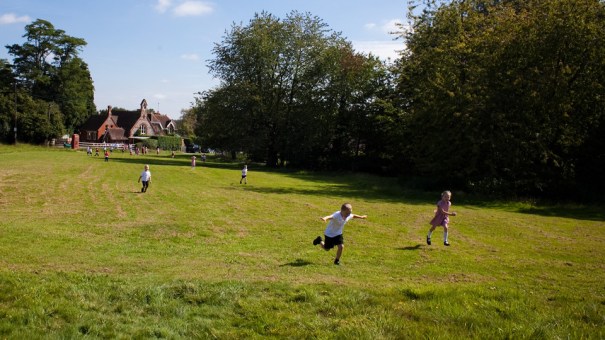
children lawn running

A recent article in the online magazine Co.EXIST discussed a study that found children benefit from being in natural environments, even if the environment is designed to appear natural but is actually human-made:

Dawn Coe, an assistant professor in the Department of kinesiology, recreation, and sport studies at the University of Tennessee spent time observing the behavior and time children spent playing on a local playground. After playground renovations added a gazebo, slides, trees, a creek, and a natural landscape of rocks, flowers and logs, Coe returned a year later to observe differences. Working with a statistician, Coe found children spent twice as much time playing in the natural landscape, and were less sedentary after the renovation and more active.“Natural playscapes appear to be a viable alternative to traditional playgrounds for school and community settings,” said Coe in a university statement. “Future studies should look at these changes long-term as well as the nature of the children’s play.”

via The Best Playground Is The One Nature Provided | Co.Exist: World changing ideas and innovation.

I attended a conference a couple of years ago where playground designers were reporting discovering the exact same thing – if you give a kid a pile of dirt and tree bark to play with and a bucket of water, they will have WAY more fun, play more, and learn some things as well.

This shouldn’t come as a surprise based on previous research on us humans:

For decades, scientists have reported our species exhibits a consistent, if not quite understood, response to spending time around nature: it boosts our mental and physical well being.

The scattering of findings have held in hospital beds, public housing, and Japanese forests. A 2001 study of public housing found the mere presence of trees and grass reduced reduced reported aggression and violence. Another showed people shown a stressful movie recovered to a normal state–as measured by metrics such as heart rate, muscle tension, and blood pressure–“faster and more complete[ly]” when exposed to natural rather than urban environments.

However, a lot of cities and schools are reluctant to install these kinds of playgrounds since they are considered “untested” or approved by several school or city boards. Thankfully, according to the article, cities are beginning to adopt and install these types of playgrounds:

“Natural playscapes are part of a growing trend appearing in cities across the US including Boston, Phoenix, Chicago, New York, Auburn and others.”

I hope to see more of these pop up around major cities. Do you have a natural playscape near your home? Tell us about it in the comments below.
anthropology · architecture · community · environment · health · Social

IDEO asks how to inspire communities to care about their environments

English: Overview of Singapore's financial dis...
Overview of Singapore’s financial district; how do we make our living environments better as our cities grow? (Photo credit: Wikipedia)

I love these OpenIDEO public challenges, so I was thrilled when I saw this challenge alert pop up in my inbox (and then unfortunately let it get buried for a week, oops!) about ideas on how to make communities more involved and engaged in their environments.

Public agencies such as Singapore’s National Environment Agency would like to envision how to rejuvenate our local environments to inspire and enable communities to make our living environments better – and are eager to collaborate with the global community to explore solutions which resonate in Singapore and across the world.

In this challenge we are looking to try and explore the following questions, both for Singapore and for communities everywhere that face similar challenges.
How might we better collectively solve problems facing our neighbourhoods?
How might communities look out for each other more?
How might we provide a safe space for positive and constructive action?
How might we help passive citizens become active contributors?
How might the role of the government evolve in the future, with regards to local neighbourhoods?
In short, what does community ownership look like in 2012 and beyond? The National Environment Agency invites you to join us in designing better answers, together.

Let’s collect examples of existing initiatives and explore the challenge topic to inform our ideas for the upcoming Concepting phase.

It’s a question that I bring up a lot on the blog, and share different examples of how communities around the world are doing just that, from adding public art to bee and butterfly gardens to building playgrounds. I am bubbling with excitement over this challenge, and have lots of different ideas, but there are only 14 more days to submit ideas and I want to make sure mine are really good, eek!

What have you seen that worked in growing communities to keep the residents and developers motivated to preserve the surrounding environments, rather than bulldoze them over for a quick couple hundred bucks? What are some of your ideas? Have you seen any story of community building on this blog that screams “Yes, this is the answer!”? Submit your ideas at the OpenIDEO website.