behavior · creativity · psychology

Fostering real, unforced creativity at the workplace

Jonah Lehrer - Pop!Tech 2009 - Camden, ME
Jonah Lehrer - Pop!Tech 2009 - Camden, ME (Photo credit: poptech)

We have all experience an “aha!” moment, but how often is that moment at work? People with “creative” jobs talk all the time about the struggle to create on a deadline or within parameters (I’m currently procrastinating on another writing assignment by working on this blog post).

Jonah Lehrer explores this idea of working creativity and more in his new book, Imagine: How Creativity Works.

The book explores where innovative thoughts originate and explains how some companies are now working to create environments where they’re more likely to occur.

“Moments of insight are a very-well studied psychological phenomenon with two defining features,” Lehrer tells Fresh Air‘s Dave Davies. “The answer comes out of the blue – when we least expect it. … [And] as soon as the answer arrives we know this is the answer we’ve been looking for. … The answer comes attached with a feeling of certainty, it feels like a revelation. These are the two defining features of a moment of insight, and they do seem to play a big role in creativity.”

Scientists have determined that people in a relaxed state and a good mood are far more likely to develop innovative or creative thoughts. And companies are now taking advantage of this fact. Lehrer points to 3M, which started out making packaging tape and has now expanded into other sectors including electronics and pharmaceutical delivery.

Companies like 3M and Google encourage their employees to take time to be creative and work on other side projects. What else works? Read the rest of the article on NPR, and the book.

community · creativity · Social

Walking to learn about your environment better

With gas prices going through the roof, many people are taking to walking more. But after being car-focused in our navigation for decades, it can be unusual for people to know how to get around by walking and how long it will take them. One student from Raleigh, North Carolina, has an idea:

On a rainy night in January, urban planning student Matt Tomasulo and two fellow schemers positioned 27 signs in three strategic locations across central Raleigh. In bold, authoritative letters, each sign indicates the number of minutes it would take for a pedestrian to reach a particular, popular destination.

And for the directionally challenged, the otherwise spartan signs are equipped with a high-tech surprise. By scanning the signs with a smartphone, pedestrians can receive a specially tailored Google Map that will keep them on the right path.

Tomasulo and his colleagues at City Fabric have dubbed their effort Walk Raleigh, and have submitted the project to the Spontaneous Interventions competition, a contest sponsored by the Institute for Urban Design. In terms of impressing judges, the group is off to a good start: far from being displeased by Tomasulo’s guerrilla antics, the city of Raleigh has expressed interest in permanently incorporating Walk Raleigh’s signs into the city’s landscape.

see more at A Walk to Remember.

I’m glad the city of Raleigh is encouraging this, and I hope it catches on in other places. I think it’s great to share our knowledge of neighborhoods with others and let them get to know their cities and environments a little bit better. Plus it’s just fun.

Have you seen similar signs in other cities? Tell me about it in the comments below.

anthropology · architecture · community · creativity · culture · design · environment · happiness · Social

How legalizing street art made Rio de Janeiro a prettier, happier place

A recent article in the Huffington Post explored Rio de Janeiro’s acceptance of street art and how it has enriched the various neighborhoods:

Brazilian graffiti art is considered among the most significant strand[s] of a global urban art movement, and its diversity defies the increasing homogeneity of world graffiti.” – Design Week

In March 2009, the Brazilian government passed law 706/07 making street art and graffiti legal if done with the consent of building owners. As progressive of a policy as this may sound, the legislation is actually a reflection of the evolving landscape in Brazilian street art, an emerging and divergent movement in the global street art landscape.

Rio de Janeiro has been particularly progressive in its policy towards street art, with its 1999 “Não pixe, grafite” (Don’t Tag, Graffiti) project that brought together 35 graffiti artists to showcase diversity in local styles. But more unique is the evolution of a permission hierarchy, blurring the line between formal and informal. The new street art law merely reinforced these unique patterns of street art and legitimized an already flourishing form of artistic expression.

Retaining walls on the steep terrain provide canvases for artists.

In Rio de Janeiro, street art is ubiquitous. It exists in all corners of the city, from the favelasto upper class neighborhoods, from residential to institutional. It is bold in scale and aesthetics and is anything but graffiti. The urban fabric of Rio de Janeiro also figures prominently in the evolving street art scene. The high walls, whether for security or to contain the topography, provide ample surfaces for painting. But rather than location dictating art, the relationship between owner and artist has a direct impact on where street art occurs.

Owners of buildings, both residential and commercial, sometimes invite artists for commissions, which is done to protect from tagging, as an aesthetic choice or as an economic choice — painting a façade with art may be cheaper than another mode of beautification. In another case, street artists ask permission from the owner.

Tudo de cor para você, Santa Marta, Rio de Janeiro (photo source: favelapainting.com)

Thanks to the city’s openness to various forms of artwork, and specifically “street” art, Rio de Janeiro is now known for its colorfulness and art. In informal studies the art has also been found to make citizens more invested in their communities and overall happier.

Hooray for public art.

community · creativity · Social

Storefront Seattle: taking art to the street (window)

Before and After example of Storefronts Seattle project.

With the down economy a lot of stores and businesses have gone out of business, leaving a lot of empty store fronts, at least in places around Seattle. But rather than let those places stay dark and dormant, one woman is spearheading an effort to get local Seattle artist’s work installed in these vacant storefronts:

Storefronts debuted in late 2010 as an experiment in activating vacant spaces with art, creative enterprise, and performance… We also revitalize neighborhoods. And we beautify blocks. And we make areas safer at night, and we market real estate, and we paint walls and mop floors and install lighting and turn desolate half-empty blocks into the hippest, happiest, and hottest real estate in town.

Storefronts Seattle leases storefront space from neighborhood property owners for the nominal rate of $1 per month. We can program up to 15 storefronts in any given neighborhood at any given time, and we fill these spaces with art installations, with creative businesses, and with artist’s studios. These projects are proposed by artists throughout the region, and are chosen by a panel that includes neighborhood representatives, local museum curators, arts professionals, and our programming staff.

At full integration into a neighborhood, Storefronts Seattle is programming up to 60 arts installations per year into your spaces. That’s enough to instantly turn any neighborhood into a walking destination, an arts and culture destination, and a shopping destination. It’s enough to generate regional press. It’s enough to get the city’s creative class and cultural leaders to pay attention.

More at Storefronts Seattle

This is a great project where everyone benefits: property managers get free positive attention for their site, artists get their work exposed, and normal people get to benefit from the art for free!

It also involves a lot of local Seattle neighborhood organizations, bringing attention and buy-in from various communities around Seattle. There are quite a few installations in place right now through May.

What a great opportunity to improve and enrich everyone’s environment. Know of other groups out there taking advantage of empty spaces like these in other cities? Share them in the comments below!

architecture · children · creativity · design · play

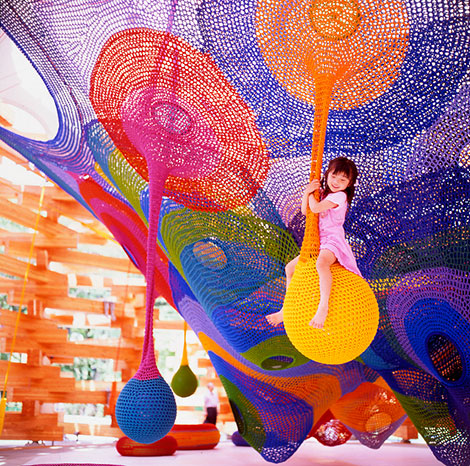
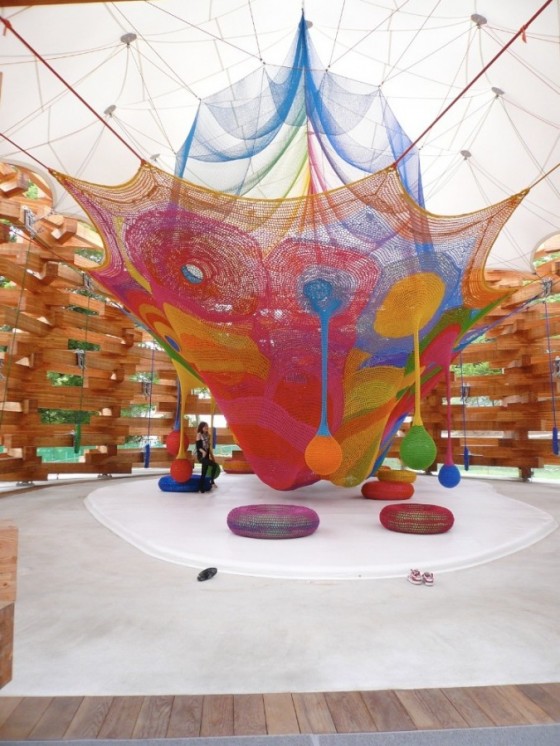
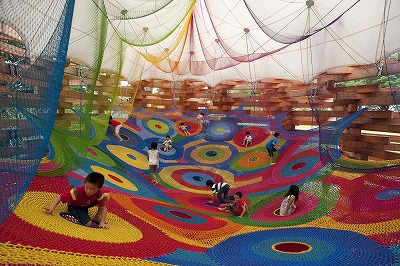
Playground Crochet by Toshiko Horiuchi

This is from last November, but still amazing!

Toshiko Horiuchi MacAdam, who orders yarn by the ton for her creations, is the textile artist behind the oft photographed net constructions at the Hakone sculpture park in Sapporo Japan.

I love the story of how she came to be engaged with children’s play:  “It all happened quite by accident. Two children had entered the gallery where she was exhibiting ‘Multiple Hammock No. 1’ and, blissfully unaware of the usual polite protocols that govern the display of fine art, asked to use it. She watched nervously as they climbed into the structure, but then was thrilled to find that the work suddenly came alive in ways she had never really anticipated. She noticed that the fabric took on new life – swinging and stretching with the weight of the small bodies, forming pouches and other unexpected transformations, and above all there were the sounds of the undisguised delight of children exploring a new play space.”

From that point, her work shifted out of the gallery and a subdued, monochromatic pallet into a riotous rainbow of colors for children’s playscapes.

Rainbow Net was produced in close collaboration with structural engineers TIS & Partners and landscape architects Takano Landscape Planning and opened in July of 2000 after three years of planning, testing, and building.

Note that the project began with a brief not for a playground, but simply for ‘public art‘.   Wouldn’t it be great if when we heard ‘public art’ we automatically thought ‘play’?

But innovative playscapes require an enormous commitment: “…endless cycles of discussion and approval, with meticulous attention to detail…[including] an actual scale wooden replica of the space in Horiuchi’s studio and accurately scaled crocheted nets using fine cotton thread. Even then, it was difficult to assess many things. What difference, for instance, would the weight of the real yarn make when everything increased in scale? All of these factors had to be calculated in order to arrive at a scientific methodology that could eradicate any risk of unacceptable danger.”During final assembly, Toshiko crocheted ten hours a day, often on her knees, until the installation was complete.”

With the current revival of the textile arts and yarn bombings everywhere, I’d love to see more crochet on the playground!

More at: Playground Crochet by Toshiko Horiuchi.

What an amazing use of fabric to create an original, creative play space.

creativity · youtube

Superbowl ad actually encourages us to exercise (sorta)

Superbowl Sunday is almost upon us, and the Superbowl ads are already being released. Volkswagen has released an ad that features a dog getting in shape for his sport. While it’s obviously meant in jest, in some ways it’s great because it arguably sends the message that anyone can train for their personal goals, whether it’s chasing cars (and vaulting through trees), fitting through the doggie door, or whatever.
What are your goals? I’m participating in a 5k on Saturday, but what physical movement and enrichment do you hope to accomplish over the weekend?

architecture · community · creativity · design · happiness · mental health · Nature

“Pop-up” park to fight the winter blues

Signs of spring are just starting to appear – birds are getting more active, tulips are just starting to show off green shoots – but even in my neck of the woods I know it’ll be awhile before spring is actually here. In New York, one group is fighting the gray and dark with an installed insta-park:

photo courtesy of laughing squid

Welcome to New York City in winter, with a cure for cold-weather blues: a pop-up indoor park in lower Manhattan that’s open through Valentine’s Day.

Despite temperate temperatures so far this year, “it’s our rebellion against winter,” says Jonathan Daou, founder and CEO of Openhouse Gallery, a company that holds a 20-year lease on the space at 201 Mulberry St.

On a recent chilly weekday afternoon, babies played barefoot in the 75-degree world of Park Here while their mothers and fathers sipped tea, eating cookies and sandwiches.

One night, a movie is planned on the lawn; other days bring a ping pong competition, a trivia contest, wine tastings and soccer workshops.

The 5,000-square-foot artificial habitat in the downtown Nolita neighborhood is filled with trees, rocks, picnic benches and the recorded ambient sounds of Central Park in spring. There are giant cushions and even a hammock, plus a baby elephant.

But the park will be gone by mid-February.

The rest of the year, the 200-year-old former police precinct is a stage for business that plays on the “pop-up” retail method mushrooming around the world in recent years: a quick presentation of a product, performance or personality, with no commitment to a lease or contract.

It’s usually set up in a mobile unit that can be assembled and disappear.

Some call it guerrilla retail. “You’re not stuck with a 10-year lease if the product doesn’t sell,” Daou says. “People are looking for novelty, off the beaten path, and this space tests the ‘legs’ of a business concept.”

The space was part of a police precinct in the late 1890s under New York Police Commissioner Theodore Roosevelt, who later became U.S. president.

But there’s nothing historic about what’s going on inside. On the contrary, it’s all the rage in retail.

Read the full article: Winter ‘Pop-Up’ Park Debuts in New York

What a nice way to slough off that winter feeling and take a break and add some fun to your day. What is happening in your area that reminds you of spring?

children · creativity · design · education · learning · Nature

Toys in space!

Toys are not only great for thinking outside the box with, they’re also great for thinking outside of our world! Two Canadian students recently sent a Lego man out to the edge of space:

Matthew Ho and Asad Muhammad used a weather balloon to carry a camera and a toy lego man high above the clouds.

(source: BBC News)

What the video here:

Image

creativity · play

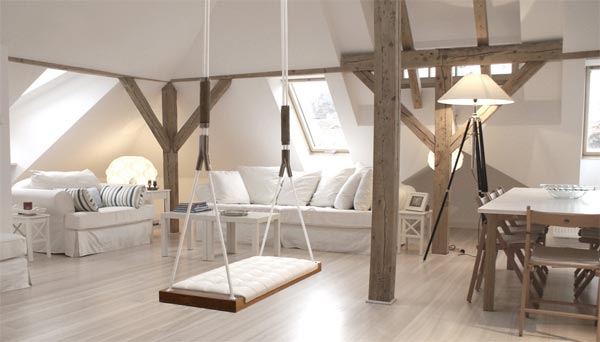
Swings for the home

This is so cool! Swings that you can install in your own home, designed specifically for grown-ups! Brought to you by Svvving.

more at Swings for the home: 2modern.

I love the idea that a company makes swings for grown-ups to use indoors. Introducing play into your space is important, and for this company profitable. 🙂

brain · creativity · design · neuroscience · play

Creating new designs through play, brain waves

Very cool video from B-Reel, Scandinavian furniture brand Varier and Oslo agency DIST Creative, on a project that involved creating fabric designs based on brain waves, specifically the brain waves of children playing and exploring:

Design based on kids' brainwaves.

Using some of the findings from its Mind Scalextricsexperiment, B-Reel used a headset to measure the brain waves of three children using Varier’s Balans chair. (The chair is designed to promote circulation and extended activity, which is claimed to leadi to better concentration and overall well-being).

It then used a custom built data visualization engine to turn the recordings into a pattern that could be printed as upholstery for the chair. As well as creating image patterns to reflect the changes in the children’s brain activities, the engine engine also used graphic presets corresponding to the children’s personal interests and took inspiration from patterns ranging from classic tapestries to pop-art and contemporary design.

Varier Furniture is featuring the project on its website as well as at international Furniture and Design Fairs.

Originally from Creativity Online, where you can also see the video.