This is a great blog post from a teacher re-learning the value of creative free play and specifically outside.
I highly recommend you read the whole post, but for me this sentence summed up the whole experience:
“…As I witnessed these projects I realised that children and adults can only be as creative as their environment allows them to be and that by letting children spend time in a natural environment like the woods or to be surrounded by loose parts, we can but only help them to become or remain creative.”
Okay, ignore that this is a granola company’s commercial.
And they may have cherry-picked to prove a point.
YET…
The fact that even these kids exist is terrifying.
Just watch the video. And cringe. Mourn. Cry. Then go do something about it!
Children are obsessed with technology, and Nature Valley wants us to be afraid. Very afraid.
That seems to be the message of this new ad for the granola bar company, which asks three generations of families: “When you were a kid, what did you do for fun?”
The elder two generations share memories of blueberry picking, sledding, fishing trips, and playing baseball as airy music plays in the background.
But then it’s the younger generation’s turn, and ominous music suggests these kids aren’t exactly frolicking in the grass and soaking in the sunshine. The kids detail that they spend five hours a day texting, emailing, tweeting, browsing the computer, or playing video games as the parents cry or lament the death of the good old days.
This is not okay people. So, so, the opposite of okay!
Go volunteer to take your niece or nephew to the park, or go hunt for cool leaves and flowers in the park. Grow a flower or even spider plant and give it to a kid! Take action!
I could, and will, write a whole blog post about just the first sentence of this article.
But I’ll just let you read the whole piece and save that for another day.
Play has a PR problem. Some think of play as frivolous –- a distraction, or worse, a waste of time. In the office, play is often regarded as a break from “real work.” But what if the opposite of play isn’t work, it’s boredom? What if work could actually benefit from play?
As a partner at IDEO, I help instill a playful culture, not only in mindset, but also in our daily behaviors. Play allows us to experiment, empathize and take creative risks. Ask anyone who works at IDEO — having play engrained in our culture makes it an incredibly satisfying place to work. It keeps us engaged in our projects and makes us better innovators.
In preparing to teach a new online course on IDEO U, I’ve been thinking about the behaviors of play that have allowed our team to be successful in developing and executing ideas to meet the needs of a particularly tough group of consumers: kids and their parents. These six behaviors not only manifest themselves in the products we create, but also in our interactions as designers, and I believe they can have a profound impact on every organization’s ability to innovate.
Fantastic! As a fellow resident of a gray and gloomy city, a little splash of surprise color can do wonders!
The grey weather was no match for a new art installation on London Bridge, which transformed the crossing into a rainbow walkway for one day only.
The project was created by Spark Your City, a global movement “dedicated to spark joy in everyday life”.
According to the group’s Facebook page, they are “travelling the world from city to city”, and London was the first major centre to get the spark makeover.
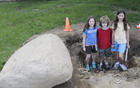
Three kids, now all high school graduates, dedicated their recesses to digging up a gigantic rock out of their elementary school yard. The principal decided to keep it and now future generations of kids are getting a chance to play with the “magical” rock.
The kids started working on the gift unwittingly. It was 10 years ago. They were in second grade and out on the playground during recess when one of them saw a little rock — or what looked like a little rock — sticking up out of the ground.
But year after year they returned to the project. Digging mostly with sticks and plastic spoons they got from the cafeteria, the kids dug down — through second grade, third grade, fourth grade and fifth grade — until finally, just before moving on to middle school, they finished.
The principal brought in heavy equipment to lift it out of the hole for them. That was 2008. Now the three are like rock stars around Kittredge, partly because of the accomplishment itself, but mostly for what the rock has become.
The kids now use the rock as a “neutral” zone, or a spot to hang out and wait for kids to come invite you to play, which as a former kid I can tell you does indeed feel magical.
It is amazing the dedication that kids can show in play and exploration. They spent years! digging up this rock with improvised tools. An amazing lesson in perseverance, creativity, and teamwork.
Incredible props to the elementary school principal who let the kids dig up the yard to get to the rock, so many may have discouraged the behavior.
And now, the residents of Melbourne have found a way to express it.
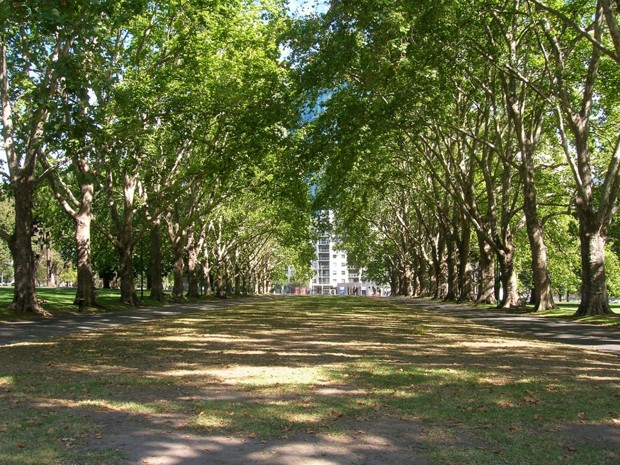
The city of Melbourne assigned trees email addresses so citizens could report problems. Instead, people wrote thousands of love letters to their favorite trees.
“My dearest Ulmus,” the message began.
“As I was leaving St. Mary’s College today I was struck, not by a branch, but by your radiant beauty. You must get these messages all the time. You’re such an attractive tree.”
This is an excerpt of a letter someone wrote to a green-leaf elm, one of thousands of messages in an ongoing correspondence between the people of Melbourne, Australia, and the city’s trees.
Officials assigned the trees ID numbers and email addresses in 2013 as part of a program designed to make it easier for citizens to report problems like dangerous branches. The “unintended but positive consequence,” as the chair of Melbourne’s Environment Portfolio, Councillor Arron Wood, put it to me in an email, was that people did more than just report issues. They also wrote directly to the trees, which have received thousands of messages—everything from banal greetings and questions about current events to love letters and existential dilemmas.
“The email interactions reveal the love Melburnians have for our trees,” Wood said. City officials shared several of the tree emails with me, but redacted the names of senders to respect their privacy.
While it may be better for you to take a walk in the woods than on an urban block, living near trees, even in an urban environment, has been found repeatedly to improve people’s health, even making them feel younger.
In a new paper published Thursday, a team of researchers present a compelling case for why urban neighborhoods filled with trees are better for your physical health. The research appeared in the open access journal Scientific Reports.
The large study builds on a body of prior research showing the cognitive and psychological benefits of nature scenery — but also goes farther in actually beginning to quantify just how much an addition of trees in a neighborhood enhances health outcomes. The researchers, led by psychologist Omid Kardan of the University of Chicago, were able to do so because they were working with a vast dataset of public, urban trees kept by the city of Toronto — some 530,000 of them, categorized by species, location, and tree diameter — supplemented by satellite measurements of non-public green space (for instance, trees in a person’s back yard).
They also had the health records for over 30,000 Toronto residents, reporting not only individual self-perceptions of health but also heart conditions, prevalence of cancer, diabetes, mental health problems and much more.
A million times yes! This article focuses on one of my biggest pet peeves and challenges as a play advocate; play not being taken seriously.
The author, Hilary O’Shaughnessy, and also the producer of the Playable City Award, discusses her play competition and the usual rub of people asking whether this is really all “worth it.” I’m quoting over half of her article, but she very eloquently covers an entire blog post I was planning on writing (I will still write it, I promise):
Amongst the usual squeals of anticipation [around the competition], there are questions about the value of these ideas to the “real” world. Fun is all well and good – but surely fun is the stuff we get to when the grown up work of building hospitals and roads is done with? When we’ve fixed the economy, let’s play. Cities are full of problems, why are we not fixing them first?
Herein lies the real issue. When we see play simply as fun, a whimsy for those of us lucky enough to have the time to engage in it, we underestimate the transformative power of play and it’s role in our lives.
Fixing problems, making our living and working spaces more livable and resilient, designing better cities, starts at every level with the people that Iive in those cities. Increasingly we are realising that our cities are designed for exclusivity, so it makes sense that we don’t feel part of shaping the future. This is revealed in the language we use to describe our relationships to the services and organisations that our cites are made of. We want them to fix it, they don’t want us to have a say, they give money to them to exclude us: the language is divisive and separating, and that’s the problem. Even the descriptions of the projects fail to deliver what they promise, because a playable city is experienced, not described.
The idea of what our cities should mean, how public money is spent, what we imagine as good for us and who is involved in designing them, is only ever addressed when we have a complaint or we feel excluded. We talk to the city council when the road is road is torn up or the lights won’t come on. We complain that our voices are unheard, but we never seize opportunities to speak, fearing that if we do we will be ignored or shouted down by the loudest ones.
This feeling of separation cannot be undone overnight. We need new approaches, new tools, and new ways to talk to one another about how to live together in cities.
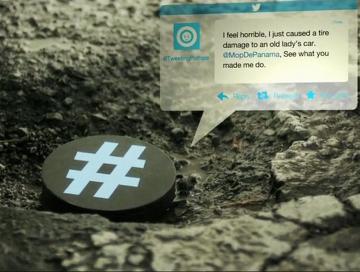
From a different article, but an example of using play as political protest: a device placed in large potholes that tweets whiny complaints when it is run over in order to publicly shame govt. into action.
Conversations about the future, about how we want to live, have to begin from a level playing field, and crucially that level playing field may not be where we expect. Play is a leveler: when we play, we play as humans, first. Traditional status markers like wealth, celebrity, or qualifications are not really much use when invited to dance with your shadow or conduct lights like a demi-god.
Addressing problems and finding solutions that work for us all begin with inviting everyone into conversation. Play as unexpected interventions in familiar places act as invitations to connect, an offer to begin to talk about those parts of our cities that we feel excluded from. To new eyes and ears, some projects can seem esoteric – but that is because we have become numbed to dull public announcements, badly designed flyers and clunky websites which act as information dumps that no-one reads, let alone takes as an invitation to work together. Yet, this is important stuff: we need to talk about the kind of future we want or it be will be decided for us while we look the other way.
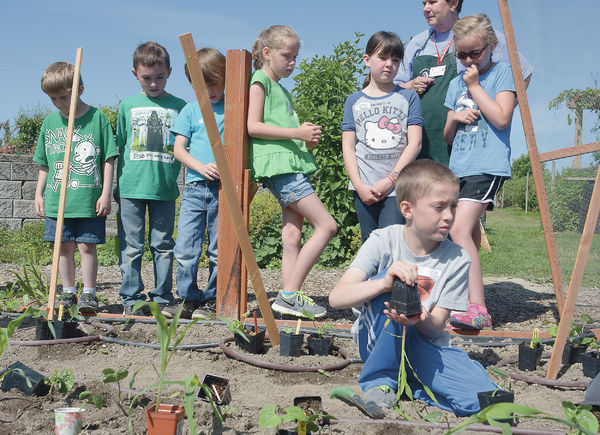
This is a great example of how even “country kids” – all of these kids come from communities surrounded by farmland and agriculture – enjoy and appreciate hands-on experiences and learning about gardening and the natural environment.
About 70 classmates participated Thursday in the Washington State University Skagit County Extension Master Gardener’s “Discovery In Gardening — Is Terrific” (DIG-IT) youth education program.
“It introduces kids to how the garden works, from the growth of the plants to how it arrives in your kitchen and what to do with the scraps,” said Master Gardener Chuck Howell.
The program was started in 2002 by two teachers, Master Gardener Gail Messett said.
The format of the program has changed over the years, Messett said, but the goal has remained the same: Get kids outside and into the garden.
“They’re learning respect for insects and bees and flowers,” Messet said. “I think they go home pretty awestruck, actually.”
This is a very well thought out and researched article about the benefits of pretend play, specifically creating and playing with puppets.
The [Puppet School] curriculum establishes the tenets of puppeteering education, which put educational theories about the importance of play and grit and resilience into practice.
In the beginning classes, students start to learn basic head and mouth movements, using motor skills in both hands and both arms, choreographed to pre-existing sound tracks of well-known pop songs. Students learn to articulate vowels and develop a sense of rhythm with their bodies. As the exercises advance, students learn to improvise using their own voices and hand movements, and eventually choreograph movement to material they’ve written. From motor skills, to communication and improv skills, then finally written skills, students exercise many parts of their brains at Puppet School, increasing communication between their two brain hemispheres.
According to Eric Jensen’s Teaching with the Brain in Mind, when brain signals are passed from one side to the other quickly, or when the left and right sides of bodies work simultaneously, the brain is able to function more efficiently, and the stronger the brain’s connections become—thereby improving literacy, movement coordination, processing data, and communication skills.






 Mental Flowers