behavior · brain · disease · health · learning · Mental · neuroscience · technology

Sensor Glove Could Help Stroke Patients Recover Mobility Through Gaming | Ecouterre

The brain is such an amazing thing, and has such amazing capabilities to recover, it just needs the right tool; in this case, using video games as a type of mental and physical therapy for stroke victims. Using computer games is also useful because it is more engaging for the brain, rather than traditional physical exercises like “pick up the cup” since framing it as a game often makes it seem less consequential for players (this is a new exercise whereas they used to know how to pick up a cup) and therefore less pressure and more fun:

Four mechanical-engineering students at McGill University in Canada have developed an inexpensive sensor glove that allows patients to exercise in a game-like fashion at home with minimal supervision. Self-therapy? Well, yes and no. Using the accompanying software, doctors will be able to monitor their charges’ progress off-site, cutting down on hospital visits and costs.

The added benefit of remote monitoring for doctors is also good for the patient, as the doctor can respond right away if they see something wrong or can provide immediate feedback, rather than having to schedule an appointment, travel to the doctor’s office, and have all of your questions answered, all of this being extra hard after you’ve had a stroke and need others to help transport you.

Check out the original story at  Sensor Glove Could Help Stroke Patients Recover Mobility Through Gaming | Ecouterre.

anthropology · behavior · children · culture · education · family

Children’s past role and identity as worker

Children in Jerusalem.
The role of children has changed significantly over the past 100 years. Image via Wikipedia

This call for paper submissions from the The Society for the Study of Childhood in the Past got me thinking about how actively children used to participate in the daily household and economic life of families, from general maintenance like sweeping the kitchen to vital income by helping during harvest time.  Children used to have to help out on the farm, and later work in factories, in order to help their families make ends meet. While some of the work was dangerous and unhealthy, some of the work was beneficial to both the kid and the family. Kids felt like they contributed to their family, and learned skills from farming to general entrepreneurship. I wonder what kids are missing out on by not having as many daily chores to do, or summer jobs like mowing lawns and lemonade stands, and how children fit into our idea of work now.


In 2011, the themed session will be on children and work. The aim of the themed papers will be to bring together scholars from a wide range of academic disciplines who are studying any aspect of children and work in the past – children as economic contributors, children as slaves, elite children taking on adult roles, children as carers, children as consumers, the impact of working in childhood on children and society. The aim will be to advance cross-cultural knowledge and understanding of childhood and children in the past, and in particular to evaluate the varying nature and impact – social, economic, cultural, medical – of work performed by or for children in the past. Archaeology, history, literature and other sources will be explored.
In providing this opportunity for scholars of childhood to present their work to an international, interdisciplinary audience, the SSCIP International Conference aims to generate new perspectives on existing knowledge and to stimulate new avenues of research for the future.

I’d be interested to hear what jobs you had growing up, before the age of 18. Did your parents encourage you to work? Did you get an allowance or did you get paid by the job, or were you just expected to “earn your keep”? How is it different with your own kids, or nieces and nephews?

behavior · community · culture · Social

From Tsunami to Storm, communities continue to give

The worldwide expansion of Salvation army
Salvation Army's presence throughout the world. Image via Wikipedia

My work was having a bake sale today for the tsunami victims of Japan when we heard the news about the major tornado in Alabama (one of the managers’ first thoughts: “maybe we should have another bake sale for Alabama.”). For my birthday we made crafts to donate to a local children’s hospital.

While it seems like the last couple of years have been filled with horrible natural disasters (or man-made; thanks BP!), and a bake sale isn’t going to fix much in the large scheme of things, what struck me is that despite our nation’s economic woes and our disaster-weary national psyche, we are still interested in reaching out to help each other, whether across the nation or across the Pacific.

As organizations and first responders offer emergency relief, food and shelter, many people across the country are looking for ways to help storm victims.

The Salvation Army has set up 10 mobile kitchens to provide hot meals to survivors in hard-hit areas like Tuscaloosa, Guntersville and Lauderdale in Alabama and Montpellier and Oxford, Mississippi.

Another 22 mobile kitchens are on standby.

Follow The Salvation Army’s blog for updates, visit its website or text “GIVE” to 80888 to make a $10 donation to the organization’s relief efforts. It will show up on your next mobile phone bill.

Samaritan’s Purse has dispatched experts and two disaster relief units, tractor trailers stocked with emergency supplies and tools, to assess the needs in Tuscaloosa, Birmingham and Cullman, Alabama.

more via Storm recovery: How you can help – CNN.com.

There are lots of different ways to help both nations. Post here for different ways you have seen your community reach out, either for these disasters or others.

anthropology · behavior · community · culture · environment · health · Nature

It’s Raining Rain Gardens | Sightline Daily

View of a bioretention cell, also called a rai...
Example of a rain garden. Image via Wikipedia

Oh, all right, but only because you asked soooo nicely; for Earth Day, an example of how communities in the Puget Sound are coming together to protect the Earth and improve their own personal environments as well.

Researchers have pointed the finger at stormwater runoff as the top source of pollution that’s getting into Puget Sound and other Northwest waterways. And because runoff comes from just about everywhere — roofs, roadways, parking lots, farms, and lawns — the solution has to be just as widespread.

Enter 12,000 Rain Gardens.

This week Washington State University and Stewardship Partners, a nonprofit working on land preservation, announced a campaign to promote the installing of 12,000 rain gardens around Puget Sound by 2016. The website even has a counter tracking the number of gardens and encourages folks to enter their rain garden into the database.

more via It’s Raining Rain Gardens — Sightline Daily – Northwest News that Matters.

anthropology · behavior · children · community · education · environment · Nature

MoMA engaging youth in art criticism (some harsh)

Happy Earth Day! I feel like I should have a blog post dedicated to the benefits of nature and why we need the Earth, but to be perfectly frank none of those environmental changes we talk about are going to happen unless we get everybody on board and engaged!

So, instead, here is one example of getting people, and particularly kids, involved and engaged, thinking critically about what they did or did not like about their experience, and giving it credibility and recognition by posting it to a public forum, and not just the online kind:

Flights of fancy, lively drawings, dreams of piloting the Bell helicopter, disdain for a museum with no dinosaurs… many of our absolute favorite “MoMA stories” were left by kids, from toddlers to teenagers. So for our second post about the “I went to MoMA and…” project, it wasn’t hard to pick a theme.

Some people think modern and contemporary art is too “hard” or “weird” for kids to understand and get excited about. Not the way our younger visitors tell it, though! It made us incredibly happy to hear from so many kids who thoroughly enjoyed their day at MoMA: admiring colors and shapes, learning new things, trying out Material Lab, picking a favorite artist, getting inspired to draw, and spending time with friends, parents, and grandparents. Take a look at some of the responses below, and a big thank you to all the kids who participated!

check it out at MoMA | “I went to MoMA and…”: The Kids Are All Right.

Kids read each other's feedback on MoMA

behavior · brain · happiness · health · neuroscience · play · psychology

Want To Live To 100? Try To Bounce Back From Stress : NPR

Hint from featured profile Helen Reichert, who's 109? A sense of humor helps.

More and more research is finding that the ability to cope with stress and bounce back better correlates with long life. Just a reminder to take it easy…

Gerontologist and commentator Mark Lachs says one of the keys to a long, healthy old age is the ability to keep moving forward after life’s inevitable setbacks.

listen via Want To Live To 100? Try To Bounce Back From Stress : NPR.

One study found that 50 year olds with a negative outlook on life lived seven years shorter than those with a positive outlook.

What’s interesting is that more than avoiding stress it seems more important to have the ability to bounce back from it. So healthy coping mechanisms for handling stress, as well as a good attitude about life, seems to be more important than nutrition and exercise.

architecture · behavior · brain · design · emotion · environment · happiness · health · mental health · Nature · psychology

Using Nature Therapy in Prisons and Hospitals

I’m seeing lots of different examples of people using nature to help heal, from the physically injured to those with aggression issues cut off from the rest of the world.

For example, I was just listening to a program this weekend on the local NPR station about a biologist at Evergreen State College who is greenifying a local prison, as well as working with inmates to grow new prairie grass and frogs (I can’t find the original story but here’s some similar coverage):

The frog rearing program here pairs inmates with scientists from the Evergreen State College as part of the Sustainable Prisons Project. So far, the frogs grown at Cedar Creek Correctional Center are doing better than those grown by professional zoologists.

LIESL PLOMSKI, graduate student, The Evergreen State College says, “They have a lot more time here to care for the frogs that a zoo wouldn’t have. I mean they’re here all day with them, so they change the water frequently. They feed them more frequently than a zoo could ever do.”

And then this morning stumbled upon this story:

Henning Larsen Architects recently won an international design competition with their plans for the new Odense University Hospital in Denmark. Situated close to the city center amidst a scenic old-growth forest, the OUH will use the surrounding landscape as a way to heal its patients. The holistic facility features a light footprint that incorporates nature at every turn to create an environment replete with peace and serenity. Daylight floods in through the glass-lined buildings, and rainwater will be collected to feed the many ponds and surrounding landscape.

more via Denmark’s New Odense Hospital is a Healing City of Glass Amid the Forest | Inhabitat – Green Design Will Save the World.

I am blown away by all the different applications of nature into therapy and recovery practices.

behavior · creativity · design · psychology · writing

How The Mundane Can Produce Creativity

I subscribe to this business blog, The 99 Percent (Success is 1% inspiration, 99% determination), that typically offers business strategies and stuff, but this article I found really interesting; the idea that having a ritual around your day actually allows your brain to focus on being creative:

You follow the same routine, sipping your coffee, browsing your email, skimming through the same blogs, the same news pages, the same social networks. As your colleagues arrive, you exchange the same greetings, the same gripes and gossip. As you drain the cup, you get the same itch for the same music, take your headphones out and plug yourself in. You open the same blank document, give it the same hard stare. The music kicks in.

Now you can begin.

If that sounds anything like your morning routine, you’re in good company. Over the years, as a coach and trainer, I’ve heard a similar story from hundreds of creative professionals. Of course, the details will vary – if you’re like me, your trip to work will be the “30 second commute” known to freelancers the world over, and you’ll be making your own coffee. You may incorporate meditation, or other exercise into your morning routine. And you may use a camera, easel, guitar or whatever instead of a computer.

But the chances are you’re living proof of one of the great paradoxes of creativity: that the most extraordinary works of imagination are often created by people working to predictable daily routines. There’s even an entire blog (sadly now on hold) devoted entirely to accounts of the Daily Routines of writers, artists, and other interesting people.

more via How Mundane Routines Produce Creative Magic :: Tips :: The 99 Percent.

It says the 3 common threads of these rituals are:

  1. Uniqueness – it should be something (or a combination of things) you don’t associate with other activities, otherwise the effect will be diluted.
  2. Emotional intensity – the kind you experience when you’re really immersed in creative work.
  3. Repetition – the more times you experience the unique trigger in association with the emotions, the stronger the association becomes.

Athletes, actors, and even accountants have these rituals, so why not creative types? What about you, what behaviors or rituals do you have to help you concentrate on being creative?

anthropology · behavior · community · happiness · mental health · Social

Transparency: Which Countries Are the Happiest?

Thanks Facebook for directing me to this follow-up to my earlier post!

For decades, the World Database of Happiness has tracked down how happy people are—not at all happy, not very happy, quite happy, or very happy. As it turns out, most of us are mostly happy, even when things aren’t going so well. Here is a look at how happy people said they were (on average) over the last 30 years.

Find out more at Transparency: Which Countries Are the Happiest? – Culture – GOOD – StumbleUpon.

anthropology · behavior · community · emotion · happiness · Social

The State of Happiness in Washington State

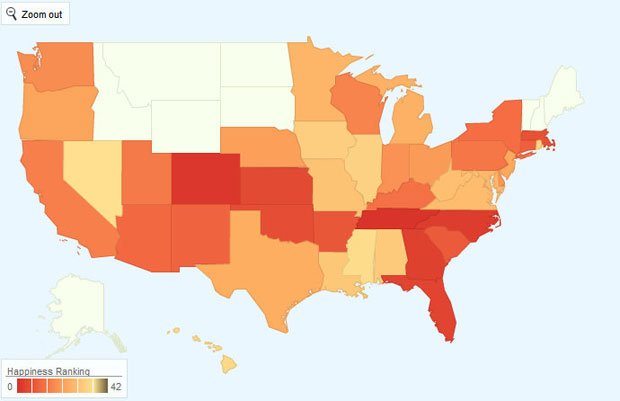
Well, I was having a good day…but enough about me, what’s going on in with the rest of the world? Pretty miserable stuff, actually: Libyan rebels, Japan’s earthquake, tsunami, and nuclear meltdown, the government shut down barely avoided…well, how are individual states doing? Now we know! A map on alexdavies.net used Twitter to determine just how happy each of our fifty nifty states are. Illinois seems darned happy. Washingtonians are – apparently only kinda sorta happy. From the Seattle PI:

On a scale of one to 42 — where one is ecstatically mirthful — Washington state has a happiness index of 21. In other words, it could go either way.

A map from alexdavies.net uses Twitter keywords to pinpoint just how positive or negative states are.

So, if lots of people are using words like “love” and “amazing” when they tweet, their states might get a better ranking.

Oddly enough, sad words for Washington include “Phillies” and “presale,” according to the site. “Starcraft” and “gentleman” also show up as negative words.

Read more at alexdavies.net.