architecture · children · community · design · play

UW professor and students help redesign International Children’s Park

A nice story about a redesign of a park in Seattle so children could actually, you know, play in it:

Located on the northeast corner of Seventh Avenue and South Lane streets in the Chinatown-International District, the park is small – about one-fifth of an acre — but in a key spot.

Vegetation had grown up around the periphery of the 30-year-old park, obscuring views and raising concerns about safety. There were few amenities for adults who bring kids to the park, and no accommodations for people with disabilities. A rock mound posed a hazard, and during the winter, the grass was often soggy.

Cultural and language differences were also part of the landscape, making decisions about the park complicated.

But renewal made sense because the neighborhood has seen increasing residential and commercial development, leading to  more active community places such as the Wing Luke Asian Museum and a branch of the Seattle Public Library.

To involve stakeholders young and old, Hou’s group, along with the city and several neighborhood groups, held an intergenerational design workshop in 2007.

“I think the most difficult challenge was to incorporate as much of the feedback we got from the community while still allowing the park to have a clear and concise design,” said student Patrick Keegan.

Engaging multiple generations of users was the most interesting part of the redesign, said Joyce Pisnanont, manager of IDEA Space, which promotes and develops the Chinatown­-International District. Desires were consistent across age groups, she said, and the adults “really wanted to ensure that the park was fun for kids to play in.”

The final design by landscape architect Karen Kiest includes an expanded children’s area with a play structure big enough for a dozen kids, a dragon sculpture restored by artist Gerard Tsutakawa, a stainless steel pagoda with seats for grown-ups and a three-level rockery that serves as both gathering space and a climbing area.

Public art by Stuart Nakamira includes a brushed stainless steel top the size of a typical 4-year-old.

In a Lane Street corner, pink viburnum are budding, surrounded by circles of black mondo grass.

See more images of the park:
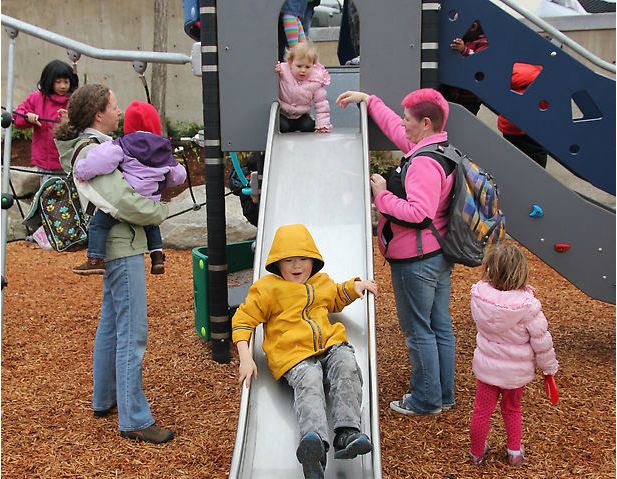
Kids play in the redesigned park.


community · creativity · Social

Storefront Seattle: taking art to the street (window)

Before and After example of Storefronts Seattle project.

With the down economy a lot of stores and businesses have gone out of business, leaving a lot of empty store fronts, at least in places around Seattle. But rather than let those places stay dark and dormant, one woman is spearheading an effort to get local Seattle artist’s work installed in these vacant storefronts:

Storefronts debuted in late 2010 as an experiment in activating vacant spaces with art, creative enterprise, and performance… We also revitalize neighborhoods. And we beautify blocks. And we make areas safer at night, and we market real estate, and we paint walls and mop floors and install lighting and turn desolate half-empty blocks into the hippest, happiest, and hottest real estate in town.

Storefronts Seattle leases storefront space from neighborhood property owners for the nominal rate of $1 per month. We can program up to 15 storefronts in any given neighborhood at any given time, and we fill these spaces with art installations, with creative businesses, and with artist’s studios. These projects are proposed by artists throughout the region, and are chosen by a panel that includes neighborhood representatives, local museum curators, arts professionals, and our programming staff.

At full integration into a neighborhood, Storefronts Seattle is programming up to 60 arts installations per year into your spaces. That’s enough to instantly turn any neighborhood into a walking destination, an arts and culture destination, and a shopping destination. It’s enough to generate regional press. It’s enough to get the city’s creative class and cultural leaders to pay attention.

More at Storefronts Seattle

This is a great project where everyone benefits: property managers get free positive attention for their site, artists get their work exposed, and normal people get to benefit from the art for free!

It also involves a lot of local Seattle neighborhood organizations, bringing attention and buy-in from various communities around Seattle. There are quite a few installations in place right now through May.

What a great opportunity to improve and enrich everyone’s environment. Know of other groups out there taking advantage of empty spaces like these in other cities? Share them in the comments below!

culture · environment · health · Nature

‘Food forest’ in middle of Seattle will feature an urban view

Woman shopping for vegetable starts at Seattle...
Soon Seattle-ites will be able to harvest their own veggies from a large community "forest." Image via Wikipedia

Sorry it has been so long since my last post. I don’t have long, but I had to stop and share in more detail this great story about an urban food forest being proposed for a Seattle neighborhood:

A plot of grass sits in the middle of Seattle, feet from a busy road and on a hill that overlooks the city’s skyline. But it’s no ordinary patch of green. Residents hope it will become one of the country’s largest “food forests.”

The Beacon Hill park, which will start at 2 acres and grow to 7, will offer city dwellers a chance to pick apples, plums and other crops right from the branch.

“I think it’s a great opportunity for the people of Seattle to be able to connect to the environment,” said Maureen Erbe, who walked her two dogs next to the plot on a recent overcast day.

Would she pluck some fruit from the forest?

“Heck yes, I love a good blueberry. You’re not from Seattle if you don’t like a good blueberry,” she said.

For health-conscious and locally grown-food-loving Seattle, the park is a new step into urban agriculture. Cities from Portland to Syracuse, N.Y., already have their own versions. In Syracuse, for example, vacant lots were turned into vegetable gardens to be tended by local teens.

Seattle is an awesome place to have an urban garden. People already replace the little strips of grass between the sidewalk and the street with gardens, and in the summer Seattle is practically overrun with feral blackberry bushes and other fruit.

This is also a great way to improve your environment and make it just a little bit healthier and happier.

This idea has been getting a lot of attention in the media (see related links below), and I hope it will inspire other cities to do the same. Even in cities where it doesn’t rain allll the time, it is more than possible to create spaces for people to garden or for crops to grow feral and let nature take its course.

creativity · play

Getting playful in the snow

Seattle-ites may not know how to drive in the snow, but they sure know how to get creative and have fun! Enjoy!

behavior · creativity · environment · happiness · play · youtube

My thesis, summed up in a two-minute video

After working for literally YEARS on my Master’s thesis (I’m still SO excited that I graduated this past quarter and am an official M.A.), I come across this video, which pretty much sums up my years of work in two and a half minutes. It showcases two students from Parkour Visions in Seattle, WA, explaining why they like parkour, mostly because it lets them play again. Upon seeing this I had two thoughts: “well done” and “dang!”

My parkour buddies also showed me this video recently, which in approximately 9 minutes explains the whole reason I wanted to do my thesis in the first place. The video is actually a pitch for funding a documentary called “Seriously!” which interviews a lot of play experts on the subject of play, including many people I cited in my thesis, and why play is important for our survival. In this case, my reaction was wanting to send it to my thesis advisers and scream: “See? See?!”

Ugh.

Anyway, it is a very nice video, so enjoy:

environment · health

Porous Roadways for Better Runoff

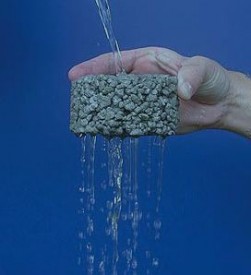
Water flowing through pervious concrete, courtesy of the National Ready Mixed Concrete Association.

This post is more focused on conservation and environmental preservation than usual, but I’m a sucker for a good “save the planet” technology story. Plus, I believe pretty much anything we can do to conserve the environment makes for an overall better, healthier, happier us.

When I first read the headline for this article, I thought it was going to be a complaint about the poor quality of several streets in major cities like Seattle and Portland that are supposedly “bike friendly,” where even a seemingly small series of potholes in a street can mean trouble for bikers like myself.

But no, this is better; a type of concrete that actually lets rain water and other liquid runoff through to the soil beneath, preventing flash floods, bad puddling and worse erosion:

Permeable pavement can make old-school road engineers and pavement builders anxious. To them, the idea of water seeping through roads like they’re made of Swiss cheese just doesn’t seem right. Water runs off roads, not through them. Or at least it used to.

In the Northwest, there’s a growing acceptance of the use of pervious concrete and porous asphalt for roads, sidewalks, parking lots, and driveways. The unconventional pavement does a great job reducing the amount of polluted stormwater runoff that damages homes, streams and lakes. Instead of gushing from the roads carrying a slug of toxic chemicals, the water seeps through small pores in the pavement, soaking into the gravel and dirt beneath the road. Some of the pollutants get trapped inside or beneath the pavement, or are consumed by organisms living in the ground below it.

Those who’ve used the pavement praise the technology. Advocates can be found around the region, including a 32-acre eco-friendly development near Salem called Pringle Creek, where all of the roads and alleys were built with porous asphalt.

Read more at: The Porous Road Less Traveled | Sightline

I’ve heard of this technology being used in driveways with great success, so it’s nice to hear it being used in larger applications.

behavior · happiness · mental health

How Optimism Affects the Economy | LearnVest

find your happy place
Image by emilychang via Flickr

Seattle is known for its gray skies, and perhaps stand-offish attitude to new comers, but I’d argue we are a surprisingly optimistic metropolis. In fact, we’re number four on a Gallup poll’s list of happy major cities. It turns out this is also a good thing for our local economy.

According to new research… the happier you are, the quicker the area you call home is likely to recover. In other words, it’s not just the economy that affects ours moods—it might actually work the other way around, too.

A recent study by the University of Miami School of Business Administration has shown that in in states where people are more optimistic, an economic recession is weaker, expansion is stronger and recovery faster.

Alok Kumar, one of the study’s researchers and a finance professor at the University of Miami School of Business, measured optimism levels across different U.S. states by looking at three key factors: weather, sports optimism and political optimism. In other words,  warm, sunny weather encourages the release of serotonin in the brain, which makes people alert and cheerful. Additionally, we’re happier when the political party we like is in power and our sports teams are performing well.

After creating an index to measure economic well-being in those same places, the researchers crunched the numbers to reveal the correlation between mood and economic activity. Overall, they found that happier places had higher retail sales, which improves the economic climate and helps lessen the effects of a recession. The results of the study showed that other non-economic factors—like warm weather and good sports teams, which improve happiness and optimism—also helped improve local economy, meaning that your mood (and the mood of your town’s fellow residents) can directly impact your area’s economic outlook.

read more about the study via Find Your Happy Place: How Optimism Affects the Economy | Living Frugally | Psychology Of Money | LearnVest – Where life gets richer, and check out their recommendations for happiest large, medium, and small cities.

Uncategorized

Benefits of Yoga Behind Bars in Jails, Prisons, and Correctional Institutions

Helen yoga
Yoga is being used in prisons to encourage calm and personal growth. Image via Wikipedia

My work has been pretty high-stress lately, and I’ve been trying different things to relax and try to make my off-work hours very enriching and recuperative. I recently read about this non-profit organization, Yoga Behind Bars, that offers free yoga classes to incarcerated youth and adults.

Yoga Behind Bars is a non-profit 501(c)(3) organization in Seattle that brings yoga and meditation classes to incarcerated youth and adults in Washington State as well as those at risk of entering the criminal justice system. We are a volunteer-driven organization that teaches 11 classes a week at 7 different facilities. Our mission is to share tools of self-awareness, healing and transformation with our students. (at Yoga Behind Bars).

I think this is a great idea! First, there are multiple benefits of yoga, even for the non-incarcerated:

“There is a growing body of research that supports our belief in the efficacy of yoga and meditation classes to support true individual healing and change. Participation in yoga classes has been shown to reduce depression, anger, and anxiety, often a root cause of antisocial behavior and drug use. Yoga has also been established as an effective adjunctive therapy during treatment for drug addiction, which is a co-factor in many of our students’ incarceration.” (more citations provided in the original article)

more via Benefits of Yoga Behind Bars in Jails, Prisons, and Correctional Institutions.

I can’t believe how stressful and un-enriching it must be to be incarcerated. There are constant political battles that often result in violence, lack of exercise, friends, or contact with the outside world. I am always supportive of programs that try to bring beneficial programs into prisons, like Puppies Behind Bars, theater classes, or raising frogs through the Sustainable Prisons Project.

This is also a great therapy and skill to teach prisoners, because they can take this training and use it outside of the yoga class without an instructor or without a structured setting, either alone in their cell or just practicing breathing when it gets tough.

I’m curious to hear of other programs that are offering enrichment to people living in incarceration, or other environments where they don’t have the same opportunities to go out and enrich their own lives. Please share any you know of in the comments.

architecture · community

Developer seeks to create inviting structures | Seattle Times Newspaper

I read an article recently about a very cool developer in the Seattle area. His company focuses on creating buildings and projects that are good for the environment and for the community:

Rogers’… 4-year-old company, Point 32, is developing one of the region’s highest-profile projects: the Bullitt Center, billed as the greenest office building on the planet.

The Capitol Hill project, which broke ground last month, has been designed to produce its own water, treat its own waste, and each year generate as much power as it uses.

“It really could change the nature of green building, nationally and locally,” Rogers says.

He acknowledges his career path hasn’t been a conventional one. But his background in conservation and the arts prepared him well for what he’s doing now, he says.

Rogers and his business partners, Chris Faul and Matt Kellogg, have been working with the owner, the environment-focused Bullitt Foundation, almost from the start. They helped find the site, design the six-story building, obtain permits and arrange construction financing.

Point 32 also recently completed the first project in which it has an ownership stake: a high-end, boutique live-work loft complex in South Lake Union called Art Stable, targeted at artists and art collectors.

The award-winning building’s most distinctive feature: a crane on the roof and enormous, hinged windows through which oversized art pieces can be lowered.

So what’s the thread that ties together Rogers’ eclectic career?

“I think it’s an interest in place-making,” he says.

Creating something that’s aesthetically appealing is part of that, he says, but there’s more:

“We’re interested in helping create places where people can come together naturally of their own accord, places that improve the physical and social fabric of the city, places that provide a greater benefit than just the physical structures.”

He’s already played a major role in creating one highly acclaimed place: the Seattle Art Museum‘s Olympic Sculpture Park. As SAM’s project manager, Rogers oversaw all facets of the $85 million park’s development — permits, financing, design, construction.

more via Business & Technology | In Person: Developer seeks to create inviting structures | Seattle Times Newspaper.

community · environment · play

It’s PARK(ing) Day!

Park(ing) Day in Indianapolis
Park(ing) Day in Indianapolis. Image by DanO'Connor via Flickr

Today in Seattle, S.F., and other major cities, activists are taking over one or several parking spaces and turning them into parks!

PARK(ing) Day is an annual, worldwide event that invites city dwellers to transform metered parking spots into parks for the day. PARK(ing) Day in Seattle happens to fall on the first day of the [Seattle Design] Festival.

We’ll be partnering with the Seattle Art Museum (SAM) at their impromptu “park.” Drop by and join us in a Festival photo/design activity open to everyone.

SAM will also be offering an all-ages, hands-on artmaking activity; an artist-designed Cornhole game (bean bag toss); and a noon concert by James Whetzel, classically trained on the sarod and tabla.

More via the Seattle Design Festival, which is going on from the 16th until the 25th!   The festival is also pretty relevant since its goal is to explore our environments, how we use them, and how to make them better.

I was able to go see the Seattle exhibit last year, but unfortunately am parked at work today, so go see it and report back. Last year they had lots of games and give aways, and maps featuring the many parks that are scattered around the Seattle metro area.