This is a great exercise in demonstrating a connection to one’s environment, plus it’s fun! And a great example of how you’re never too old to be playful and maybe a little silly.
Tag: nature

Ron Finley: A guerilla gardener in South Central LA | Video on TED.com
Happy Spring Forward. Time to start planting seeds and playing in the dirt. In honor of getting dirty and creative, here’s a a TED talk from Ron Finley, guerrilla gardener.
Ron Finley plants vegetable gardens in South Central LA — in abandoned lots, traffic medians, along the curbs. Why? For fun, for defiance, for beauty and to offer some alternative to fast food in a community where “the drive-thrus are killing more people than the drive-bys.”Ron Finley grows a nourishing food culture in South Central L.A.’s food desert by planting the seeds and tools for healthy eating.
Best quote ever: “Gardening is the most therapeutic & defiant act you can do, especially in the inner city. Plus you get strawberries.”
via Ron Finley: A guerilla gardener in South Central LA | Video on TED.com.
Related articles
- TED: Ron Finley: A guerilla gardener in South Central LA – Ron Finley (2013) (ted.com)
- Ron Finley: A guerilla gardener in South Central LA (livinginnatureengland.wordpress.com)
- Ron Finley: A Guerilla Gardener in South Central LA (enpundit.com)
- Ron Finley: A Guerilla Gardener in South Central LA (secretsofthefed.com)
As you digest your turkey and reflect on a hopefully happy Thanksgiving, I am offering this summary of a recent conference session that talked about how to integrate biophilia into urban spaces and cities. As the human population increases, more people move away from the country and into the city, yet as humans we still crave nature and natural environments. Three researchers suggest how to go about addressing that.
The Best Playground Is The One Nature Provided | Co.Exist: World changing ideas and innovation
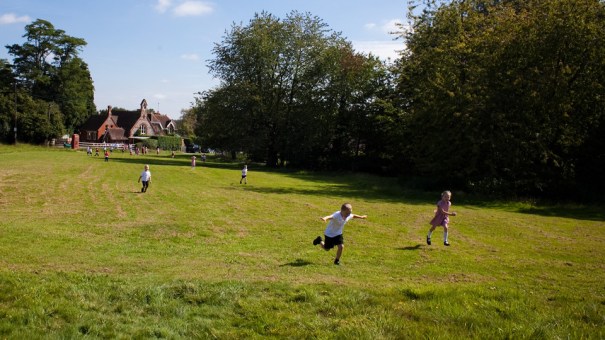
A recent article in the online magazine Co.EXIST discussed a study that found children benefit from being in natural environments, even if the environment is designed to appear natural but is actually human-made:
Dawn Coe, an assistant professor in the Department of kinesiology, recreation, and sport studies at the University of Tennessee spent time observing the behavior and time children spent playing on a local playground. After playground renovations added a gazebo, slides, trees, a creek, and a natural landscape of rocks, flowers and logs, Coe returned a year later to observe differences. Working with a statistician, Coe found children spent twice as much time playing in the natural landscape, and were less sedentary after the renovation and more active.“Natural playscapes appear to be a viable alternative to traditional playgrounds for school and community settings,” said Coe in a university statement. “Future studies should look at these changes long-term as well as the nature of the children’s play.”
via The Best Playground Is The One Nature Provided | Co.Exist: World changing ideas and innovation.
I attended a conference a couple of years ago where playground designers were reporting discovering the exact same thing – if you give a kid a pile of dirt and tree bark to play with and a bucket of water, they will have WAY more fun, play more, and learn some things as well.
This shouldn’t come as a surprise based on previous research on us humans:
For decades, scientists have reported our species exhibits a consistent, if not quite understood, response to spending time around nature: it boosts our mental and physical well being.
The scattering of findings have held in hospital beds, public housing, and Japanese forests. A 2001 study of public housing found the mere presence of trees and grass reduced reduced reported aggression and violence. Another showed people shown a stressful movie recovered to a normal state–as measured by metrics such as heart rate, muscle tension, and blood pressure–“faster and more complete[ly]” when exposed to natural rather than urban environments.
However, a lot of cities and schools are reluctant to install these kinds of playgrounds since they are considered “untested” or approved by several school or city boards. Thankfully, according to the article, cities are beginning to adopt and install these types of playgrounds:
“Natural playscapes are part of a growing trend appearing in cities across the US including Boston, Phoenix, Chicago, New York, Auburn and others.”
I hope to see more of these pop up around major cities. Do you have a natural playscape near your home? Tell us about it in the comments below.
Related articles
- The Best Playground Is The One Nature Provided (fastcoexist.com)
- How to design the perfect playground (guardian.co.uk)
- Natural playgrounds more beneficial to children, inspire more play, study finds (sciencedaily.com)
- Children Inspired By Natural Playgrounds Tend To Be More Physically Active (medicalnewstoday.com)
- UT study: Natural playgrounds more beneficial to children, inspire more play (eurekalert.org)
Attention Disorder or Not, Children Prescribed Pills to Help in School – NYTimes.com

I find this article in today’s New York Times extremely disturbing:
When Dr. Michael Anderson hears about his low-income patients struggling in elementary school, he usually gives them a taste of some powerful medicine: Adderall.
The pills boost focus and impulse control in children with attention deficit hyperactivity disorder. Although A.D.H.D is the diagnosis Dr. Anderson makes, he calls the disorder “made up” and “an excuse” to prescribe the pills to treat what he considers the children’s true ill — poor academic performance in inadequate schools.
“I don’t have a whole lot of choice,” said Dr. Anderson, a pediatrician for many poor families in Cherokee County, north of Atlanta. “We’ve decided as a society that it’s too expensive to modify the kid’s environment. So we have to modify the kid.”
via Attention Disorder or Not, Children Prescribed Pills to Help in School – NYTimes.com.
Sadly the doctor is correct that many schools refuse to change a child’s environment to improve academic success, namely that they are cutting out activities like recess and P.E. in order to make more time for studying.
However, P.E., recess, and just getting outside for a quick breath of fresh air have all shown to also be extremely effective ways to improve attention and academic success. Yet because these activities are getting cut out of the school day, doctor’s feel like they must prescribe these incredibly strong, brain-chemistry changing medications to growing brains, many of these drugs with strong side effects .
I have no problem with using these drugs for what they were originally intended for, but prescribing them basically as “performance-enhancing” drugs just seems unethical to me. We frown upon athletes and grown-ups in the business world from taking speed and other kinds of drugs that are supposed to improve performance (other than coffee of course, that seems pretty much like a must-have for adults), but it’s okay for students so they can do well in elementary and middle school? To put in mildly, yuck!
I hope other people will be as outraged as I am and stand up for a child’s right to recess and P.E., and actually NOT studying from time to time, rather than encouraging giving them strong medications in order to perform well on standardized tests.
Related articles
- NYT Hits The Problem With ADHD Drugs: They Work (forbes.com)
- Raising the Ritalin Generation – NYTimes.com (mbcalyn.com)
Bee boulevard: How to turn an urban corridor into a haven for native pollinators | Grist

I couldn’t stay away for long, could I?
I thought this was an interesting article about actively creating space in urban environments to promote biodiversity and making our lives as humans healthier (more bees means more flowers, fruits and veggies), and it just so happens to make the space prettier and more enjoyable visually as well.
Several years ago, Sarah Bergmann, a painter by training, started asking questions about the fate of the world’s pollinators. And while she’s not an environmentalist per se, Bergmann’s art and graphic design work never stray far from the environmental sphere. To her, the complex and shifting relationships between pollinators and plants have always begged further investigation. Bergmann’s response to what she learned is a work-in-progress called the Pollinator Pathway, a mile-long corridor of pollinator-friendly, mostly native plants stretching between two green spaces in the heart of Seattle.
Bergmann chose the pathway’s two endpoints — the Seattle University campus and a lot-sized forest called Nora’s Woods — for their diverse plant life and lack of pesticides. Since building the first test garden in 2008 with the help of a small city grant, she and hundreds of volunteers have installed 16 more gardens in parking strips along the way. “It’s not just a random line of plants; it’s meant to find two existing green spaces within the city and draw a line between them,” she says.
Gardens are built with the cooperation and enthusiasm of homeowners on the corridor, who have also agreed to maintain them. They must be drought-tolerant, pesticide free, and, ideally, contain at least 70 percent native plants — though Bergmann says the project hasn’t quite hit that target yet. And of course, the plants must be appealing to bees and other pollinators. These requirements, combined with city height restrictions for parking-strip vegetation, led to a list of about 50 plants that can be part of the pathway.
Biologists have been promoting migration corridors for mammals and birds for decades, so why not bees? Gardening is also a fun, playful activity for many people, and the idea that they’re helping out something else in return is also satisfying.
Find out more about creating bee corridors via Bee boulevard: How to turn an urban corridor into a haven for native pollinators | Grist.
Related articles
- Bee boulevard: How to turn an urban corridor into a haven for native pollinators (grist.org)
- Why Bees Need Trees (wtcampaigns.wordpress.com)
- Wild pollinators support farm productivity and stabilize yield (sciencedaily.com)
Outdoor Play Poster
From the nonprofit organization Voice of Play and their host organization, the IPEMA (International Play Equipment Manufacturing Assocation):

This poster is appropriate for any player, whether you are 2 or 92.
What other reasons can you think of to play outside? Leave them in the comments below.
Indeed! Fascinating findings and I like how they’re being applied.
For developing brains and global health, it’s all about the trees

As I head off on my latest grand adventure (a road-trip across Washington State), I will be driving through some fairly pristine landscapes; prairies, desert, forests, river basins. I love experiencing natural environments, even if it’s only from my car window. I find it rejuvenating and relaxing, more than a 90-minute massage! And enough research is coming out these days that finds I am not alone in my need for green spaces. So these two articles that were recently published seemed very timely for me. I know a lot of people wonder, “what does saving trees have anything to do with play?” Well, in a word, LOTS!
A new blog post by No Child Left Inside writer Richard Louv states:
From conception through early childhood, brain architecture is particularly malleable and influenced by environment and relationships with primary caregivers, including toxic stress caused by abuse or chronic neglect. By interfering with healthy brain development, such stress can undermine the cognitive skills and health of a child, leading to learning difficulty and behavior problems, as well as psychological and behavior problems, heart disease, obesity, diabetes and other physical ailments later in life.
A growing body of primarily correlative evidence suggests that, even in the densest urban neighborhoods, negative stress, obesity and other health problems are reduced and psychological and physical health improved when children and adults experience more nature in their everyday lives. These studies suggest that nearby nature can also stimulate learning abilities and reduce the symptoms of attention deficit hyperactivity disorder, and we know that therapies using gardening or animal companions do improve psychological health. We also know that parks with the richest biodiversity appear to have a positive impact on psychological well-being and social bonding among humans.
While we can’t say with certainty that these influences play a direct role in early brain development, it’s fair to suggest that the presence of nature can soften the blow of toxic stress in early childhood and throughout our lives. It’s understandable that researchers have yet to explore the natural world’s impact on brain development because the topic itself is rather new. Also, scientists have a hard time coming up with an agreed-upon definition of nature – or of life itself.
He’s right that we can directly link the two, but we do have research that demonstrates all of the following:
- play is good for you
- stress is bad for you
- less stress = more play
- more nature = less stress
- more nature = more play
- The environment you grow up in as a kid leads to permanent learned behaviors as an adult.
So there is a STROOOONG correlation to more exposure to nature as a kid leading to a less stressed, healthier, more playful brain.
Fortunately or unfortunately, there are now calls out to step up preserving natural forests, with some researchers claiming deforestation poses more of a threat to the planet’s health than global warming:
Bill Laurance, a professor at James Cook University in Cairns, Australia, studied 60 protected areas in tropical regions around the world and is the lead author of an article that will be published in tomorrow’s issue of Nature.
Tropical forests are the most diverse ecosystems on Earth, and failing to maintain them may drive more species to extinction, he said. To serve as a sanctuary for wildlife, the areas must also be protected from nearby development and other activities in adjacent lands that will have impact on designated preserves.
Protecting nature is important for our own health, as well as our children and grandchildren. Remember to be thankful for nature this weekend, and maybe even give a tree a hug; it’s playful and gets you closer to nature, literally.
Related articles
- You: Social deprivation hurts child brain development, study finds (latimes.com)
- Rainforest wildlife havens on brink of collapse (independent.co.uk)
- Your great grandparent’s experience might have altered your stress response. (mindblog.dericbownds.net)
- The Kiss of Health (psychologytoday.com)
- If I ruled the world – Richard Louv (outdoornation.org.uk)
- Richard Louv: 10 Benefits Of The Great Outdoors (huffingtonpost.com)
- Playing out – reclaiming the streets (outdoornation.org.uk)
- 20 Ways to Create a Naturally Restorative Home and Garden (my.psychologytoday.com)
The office for people who hate offices

This is a great idea! So many people have told me how they hate being inside the office all day, especially on nice summer days like this. We NEED exposure to the outdoors and nature in order to stay productive, mentally healthy, and physically fit. Just a 20-minute walk in the woods can have the same productivity benefits as an hour-long nap.
What’s your dream office? If you fantasize about bouldering on your lunch break–and appreciate being in a zero-waste, net zero-energy environment–you might want to take a look at the soon-to-be-completed space in the slideshow above: the new Alameda, Calif. headquarters of VF Corporation‘s outdoor and action sports coalition brands, which include The North Face, Lucy, and Jansport.
Now that VF’s outdoor brands are on good financial footing (especially The North Face), the corporation is working on a headquarters–set to be completed this summer–that was built with employee wish lists in mind. It shows.Below, some of the amenities available at the new 160,000-square-foot complex (many of them suggested by an employee task force).
- A large onsite garden that will grow things like kale, tomatoes, and basil. VF expects to grow so much that employees won’t even be able to consume all of it. Leftover will be donated to a local food bank. Employees will be encouraged to help out with the garden, but local volunteers will also pitch in. A side note: Originally, VF toyed with the idea of installing a volleyball court, but employees elected to grow a garden instead.
- Lots of natural light. 90% of employees will have access to direct sunlight, and in many areas of the complex, the overhead lights can often be kept off. Bonus: All the windows in the complex open (this should be a given, but it isn’t always).
- Opportunities for onsite fitness, including an indoor fitness area and yoga room, an outside training area for bootcamp, an outside bouldering space, and an outdoor gear rental and repair shop.
- A cafe serving the vegetables grown in the garden, among other things.
- Eventually, if employees are really lucky, the ability to kayak out into the water just outside the complex (VF would need to make sure this is feasible and legal first, but employees have been asking for it).
- A convenient location for almost everyone. When VF first started thinking about the new complex, it “took employee addresses and mapped out where they were” to figure out an ideal spot, according to Steve Rendle, group president of VF’s Outdoor & Action Sports Americas.
- The office space is inside out: executive offices are in the middle of the room, and other employees sit by the windows.
VF is far from the only corporation to have an environmentally and outdoors-friendly campus. New Belgium Brewing Company, for example, buys clean energy, powers itself partially with methane from an on-site water treatment plant–and it offers perks like free bicycles and volleyball.
But the idea of a company keeping employees active, innovating, and considering the environment shouldn’t be a novel one. We hope, in other words, that this becomes a trend well outside the outdoor apparel industry.
The only thing I’m bummed about is that they didn’t use one of the hangars on the old Alameda Air Base, that closed down just over 12 years ago and hasn’t had much development done with it since. It would have been very “green” to recycle those old structures, but I also understand the price and space limitations. Still, very exciting overall, and I hope this trend continues with new office buildings.
Related articles
- An Office Created For People Who Would Rather Be Outside (fastcoexist.com)
 Mental Flowers