Nice interview from Salon with scientist Shimon Edelman about how scientists are discovering neural patterns to the behaviors and activities that make humans happy; turns out the act of learning is often more rewarding than what we learn:
Shimon Edelman, a cognitive expert and professor of psychology at Cornell University, offers some insight in “The Happiness of Pursuit: What Neuroscience Can Teach Us About the Good Life.” In his new book, Edelman walks the reader through the brain’s basic computational skills – its ability to compute information, perform statistical analysis and weigh value judgments in daily life – as a way to explain our relationship with happiness. Our capacity to retain memories and develop foresight allows us to plan for the future, says Edelman, by using a mental “personal space-time machine” that jumps between past, present and future. It’s through this process of motivation, perception, thinking, followed by motor movement, that we’re able not only to survive, but to feel happy. From Bayes’ theorem of probability to Shakespeare’s “Romeo and Juliet,” Edelman offers a range of references and allegories to explain why a changing, growing self, constantly shaped by new experiences, is happier than the satisfaction any end goal can give us. It turns out the rewards we get for learning and understanding the workings of the world really make it the journey, not the destination, that matters most.
Being thankful for the little everyday things, like just being able to eat, is better for you psychologically over the long haul. Image via Wikipedia
I received this newsletter post from financial advice blog LearnVest. It provided some interesting insight into another reason why practicing how to be grateful in itty-bitty ways (see my earlier post) is actually better for you in the long run.
—
Lately, I’ve been thinking a lot about gratefulness and what really makes us happy. This has been a truly happy year for me personally—the LearnVest audience has grown 310%, our company is celebrating its two-year anniversary, our team has tripled in size, and, to top it all off, I got engaged last month to the best guy I know.
All of this has reminded me of the “happiness lab” I worked at back in college, where I witnessed one psych study that changed my life:
When given the hypothetical choice between lots of big wins in a short amount of time (like all of your dreams coming true in a week) and one consistent thing they already liked, guaranteed forever (like a warm cup of coffee every morning), most people chose the big wins: a bigger house, a fancy car, a promotion, winning the lottery.
But the lab’s researchers found that the coffee-every-day-forever approach really makes people happier when push comes to shove. Why?
We say we want a bigger house, but then we have to maintain it. We say we want a promotion, but it comes with more stress and longer hours. Meanwhile, one reliable, comforting constant in our lives—like a soothing cup of coffee every day—can make us feel great. In general, the big things we strive for don’t necessarily make us happier.
This study proves scientifically what many of us have always known: Money can’t buy happiness.
This Thanksgiving, I encourage you to think about what really makes you happy. Is it writing? Taking pictures? Giving back to the community? I have a feeling you’ll find that many of the best things in your life don’t cost a thing, or are well within your reach right now.
I hope you can find the laughter and the joy in every situation. May this year and every year bring you a lot to be thankful for.
It’s Friday, and I’m looking forward to the weekend, and apparently so is the rest of the online world. A team of sociologists measured the amount of “happy” tweets people put out around the world, and found it matched previously known patterns of happiness trends:
Drawing on messages posted by more than two million people in 84 countries, researchers discovered that the emotional tone of people’s messages followed a similar pattern not only through the day but also through the week and the changing seasons. The new analysis suggests that our moods are driven in part by a shared underlying biological rhythm that transcends culture and environment.
The report, by sociologists at Cornell University and appearing in the journal Science, is the first cross-cultural study of daily mood rhythms in the average person using such text analysis. Previous studies have also mined the mountains of data pouring into social media sites, chat rooms, blogs and elsewhere on the Internet, but looked at collective moods over broader periods of time, in different time zones or during holidays.
Studying emotions through Twitter and other social media can always be a little tricky (for example, most algorithms don’t get sarcasm). But, that aside, I am very intrigued to see the results that market researchers and sociologists are finding using social media, and seeing how much our “real” lives are accurately reflected in our online worlds as well.
Countries with national health care. Does it make them happy? Image via Wikipedia
Turns out Americans aren’t so happy right now; we didn’t even make it into the top ten. In fact, eight of the top ten happiest nations are in Europe.
There is more to happiness than raw economic growth. What happens when you measure countries by employment, health care, and life satisfaction? The United States and Europe run in opposite directions.
#1: Denmark
Employment Score: 5th Self-Reported Health:15th Employees Working Long Hours: 3rd Disposable Income:18th Educational Attainment: 18th Life Expectancy: 25th
I was surprised to see that Danes worked some of the longest hours of all the nations polled. They also didn’t score super high on life expectancy or disposable income.
#2, Canada, had a seemingly more balanced ranking, ranking tenth in long hours worked and 2nd for self-reported health. Norway at #3 also had pretty good scores all around.
What are the real keys to a fulfilling career? Image via Wikipedia
As a child growing up smooshed in between the “Me” generation and the Millenials, I have always been told that I could be whatever I wanted when I grew up, and to follow my passion; pursue my dreams and the money will follow. After going to college, getting a real job, going back to college, and getting several other jobs, it started to dawn on me that this whole “pursue your dream” thing might not be the best strategy after all, (although I wouldn’t say I’ve completely abandoned the idea). So I was intrigued when I read this post from the blog Study Hacks by David Shenk, full-on condoning this sneaking suspicion I’ve had for awhile.
For the past couple years I’ve been advancing a controversial argument: “follow your passion” is bad advice.
I’m not against feeling passionate about your work — in fact, I think this is a fantastic goal. But from my experience studying this issue, passion is not something that you discover and then match a job to; it is, instead, something that grows over time along with your skills.
In other words, working right trumps finding the right work.
“College grads are often sent out into the world amid rapturous talk of limitless possibilities. But this talk is of no help to the central business of adulthood, finding serious things to tie yourself down to.”
It’s nice that “grown-ups” are finally acknowledging that we’re not all going to grow up to rock stars or astronauts. That there needs to be more behind “finding your passion” in order to succeed in a competitive capitalist market structure.
However, my vision is slightly skewed, because of how many people in my family DID follow their passions. My mom, my dad, two of my cousins, my husband, my mother-in-law, and multiple siblings-in-law, all of them made money at one point in their lives (or continue to) doing what they loved, following what was their “passion” at the time. Only a couple of them have made much money doing it, and many of them eventually got “real jobs.” But still, many of my family members were able to turn their passions into a career.
So I think there IS a part of the equation where passion is important; if the subject matter doesn’t interest you, then you’re asking for a looooong slog. The difference between their success and others’ failures, I think, is that they weren’t just “following” their dream; they all actively pursued it! They wrote up business plans and proposals. They sold their cars and slept of friends’ sofas and lived off of beans and rice while they got started. Maybe they were only able to pursue it part-time because they had to take a “real” job to pay rent. When more training was needed they got it. When long nights were needed, they put them in.
I think the idea is we are more motivated to put these long hours in if we are passionate about something. However, I do think both Brooks and Shenk are also right in that it is NOT always fun, it is NOT always easy, and there is realistically more value in dedicating yourself to what you are doing right now!
Another factor is prioritizing what’s important to you, including your time. In the world of the desk job and remote access, there is more flexibility. I think it is harder to be dedicated to something than simply passionate about it. Stenk has a great post from last year about how to love your career. I’m sure I’m butchering the message, but basically it comes down to
feeling like you have control of your own destiny,
you’re making a difference (in any small way),
and that you’re good at what you do.
That certainly matches up with the most successful entrepreneurs in my family. They valued the autonomy over their lives, and they were GOOD at what they did, but it came from years of training and hard work.
It definitely adds some much-needed perspective to the question, “what do you want to be when you grow up?”
Hint from featured profile Helen Reichert, who's 109? A sense of humor helps.
More and more research is finding that the ability to cope with stress and bounce back better correlates with long life. Just a reminder to take it easy…
Gerontologist and commentator Mark Lachs says one of the keys to a long, healthy old age is the ability to keep moving forward after life’s inevitable setbacks.
One study found that 50 year olds with a negative outlook on life lived seven years shorter than those with a positive outlook.
What’s interesting is that more than avoiding stress it seems more important to have the ability to bounce back from it. So healthy coping mechanisms for handling stress, as well as a good attitude about life, seems to be more important than nutrition and exercise.
I’m seeing lots of different examples of people using nature to help heal, from the physically injured to those with aggression issues cut off from the rest of the world.
For example, I was just listening to a program this weekend on the local NPR station about a biologist at Evergreen State College who is greenifying a local prison, as well as working with inmates to grow new prairie grass and frogs (I can’t find the original story but here’s some similar coverage):
The frog rearing program here pairs inmates with scientists from the Evergreen State College as part of the Sustainable Prisons Project.So far, the frogs grown at Cedar Creek Correctional Center are doing better than those grown by professional zoologists.
LIESL PLOMSKI, graduate student, The Evergreen State College says, “They have a lot more time here to care for the frogs that a zoo wouldn’t have.I mean they’re here all day with them, so they change the water frequently.They feed them more frequently than a zoo could ever do.”
And then this morning stumbled upon this story:
Henning Larsen Architects recently won an international design competition with their plans for the new Odense University Hospital in Denmark. Situated close to the city center amidst a scenic old-growth forest, the OUH will use the surrounding landscape as a way to heal its patients. The holistic facility features a light footprint that incorporates nature at every turn to create an environment replete with peace and serenity. Daylight floods in through the glass-lined buildings, and rainwater will be collected to feed the many ponds and surrounding landscape.
Flash mob pillow fight in Switzerland (neutral, yeah right!). Image via Wikipedia
Thanks again to the Seattle PI for bringing us great stories of spreading joy and happiness (see posts from earlier this week)!
If you were out and about in Seattle Sunday, you might have encountered more dancing and music than expected.
You can thank the TV show “Glee” and Seattle’s propensity for flash-mob participation for that.
“Glee” flash mobs broke out in several spots around the city Sunday afternoon. Here’s video of one of the best performances I’ve seen out of a bunch posted on YouTube.
This is such an awesome trend of seeing flash mobs of people performing public dancing and performance, from Michael Jackson’s Thriller to Glee to improv and beyond.
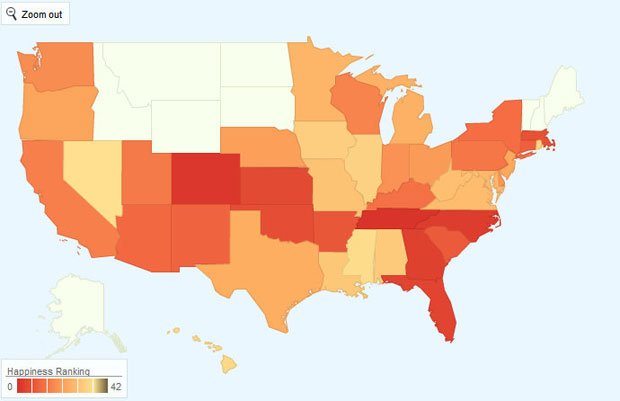
Well, I was having a good day…but enough about me, what’s going on in with the rest of the world? Pretty miserable stuff, actually: Libyan rebels, Japan’s earthquake, tsunami, and nuclear meltdown, the government shut down barely avoided…well, how are individual states doing? Now we know! A map on alexdavies.net used Twitter to determine just how happy each of our fifty nifty states are. Illinois seems darned happy. Washingtonians are – apparently only kinda sorta happy. From the Seattle PI:
On a scale of one to 42 — where one is ecstatically mirthful — Washington state has a happiness index of 21. In other words, it could go either way.
A map from alexdavies.net uses Twitter keywords to pinpoint just how positive or negative states are.
So, if lots of people are using words like “love” and “amazing” when they tweet, their states might get a better ranking.
Oddly enough, sad words for Washington include “Phillies” and “presale,” according to the site. “Starcraft” and “gentleman” also show up as negative words.

 Nice interview from Salon with scientist Shimon Edelman about how scientists are discovering neural patterns to the behaviors and activities that make humans happy; turns out the act of learning is often more rewarding than what we learn:


 Mental Flowers