behavior · environment · health · mental health

How to Find a Quiet Space for Meditation

Levitating, Meditating, Flute-playing Gnu
How do you find space to relax and/or meditate? Image via Wikipedia

Work has been really hectic lately, and I’m finding it can be hard to find a quiet place for myself, not only metaphorically, but even physically. My house is full of dog or husband, the bus is impossible, and it seems like there isn’t an empty spot anywhere in the whole 20-story building I work in.

Here is some great advice from blog Quieting the Mind “for finding a quiet space for meditation:”

Make sure everyone in the house knows not to disturb you. If you have young children who can’t understand this, make sure to meditate when your spouse or someone else is home, so they can care for the children during this time. It’s only ten minutes. Surely, someone can ward off any distractions.

Find the quietest room in your house and set a little area that is designated for meditation. Always use the same room and close the door when you meditate. This way, people will know not to disturb you.

Meditate at the same time every day. If your household knows that you wake up at 5 a.m. to get your daily meditation in every day, they’ll learn to respect your privacy during that time.

If all else fails, put up a sign: “Meditating: Do not disturb!” If you get a distraction (one that isn’t an emergency) pretend you don’t hear the person. They won’t continue interrupting you if they don’t ever get a response.

Invite others to meditate with you. They may enjoy it, but best of all, you’ll all have some quiet time. It may take some getting used to for everyone, so allow an adjustment period, but it can really be worth it.

more via How to Find a Quiet Space for Meditation.

How do you make space, both using time and physical space, to find a piece of quiet? I know of more than a few people who use their commute as their quiet time, but that doesn’t work for others (myself included). Where else?

brain · creativity

Humans Vs. Computers at Winning Games

Thanks xkcd:


anthropology · behavior · brain · community · happiness · health · mental health · psychology

Life Lessons Passed On

English: Elderly Muslim during the Republic of...

I was really inspired by that blog post I shared a couple of months ago about cancer survivors and what they’d learned about life. I also posted a survey done with older folks last year giving advice on what NOT to do.

Well, thankfully all of that hard-earned knowledge is coming out in book form. Many of the interviews can also be at legacyproject.human.cornell.edu. From the NYTimes:

Eventually, most of us learn valuable lessons about how to conduct a successful and satisfying life. But for far too many people, the learning comes too late to help them avoid painful mistakes and decades of wasted time and effort…

Enter an invaluable source of help, if anyone is willing to listen while there is still time to take corrective action. It is a new book called “30 Lessons for Living” (Hudson Street Press) that offers practical advice from more than 1,000 older Americans from different economic, educational and occupational strata who were interviewed as part of the ongoing Cornell Legacy Project.

Its author, Karl Pillemer, a professor of human development at the College of Human Ecology at Cornell and a gerontologist at the Weill Cornell Medical College, calls his subjects “the experts,” and their advice is based on what they did right and wrong in their long lives.

You can also read a summary of their advice in the article: Advice From Life’s Graying Edge on Finishing With No Regrets

What are your life lessons?

environment · health

Porous Roadways for Better Runoff

Water flowing through pervious concrete, courtesy of the National Ready Mixed Concrete Association.

This post is more focused on conservation and environmental preservation than usual, but I’m a sucker for a good “save the planet” technology story. Plus, I believe pretty much anything we can do to conserve the environment makes for an overall better, healthier, happier us.

When I first read the headline for this article, I thought it was going to be a complaint about the poor quality of several streets in major cities like Seattle and Portland that are supposedly “bike friendly,” where even a seemingly small series of potholes in a street can mean trouble for bikers like myself.

But no, this is better; a type of concrete that actually lets rain water and other liquid runoff through to the soil beneath, preventing flash floods, bad puddling and worse erosion:

Permeable pavement can make old-school road engineers and pavement builders anxious. To them, the idea of water seeping through roads like they’re made of Swiss cheese just doesn’t seem right. Water runs off roads, not through them. Or at least it used to.

In the Northwest, there’s a growing acceptance of the use of pervious concrete and porous asphalt for roads, sidewalks, parking lots, and driveways. The unconventional pavement does a great job reducing the amount of polluted stormwater runoff that damages homes, streams and lakes. Instead of gushing from the roads carrying a slug of toxic chemicals, the water seeps through small pores in the pavement, soaking into the gravel and dirt beneath the road. Some of the pollutants get trapped inside or beneath the pavement, or are consumed by organisms living in the ground below it.

Those who’ve used the pavement praise the technology. Advocates can be found around the region, including a 32-acre eco-friendly development near Salem called Pringle Creek, where all of the roads and alleys were built with porous asphalt.

Read more at: The Porous Road Less Traveled | Sightline

I’ve heard of this technology being used in driveways with great success, so it’s nice to hear it being used in larger applications.

behavior · community · culture · environment · happiness · psychology

The Psychological Importance of Home

English: Clayton H. Delano House, Ticonderoga,...
Our sense of place, and particularly our home, can be very intricately woven into our identities. Image via Wikipedia

As the weekend, approaches, many of us are making plans to go out to events in our local cities, or work around the house, or just sleep in our own beds after several weeks of visiting and traveling. The psychology of home is very important to us humans, and was captured really well in an article by Julie Beck in The Atlantic:

Susan Clayton, an environmental psychologist at the College of Wooster, says that for many people, their home is part of their self-definition, which is why we do things like decorate our houses and take care of our lawns. These large patches of vegetation serve little real purpose, but they are part of a public face people put on, displaying their home as an extension of themselves. It’s hardly rare, though, in our mobile modern society, to accumulate several different homes over the course of a lifetime. So how does that affect our conception of ourselves?

When you visit a place you used to live, these cues can cause you to revert back to the person you were when you lived there.

For better or worse, the place where we grew up usually retains an iconic status, Clayton says. But while it’s human nature to want to have a place to belong, we also want to be special, and defining yourself as someone who once lived somewhere more interesting than the suburbs of Michigan is one way to do that. “You might choose to identify as a person who used to live somewhere else, because it makes you distinctive,” Clayton says. I know full well that living in Paris for three months doesn’t make me a Parisian, but that doesn’t mean there’s not an Eiffel Tower on my shower curtain anyway.

We may use our homes to help distinguish ourselves, but the dominant Western viewpoint is that regardless of location, the individual remains unchanged. It wasn’t until I stumbled across the following notion, mentioned in passing in a book about a Hindu pilgrimage by William S. Sax, that I began to question that idea: “People and the places where they reside are engaged in a continuing set of exchanges; they have determinate, mutual effects upon each other because they are part of a single, interactive system.”

Read the full article here.

I definitely feel like I have a connection and identify with every place that I’ve lived, although some have felt more like home and have shaped me more than others. A lot of that has been due to how safe or at peace I feel in a place, and how much I have bonded with the people around me.

I also think one thing that was so traumatic about the housing bubble was that sense of losing your home. Not just a piece of property you owned, but this landmark of who you were, the space where you kept all of your memories and built new ones, your safe house, literally.

What is your experience with home? What makes a place “home” for you?

behavior · creativity · health · youtube

30 minutes of play a day!

*edit*: NOW with working YouTube link. Thanks for NOT telling me, people, gosh! 😛

In case you’re still trying to come up with a new year’s resolution, or even if you think you’ve got your goals for 2012 all set, you might want to make room for one more.

Ryan Ford, the man behind the DemonDrills workouts on YouTube and owner of Apex Movement, a Parkour and Crossfit gym in Colorado, makes a very convincing argument for just how easy it is to incorporate 30 minutes of fun exercise, i.e. play, into your day:

You’d be amazed at how easy it is to add a little play into your day, and how quickly that play adds up. It also helps get the creative juices flowing and helps you see the world in new ways, so it’s also good brain exercise.

behavior · community · creativity · Social · youtube

More subway enrichment

More examples of how to make your environment fun, thanks to Boing Boing:

In this video from the NYC subway, a singer named Jessica Latshaw, bearing a small uke, finds herself sitting across from a gentleman with a fine pair of bongos. The two begin an impromptu jam session, emceed by a random gregarious stranger and captured for posterity by a subway rider with a camphone. The performance is just fine, and it’s clear from the footage that the rest of the car is having a fine time.

In theory, it’s possible that the whole thing is a fix, “buzz marketing” from Latshaw and co, and if so, well, it’s an extraordinarily nonobnoxious example of the form.

okay- what you are about to watch is a true new york experience. what originally started out as a typical nyc subway ride (sitting across from guy who smelled like urine) turned into an awesome performance by two people who have never met before. i captured the whole thing on video.

never a dull moment on the nyc subway (Thanks, z7q2!)

children · education · learning

Un-geekifying scientists

Español: Investigadores en un laboratorio de l...
What makes a career seem achievable, especially in STEM fields? Image via Wikipedia

Interesting article about making science appealing to youngsters, particularly girls:

Addressing the country’s shortfall of students in the STEM disciplines (science, engineering, technology and mathematics) begins with persuading students that scientists are people, too.

A series produced by the science program NOVA, available online, is a good place to start. The Secret Life of Scientists and Engineers (tag line: “Where the lab coats come off”) features footage of scientists working in their labs and sitting down for interviews. The researchers come off as curious, playful, even goofy — people you might want to befriend, or become. The same process of humanization can work with written materials. Susan Nolen, a professor of psychology at the University of Washington, gave two different statistics texts to groups of female students. One selection was written in the remote, impersonal style of most textbooks. The other struck a more accessible tone, sharing the writer’s views and opinions on the information. The text with a “visible author,” as Nolen describes it, prompted the students to engage in mental interactions with the author as they read, a process that promoted their understanding and retention of the material.

Read more: America Needs More Geeks: How to Make Science Cool

Do you agree or disagree with Paul’s assessment? Are scientists scary, unapproachable beings that nobody wants to be when they grow up?

From my personal experience I know that making that kind of job and expertise seem attainable was important to me as a high school and college student. I had a journalism professor in college that I greatly admired, Conn Hallinan. He was so GOOD at what he did; he seemed to know the history of every issue. In his provost house (not even his “real” house) he had an entire room full of file cabinets filled with clippings of stories, and somehow kept track of all of it. It was somewhat intimidating as a budding journalist. I remember thinking a couple of times “I will NEVER be this organized/dedicated/whatever. How will I ever become a journalist?” Thankfully he was very supportive of my budding talents, and I ended up writing for a scientific magazine for several years.

That being said, I think it helps to have the mask removed and being able to see the real people behind some of these professions. At the same time, probably the most helpful course I took in college was a two-credit seminar on writing professions. Each week they brought in guest speakers who talked about how they made money writing, and what they did as side-jobs if/when the writing didn’t pay enough. One journalist who’s name I can’t remember told us that she was a terrible introvert, but loved being a journalist because it gave her an excuse and a reason to talk to people. As a fellow introvert, that helped me a lot.

So, I do think it’s important to humanize jobs if we want kids to pursue them. I was going to say this is especially true for girls, but I think it’s true for both genders.

What are your thoughts? Was there a person that inspired you to get into your current career? What were they like; were they very approachable, or more legendary/iconic? Leave your story in the comments.

behavior · community · creativity · happiness · youtube

Slide into 2012

Happy New Year. One more great campaign from Volkswagen about having fun in your life and finding fun in the space that surrounds you:

architecture · creativity · culture · design · environment

Top stories in architecture from Inhabitat

Happy New Year! This has been a pretty crazy year for me. One of change, growth, more change, more growth… but hopefully all of it has paid off to create a better, more enriching space for me both at work and at home.

In honor of enriching spaces, I figured I’d share Inhabitat’s top six (why six? Not sure) architecture stories of the year:

2011 saw more exciting, innovative and record-breaking green buildingsthan ever before, and judging from the popularity of our eco architecture stories, many of you agree! From the world’s largest wooden structure in Seville to the world’s first vertical forest beginning construction in Milan, if you want to see some of the most mind-blowing designs that made waves this year, then check out 2011′s most popular stories below — and be sure to vote for your favorite!

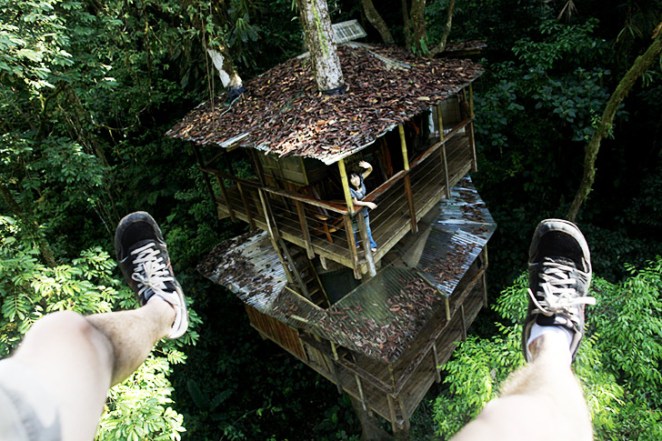
Finca Bella Vista
Where do Ewoks go when they're bored with Endor? Why, to Finca Bellavista village of course.


Bosco Verticale


sunken pedestrian bridge in the netherlands parts moat waters like moses

See the other three and vote for them here: Top 6 Green Architecture Stories of 2011 – Vote for Your Favorite! | Inhabitat – Green Design Will Save the World