
Superbowl Sunday is almost upon us, and the Superbowl ads are already being released. Volkswagen has released an ad that features a dog getting in shape for his sport. While it’s obviously meant in jest, in some ways it’s great because it arguably sends the message that anyone can train for their personal goals, whether it’s chasing cars (and vaulting through trees), fitting through the doggie door, or whatever.
What are your goals? I’m participating in a 5k on Saturday, but what physical movement and enrichment do you hope to accomplish over the weekend?
“Pop-up” park to fight the winter blues
Signs of spring are just starting to appear – birds are getting more active, tulips are just starting to show off green shoots – but even in my neck of the woods I know it’ll be awhile before spring is actually here. In New York, one group is fighting the gray and dark with an installed insta-park:

Welcome to New York City in winter, with a cure for cold-weather blues: a pop-up indoor park in lower Manhattan that’s open through Valentine’s Day.
Despite temperate temperatures so far this year, “it’s our rebellion against winter,” says Jonathan Daou, founder and CEO of Openhouse Gallery, a company that holds a 20-year lease on the space at 201 Mulberry St.
On a recent chilly weekday afternoon, babies played barefoot in the 75-degree world of Park Here while their mothers and fathers sipped tea, eating cookies and sandwiches.
One night, a movie is planned on the lawn; other days bring a ping pong competition, a trivia contest, wine tastings and soccer workshops.
The 5,000-square-foot artificial habitat in the downtown Nolita neighborhood is filled with trees, rocks, picnic benches and the recorded ambient sounds of Central Park in spring. There are giant cushions and even a hammock, plus a baby elephant.
But the park will be gone by mid-February.
The rest of the year, the 200-year-old former police precinct is a stage for business that plays on the “pop-up” retail method mushrooming around the world in recent years: a quick presentation of a product, performance or personality, with no commitment to a lease or contract.
It’s usually set up in a mobile unit that can be assembled and disappear.
Some call it guerrilla retail. “You’re not stuck with a 10-year lease if the product doesn’t sell,” Daou says. “People are looking for novelty, off the beaten path, and this space tests the ‘legs’ of a business concept.”
The space was part of a police precinct in the late 1890s under New York Police Commissioner Theodore Roosevelt, who later became U.S. president.
But there’s nothing historic about what’s going on inside. On the contrary, it’s all the rage in retail.
Read the full article: Winter ‘Pop-Up’ Park Debuts in New York
What a nice way to slough off that winter feeling and take a break and add some fun to your day. What is happening in your area that reminds you of spring?
Related articles
- NY Indoor Park a ‘Rebellion Against Winter’ (abcnews.go.com)
- NY indoor park a ‘rebellion against winter’ (seattletimes.nwsource.com)
- Park Here, An Indoor Pop-Up Park in New York City (laughingsquid.com)
- Weekend Miser: Weekend Miser: An Indoor Park and Mini-Golf in a Bar (nytimes.com)
- ‘Park Here’ NYC Pop-Up Offers Cold Weather Relief, Foodie Delights At Indoor Picnic (newyork.cbslocal.com)
Non-Elimination Games Leads to More Physically Active Children, Researchers Say | MomsTeam

Interesting article about the value of non-elimination games (the original author focused on “non-competitive” but there are many competitive games that don’t involve elimination):
A study presented in May 2008 established that the structuring of children’s games has a significant effect on energy expenditure.
A research team led by Karla Bruggeman and David Dzewaltowski, Ph.D., measured activity during both elimination- and non-elimination games, using accelerometers, in 29 children in grades four through six. Both normal weight and overweight children participated in the study, but were not separated for analysis.
In non-elimination games, kids accrued more overall physical activity due to not having to spend time on the sidelines as a result of elimination. They also accumulated significantly more moderate and vigorous physical activity than elimination games. Both sets of games were adopted from a children’s program devised by a nonprofit group that uses various pieces of equipment to facilitate non-competitive play; elimination games were modified from non-competitive versions.
Children were surveyed for self-efficacy, enjoyment, and peer victimization following both types of games. Results showed that enjoyment was somewhat higher following elimination games, although enjoyment scores were high in non-elimination games as well. There were no reports of peer victimization in either set of games, but were significant increases in self-efficacy after both sets.
“The games in this study were part of fun and enjoyable day camp,” Bruggeman said. “It is likely that a well organized and positive game experience increases a kid’s confidence regardless of elimination or non-elimination game conditions.”
Related articles
- Why Kids in Child Care Are Not Physically Active (scienceblog.com)
- Play Physical Activity Bingo! (expsychlab.com)
Urban rooftop farm expanding
A feel-good story from Inhabitat about communities getting together and creating something healthy and happiness-inducing:
As the world’s largest rooftop farm, Brooklyn Grange has been super busy for the last three years providing the local community with delicious fresh vegetables. While their 40,000 square foot space atop a warehouse in Long Island City has been enough to grow more than 40 different types of vegetables each year, Brooklyn Grange is in the process of expanding to a rooftop in the Brooklyn Navy Yard. The new food-producing plot is largerthan their current farm, and it is expected to be up and running by this summer.
…the Brooklyn Grange has added more photos of the new rooftop to their Facebook page, giving us a much better look at the space. The new rooftop is more than 45,000 square feet, which means that the world’s largest rooftop farm is more than doubling in size!
No doubt, the new location will let the Grange become highly involved in the immediate local neighborhoods, a characteristic of most organizations in the Navy Yard. The Grange farmers have mastered the art of urban rooftop agriculture, growing their organic produce in 7.5” deep beds with Rooflite soil, and we can’t wait until this massive rooftop is lush with produce!


Related articles
- New Farm! (brooklyngrangefarm.com)
- Farm the Rooftops (dirt.asla.org)
- Brooklyn Navy Yard Retail Construction Moves Forward (newyork.cbslocal.com)
It really is the journey rather than destination
 Nice interview from Salon with scientist Shimon Edelman about how scientists are discovering neural patterns to the behaviors and activities that make humans happy; turns out the act of learning is often more rewarding than what we learn:
Shimon Edelman, a cognitive expert and professor of psychology at Cornell University, offers some insight in “The Happiness of Pursuit: What Neuroscience Can Teach Us About the Good Life.” In his new book, Edelman walks the reader through the brain’s basic computational skills – its ability to compute information, perform statistical analysis and weigh value judgments in daily life – as a way to explain our relationship with happiness. Our capacity to retain memories and develop foresight allows us to plan for the future, says Edelman, by using a mental “personal space-time machine” that jumps between past, present and future. It’s through this process of motivation, perception, thinking, followed by motor movement, that we’re able not only to survive, but to feel happy. From Bayes’ theorem of probability to Shakespeare’s “Romeo and Juliet,” Edelman offers a range of references and allegories to explain why a changing, growing self, constantly shaped by new experiences, is happier than the satisfaction any end goal can give us. It turns out the rewards we get for learning and understanding the workings of the world really make it the journey, not the destination, that matters most.
Toys in space!
Toys are not only great for thinking outside the box with, they’re also great for thinking outside of our world! Two Canadian students recently sent a Lego man out to the edge of space:
Matthew Ho and Asad Muhammad used a weather balloon to carry a camera and a toy lego man high above the clouds.
(source: BBC News)
What the video here:

Related articles
- VIDEO: Child’s toy launched into space (bbc.co.uk)
- Teens Send Weather Balloon to Outer Space (Almost) (fox4kc.com)
- Kids Shoot LEGO Figure Into Space [Toys] (kotaku.com)
- Lego astronaut makes debut in space with the help Mathew Ho and Asad Muhammad (dailymail.co.uk)
Cute play fix: baby otter playing
Happy Thursday! To get you over the “week’s almost over” hump, here is an adorable baby otter doing what otters, and young critters in general, do best: play!
I like the playful human/otter interactions as well.
Swings for the home
This is so cool! Swings that you can install in your own home, designed specifically for grown-ups! Brought to you by Svvving.
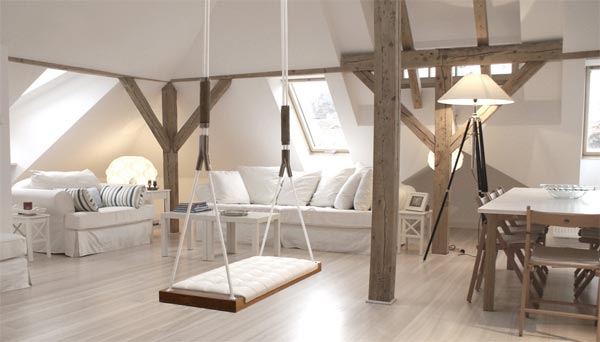

more at Swings for the home: 2modern.
I love the idea that a company makes swings for grown-ups to use indoors. Introducing play into your space is important, and for this company profitable. 🙂
Creating new designs through play, brain waves
Very cool video from B-Reel, Scandinavian furniture brand Varier and Oslo agency DIST Creative, on a project that involved creating fabric designs based on brain waves, specifically the brain waves of children playing and exploring:

Using some of the findings from its Mind Scalextricsexperiment, B-Reel used a headset to measure the brain waves of three children using Varier’s Balans chair. (The chair is designed to promote circulation and extended activity, which is claimed to leadi to better concentration and overall well-being).
It then used a custom built data visualization engine to turn the recordings into a pattern that could be printed as upholstery for the chair. As well as creating image patterns to reflect the changes in the children’s brain activities, the engine engine also used graphic presets corresponding to the children’s personal interests and took inspiration from patterns ranging from classic tapestries to pop-art and contemporary design.
Varier Furniture is featuring the project on its website as well as at international Furniture and Design Fairs.
Originally from Creativity Online, where you can also see the video.
Playing leads to lower Alzheimer’s risk

From USA Today:
People who engage in activities such as reading and playing games throughout their lives may be lowering levels of a protein in their brains that is linked to Alzheimer’s disease, a new study suggests.
Although whether the buildup of the protein, beta amyloid, causes Alzheimer’s disease is debatable, it is a hallmark of the condition, the researchers noted.
“Staying cognitively active over the lifetime may reduce the risk of Alzheimer’s by preventing the accumulation of Alzheimer’s-related pathology,” said study author Susan Landau, a research scientist at the Helen Wills Neuroscience Institute at the University of California, Berkeley.
“Some of the literature has hypothesized this finding, but this is the first study to report that lifetime cognitive activity is directly linked to amyloid deposition in the brain,” she said. “We think that cognitive activity is probably one of a variety of lifestyle practices — occupational, recreational and social activities — that may be important.”
Read more at Keeping brain sharp, active may ward off Alzheimer’s
There have been several different studies that find the correlation between play and a healthy brain less susceptible to dementia, disease, and overall decay. Literally use it or lose it. So you might as well have fun using it!
 Mental Flowers