architecture · behavior · culture · design · happiness · mental health · Social

New Office Designs in Seattle Trend Towards Open, Social Spaces

Most of us these days work in a cubicle, although the past ten years have really seen a transformation of space and place at the workplace in order to create happier, and therefore more productive, workers. This article in the NYTimes focused on some organizations in Seattle that have embraced a more open work floor plan:

Is this your idea of a perfect work environment?

MARTHA CHOE’S ideal working space is not her private office, nice though it is, but rather a long, narrow table in the vast atrium of the Bill & Melinda Gates Foundation headquarters here.

Ms. Choe, a former member of the City Council here, is the foundation’s chief administrative officer, and she had considerable input in the building’s design. One objective from the start was to give the 1,000 employees a variety of spaces to accommodate different kinds of work. “There’s a recognition that we work in different modes, and we’ve designed spaces to accommodate them,” she says. “I think one of the lessons is to understand your business, and understand what your people need to do their best work.”

The building was designed by NBBJ, a 700-employee architecture firm whose largest operation is in Seattle. The structure is a culmination of ideas about the 21st-century workplace that NBBJ has been exploring in corporate office designs worldwide, including its own offices here.

These are the main concepts: Buzz — conversational noise and commotion — is good. Private offices and expressions of hierarchy are of debatable value. Less space per worker may be inevitable for cost-effectiveness, but it can enhance the working environment, not degrade it. Daylight, lots of it, is indispensable. Chance encounters yield creative energy. And mobility is essential.

This isn’t a suddenly exploding trend. NBBJ’s research has found that two-thirds of American office space is now configured in some sort of open arrangement. But even as these designs save employers space and money, they can make office workers feel like so many cattle. So how to humanize the setting?

SEATTLE serves as a test tube because of several converging factors: There’s a lot of money here to experiment with projects. The work force is relatively young and open to innovation. And the local culture places a high value on informality, autonomy and egalitarianism. People will put in long hours under high pressure if they feel respected, but they won’t tolerate being treated like Dilberts.

Most office workers in Seattle and elsewhere labor in environments much less inspiring than Ms. Choe’s. And most employers have much less to spend to make things pleasant. (Bill and Melinda Gates personally contributed $350 million of the campus’s $500 million cost.) But staying competitive requires coming up with the best ideas, and the office environment can be the incubator for them.

Read the full article.

I am all for creating spaces that encourage collaboration and make workers feel comfortable and ready to get down to business. My only question is lack of meeting space. In my last two jobs it has been very hard to find private spaces to meet, although both were cubicle-based workspaces so that layout doesn’t necessarily solve things either. And I’m not alone in my concerns, as the article points out:

NOT all of NBBJ’s corporate clients have boarded the informality-and-buzz bandwagon. When the R.C. Hedreen Company, a real estate development firm based in Seattle, commissioned a renovation of a 10,800-square-foot floor in an old downtown office building five years ago, it specified a perimeter of private offices. Collaborative spaces are provided for creative teamwork, but the traditional offices remain the executives’ home ports.

“Individually, a lot of our workday is taken up with tasks that are better served by working alone in private offices,” says David Thyer, Hedreen’s president.

Susan Cain, author of “Quiet: The Power of Introverts in a World That Can’t Stop Talking,” is skeptical of open-office environments — for introverts and extroverts alike, though she says the first group suffers much more amid noise and bustle.

What are your thoughts on work space? Do you like having an open space to share, or do you prefer your own cubicle or booth? How do you handle the meeting privacy issues at your office? Leave your thoughts in the comments below.

architecture · children · community · design · play

UW professor and students help redesign International Children’s Park

A nice story about a redesign of a park in Seattle so children could actually, you know, play in it:

Located on the northeast corner of Seventh Avenue and South Lane streets in the Chinatown-International District, the park is small – about one-fifth of an acre — but in a key spot.

Vegetation had grown up around the periphery of the 30-year-old park, obscuring views and raising concerns about safety. There were few amenities for adults who bring kids to the park, and no accommodations for people with disabilities. A rock mound posed a hazard, and during the winter, the grass was often soggy.

Cultural and language differences were also part of the landscape, making decisions about the park complicated.

But renewal made sense because the neighborhood has seen increasing residential and commercial development, leading to  more active community places such as the Wing Luke Asian Museum and a branch of the Seattle Public Library.

To involve stakeholders young and old, Hou’s group, along with the city and several neighborhood groups, held an intergenerational design workshop in 2007.

“I think the most difficult challenge was to incorporate as much of the feedback we got from the community while still allowing the park to have a clear and concise design,” said student Patrick Keegan.

Engaging multiple generations of users was the most interesting part of the redesign, said Joyce Pisnanont, manager of IDEA Space, which promotes and develops the Chinatown­-International District. Desires were consistent across age groups, she said, and the adults “really wanted to ensure that the park was fun for kids to play in.”

The final design by landscape architect Karen Kiest includes an expanded children’s area with a play structure big enough for a dozen kids, a dragon sculpture restored by artist Gerard Tsutakawa, a stainless steel pagoda with seats for grown-ups and a three-level rockery that serves as both gathering space and a climbing area.

Public art by Stuart Nakamira includes a brushed stainless steel top the size of a typical 4-year-old.

In a Lane Street corner, pink viburnum are budding, surrounded by circles of black mondo grass.

See more images of the park:

Kids play in the redesigned park.


anthropology · architecture · community · creativity · culture · design · environment · happiness · Social

How legalizing street art made Rio de Janeiro a prettier, happier place

A recent article in the Huffington Post explored Rio de Janeiro’s acceptance of street art and how it has enriched the various neighborhoods:

Brazilian graffiti art is considered among the most significant strand[s] of a global urban art movement, and its diversity defies the increasing homogeneity of world graffiti.” – Design Week

In March 2009, the Brazilian government passed law 706/07 making street art and graffiti legal if done with the consent of building owners. As progressive of a policy as this may sound, the legislation is actually a reflection of the evolving landscape in Brazilian street art, an emerging and divergent movement in the global street art landscape.

Rio de Janeiro has been particularly progressive in its policy towards street art, with its 1999 “Não pixe, grafite” (Don’t Tag, Graffiti) project that brought together 35 graffiti artists to showcase diversity in local styles. But more unique is the evolution of a permission hierarchy, blurring the line between formal and informal. The new street art law merely reinforced these unique patterns of street art and legitimized an already flourishing form of artistic expression.

Retaining walls on the steep terrain provide canvases for artists.

In Rio de Janeiro, street art is ubiquitous. It exists in all corners of the city, from the favelasto upper class neighborhoods, from residential to institutional. It is bold in scale and aesthetics and is anything but graffiti. The urban fabric of Rio de Janeiro also figures prominently in the evolving street art scene. The high walls, whether for security or to contain the topography, provide ample surfaces for painting. But rather than location dictating art, the relationship between owner and artist has a direct impact on where street art occurs.

Owners of buildings, both residential and commercial, sometimes invite artists for commissions, which is done to protect from tagging, as an aesthetic choice or as an economic choice — painting a façade with art may be cheaper than another mode of beautification. In another case, street artists ask permission from the owner.

Tudo de cor para você, Santa Marta, Rio de Janeiro (photo source: favelapainting.com)

Thanks to the city’s openness to various forms of artwork, and specifically “street” art, Rio de Janeiro is now known for its colorfulness and art. In informal studies the art has also been found to make citizens more invested in their communities and overall happier.

Hooray for public art.

anthropology · behavior · community · environment · happiness · Nature · psychology · technology

Mappiness: Mapping Happiness

A shot of the app.

From the blog How Do you Landscape; a group from the UK has created an app that can be used to measure our happiness based on our surroundings, and using maps to look at the data:

“People feel better outside than inside”. “People feel better in the park/woods/nature than in the city”. These are some of the conclusions from a project with the telling title ‘Mappiness’ Good news for landscape and Landscape Architecture on first sight. But are these only one-liners or firmly based scientific statements? Well, that depends on the quality of the empirical evidence of course. Most experience sample methods (ESM) have a hard time getting a representative group (in the end almost only colleagues) that has to struggle trough tedious interview forms (“it will take only twenty minutes”) to step-by-step end up with modest results. How about a sample group of 47.331 people (and growing by the day) who willingly support their data three times a day to the researchers that by now collected over three million forms in a few months? I stumbled upon these remarkable Experience research feats in a TedxBrighton 2011. In this “Twenty minutes lectureGeorge MacKerron explains why and how he and Susana Mourato (both from the Department of Geography & Environment at the London School of Economics and Political Science) created ‘mappiness’. They want to better understand how people’s feelings are affected by features of their current environment. Things like air pollution, noise, and green spaces influence your well being is their hypothesis.

This is how it works. They developed an app that can be downloaded for free. It must be one of the most irritating apps around on the web because it rings you (with your approval, you can influence the settings) three times a day to ask you three simple questions.

When put through a big regression model they can gauge the happiness as the function of habitat type, activity, companionship, weather conditions (there is of course a link between meteorological data and the GPS data), daylight conditions, location type (in, out, home, work, etc), ambient noise level, time of the day, response speed, and individual ‘fixed-effects’ (that come out of your personal Mappiness-history). Factors can be plotted out against each other.

How awesome is that? What a neat piece of technology to measure our surroundings and how they influence us!

community · creativity · Social

Storefront Seattle: taking art to the street (window)

Before and After example of Storefronts Seattle project.

With the down economy a lot of stores and businesses have gone out of business, leaving a lot of empty store fronts, at least in places around Seattle. But rather than let those places stay dark and dormant, one woman is spearheading an effort to get local Seattle artist’s work installed in these vacant storefronts:

Storefronts debuted in late 2010 as an experiment in activating vacant spaces with art, creative enterprise, and performance… We also revitalize neighborhoods. And we beautify blocks. And we make areas safer at night, and we market real estate, and we paint walls and mop floors and install lighting and turn desolate half-empty blocks into the hippest, happiest, and hottest real estate in town.

Storefronts Seattle leases storefront space from neighborhood property owners for the nominal rate of $1 per month. We can program up to 15 storefronts in any given neighborhood at any given time, and we fill these spaces with art installations, with creative businesses, and with artist’s studios. These projects are proposed by artists throughout the region, and are chosen by a panel that includes neighborhood representatives, local museum curators, arts professionals, and our programming staff.

At full integration into a neighborhood, Storefronts Seattle is programming up to 60 arts installations per year into your spaces. That’s enough to instantly turn any neighborhood into a walking destination, an arts and culture destination, and a shopping destination. It’s enough to generate regional press. It’s enough to get the city’s creative class and cultural leaders to pay attention.

More at Storefronts Seattle

This is a great project where everyone benefits: property managers get free positive attention for their site, artists get their work exposed, and normal people get to benefit from the art for free!

It also involves a lot of local Seattle neighborhood organizations, bringing attention and buy-in from various communities around Seattle. There are quite a few installations in place right now through May.

What a great opportunity to improve and enrich everyone’s environment. Know of other groups out there taking advantage of empty spaces like these in other cities? Share them in the comments below!

culture · environment · health · Nature

‘Food forest’ in middle of Seattle will feature an urban view

Woman shopping for vegetable starts at Seattle...
Soon Seattle-ites will be able to harvest their own veggies from a large community "forest." Image via Wikipedia

Sorry it has been so long since my last post. I don’t have long, but I had to stop and share in more detail this great story about an urban food forest being proposed for a Seattle neighborhood:

A plot of grass sits in the middle of Seattle, feet from a busy road and on a hill that overlooks the city’s skyline. But it’s no ordinary patch of green. Residents hope it will become one of the country’s largest “food forests.”

The Beacon Hill park, which will start at 2 acres and grow to 7, will offer city dwellers a chance to pick apples, plums and other crops right from the branch.

“I think it’s a great opportunity for the people of Seattle to be able to connect to the environment,” said Maureen Erbe, who walked her two dogs next to the plot on a recent overcast day.

Would she pluck some fruit from the forest?

“Heck yes, I love a good blueberry. You’re not from Seattle if you don’t like a good blueberry,” she said.

For health-conscious and locally grown-food-loving Seattle, the park is a new step into urban agriculture. Cities from Portland to Syracuse, N.Y., already have their own versions. In Syracuse, for example, vacant lots were turned into vegetable gardens to be tended by local teens.

Seattle is an awesome place to have an urban garden. People already replace the little strips of grass between the sidewalk and the street with gardens, and in the summer Seattle is practically overrun with feral blackberry bushes and other fruit.

This is also a great way to improve your environment and make it just a little bit healthier and happier.

This idea has been getting a lot of attention in the media (see related links below), and I hope it will inspire other cities to do the same. Even in cities where it doesn’t rain allll the time, it is more than possible to create spaces for people to garden or for crops to grow feral and let nature take its course.

behavior · brain · children · culture · education · learning · mental health · play · technology

Toddlers to tweens: relearning how to play

Español: Guiliana moreno Jugando en bogota
Free play is finally getting the recognition it deserves. Image via Wikipedia

Great article from the Christian Science Monitor about the value of play:

In recent years, child development experts, parents, and scientists have been sounding an increasingly urgent alarm about the decreasing amount of time that children – and adults, for that matter – spend playing. A combination of social forces, from a No Child Left Behind focus on test scores to the push for children to get ahead with programmed extracurricular activities, leaves less time for the roughhousing, fantasizing, and pretend worlds advocates say are crucial for development.

Meanwhile, technology and a wide-scale change in toys have shifted what happens when children do engage in leisure activity, in a way many experts say undermines long-term emotional and intellectual abilities. An 8-year-old today, for instance, is more likely to be playing with a toy that has a computer chip, or attending a tightly supervised soccer practice, than making up an imaginary game with friends in the backyard or street.

But play is making a comeback. Bolstered by a growing body of scientific research detailing the cognitive benefits of different types of play, parents such as Taylor are pressuring school administrations to bring back recess and are fighting against a trend to move standardized testing and increased academic instruction to kindergarten.

more at: Toddlers to tweens: relearning how to play.

architecture · children · creativity · design · play

Playground Crochet by Toshiko Horiuchi

This is from last November, but still amazing!

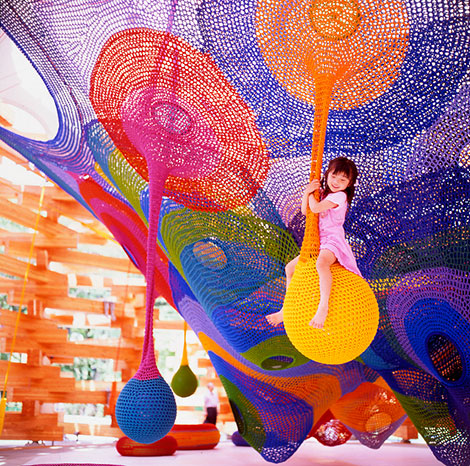
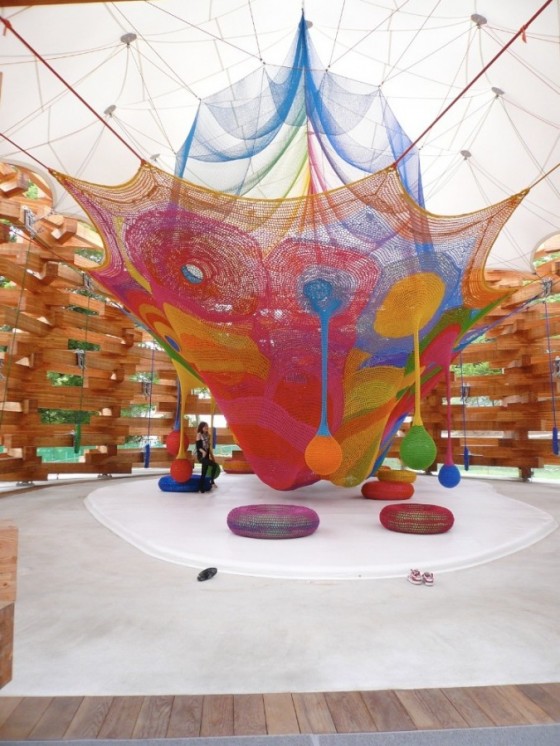
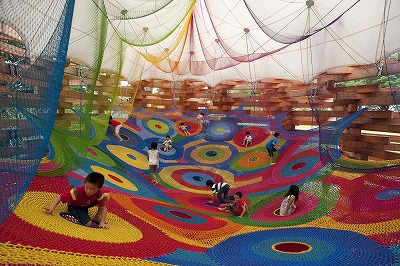
Toshiko Horiuchi MacAdam, who orders yarn by the ton for her creations, is the textile artist behind the oft photographed net constructions at the Hakone sculpture park in Sapporo Japan.

I love the story of how she came to be engaged with children’s play:  “It all happened quite by accident. Two children had entered the gallery where she was exhibiting ‘Multiple Hammock No. 1’ and, blissfully unaware of the usual polite protocols that govern the display of fine art, asked to use it. She watched nervously as they climbed into the structure, but then was thrilled to find that the work suddenly came alive in ways she had never really anticipated. She noticed that the fabric took on new life – swinging and stretching with the weight of the small bodies, forming pouches and other unexpected transformations, and above all there were the sounds of the undisguised delight of children exploring a new play space.”

From that point, her work shifted out of the gallery and a subdued, monochromatic pallet into a riotous rainbow of colors for children’s playscapes.

Rainbow Net was produced in close collaboration with structural engineers TIS & Partners and landscape architects Takano Landscape Planning and opened in July of 2000 after three years of planning, testing, and building.

Note that the project began with a brief not for a playground, but simply for ‘public art‘.   Wouldn’t it be great if when we heard ‘public art’ we automatically thought ‘play’?

But innovative playscapes require an enormous commitment: “…endless cycles of discussion and approval, with meticulous attention to detail…[including] an actual scale wooden replica of the space in Horiuchi’s studio and accurately scaled crocheted nets using fine cotton thread. Even then, it was difficult to assess many things. What difference, for instance, would the weight of the real yarn make when everything increased in scale? All of these factors had to be calculated in order to arrive at a scientific methodology that could eradicate any risk of unacceptable danger.”During final assembly, Toshiko crocheted ten hours a day, often on her knees, until the installation was complete.”

With the current revival of the textile arts and yarn bombings everywhere, I’d love to see more crochet on the playground!

More at: Playground Crochet by Toshiko Horiuchi.

What an amazing use of fabric to create an original, creative play space.

behavior · brain · cognition · health · play

Make your cells cleaner by exercising

Cells stained for keratin and DNA: such parts ...
For cleaner cells, work up a sweat. Image via Wikipedia

We joke about getting the cobwebs out of our brain, but it turns out there really is some truth to that. And one of the best ways to give our bodies a thorough spring (or winter, or fall…) cleaning, is not through cleansing diets or saunas, but exercise! It’s beneficial on so many levels, including making you cleaner and a better environment for yourself down to the cellular level!

In the new research, which was published last month in Nature, scientists at the University of Texas Southwestern Medical Center in Dallas gathered two groups of mice. One set was normal, with a finely tuned cellular scrubbing system. The other had been bred to have a blunted cleaning system.

It’s long been known that cells accumulate flotsam from the wear and tear of everyday living. Broken or misshapen proteins, shreds of cellular membranes, invasive viruses or bacteria, and worn-out, broken-down cellular components, like aged mitochondria, the tiny organelles within cells that produce energy, form a kind of trash heap inside the cell.

In most instances, cells diligently sweep away this debris. They even recycle it for fuel. Through a process with the expressive name of autophagy, or “self-eating,” cells create specialized membranes that engulf junk in the cell’s cytoplasm and carry it to a part of the cell known as the lysosome, where the trash is broken apart and then burned by the cell for energy.

Without this efficient system, cells could become choked with trash and malfunction or die. In recent years, some scientists have begun to suspect that faulty autophagy mechanisms contribute to the development of a range of diseases, including diabetes, muscular dystrophy, Alzheimer’s and cancer. The slowing of autophagy as we reach middle age is also believed to play a role in aging.

Read the full article at the New York Times: Exercise as Housecleaning for the Body

The best part is it doesn’t seem to matter what kind of exercise, so anything from hop scotch to marathons will give you some benefit!

autism · behavior · children · health · Social

Dogs trained to help disabled kids lead more enriching lives

Your feel good story of the day, brought to you by the New York Times: a nonprofit organization trains dogs to help kids with all kinds of disorders, from autism to muscular dystrophy to seizures.

In October 1998, Shirk assembled a board and founded 4 Paws for Ability, a nonprofit corporation. She rescued Butler, a German shepherd mix, from a shelter; hired a trainer to prepare him for mobility work with the 12-year-old; and became a pioneer among service-dog agencies. “People started calling from all over to ask, Am I too young? Am I too old? Am I too disabled? Am I disabled enough?” she says. “I said, ‘If your life can be improved by a dog, and if you and your family can take good care of a dog, we’re going to give you a dog.’…” “We place dogs with kids in wheelchairs, kids on ventilators, kids with autism, kids with dwarfism, kids with seizure disorder and cognitive impairments; but if your dog does tricks, other kids want to meet you. Kids will ignore your disability if you’ve got a cool dog.”

Watch the video at the New York Times:

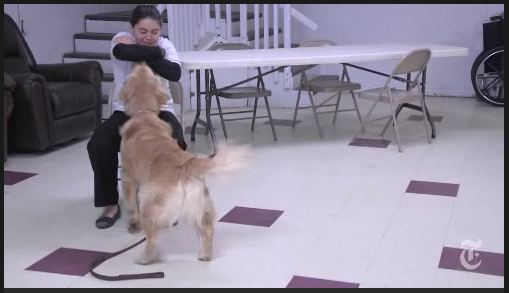
A trainer works with a dog on behavior modification techniques. Click the image to see the video.

It is also an amazing relationship dynamic to see occur between the children and their dogs, how the children with cognitive disabilities in particular are helped to see the world, in a way, through their dog’s eyes:

Alan M. Beck, the director of the Center for the Human-Animal Bond at Purdue University’s College of Veterinary Medicine, is among those intrigued by it. “There is a real bond between children and animals,” he told me. “The younger the child, the greater the suspension of disbelief about what an animal understands or doesn’t understand.” According to Beck, more than 70 percent of children confide in their dogs, and 48 percent of adults do. “The absolutely nonjudgmental responses from animals are especially important to children,” he says. “If your child with F.A.S.D. starts to misbehave, your face may show disapproval, but the dog doesn’t show disapproval. The performance anxiety this child may feel all the time is absent when he’s with his dog. Suddenly he’s relaxed, he’s with a peer who doesn’t criticize him.”