play · youtube

Elk Puddle Hopping

Happy mid-week! Since cute things are supposed to help you concentrate, here is a cute elk calf playing in a puddle. (I’m pretty sure I already posted this about a year ago, but it’s worth it to see it again!). You’re welcome.

architecture · community · culture · happiness · work

Does Not Having an Office Make You a Happier Worker?

Office Space
Office Space (Photo credit: steve-and-diane)

I read an article yesterday about “the next big thing” in office space. According to Uday Dandavate, the CEO of SonicRim, the next “megatrend” is going to be no office space:

Large working complexes will be pyramids for dead people. I’m not making a judgment. I am just observing. They are fading symbols of an era that is soon going to be a bygone era.The ideal environment is where people don’t have to go to a workplace. The workplace is distributed in the community.
Companies won’t be building offices; they will be building communities and nice places to work in those communities. It’s a fallacy that people want to stay at home to work. In a given moment they want to work where they would be most productive, or relaxed, in the kind of mindset they need to be in. We need to get away from constructing buildings that have flexibility to creating work environments that can evolve.

There needs to be a complex assessment of different moments at work. Recently we finished a global study on auto interiors for Johnson Controls. When you sit inside your car there are different moments that have different states of mind, going to work or coming home. Sometimes people want to feel their car is their home. At times people want the car to feel like a workplace. Take the same concept and apply it to architecture and work places. For any productive activity, not just working but cooking, reading, writing a letter, there is always a most conducive environment.

More at: The Registry SF

While Dandavate believes that the workers will be dispersed throughout the community, I’m not sure I entirely buy the idea that the central office space or main corporate headquarters is going to disappear. The emphasis on having everyone in one space my diminish, but there are a lot of reasons why having a central space sanctioned as “for work” is important.
To name a few:

  • Working parents who need a space away from family distractions, like screaming children and biting puppies. Or heck, noisy roommates for that matter.
  • People for whom going to the local library or coffee shop every day. This isn’t an option for a lot of people, even those living in big cities.
  • People who work very collaboratively and need real-time input, and face time in order to accomplish their work.
  • People who need more space to work than the kitchen table or their tiny apartment walls can provide.
  • Those who just need the peer pressure of others working around them to push through a hard deadline.
  • Extraverts!

Dandavate mentions a sense of identity for workers with the company that doesn’t require a tangible, geographical locale. I agree with his assessment that people don’t need a geographic place to congregate at to form a bond with coworkers or identify with a company, but they sure want one. Microsoft has a huge annual gathering of its employees in or near their homebase in Redmond, that most employees working from afar get really excited about. Traceurs (people who train parkour) will make pilgrimages to a small park outside of Paris simply because one of the sport’s founders filmed a video there. Elvis fans have Graceland.

Workers are also becoming more vocal about work vs. home life, and for many it is unappealing to have your work at home or not be able to leave it somewhere else (even places like Office Nomads you have to bring most of your stuff home with you).

Maybe I’m totally off-base, but while I think the workplace will become more flexible, we will always have the “homebase/headquarters” office buildings.
Disagree? Leave your thoughts in the comments below.

anthropology · architecture · behavior · community

Parkour and Preserving Playful Spaces

People who practice parkour, called traceurs or tracers, often get a bad rap by city officials, saying they are disturbing or damaging public property. But in fact, often traceurs are some of the most vocal activists for preserving and protecting their environments. Take this story from The Atlantic, for example:

On warm days, when office-tower émigrés can enjoy their lunches next to its calming water features, Calgary’s Century Gardens Park serves as a popular daytime downtown retreat.

But at 38 years-old, the Brutalist public space is starting to show its age. The color of its odd concrete features has faded to a dreary ash, the foliage is overgrown, and the water pumps are failing. Angular slabs create both barriers to pedestrian access and places for miscreants to hide—city park staff complain of finding evidence of overnight drinking and drug use.

The city is itching to overhaul Century Gardens, though how much of the park might survive the process remains to be seen. Early proposals range from sprucing up the existing park and keeping it mostly intact to completely razing it and building a new park from scratch. The park’s age and need for refurbishment has given the city the opportunity to address its magnetism for social disorder, as well as apply a more contemporary approach to urban design.In the meantime Calgary’s parkour community—for whom the park’s structures are perfectly suited—have allied themselves with a local heritage group to try to save it.”Century Gardens is one of the coolest locations around for parkour. Not just in Calgary, but Canada-wide, and internationally,” says Steve Nagy, editor of the Calgary-based parkour magazine Breathe and co-owner of a local parkour gym. The Netherlands-based MunkiMotion parkour group also included it in their YouTube series, “Best Parkour Spots in the World”

more via The Calgary Park Thats United Historic Preservationists and Parkour Athletes – Brandon Beasley – The Atlantic Cities.

This group of traceurs is banding together with a preservationist group in Calgary to save the park. It’s a great example of two seemingly incompatible groups joining forces to preserve an urban space.

I think this kind of collaboration can and should be done more often.

In many peoples’ eyes these older parks, structures, or abandoned lots are just seen as wasted space, or maybe even dangerous, and certainly many old playgrounds don’t meet current safety codes. But for traceurs, or any adults that likes to climb or jump around, these spaces offer endless playful opportunities. I believe traceurs are some of the best urban playground spotters, and they know a good playground or playful space when they see it. Preserving or adjusting these spaces, rather than tearing them down and starting from scratch, is a viable alternative that can appease all parties involved.

I am glad The Atlantic is looking at this challenge over balancing use of space by different groups in urban environments.

Juliet Vong, President of HBB Landscape Architecture, Tyson Cecka, Executive Director of Parkour Visions, and I proposed a session about this topic for the annual meeting for the American Society of Landscape Architects. Sadly, it was turned down, I believe primarily because we didn’t explain what parkour was well enough to the panel. Hopefully next year we’ll be accepted, because I STILL think this is an important topic that needs to be explored more, and we are happy to come chat about it with your school, company, or conference. Just ping me. 🙂

behavior · creativity · play · psychology · work

How Play Makes You A Better Adult

I Watch them watch them play the game Then I w...
Adults at play. (Photo credit: Wikipedia)

Happy Friday. The weather is turning beautiful in many places around the U.S., with lots of sun. In fact one school in Washington gave kids the day off so they could go out and play. Some places get snow days, the principal figured, so why not a sun day? Perfect reasoning to me.

Unfortunately a lot of adults don’t take these opportunities to go out and play, thinking it’s a “waste” of their time. But, as I constantly argue on this blog, play is vital for healthy grown-ups too.

Erika Andersen explores the intersection between work and play for grown-ups, and how play makes us better grown-ups.

Sadly, by the time most of us reach our teens, play has been replaced as our primary learning mode by competition, memorization, practice and recitation – otherwise known as “sports” and “school.”  And we come to think of play as something we do when there’s nothing more urgent to be done – as time stolen from more critical things. However, the elements that make play such a great way to learn when we’re kids still work for us when we’re adults.  The happiest and most creative adults I know regularly bring play into their lives as a way to stretch, evolve, innovate and – this is important – enjoy.  Here’s a great example – two guys named Jay Silver and Eric Rosenbaum have created a kit called MaKey MaKey, that allows you to control any electronic device using household objects.

…When you play, you’re making up the world.  You’re saying, “Let’s imagine that…”  or “Why don’t we…?”  or “What if….?” And that’s where freshness, learning and innovation live.

Full article at: How Play Can Make You a Better Grown-up | Forbes

Andersen offers up some ideas on how to be more playful as a grown-up, although as she points out the whole point of being playful is to think outside the box, so just think of these as starting places:

Be the littlest kid.  You know how when kids play, the littler kids usually follow the older kids’ lead?  When you play with actual kids, let them call the shots, rather than you, adult-like, defining the play.  You’ll get drawn into wonderful worlds you would never have considered.

Declare a no win-zone.  Occasionally, when trying someone new, agree with yourself that the goal isn’t to ‘get good at it’ or ‘be better at this than so-and-so’ – but rather ‘to look like a fool’ or ‘have as much fun as possible.’ Remember what Bettelheim says about play including “the absence of any goals outside the activity itself.”

Lose the watch.  Little kids have no sense of time.  When they’re engrossed in something, hours could pass and they’d never know it. Try moving all your time-based commitments out of a day (or at least part of a day), and give yourself permission to do whatever you want for as long as you want.  Get fascinated about your choices.

Bring play to work.  Sometime during the next week, approach a work problem through the rules of play, that is “characterized by freedom from all but personally imposed rules (which are changed at will).”  Start thinking about it by asking “What if we didn’t have any constraints – how would we think about this?”  If you really get into that “play” mindset, you just might come up with a crazy notion that contains the germ of greatness.

anthropology · behavior · community · creativity · culture · mental health · play

Offices move towards more playful space design, but what kind of play is best for workspace environments?

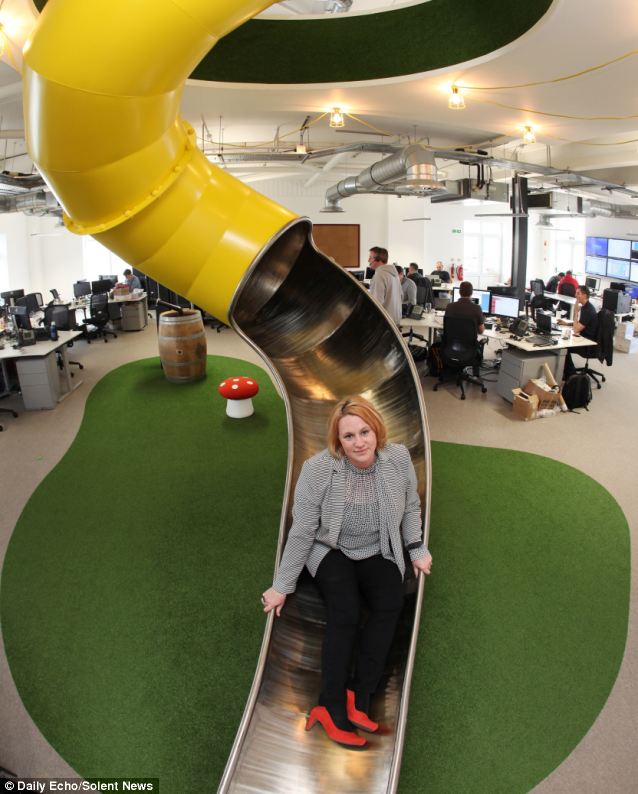
More and more office spaces are trying to become more playful, offering employees a way to destress and/or get more creative. Usually that takes the form of having ping pong tables or video game consoles set up for breaks, but more and more offices are adding slides, swing sets, picnic tables, or other more active and engaging apparatus. They are also bringing in more greenery for workers.

This office may be the most fun in Britain as it comes kitted out with a giant helter skelter slide, a tree house and even a pub.

The unique workplace also boasts a pool table, a putting green, a giant swing and a cinema.

Office designers Space & Solutions were tasked with turning a former pub in Southampton into the home for IT company, Peer 1 Hosting.

‘If you don’t feel comfortable sitting at a desk you can sit on a picnic bench. The reality is that you can do your work from anywhere.’

Read more: UK Daily Mail

The article points out that some people may find all this fun a little distracting to actually work around. Some kinds of play are probably great at cutting stress but may be more of a time suck than creativity inducer. I’m curious what readers think. Are you one of those people who does their best work sitting on a couch, or heck, a swing? Do you prefer quiet and focus without any noise? Do you have a toy or plant on your desk you fiddle with when you’re trying to think or just need to destress?

Another question; do you actually use the toys and playful apparatus in the office? The office I currently work in has a ping pong and air hockey table, but only two people ever use the ping pong table, and I have only seen the air hockey table turned on once for a promo video.

Leave your thoughts in the comments below.

architecture · community · creativity · disease

Adding art to Belltown, Seattle

This is an ongoing project in Seattle of sprucing up vacant office or retail space with art. It’s a plus for the artists, the building managers since it brings attention to their space, and the passersby who are charging to and from work or tourists who stop and linger a little bit longer to view. Always love seeing updates on new projects by this group.

storefrontsseattle's avatarStorefronts

Storefronts Seattle is proud to announce the first two of three projects in the Belltown neighborhood!

Ingrid Lahti
One Pacific Tower, 2006 First Avenue, Belltown
Through June 2013

IMG_3742

Ingrid Lahti traditionally works in neon, but has branched out into illuminated lighting gels in her new installation at First and Virginia.  Inspired by the saturated color in Matisse paintings and Chinese artwork, Ingrid views the illuminated window pieces as a study on the emotional effects of color and light, fitting seamlessly into the vibrant neighborhood in Belltown.  

These installations glow brightly at night, adding to the street-level nightlife of Belltown and kicking off a summer in Seattle with a burst of color.

Chris Papa
2505 Second Avenue
Through June 2013

IMG_0059

Chris Papa, a local printmaker and sculptor, has installed 5 sculptures at Second and Wall, featuring playful sewn wood sculptures conflating art, craft, and architecture.   Interested in the…

View original post 86 more words

community · creativity · environment

Creating Open & Collaborative Cultures through Play

A really great look at playfulness in a corporate environment.

annemariesteen's avatarAnnemarie Steen

worrySince 2004 IBM conducts every two years a Global CEO Survey among global business and public sector leaders to research what keeps them busy (at night in bed). The survey consists of in-person interviews with (in 2012) over 1700 CEO’s worldwide.

More than half of all CEO’s see Human Capital, Customer Relationships and Innovation as key sources of sustained economic value (report 2012).

The findings (2010 & 2012) show a fast growing need for some critical capabilities of employees, in order to deal with the complexity of operating in an increasingly volatile and uncertain world. These include; creativity and creative leadership, collaborativeness, connectedness, communication and flexibility.

To foster these capabilities “CEO’s are creating more Open & Collaborative cultures – encouraging employees to connect, learn from each other and thrive in a world of rapid change. The emphasis on Openness is even higher among Outperforming organizations(*) – and they have the changemanagement-capabilities to make it…

View original post 220 more words

environment · Nature

Quantification of how urban green spaces deliver big happiness boost

There have been studies that have found a correlation between nature and calming, relaxation, and an ability to concentrate. But is this effect quantifiable? And how much of an impact is there?

A lot, according to a new study in Psychological Science. The researchers estimate that green urban areas provide a life satisfaction boost roughly equivalent to one-fifth to one-quarter of the increase associated with being married or having a job.

Several studies have suggested that people living near green spaces are less anxious and depressed. But these studies generally don’t account for the possible effects of personality. For example, perhaps more upbeat people tend to live in greener places.

To avoid that problem, the study authors analyzed survey data from more than 10,000 people in the UK over an 18-year period, noting changes in the participants’ well-being and health as they moved from place to place. That way, the researchers could compare happiness in the same person while living in a green and not-so-green area. The team also controlled for factors such as crime rates, income level, and the type of housing.

More at Conservation Magazine.

behavior · community · happiness · Social

Seattle City Hall is at least thinking about happiness, even if haphazardly

Seattle: Christmas Cookie Edition
What about Seattle as a cookie? Cookies make people happy.

I read this article in Seattle’s The Stranger: Can City Government Make Us Happy?

The authror of the article was pretty snarky about the whole process, and I admit it’s not the best thought-out initiative, but my first thought was, “at least they’re interested and trying.”

I actually thought the task force (let’s call it that since the town hall meeting was fairly limited in public representation) had some pretty interesting insights:

“The last four days, we were out on the streets asking, ‘What makes people happy?'” explained Laura Musikanski of Seattle’s Happiness Initiative, which was tasked with surveying Seattle’s happiness levels in 2011 (spoiler: Poor people are less happy). Behind the panelists sat a wall of sticky notes with the answers to that question, including sex, fish, power, free parking, corn, and sun.
“A lot of people said water—they love the rain,” added Mario Chamorro of Make It Happy. “People in Seattle are waterproof!”

I don’t know if people meant rain when they said water – Seattle is also surrounded on multiple sides by lake or sound – but maybe they did mean rain. Who knows, we might just be that crazy. But rather than critique their methodology, I would like to applaud the city of Seattle, a city that is shrouded in damp, dark, and gray for most of the year, for at least starting to tackle this question.

I’m curious if anything will come of this, or if they’ve burned all their happy budget on the Make It Happy team from New York. If this is in fact ongoing, I might suggest having your next Happy Team meeting in the sun. It was one of the things on your list that makes people happy, after all. And maybe offer some fish and corn. 🙂

behavior

Play anywhere, with anything

A boy slides down a metal beam in Manila, Philippines, on April 23.
According to new census data, the Philippines has failed to make headway in cutting rampant poverty, with more than one in four citizens deemed poor despite the country’s economic growth. However, seeing children play is a good sign for the country’s overall well being of its citizens, since play tends not to occur unless all essential needs have been met (food, shelter, safety).