
What a great online resource showing the both short and long-term benefits of nature.

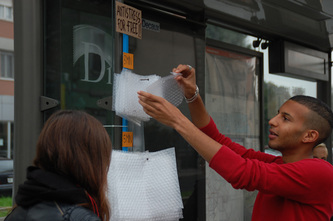
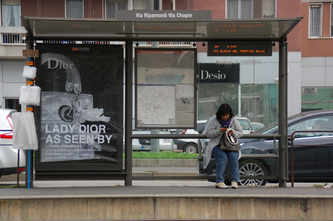
antistressforfree: Street Art by Fra Biancoshock

Tiny superheroes combat big challenges with capes made by Seattle mom | Local News | The Seattle Times

Have you ever had days where you felt you had super powers, or felt you needed them? One woman in Seattle is making that a reality for over 1,700 kids with illnesses and disabilities in 50 states and 14 countries, with a new workshop opening to help out more kids:
Gabby has epilepsy and is completely dependent: She cannot talk, walk or eat on her own. But she is a tiny superhero — her superpowers include perseverance, courage and strength — and she has the cape to prove it. A purple number, with a blue letter “G” hand-sewn on by Robyn Rosenberger.
Rosenberger is the powerhouse behind TinySuperheroes, which makes capes as a form of empowerment. “Our mission is to empower these kids to feel as extraordinary as we see they are,” Rosenberger explained.
On the surface this may seem a little fluffy, but it exemplifies the power of play, particularly imaginary play and pretending. First, it gives the kids a chance to take a break from their illness and maybe laugh a little, which is good for everyone. Second, the crazy thing is researchers are finding that by pretending to be big, strong, dominant, and super-hero-esque, it can train your body to actually be more strong, dominant, and super-hero-esque. Even healthy kids can feel pretty powerless, so by imagining what it feels like to be strong and healthy it can help their minds and bodies map out what that might look and feel like and maybe even help along the road the recovery.
So by giving these kids superhero capes, these volunteers are in fact giving these kids some pretty strong medicine.
Now I want a cape, or at least a magic wand.
If you are interested in helping out, visit the Tiny Superheroes site.
Related articles
- Tiny superheroes combat big challenges with capes made by Seattle mom (seattletimes.com)
- Seattle mom turns kids into tiny superheroes (q13fox.com)
- Robyn Rosenberger Makes Superhero Dreams Come True for Sick Children (people.com)
Park by Swarm
Yes! Community-based park building. 🙂
Social Networks Can’t Replace Real Human Interaction
Virtual space, including friendships there, does not fully replace that real live human interaction we get in real world spaces. More and more studies are finding this out, and people are reacting to it, often on social media.
graphic designer Shimi Cohen, based in Tel Aviv, has provided “a fresh and subtly soul-wrenching reminder of the way our screens can become cells of solitary confinement.”
The animation was Cohen’s senior project at Shenkar College of Engineering and Design. Based in part on MIT professor Sherry Turkle’s book Alone Together and Yair Amichai-Hamburger’s article “The Invention of Being Lonely,” inspiration also came from a personal place. “Like many others,” Cohen tells Co.Design, “I became addicted to socializing through my phone and social media. This started to bother me and intrigue me at the same time.”
Discovered at Co.Design.
This is a wonderful and simple reminder to get off the computer from time to time and actually go interact outside with real people.
Related articles
- The Innovation of Loneliness: short film based on Sherry Turkle book ‘Alone Together’ (boingboing.net)
- The Innovation of Loneliness from Shimi Cohen (theradicaluprise.wordpress.com)
- New Animation Explains Sherry Turkle’s Theories on Why Social Media Makes Us Lonely (openculture.com)
- Do Social Networks Make Us More Lonely? (mediabistro.com)
- Social Networking: Making the World a Lonelier Place Every Day (ucsc.uloop.com)
Why adult hospitals should be more like children’s hospitals – FierceHealthcare

It’s not as silly as it sounds; in fact it’s genius!
Hospitals could improve patients’ quality of life, satisfaction and even health outcomes if they simply model adult hospitals after the ones designed for children, according to an opinion piece written by a fourth-year medical student in this week’s Journal of the American Medical Association.
Mark A. Attiah, who attends Perelman School of Medicine at the University of Pennsylvania in Philadelphia, writes in the piece, “Treat Me Like a Child,” that adult hospitals should take a page from pediatric facilities by creating surroundings that distract and reduce stress and making clinical practices more patient- and family-oriented rather than more convenient for caretakers.
Attiah was inspired to write the opinion piece after encounters with two pediatric patients during a rotation and another who transitioned into an adult hospital, according to an announcement about the editorial. The children’s hospital was bright, had longer visiting hours and allowed families to stay at the child’s bedside throughout the night. In addition, pediatric patients enjoyed the distractions of group activities, arts and crafts, and concerts. “If I ever get sick, I’d want to be taken here,” he writes.
more via Why adult hospitals should be more like children’s hospitals – FierceHealthcare.
Kid’s hospitals keep stuff light, upbeat, and optimistic. which is exactly what we need to get healthier, and want to go back to a particular hospital for our next ailment, since most hospitals care about that sort of thing.
Related articles
- What can hospitals learn from pediatric institutions to improve the patient experience? (medcitynews.com)
- What can adult hospitals learn from pediatric institutions about patient-centered care? (medcitynews.com)
- Making Adult Hospitals More Like Children Hospitals (livescience.com)
- Pediatric Hospitals and Enhancing Patient Experience (engagingthepatient.com)
Introducing Park-A-Park: Vancouver’s Recently Launched Mobile Parklet | Spacing Vancouver
Have you ever wandered into a neighborhood or parking lot and thought, “Wow, this space could use a nice mini-park, or even a bench.” Well, here you go!

A colorful banner pasted alongside the bin’s rough exterior cheerfully announces ‘Park-A-Park’, the mobile parklet that launched on Vancouver’s Commercial Drive at the tail end of July. The bin reaches just over three feet high, its inner walls are ringed with wooden bench seating, and planters and tables mingle inside to offer a charming, yet functional environment. The unit is capped by a shade-providing umbrella, and one end of the bin lies open, like a drawbridge, coyly beckoning passersby to enter.
A partnership between Emily Carr University of Art + Design and local Urban Interventionist Julien Thomas, Park-A-Park has been designed to transform an industrial disposal bin into an aesthetic mobile park that can be transported, parked, and enjoyed throughout the city. The unit is a component of Emily Carr’s chART project and aims to support public art and community engagement through creativity and innovation.
more via Introducing Park-A-Park: Vancouver’s Recently Launched Mobile Parklet | Spacing Vancouver.
For more information, you can also visit: www.parkapark.com.
This is reminiscent of PARK(ing) Days in the U.S. where people take over parking spaces in cities and turn them into mini-parks.
Where have you seen mini-parks, or think there should be one? Leave your ideas in the comments below.
Related articles
- Defenseless parklet defaced by taggers (sfbay.ca)
- San Francisco to See Boom in Parklets (theepochtimes.com)
- North Vancouver signmaker retires after 14 years of making us look twice (vancouversun.com)
- Seattle Department of Transportation takes up parklets (blogs.seattletimes.com)
Ear Sculpture Listens To Citizen Complaints
Making space for listening and being heard…
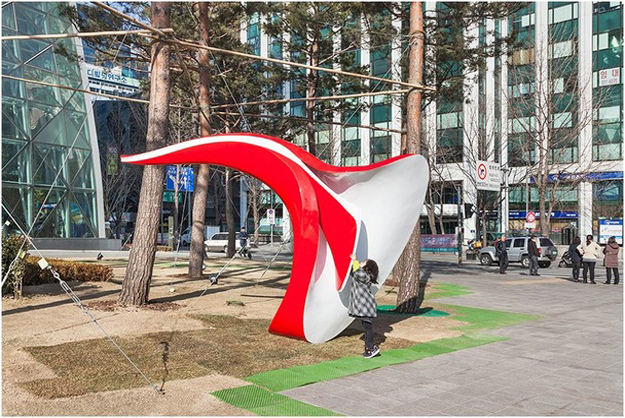
The normal procedure for submitting a complaint to the government is to write a letter, send an email, or make a long drawn-out phone call. In Seoul, South Korea, there’s an alternative – yelling into a giant sculpture shaped like an ear.
Designed by artist Yang Soo-in, and backed by the organization, Lifethings, the sculpture sits outside City Hall in Seoul. It symbolizes the fact that Mayor Park Won-soon and his administration are willing to listen to the people.Since it’s installation, Koreans have lined up to speak their woes or ideas for civic improvement into the impressively sized artificial ear.
more via Ear Sculpture Listens To Citizen Complaints [Pics] – PSFK.
Related articles
- Got a Complaint With the Government? Yell It Into This 8-Foot Ear (theatlanticcities.com)
10 Simple Things You Can Do Today That Will Make You Happier, Backed By Science – The Buffer Blog
 I think I’ve talked about ALL of these tips individually on the blog before, so I’m thrilled that somebody combined them into a “Top 10 With Science!” post:
Happiness is so interesting, because we all have different ideas about what it is and how to get it. It’s also no surprise that it’s the Nr.1 value for Buffer’s culture, if you see our slidedeck about it. So naturally we are obsessed with it.
I would love to be happier, as I’m sure most people would, so I thought it would be interesting to find some ways to become a happier person that are actually backed up by science. Here are ten of the best ones I found.
1. Exercise More (7 minutes might be enough)
2. Sleep More
read all 10 Simple Things You Can Do Today That Will Make You Happier, Backed By Science – The Buffer Blog.
I particularly like suggestion #5.
Related articles
- 10 Simple Things You Can Do To Be Happier, Backed By Science (lifehacker.com.au)
- 10 simple things you can do to be happier, backed by science… (lifehacker.com)
- 10 scientifically proven ways to make yourself happier that you can implement today – – The Buffer B (250ideationstation.wordpress.com)
8 New Jobs People Will Have In 2025
Have you ever wondered what job you’ll have in 10 years? This trend-spotting firm came up with some ideas for what new jobs could exist by then.

New technology will eradicate some jobs, change others, and create whole new categories of employment. Innovation causes a churn in the job market, and this time around the churn is particularly large–from cheap sensors (creating “an Internet of things“) to 3-D printing (enabling more distributed manufacturing).
Sparks & Honey, a New York trend-spotting firm, has a wall in its office where staff can post imaginative next-generation jobs. Below are eight of them, with narration from CEO Terry Young (who previously appeared here talking about health care).
1. Digital Death Manager
2. Un-schooling Counselor
3. Armchair Explorer (this already exists, btw).
see all 8 via 8 New Jobs People Will Have In 2025 | Co.Exist | ideas + impact.
First, this list is a great example of why creativity and playfulness are so important to cultivate – it’ll help you adapt to the future.
But several of these jobs also require being able to think creatively and outside the box, being adaptable and adjusting to new problems like “I haven’t been in school in 10 years but want to go back), and thinking abstractly. All of which are cultivated and grown through play!
Related articles
- 8 New Jobs People Will Have In 2025 (fastcoexist.com)
- I Have Changed My Job Title To…Corporate Disorganizer. (thismuchweknow.net)
- Disruptive Technologies (michaelchishala.wordpress.com)
 Mental Flowers