I don’t recall this parable from Dr. Seuss, but I like the idea of a bubblefest!
If you want to recapture your childhood this weekend, head to Cal Anderson Park in Seattle, WA, with a gallon or so of soapy liquid for Bubble Bath Seattle, the biggest bubble fight this city has ever seen.
From 3:00 pm to 5:00 pm, Cal Anderson will transform into a sea of bubbles. Evidently these events have been going on in New York for years, but it’s the first time that Seattle has ever seen something this epic. Organizers draw inspiration from Dr. Seuss’s The Butter Battle Book
Public, collaborative art happening in Seattle. Go be a part of it!
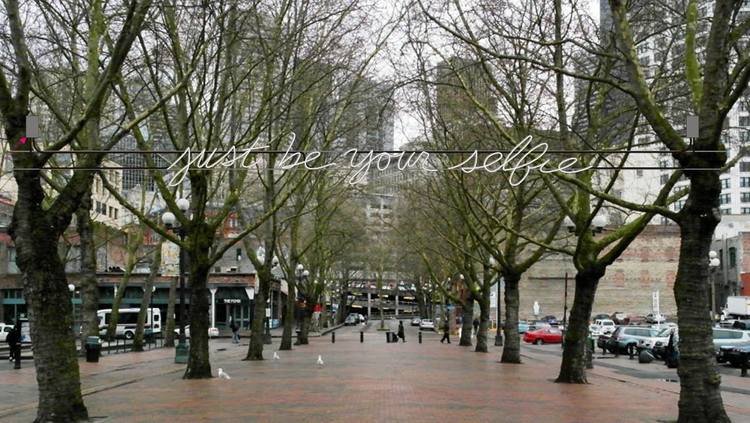
Just Be Your Selfie in Occidental Park, Seattle by Dylan Neuwirth
I am pleased to announce a new large-scale public work coming to Seattle in late May and on display in Occidental Park from June to September, 2014 as a part of ArtSparks.
“JUST BE YOUR SELFIE” is a monumental neon status update rendered in cursive.
Designed to initiate personal and shared, web-based experiences; this social sculpture is an iconic contemporary work of real-time internet art embedded into an urban environment. Not necessarily a solid structure, or a pure concept; this slippery expression bridges the gap between existing in both the analog and digital realities we now accept as inseparable.
The work will have its own Instagram account, associated hashtags, and is intended to take on a life of its own.
Staying playful and creative sometimes requires going back to your roots, or at least your crayons. Drawing, scribbling, doodling, and coloring have all been found to help with destressing, thinking out ideas and problems, and keep brains active into old age.
Drawing is also a great learning activity with lots of fine motor skill and development, problem solving, language development and social learning opportunities… (Editor’s note: all of which tie into the above-mentioned benefits, and these skills are all useful for both grownups and kids to practice and refresh on a regular basis).
Drawing is a way for children everyone to process their world, to represent and share their ideas and to explore new skills and information.
Drawing with Geometry ToolsGraph Paper DrawingCollaborative Doodle Drawings
If you think this is just “kid’s stuff” I dare you to try some of these, especially the collaborative drawing exercise. It’ll (potentially) expose some growth areas of yourself and/or others very quickly. 😛
Yes, yes, yes! This is so exciting! I love some of these ideas on how to encourage play in your community as a way of creating joy and growing community bonds:
Here’s our list of 75 100 ways that you can start making your city or town a playful place:
Join the CommunityMatters conference call on play and placemaking
Taking the arcade experience outdoors. (Photo credit: Wikipedia)
Coming soon(ish) to a street near you (if you live in Colorado):
OHY will transform a Downtown Denver street into an interactive arcade using LED screens, projections, custom games and street art.
BRINGING PLAY BACK TO THE STREET: Get ready! This summer – June & July, 2014 – Champa Street in Denver, from 14th Street to the 16th Street Mall, will be transformed into a street arcade like you’ve never seen. This isn’t your father’s old-school arcade. Powered through a combination of the Denver Theatre District’s LED screens, building projections, street art, social media and a website, this immersive arcade is going to be a gaming experience for all!
ON THE WEB: The public will be able to interact with video game characters through personalized Twitter profiles powered by local improv comedians from Bovine Metropolis.
ON THE STREET: Once you’re on Champa Street, you’ll feel it – the pulse of the arcade bringing downtown to life. To play at the arcade is to be immersed in each game. The entire two city blocks will be full of street art and custom structures that will transport players to a modern game world. The enormity and excitement is going to blow people away.
GAMES: Built by the Denver-based, award-winning creative team of Legwork Studio and Mode Set, the games will allow players to use a smart phone and their body as controllers while playing on the huge Denver Theater District LED screens, as well as projections on buildings. Microsoft Kinect devices will be utilized so participants feel like they’ve jumped right into the video games.
This sounds like a really great way to get people playing together in public spaces.
(Word to the wise, if you have a play-based Kickstarter event, toy, program, or other play-related thing you are trying to get attention for, let me know about it as it is pretty much guaranteed to get some blog time.)
How many of your virtual friends would you actually invite over for lunch? (Photo credit: Meer)
Does social media make us feel more or less connected? How does connecting and communicating in a digital space impact us differently than connecting and communicating in a physical space?
There are mixed results from various studies, but recently more studies have come out finding that we actually feel less connected to each other the more we use social media like Facebook:
Kross found that the more people used Facebook, the less happy they felt—and the more their overall satisfaction declined from the beginning of the study until its end. The data, he argues, shows that Facebook was making them unhappy.Research into the alienating nature of the Internet—and Facebook in particular—supports Kross’s conclusion. In 1998, Robert Kraut, a researcher at Carnegie Mellon University, found that the more people used the Web, the lonelier and more depressed they felt. After people went online for the first time, their sense of happiness and social connectedness dropped, over one to two years, as a function of how often they used the Internet.Lonelier people weren’t inherently more likely to go online, either; a recent review of some seventy-five studies concluded that “users of Facebook do not differ in most personality traits from nonusers of Facebook.”
But, as with most findings on Facebook, the opposite argument is equally prominent. In 2009, Sebastián Valenzuela and his colleagues came to the opposite conclusion of Kross: that using Facebook makes us happier. They also found that it increases social trust and engagement—and even encourages political participation. Valenzuela’s findings fit neatly with what social psychologists have long known about sociality: as Matthew Lieberman argues in his book “Social: Why Our Brains are Wired to Connect,” social networks are a way to share, and the experience of successful sharing comes with a psychological and physiological rush that is often self-reinforcing. The prevalence of social media has, as a result, fundamentally changed the way we read and watch: we think about how we’ll share something, and whom we’ll share it with, as we consume it. The mere thought of successful sharing activates our reward-processing centers, even before we’ve actually shared a single thing.
Virtual social connection can even provide a buffer against stress and pain: in a 2009 study, Lieberman and his colleagues demonstrated that a painful stimulus hurt less when a woman either held her boyfriend’s hand or looked at his picture; the pain-dulling effects of the picture were, in fact, twice as powerful as physical contact.
So what does this all mean? That we are complicated. And so is how we use social media.
“What makes it complicated is that Facebook is for lots of different things—and different people use it for different subsets of those things. Not only that, but they are also changing things, because of people themselves changing,” said Gosling. A 2010 study from Carnegie Mellon found that, when people engaged in direct interaction with others—that is, posting on walls, messaging, or “liking” something—their feelings of bonding and general social capital increased, while their sense of loneliness decreased. But when participants simply consumed a lot of content passively, Facebook had the opposite effect, lowering their feelings of connection and increasing their sense of loneliness.
I have seen forums used to create physical communities (I don’t want to say “real world” because virtual is real, it’s really happening) and create friendships that crossed continents, but I have also heard of and seen virtual bullying that in some very sad cases led to a person’s death. We can be cruel to others by hiding behind that veil of anonymity, or even just by creating a lack of physical presence which also creates a mental separation which makes it easier for us to feel isolated or intentionally isolate others. But we also want to share and connect with others, even if we can’t be physically near them, and share very intimate details with people we may not otherwise have given the time of day, which can be a good or bad thing depending on the context and situation.
How do you use social media? Does it make you feel more connected to your tribe, or do you feel left out or perhaps even more isolated? Do you bridge the gap between your virtual world and physical world, or does the slogan “What happens in Vegas stays in Vegas” also apply to your social media and physical lives? Leave your thoughts in the comments below.
Virtual space, including friendships there, does not fully replace that real live human interaction we get in real world spaces. More and more studies are finding this out, and people are reacting to it, often on social media.
graphic designer Shimi Cohen, based in Tel Aviv, has provided “a fresh and subtly soul-wrenching reminder of the way our screens can become cells of solitary confinement.”
The animation was Cohen’s senior project at Shenkar College of Engineering and Design. Based in part on MIT professor Sherry Turkle’s book Alone Together and Yair Amichai-Hamburger’s article “The Invention of Being Lonely,” inspiration also came from a personal place. “Like many others,” Cohen tells Co.Design, “I became addicted to socializing through my phone and social media. This started to bother me and intrigue me at the same time.”
Where you live apparently can influence your happiness – or maybe happy people just tend head west?
Which way to happy? Geographically speaking, it’s the route to Hawaii, Maine or one of the clusters of blissful cities in California and Colorado.
The map below is based on results from a study of geotagged tweets published earlier this year in PLoS ONE by researchers at the University of Vermont. The team scored more than 10,000 words on a positive-negative scale and measured their frequency in millions of tweets across the country, deliberately ignoring context to eliminate experimental bias. What emerged was significant regional variation in happiness by this calculation, which correlates with other lifestyle measures such as gun violence, obesity and Gallup‘s traditional wellbeing survey. A sadness belt across the South includes states that have high levels of poverty and the shortest life expectancies.
On a more playful note, I love the idea of having public garden festivals where everyone is invited to come out and admire and enjoy nature, and each other’s company.
On a more playful note, I love the idea of having public garden festivals where everyone is invited to come out and admire and enjoy nature, and each other’s company.







 Mental Flowers