Nature · Social

PARKing Day in Seattle

Speaking of public creativity, yesterday Seattle held its third annual PARK(ing) Day demonstration. Despite the drizzly weather, several groups such as theΒ Trust for Public Land, Piper Creek Nursery, Hazard Factory, and others* came out to raise awareness about open space and promote public space and parks.

From the website:

PARK(ing) Day is an annual, worldwide event that inspires city dwellers everywhere to transform metered parking spots into temporary parks for the public good.

It’s happening already in Australia, Japan, Korea, and for the first time ever, in China! Rebar is up bright and early for the first major PARK(ing) Day installation in Paris. And hundreds of you are preparing to please the public with your own PARKs across Europe, America and beyond.

More at parkingday.org.

Seattle held their event outside the Seattle Art Museum (SAM) downtown. One of the representatives from the Public Land Trust told me how the rotten economy has led people to hold more events outside in public places, from business picnics to yoga classes, raising awareness of all the public space Seattle has to offer and why it’s important to maintain these and add more. Hopefully people won’t forget that once the weather turns bad, or the economy turns good.

Here are some of the pictures I took at the Seattle event:

Park(ing) Day, SAM, Seattle WA 2010
PARKing Day outside the SAM, Seattle WA
Parking Day Seattle 2010 line-up
an arts+crafts table and lounge area were set up for visitors to PARKing Day
Parking Day Seattle 2010 Mark a Park
The Trust for Public Land set up a map for people to mark parks that they liked, could use a little love, or places they wanted parks.
Parking Day Seattle 2010 Bear feet
Bear feet drawn by a little girl visiting the event
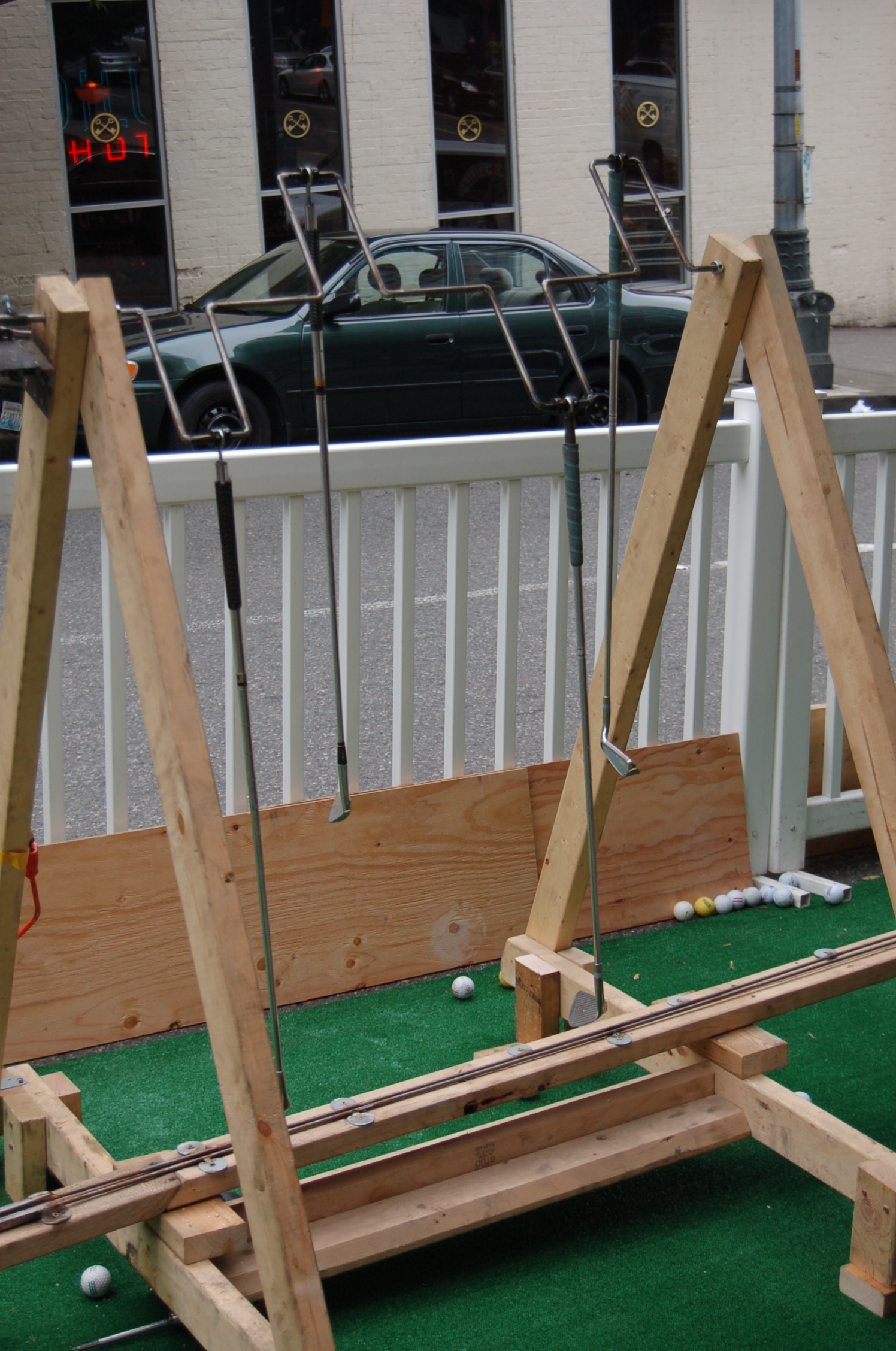
PARKing Day activity, Rusty Oliver, Seattle 2010
Rusty Oliver, artist behind the Hazard Factory, devoted his PARKing space to this portable mini-golf obstacle he built.

Hopefully the weather next year will be nicer and bring out more participants.

*If I missed any organizers, please leave their names in the comments and I’ll update this post. Thanks!

Social · writing

Crafternoons happening RIGHT NOW in NYC Public Library

If you live anywhere near the New York Public Library, go go go right now now now! And then tell me all about it. πŸ™‚

After a talk with Julia, you and fellow attendees will work with the artists to create a collaborative craft project inspired by the book β€” a classic exquisite corpse, a hand-sewn double-bound book, a giant scroll, or even a crowdsourced short story. Supplies will be on hand (including some amazing images from the NYPL’s image collection) and all you have to do is show up because it’s FREE! So if you’re in town, stop by, get crafty, meet the artists and enter a raffle to win a free copy of the book! (Books will be available for sale, as well.)

Thanks for the tip atΒ Design*Sponge Β» Blog Archive Β» crafternoons: the exquisite book + d*s event poll.

Mental · Social

Visit 1,400 museums for free on Sept. 25, Museum Day – LATimes

I’m so excited about this year because a) I don’t work that day, and b) I finally live in a big city where I have access to more than just the local children’s museum! Museums are a great source of knowledge, art, culture, science, and history in one weather-protected, thought-provoking building. Hooray!!

Here’s how it works: Go to theΒ Smithsonian Magazine website, peruse theΒ list of participating museums and pick one to visit β€” preferably one you’ve never been to. Then register to download and print out a ticket that provides free admission for two to the museum that you chose; you’ll need this for entry. Each ticket is good for only one museum, and only one ticket is allowed per household.

Visit 1,400 museums for free on Sept. 25, Museum Day – Travel – LATimes.com.

Mental · Social

Revenge of the Introvert | Psychology Today

I spent the morning readingΒ Revenge of the Introvert in Psychology Today. This is an interesting article that talks about how prevalent introversion actually is in humans when given psychology tests, and why accepting one’s intraverted tendencies is okay.

From the creative side of things, the author Laurie Helgoe points out how mentally draining it is for introverts to force themselves to be more outgoing and social, and in fact they are better at problem solving and creativity when they have a chance to sit in a quiet corner (or go running, sit on the bus with their headphones plugged in) and contemplate.

What I found interesting also, from a social science aspect, was when Helgoe pointed out that while American culture strongly encourages extraverted behavior, other cultures like in Finland and East Asia value introversion.

As Helgoe states “…if every other person is an introvert, why doesn’t the cultural tone reflect that?”

Indeed.

But overall the article provides a great message of why introversion is a good thing (really, truly) and how all us introverts can thrive in an extraverted culture.

Headphones, anyone?

read more atΒ Revenge of the Introvert | Psychology Today.

Mental · Social

New Nicaraguan sign language shows how language affects thought | Not Exactly Rocket Science | Discover Magazine

A cool look at language and how it shapes our thoughts in the article “New Nicaraguan sign language shows how language affects thought | Not Exactly Rocket Science | Discover Magazine.”

NSL has been a goldmine for scientists, providing an unparalleled opportunity to study the emergence of a new language. And in a new study led by Jennie Pyers from Wellesley College, it even tells us how language shapes our thought.By studying children who learned NSL at various stages of its development, Pyers has shown that the vocabulary they pick up affects the way they think. Specifically, those who learned NSL before it developed specific gestures for left and right perform more poorly on a spatial awareness test than children who grew up knowing how to sign those terms.

more…

architecture · Nature · Social · technology

Nine of the World’s Most Promising Carbon-Neutral Communities | Popular Science

Looking for some last minute destinations for Labor Day weekend here in the U.S.? Why not choose a destination that is carbon neutral? Although the plane ticket to get there would cancel out a lot of their hard work. From the article in Popular Science:

In the global race to reduce carbon emissions, these eco-minded communities, from Kansas to the Maldives, lead the pack. Here’s how they’re making their carbon footprints disappear.

See the nine atΒ Nine of the World’s Most Promising Carbon-Neutral Communities | Popular Science.

Social · technology

Walk in Workshops | Science Gallery

The Science Gallery in Dublin provides a space to explore science, technology, and art in its multiple facets.

In June, they ran workshops “a selection of walk in workshops and a chance to test out the speed and accuracy of a penalty kick, thanks to the institute of Physics.”

Different programs included:

Bristlebot
Make a simple vibrating robot with a scrubbing brush and a small motor.

DNA Extraction
It might sound painful but all we need is a little bit of your saliva for you to actually be able to see a small amount of your very own DNA.

LED Wrist Band
Turn up in techno style at the festival season this year with this simple LED wrist band, a simple circuit using a 3 VΒ  battery and an LED

Origami Bucky Ball
Explore the unusual construction of a Bucky Ball through the art of origami. With the simple building blocks you can build Bucky Balls out a variety of materials.

BeetleBot
A slightly more complicated robot, the BristleBot appears like it has some expensive sensory equipment enabling it to reverse away from a barrier. Find out it’s secret at this make and take.

Find out about more of their programs via Walk in Workshops | Science Gallery.

Social · writing

Mary Catherine Bateson on Domesticity – NYTimes.com

garden art at Dr. Bateson's New Hampshire farm

A nicely written article in the August 25th edition of the New York Times on anthropologist Dr. Mary Catherine Bateson (Margaret Mead‘s and Gregory Bateson‘s daughter) on her latest book which looks at domesticity, homemaking, and what it means to be part of a couple.

In Dr. Bateson’s parlance, homemaking is … a metaphor for community, for the design of an environment β€” professional or domestic or societal β€” that challenges and supports its inhabitants, an ideal closer to the arrangement of a Samoan village than a perfectly appointed living room. β€œIt’s critical that home not just be a place that you use whatever is there, but that it be a place you are truly responsible for,” she said. β€œIt’s not just your home and you get to mess it up.”

Homemaking, she added, is also a metaphor for longevity, a way of looking at the second stage of adulthood that precedes old age β€” what she calls β€œadulthood II” β€” which is the subject of her new book.

Yes, it’s a sequel to her 1990 meditation on the stop-and-start nature of women’s lives, except that this time she has invited men into the conversation.

more atΒ At Home With Mary Catherine Bateson – Mary Catherine Bateson on Domesticity – NYTimes.com.

Social · technology

Steven Pinker Op-Ed – Mind Over Mass Media – NYTimes

There is so much buzz right now about whether or not we’re over-saturated with technology and gizmos and electronic thingamabobs and constant electronic feedback that it’s wrecking our brains. Some people have said absolutely, 100% yes.

Steven Pinker, a language, cognitive science, evolutionary psychologist working out of MIT and most famous for popularizing the idea that language is an “instinct” orΒ biological adaptation shaped by natural selection, however points out that in some ways electronic technologies have helped us do better science, be more creative, and build social networks.

When comic books were accused of turning juveniles into delinquents in the 1950s, crime was falling to record lows, just as the denunciations of video games in the 1990s coincided with the great American crime decline. The decades of television, transistor radios and rock videos were also decades in which I.Q. scores rose continuously.

For a reality check today, take the state of science, which demands high levels of brainwork and is measured by clear benchmarks of discovery. These days scientists are never far from their e-mail, rarely touch paper and cannot lecture without PowerPoint. If electronic media were hazardous to intelligence, the quality of science would be plummeting. Yet discoveries are multiplying like fruit flies, and progress is dizzying.

via Op-Ed Contributor – Mind Over Mass Media – NYTimes.com.

I have mixed opinions about technology and the modern world – I am a blogger, and I write for both hard-copy and online publications. Most of my paychecks have come from online writing. I gain unmeasurable knowledge and enjoyment from the Internet, and yet the most restful vacation I have had in years is three days in Boulder where the only technology I had was my cell phone and a car, both of which turned off the majority of my visit. My husband can hear the buzz of electronics at night and can’t have anything plugged in when he goes to bed.

What do you think? Any other links to people’s opinions on the subject?

Social · technology · writing

Open Diary: Chronicling The Hidden World Of Girls : NPR

It’s not too late to submit! Be a part of the story on NPR’sΒ Open Diary: Chronicling The Hidden World Of Girls.

one submission to the Flickr account

As part of the Hidden World of Girls project, we’re looking to create a database of intimate diary entries. With enough of them, they could form a comprehensive tapestry β€” from elation to depression β€” of life experiences. We already have a small collection on Flickr.

How Can You Help? Submit pictures or scans of your diary’s pages β€” or even the pages of your mother’s diaries or grandmother’s diaries.

How To Submit: Photos should be submitted through The Hidden World Of Girl’s Flickr group. Or if it makes things easier, just upload them anywhere and leave us a link to the picture in the comments section. We will be getting in touch with you through Flickr mail or through the e-mail address provided when you sign up for an NPR community account. On Flickr, you’ll know if you’ve submitted photos correctly if they show up here.

via Open Diary: Chronicling The Hidden World Of Girls : NPR.