
Really interesting article about the concept of biophilic design, something I’ve brought up a lot on this sight. In summary, humans love natural environments, so why haven’t our buildings and other spaces moved more in that direction? It’s all broken out very nicely in this post:
Category: psychology

The financial and emotional drain of growing old alone

I came across this article today that focuses on the financial drain of growing old:
More Americans are living alone now than at any other point in history, and one-third of those 32.7 million are older than 65. A rise in the divorce rate in the over-50 set, which has doubled over the past two decades, along with women outliving their spouses by five to six years, is fueling the trend, which will only grow with an aging boomer population.
The older population in 2030 is projected to double from the start of this century — from 35 million to 72 million — representing nearly 20% of the total U.S. population, according to AARP.
Living on your own can be far more costly than sharing expenses like food and housing with a spouse, relative or housemate. Single seniors who also face escalating health care costs are five times more likely to live in poverty as their married peers.
I also feel like an important element was being skipped; the emotional drain and tax on growing old alone. If nothing else, for somebody to have your back.
One study in Denmark found that
A study involving more than 138,000 adults in Denmark showed that living alone carries a serious risk of heart disease. The subjects were followed from 2000 to 2002 and during that time 646 experienced severe angina, a heart attack, or sudden cardiac death. The two strongest predictors of these diagnoses, called acute coronary syndrome, were age and living alone. Women over the age of 60 and men over the age of 50, who lived alone, were twice as likely to have the syndrome as the other people. Although women over 60 who lived alone compromised only five percent of the studied group, they accounted for 30 percent of all deaths. Lone men over 50 were eight percent of the group, yet represented two thirds of the deaths.
In the Telegram UK:
Middle-aged men who reject family life and choose to live alone are more likely to die earlier than their married counterparts, UK Government figures published yesterday reveal.
They are also significantly more prone than married men to a variety of debilitating illnesses such as diabetes and rheumatism, said the study released by the Office for National Statistics.
The findings come against a backdrop of research which shows that married couples tend to enjoy better health than unmarried people.
Another study of 29 countries found that people who live alone are more likely to die young:
A four-year study of 45,000 people from 29 countries. Researchers found that those living solo under age 65 had a 21% greater chance of dying; in their study, 9.3% of those who had a roommate died within the four years, compared to 11.4% of those who had none. The researchers believe the main reason for the bump may simply be that being alone means there is no one around to help when something goes wrong, notes the Orlando Sentinel.
Although, to be fair, the same study found that after a certain age living alone was associated with longer life, but that could also be because older folks who are healthier are able to live alone and not move into assisted living for longer.
“but the hunch is if you make it to 80 and are independent, you’re doing pretty well.”
So, the bottom line of all of this? Think about splitting the rent with someone, even if you don’t technically need to.
Surefire way to make yourself smile
Feeling a little down after the festive weekend with possibly WAY too many chocolate bunnies? There is a cure for that. But don’t take my word for it, ask Canadian artist Alison Ann:

I was a bit sad that my vacation was over until I remembered this little gem of a project that I did on a cool January eve.
The goal here was to draw 100 smiley faces in an act of self cheering.It totally works.Here is my sample, and I encourage you to do the same.If you do do the same you should share it with others too.. or share it with me!!!
Or share on this blog! 🙂
Happy Monday!
Fostering real, unforced creativity at the workplace

We have all experience an “aha!” moment, but how often is that moment at work? People with “creative” jobs talk all the time about the struggle to create on a deadline or within parameters (I’m currently procrastinating on another writing assignment by working on this blog post).
Jonah Lehrer explores this idea of working creativity and more in his new book, Imagine: How Creativity Works.
The book explores where innovative thoughts originate and explains how some companies are now working to create environments where they’re more likely to occur.
“Moments of insight are a very-well studied psychological phenomenon with two defining features,” Lehrer tells Fresh Air‘s Dave Davies. “The answer comes out of the blue – when we least expect it. … [And] as soon as the answer arrives we know this is the answer we’ve been looking for. … The answer comes attached with a feeling of certainty, it feels like a revelation. These are the two defining features of a moment of insight, and they do seem to play a big role in creativity.”
Scientists have determined that people in a relaxed state and a good mood are far more likely to develop innovative or creative thoughts. And companies are now taking advantage of this fact. Lehrer points to 3M, which started out making packaging tape and has now expanded into other sectors including electronics and pharmaceutical delivery.
Companies like 3M and Google encourage their employees to take time to be creative and work on other side projects. What else works? Read the rest of the article on NPR, and the book.
Related articles
- Creativity: Jonah Lehrer and NPR All things Considered (iamdustycole.wordpress.com)
- Creativitor/Innovator Jonah Lehrer on ‘Fresh Air’ (iamdustycole.wordpress.com)
- Jonah Lehrer Writes New Book on Creativity (imaginationnow.wordpress.com)
- The Neuroscience of Creativity: Why Daydreaming Matters (openforum.com)
- How to be Creative – WSJ (anamericanpointofview.wordpress.com)
- How to Get Your Creative Juices Flowing (openforum.com)
Mappiness: Mapping Happiness

From the blog How Do you Landscape; a group from the UK has created an app that can be used to measure our happiness based on our surroundings, and using maps to look at the data:
“People feel better outside than inside”. “People feel better in the park/woods/nature than in the city”. These are some of the conclusions from a project with the telling title ‘Mappiness’ Good news for landscape and Landscape Architecture on first sight. But are these only one-liners or firmly based scientific statements? Well, that depends on the quality of the empirical evidence of course. Most experience sample methods (ESM) have a hard time getting a representative group (in the end almost only colleagues) that has to struggle trough tedious interview forms (“it will take only twenty minutes”) to step-by-step end up with modest results. How about a sample group of 47.331 people (and growing by the day) who willingly support their data three times a day to the researchers that by now collected over three million forms in a few months? I stumbled upon these remarkable Experience research feats in a TedxBrighton 2011. In this “Twenty minutes lecture” George MacKerron explains why and how he and Susana Mourato (both from the Department of Geography & Environment at the London School of Economics and Political Science) created ‘mappiness’. They want to better understand how people’s feelings are affected by features of their current environment. Things like air pollution, noise, and green spaces influence your well being is their hypothesis.
This is how it works. They developed an app that can be downloaded for free. It must be one of the most irritating apps around on the web because it rings you (with your approval, you can influence the settings) three times a day to ask you three simple questions.
When put through a big regression model they can gauge the happiness as the function of habitat type, activity, companionship, weather conditions (there is of course a link between meteorological data and the GPS data), daylight conditions, location type (in, out, home, work, etc), ambient noise level, time of the day, response speed, and individual ‘fixed-effects’ (that come out of your personal Mappiness-history). Factors can be plotted out against each other.
How awesome is that? What a neat piece of technology to measure our surroundings and how they influence us!
Playing leads to lower Alzheimer’s risk

From USA Today:
People who engage in activities such as reading and playing games throughout their lives may be lowering levels of a protein in their brains that is linked to Alzheimer’s disease, a new study suggests.
Although whether the buildup of the protein, beta amyloid, causes Alzheimer’s disease is debatable, it is a hallmark of the condition, the researchers noted.
“Staying cognitively active over the lifetime may reduce the risk of Alzheimer’s by preventing the accumulation of Alzheimer’s-related pathology,” said study author Susan Landau, a research scientist at the Helen Wills Neuroscience Institute at the University of California, Berkeley.
“Some of the literature has hypothesized this finding, but this is the first study to report that lifetime cognitive activity is directly linked to amyloid deposition in the brain,” she said. “We think that cognitive activity is probably one of a variety of lifestyle practices — occupational, recreational and social activities — that may be important.”
Read more at Keeping brain sharp, active may ward off Alzheimer’s
There have been several different studies that find the correlation between play and a healthy brain less susceptible to dementia, disease, and overall decay. Literally use it or lose it. So you might as well have fun using it!
Related articles
Life Lessons Passed On

I was really inspired by that blog post I shared a couple of months ago about cancer survivors and what they’d learned about life. I also posted a survey done with older folks last year giving advice on what NOT to do.
Well, thankfully all of that hard-earned knowledge is coming out in book form. Many of the interviews can also be at legacyproject.human.cornell.edu. From the NYTimes:
Eventually, most of us learn valuable lessons about how to conduct a successful and satisfying life. But for far too many people, the learning comes too late to help them avoid painful mistakes and decades of wasted time and effort…
Enter an invaluable source of help, if anyone is willing to listen while there is still time to take corrective action. It is a new book called “30 Lessons for Living” (Hudson Street Press) that offers practical advice from more than 1,000 older Americans from different economic, educational and occupational strata who were interviewed as part of the ongoing Cornell Legacy Project.
Its author, Karl Pillemer, a professor of human development at the College of Human Ecology at Cornell and a gerontologist at the Weill Cornell Medical College, calls his subjects “the experts,” and their advice is based on what they did right and wrong in their long lives.
You can also read a summary of their advice in the article: Advice From Life’s Graying Edge on Finishing With No Regrets
What are your life lessons?
Related articles
- What Are Your Life Lessons? (well.blogs.nytimes.com)
- Finishing With No Regrets (3quarksdaily.com)
- Advice From Life’s Graying Edge on Finishing With No Regrets (nytimes.com)
- Top 10 Lessons for Living from the Wisest Americans (talesfromthelou.wordpress.com)
The Psychological Importance of Home

As the weekend, approaches, many of us are making plans to go out to events in our local cities, or work around the house, or just sleep in our own beds after several weeks of visiting and traveling. The psychology of home is very important to us humans, and was captured really well in an article by Julie Beck in The Atlantic:
Susan Clayton, an environmental psychologist at the College of Wooster, says that for many people, their home is part of their self-definition, which is why we do things like decorate our houses and take care of our lawns. These large patches of vegetation serve little real purpose, but they are part of a public face people put on, displaying their home as an extension of themselves. It’s hardly rare, though, in our mobile modern society, to accumulate several different homes over the course of a lifetime. So how does that affect our conception of ourselves?
When you visit a place you used to live, these cues can cause you to revert back to the person you were when you lived there.
For better or worse, the place where we grew up usually retains an iconic status, Clayton says. But while it’s human nature to want to have a place to belong, we also want to be special, and defining yourself as someone who once lived somewhere more interesting than the suburbs of Michigan is one way to do that. “You might choose to identify as a person who used to live somewhere else, because it makes you distinctive,” Clayton says. I know full well that living in Paris for three months doesn’t make me a Parisian, but that doesn’t mean there’s not an Eiffel Tower on my shower curtain anyway.
We may use our homes to help distinguish ourselves, but the dominant Western viewpoint is that regardless of location, the individual remains unchanged. It wasn’t until I stumbled across the following notion, mentioned in passing in a book about a Hindu pilgrimage by William S. Sax, that I began to question that idea: “People and the places where they reside are engaged in a continuing set of exchanges; they have determinate, mutual effects upon each other because they are part of a single, interactive system.”
Read the full article here.
I definitely feel like I have a connection and identify with every place that I’ve lived, although some have felt more like home and have shaped me more than others. A lot of that has been due to how safe or at peace I feel in a place, and how much I have bonded with the people around me.
I also think one thing that was so traumatic about the housing bubble was that sense of losing your home. Not just a piece of property you owned, but this landmark of who you were, the space where you kept all of your memories and built new ones, your safe house, literally.
What is your experience with home? What makes a place “home” for you?
How Knitting Behind Bars Transformed Maryland Convicts – News – GOOD

Creating something with your hands, learning a craft, and being successful with something even as simple as crochet can have huge positive effects on people. That effect that be even more significant if you’ve been a screw-up your whole life, as many people behind bars feel they have been. This story about bringing knitting workshops to prisons is a great example, similar to the Puppies Behind Bars program or helping to raise endangered frogs, of how doing something as simple as a pearl and stitch can have huge psychologically positive impacts.
In late 2009, Lynn Zwerling stood in front of 600 male prisoners at the Pre-Release Unit in Jessup, Maryland. “Who wants to knit?” she asked the burly crowd. They looked at her like she was crazy.
Yet almost two years later, Zwerling and her associates have taught more than 100 prisoners to knit, while dozens more are on a waiting list to take her weekly class. “I have guys that have never missed one time in two years,” Zwerling says. “Some reported to us that they miss dinner to come to class.”
Zwerling, 67, retired in 2005 after 18 years of selling cars in Columbia, Maryland. She didn’t know what to do with her time, so she followed her passion and started a knitting group in her town. No one came to the first meeting, but the group quickly grew to 500 members. “I looked around the room one day and I saw a zen quality about it,” Zwerling says. “Here were people who didn’t know each other, had nothing in common, sitting together peacefully like little lambs knitting. I thought, ‘It makes me and these people feel so good. What would happen if I took knitting to a population that never experienced this before?’”
Her first thought was to bring knitting to a men’s prison, but she was turned down repeatedly. Wardens assumed the men wouldn’t be interested in a traditionally feminine hobby and worried about freely handing out knitting needles to prisoners who had been convicted of violent crimes. Five years passed before the Pre-Release Unit in Jessup accepted her, and Knitting Behind Bars was born. “I [wanted to teach] them something that I love that I really believe will make them focus and happy,” Zwerling says. “I really believe that it’s more than a craft. This has the ability to transform you.”
via How Knitting Behind Bars Transformed Maryland Convicts – News – GOOD.
Related articles
- Knitting Behind Bars (neatorama.com)
- Knitting Behind Bars, Retiree Teaches Male Inmates How to Knit (laughingsquid.com)
- Stitch ‘n Bitch: Prison Edition (thestitcherati.com)
- Knitting Group Provides Zen Moments For Male Convicts (craftzine.com)
For those days you really need a hug
Ever have a day when you just really need a hug, like, right now? Well now you’re in luck:
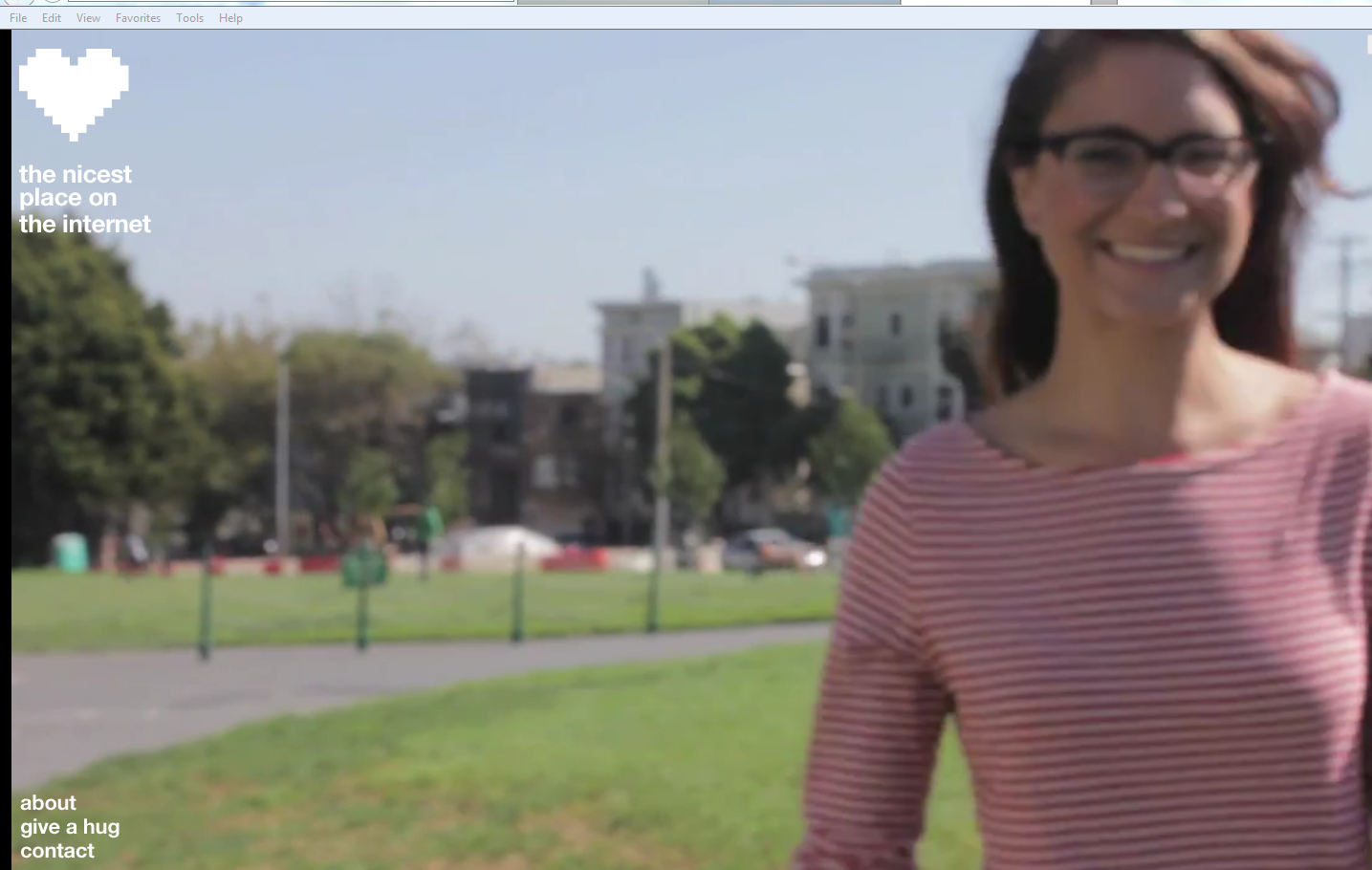
"Jeff Lam and Lauren Perlow created The Nicest Place on the Internet, a place where you can feel warm and fuzzy with virtual hugs, because they were having an off day. It’s perfect for those chilly winter days."
Check out Creativity Online.
You can also go directly to the site: The Nicest Place on the Internet
You can also contribute your own hug.
I love this idea of virtual kindness; it’s a weird concept in a way, of people donating hugs (so to speak) to complete strangers. But, it’s great because it’s using the World Wide Web to create community and connections with people all over the world. Somehow, by being open to receiving a hug, even a virtual one, we are able to create connections and feel like part of a larger tribe or cohesion.
So often online communities can turn harsh or downright mean; it’s great to see online crowdsourcing being used for positive psychological benefits!
 Mental Flowers