Staying playful and creative sometimes requires going back to your roots, or at least your crayons. Drawing, scribbling, doodling, and coloring have all been found to help with destressing, thinking out ideas and problems, and keep brains active into old age.
Drawing is also a great learning activity with lots of fine motor skill and development, problem solving, language development and social learning opportunities… (Editor’s note: all of which tie into the above-mentioned benefits, and these skills are all useful for both grownups and kids to practice and refresh on a regular basis).
Drawing is a way for children everyone to process their world, to represent and share their ideas and to explore new skills and information.
Drawing with Geometry ToolsGraph Paper DrawingCollaborative Doodle Drawings
If you think this is just “kid’s stuff” I dare you to try some of these, especially the collaborative drawing exercise. It’ll (potentially) expose some growth areas of yourself and/or others very quickly. 😛
I’m working on an article for work, and came across this article as part of my research for the article. It pretty much sums up everything I wanted to say (darn it!).
Americans and their brains are preoccupied with work much of the time. Throughout history people have intuited that such puritanical devotion to perpetual busyness does not in fact translate to greater productivity and is not particularly healthy. What if the brain requires substantial downtime to remain industrious and generate its most innovative ideas? “Idleness is not just a vacation, an indulgence or a vice; it is as indispensable to the brain as vitamin D is to the body, and deprived of it we suffer a mental affliction as disfiguring as rickets,” essayist Tim Kreider wrote in The New York Times. “The space and quiet that idleness provides is a necessary condition for standing back from life and seeing it whole, for making unexpected connections and waiting for the wild summer lightning strikes of inspiration—it is, paradoxically, necessary to getting any work done.”
In contrast to the European Union, which mandates 20 days of paid vacation, the U.S. has no federal laws guaranteeing paid time off, sick leave or even breaks for national holidays. In the Netherlands 26 days of vacation in a given year is typical. In America, Canada, Japan and Hong Kong workers average 10 days off each year. Yet a survey by Harris Interactive found that, at the end of 2012, Americans had an average of nine unused vacation days. And in several surveys Americans have admited that they obsessively check and respond to e-mails from their colleagues or feel obliged to get some work done in between kayaking around the coast of Kauai and learning to pronounce humuhumunukunukuapua’a.
The article focuses on mental downtime options like naps and meditation, which are awesome, but I would argue that being awake and aware, but also not actively engaged, like going for a walk or just sitting down and observing a garden, are good options too, especially since getting outside has also shown to be mentally reinvigorating.
This is one of the best descriptions of the power of pretend play, especially dissecting how pretend play is hard work, and can be overwhelming, especially to someone who doesn’t have practice, which is why lots of play is important for practicing real-world feelings and situations like power, restraint, and questioning assumed priors.
Power is intoxicating.
It is also dangerous.
And it is especially dangerous when applied to four-year-olds.
Four-year-olds lack the experience to wield power responsibly. They have no idea what to do with it or how to control it.
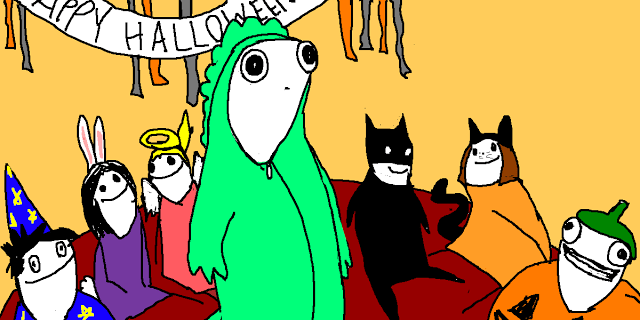
The dinosaur costume was the greatest thing that had ever happened to me.
…All I knew was that being a dinosaur felt very different from being a person, and I was doing things that I had never even dreamed of doing before. …Of course, I had always had the ability to do these things — even as a person — but I didn’t know that. I’d just assumed that I was unable. As a dinosaur, I didn’t have any of those assumptions. It felt like I could do whatever I wanted without fear of repercussions.
Do you notice you have different moods depending on how bright or dark it is outside? Do you notice the warmth or cold feeling emitting from a light bulb? Whether you consciously notice them or not, they do have an effect on your brain and body. Since these days most of us don’t get to work outside and absorb natural light, scientists are working on the right kind of artificial light for us.
The light emitted from our lamps and fixtures at home doesn’t just spruce up a room; it has the power to significantly augment our mood and lift our spirits.To explore further the link between lighting and personal wellbeing, glass engineering company Cantifix and Oxford University have collaborated to create the Photon Project. This scientific study comes to life at this month’s London Design Festival in the form of the Photon Pod, an all-glass living space that will help the Photon Project gather data and insights on the links between light and health.Resembling a futuristic bedroom, the pod invites visitors to experience what life is like in a completely translucent living space, as well as take part in simulations that measure levels of alertness or relaxation under varied light conditions.
More analysis and research looking into how we interact with and effect the digital space, and how that space in turn effects us, emotionally and mentally.
[Facebook, Bitly, Google+]… all these interfaces are now focusing on the emotional aspects of our information diets. To put this development in a broader context: the mood graph has arrived, taking its place alongside the social graph (most commonly associated with Facebook), citation-link graph and knowledge graph (associated with Google), work graph (LinkedIn and others), taste graph and interest graph (Pinterest and others).
Like all these other graphs, the mood graph will enable relevance, customization, targeting; search, discovery, structuring; advertising, purchasing behaviors, and more. It also signals an important shift in computer-mediated communication.
But placing a digital mood ring on users also has the power to change us — how we express ourselves. Especially when one considers that the data populating mood graphs comes from our encounters with behavior-altering interfaces packaged as fun little emojis and innocuous, “handy-dandy buttons”…
…drop-down expression makes us one-dimensional, living caricatures of G-mail’s canned responses — a style of speech better suited to emotionless computers than flesh-and-blood humans. As Marshall McLuhan observed, just as we shape our tools, they shape us too. It’s a two-way street.
The author of the opinion, Evan Selinger, is a Fellow at the Institute for Ethics and Emerging Technology who focuses on the collisions between technology, ethics, and law.
He seems hell bent against putting a happy face next to his Facebook post, and I hear what he’s saying about the dangers of trying to sum up a concept with a parenthesis or semicolon. And I agree that companies are offering these emoticon options often just so they can collect more data on their users, rather than be focused on helping their customers express themselves more fully.
But, as Selinger also points out, spoken language itself can be nuanced and tricky, in the digital or non-digital world, and it can be nice to have more tools to express yourself in the digital space. People also post songs or pictures in order to share their mood or sentiment with others.
I feel that these are enhancements for people to share more ideas, not have them boxed in. Sometimes creativity is aided with a few rules. All language has restrictions, whether you’re coding or signing or chatting. Yes these restrictions should be recognized, but not
Do you feel that a smiley face or frowny face limits your ability to communicate and express yourself with others online? Leave your thoughts in the comments below.
Robyn Rosenberger makes capes for only the fiercest of fighters.
Have you ever had days where you felt you had super powers, or felt you needed them? One woman in Seattle is making that a reality for over 1,700 kids with illnesses and disabilities in 50 states and 14 countries, with a new workshop opening to help out more kids:
Gabby has epilepsy and is completely dependent: She cannot talk, walk or eat on her own. But she is a tiny superhero — her superpowers include perseverance, courage and strength — and she has the cape to prove it. A purple number, with a blue letter “G” hand-sewn on by Robyn Rosenberger.
Rosenberger is the powerhouse behind TinySuperheroes, which makes capes as a form of empowerment. “Our mission is to empower these kids to feel as extraordinary as we see they are,” Rosenberger explained.
On the surface this may seem a little fluffy, but it exemplifies the power of play, particularly imaginary play and pretending. First, it gives the kids a chance to take a break from their illness and maybe laugh a little, which is good for everyone. Second, the crazy thing is researchers are finding that by pretending to be big, strong, dominant, and super-hero-esque, it can train your body to actually be more strong, dominant, and super-hero-esque. Even healthy kids can feel pretty powerless, so by imagining what it feels like to be strong and healthy it can help their minds and bodies map out what that might look and feel like and maybe even help along the road the recovery.
So by giving these kids superhero capes, these volunteers are in fact giving these kids some pretty strong medicine.
Now I want a cape, or at least a magic wand.
If you are interested in helping out, visit the Tiny Superheroes site.
I think I’ve talked about ALL of these tips individually on the blog before, so I’m thrilled that somebody combined them into a “Top 10 With Science!” post:
Happiness is so interesting, because we all have different ideas about what it is and how to get it. It’s also no surprise that it’s the Nr.1 value for Buffer’s culture, if you see our slidedeck about it. So naturally we are obsessed with it.
I would love to be happier, as I’m sure most people would, so I thought it would be interesting to find some ways to become a happier person that are actually backed up by science. Here are ten of the best ones I found.
The term “tree hugger” has been applied to people viewed as uber-liberal or too idealistic, however… “it has been recently scientifically validated that hugging trees is actually good for you.”
Research has shown that you don’t even have to touch a tree to get better, you just need to be within its vicinity has a beneficial effect.
In a recently published book, Blinded by Science, the author Matthew Silverstone, proves scientifically that trees do in fact improve many health issues such as Attention Deficit Hyperactivity Disorder (ADHD), concentration levels, reaction times, depression and other forms of mental illness. He even points to research indicating a tree’s ability to alleviate headaches in humans seeking relief by communing with trees.
The author points to a number of studies that have shown that children show significant psychological and physiological improvement in terms of their health and well being when they interact with plants and trees. Specifically, the research indicates that children function better cognitively and emotionally in green environments and have more creative play in green areas. Also, he quotes a major public health report that investigated the association between green spaces and mental health concluded that “access to nature can significantly contribute to our mental capital and wellbeing”.
I”m sorry the article only looked at research in children, as more and more findings are showing the same improvements in adults from interacting and playing with nature, and even results that some would term “nature deprivation” or as Richard Louv calls it “Nature Deficit Disorder.”
One of my favorite little trivia facts is that there are microbes in soil that induce positive emotions in people, so digging in the dirt actually makes you happier. Plus helps you learn and concentrate more.
Hospital patients with a view of a tree or greenery from their room window were found to heal faster.
Those kinds of benefits are for everybody!
While I do feel like it’s important to make sure children get enough outdoor time, I continually want to drive home the message that not only should you encourage children to go outside and play, but adults too. We ALL need fresh air and nature and flowers and bugs and dirt.
Happy Friday. The weather is turning beautiful in many places around the U.S., with lots of sun. In fact one school in Washington gave kids the day off so they could go out and play. Some places get snow days, the principal figured, so why not a sun day? Perfect reasoning to me.
Unfortunately a lot of adults don’t take these opportunities to go out and play, thinking it’s a “waste” of their time. But, as I constantly argue on this blog, play is vital for healthy grown-ups too.
Erika Andersen explores the intersection between work and play for grown-ups, and how play makes us better grown-ups.
Sadly, by the time most of us reach our teens, play has been replaced as our primary learning mode by competition, memorization, practice and recitation – otherwise known as “sports” and “school.” And we come to think of play as something we do when there’s nothing more urgent to be done – as time stolen from more critical things. However, the elements that make play such a great way to learn when we’re kids still work for us when we’re adults. The happiest and most creative adults I know regularly bring play into their lives as a way to stretch, evolve, innovate and – this is important – enjoy. Here’s a great example – two guys named Jay Silver and Eric Rosenbaum have created a kit called MaKey MaKey, that allows you to control any electronic device using household objects.
…When you play, you’re making up the world. You’re saying, “Let’s imagine that…” or “Why don’t we…?” or “What if….?” And that’s where freshness, learning and innovation live.
Andersen offers up some ideas on how to be more playful as a grown-up, although as she points out the whole point of being playful is to think outside the box, so just think of these as starting places:
– Be the littlest kid. You know how when kids play, the littler kids usually follow the older kids’ lead? When you play with actual kids, let them call the shots, rather than you, adult-like, defining the play. You’ll get drawn into wonderful worlds you would never have considered.
– Declare a no win-zone. Occasionally, when trying someone new, agree with yourself that the goal isn’t to ‘get good at it’ or ‘be better at this than so-and-so’ – but rather ‘to look like a fool’ or ‘have as much fun as possible.’ Remember what Bettelheim says about play including “the absence of any goals outside the activity itself.”
– Lose the watch. Little kids have no sense of time. When they’re engrossed in something, hours could pass and they’d never know it. Try moving all your time-based commitments out of a day (or at least part of a day), and give yourself permission to do whatever you want for as long as you want. Get fascinated about your choices.
– Bring play to work. Sometime during the next week, approach a work problem through the rules of play, that is “characterized by freedom from all but personally imposed rules (which are changed at will).” Start thinking about it by asking “What if we didn’t have any constraints – how would we think about this?” If you really get into that “play” mindset, you just might come up with a crazy notion that contains the germ of greatness.
Creating organic, peaceful spaces can be arguably one of the most powerful, important acts for human wellness, both physically and mentally. These gardens are also peaceful just to look at, even if you can’t experience them firsthand.
Creating organic, peaceful spaces can be arguably one of the most powerful, important acts for human wellness, both physically and mentally. These gardens are also peaceful just to look at, even if you can’t experience them firsthand.






 Mental Flowers