behavior · brain · children · culture · education · learning · mental health · play · technology

Toddlers to tweens: relearning how to play

Español: Guiliana moreno Jugando en bogota
Free play is finally getting the recognition it deserves. Image via Wikipedia

Great article from the Christian Science Monitor about the value of play:

In recent years, child development experts, parents, and scientists have been sounding an increasingly urgent alarm about the decreasing amount of time that children – and adults, for that matter – spend playing. A combination of social forces, from a No Child Left Behind focus on test scores to the push for children to get ahead with programmed extracurricular activities, leaves less time for the roughhousing, fantasizing, and pretend worlds advocates say are crucial for development.

Meanwhile, technology and a wide-scale change in toys have shifted what happens when children do engage in leisure activity, in a way many experts say undermines long-term emotional and intellectual abilities. An 8-year-old today, for instance, is more likely to be playing with a toy that has a computer chip, or attending a tightly supervised soccer practice, than making up an imaginary game with friends in the backyard or street.

But play is making a comeback. Bolstered by a growing body of scientific research detailing the cognitive benefits of different types of play, parents such as Taylor are pressuring school administrations to bring back recess and are fighting against a trend to move standardized testing and increased academic instruction to kindergarten.

more at: Toddlers to tweens: relearning how to play.

architecture · children · creativity · design · play

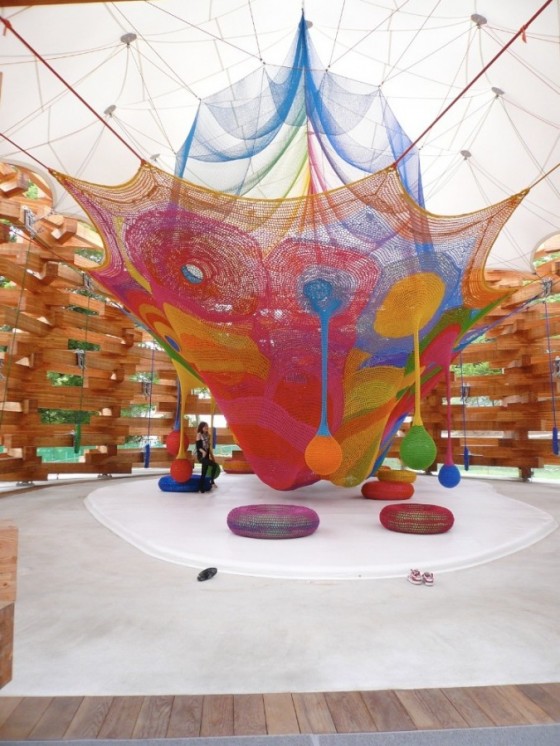
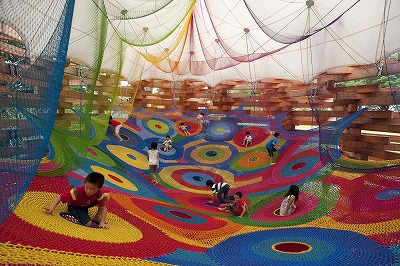
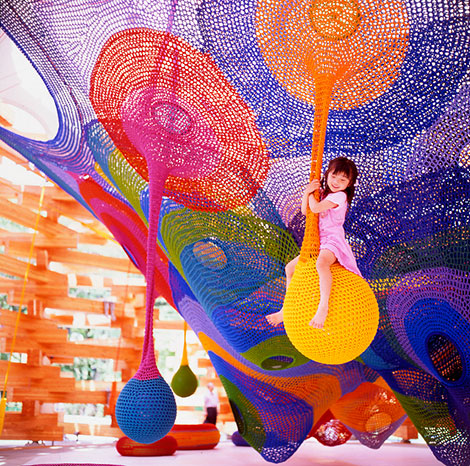
Playground Crochet by Toshiko Horiuchi

This is from last November, but still amazing!

Toshiko Horiuchi MacAdam, who orders yarn by the ton for her creations, is the textile artist behind the oft photographed net constructions at the Hakone sculpture park in Sapporo Japan.

I love the story of how she came to be engaged with children’s play:  “It all happened quite by accident. Two children had entered the gallery where she was exhibiting ‘Multiple Hammock No. 1’ and, blissfully unaware of the usual polite protocols that govern the display of fine art, asked to use it. She watched nervously as they climbed into the structure, but then was thrilled to find that the work suddenly came alive in ways she had never really anticipated. She noticed that the fabric took on new life – swinging and stretching with the weight of the small bodies, forming pouches and other unexpected transformations, and above all there were the sounds of the undisguised delight of children exploring a new play space.”

From that point, her work shifted out of the gallery and a subdued, monochromatic pallet into a riotous rainbow of colors for children’s playscapes.

Rainbow Net was produced in close collaboration with structural engineers TIS & Partners and landscape architects Takano Landscape Planning and opened in July of 2000 after three years of planning, testing, and building.

Note that the project began with a brief not for a playground, but simply for ‘public art‘.   Wouldn’t it be great if when we heard ‘public art’ we automatically thought ‘play’?

But innovative playscapes require an enormous commitment: “…endless cycles of discussion and approval, with meticulous attention to detail…[including] an actual scale wooden replica of the space in Horiuchi’s studio and accurately scaled crocheted nets using fine cotton thread. Even then, it was difficult to assess many things. What difference, for instance, would the weight of the real yarn make when everything increased in scale? All of these factors had to be calculated in order to arrive at a scientific methodology that could eradicate any risk of unacceptable danger.”During final assembly, Toshiko crocheted ten hours a day, often on her knees, until the installation was complete.”

With the current revival of the textile arts and yarn bombings everywhere, I’d love to see more crochet on the playground!

More at: Playground Crochet by Toshiko Horiuchi.

What an amazing use of fabric to create an original, creative play space.

behavior · brain · cognition · health · play

Make your cells cleaner by exercising

Cells stained for keratin and DNA: such parts ...
For cleaner cells, work up a sweat. Image via Wikipedia

We joke about getting the cobwebs out of our brain, but it turns out there really is some truth to that. And one of the best ways to give our bodies a thorough spring (or winter, or fall…) cleaning, is not through cleansing diets or saunas, but exercise! It’s beneficial on so many levels, including making you cleaner and a better environment for yourself down to the cellular level!

In the new research, which was published last month in Nature, scientists at the University of Texas Southwestern Medical Center in Dallas gathered two groups of mice. One set was normal, with a finely tuned cellular scrubbing system. The other had been bred to have a blunted cleaning system.

It’s long been known that cells accumulate flotsam from the wear and tear of everyday living. Broken or misshapen proteins, shreds of cellular membranes, invasive viruses or bacteria, and worn-out, broken-down cellular components, like aged mitochondria, the tiny organelles within cells that produce energy, form a kind of trash heap inside the cell.

In most instances, cells diligently sweep away this debris. They even recycle it for fuel. Through a process with the expressive name of autophagy, or “self-eating,” cells create specialized membranes that engulf junk in the cell’s cytoplasm and carry it to a part of the cell known as the lysosome, where the trash is broken apart and then burned by the cell for energy.

Without this efficient system, cells could become choked with trash and malfunction or die. In recent years, some scientists have begun to suspect that faulty autophagy mechanisms contribute to the development of a range of diseases, including diabetes, muscular dystrophy, Alzheimer’s and cancer. The slowing of autophagy as we reach middle age is also believed to play a role in aging.

Read the full article at the New York Times: Exercise as Housecleaning for the Body

The best part is it doesn’t seem to matter what kind of exercise, so anything from hop scotch to marathons will give you some benefit!

creativity · play

Swings for the home

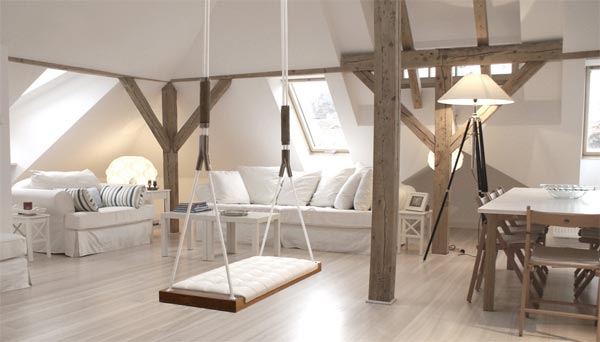
This is so cool! Swings that you can install in your own home, designed specifically for grown-ups! Brought to you by Svvving.

more at Swings for the home: 2modern.

I love the idea that a company makes swings for grown-ups to use indoors. Introducing play into your space is important, and for this company profitable. 🙂

brain · creativity · design · neuroscience · play

Creating new designs through play, brain waves

Very cool video from B-Reel, Scandinavian furniture brand Varier and Oslo agency DIST Creative, on a project that involved creating fabric designs based on brain waves, specifically the brain waves of children playing and exploring:

Design based on kids' brainwaves.

Using some of the findings from its Mind Scalextricsexperiment, B-Reel used a headset to measure the brain waves of three children using Varier’s Balans chair. (The chair is designed to promote circulation and extended activity, which is claimed to leadi to better concentration and overall well-being).

It then used a custom built data visualization engine to turn the recordings into a pattern that could be printed as upholstery for the chair. As well as creating image patterns to reflect the changes in the children’s brain activities, the engine engine also used graphic presets corresponding to the children’s personal interests and took inspiration from patterns ranging from classic tapestries to pop-art and contemporary design.

Varier Furniture is featuring the project on its website as well as at international Furniture and Design Fairs.

Originally from Creativity Online, where you can also see the video.

behavior · brain · mental health · neuroscience · play · psychology

Playing leads to lower Alzheimer’s risk

English: PET scan of a human brain with Alzhei...
Brain with Alzheimer's. Image via Wikipedia

From USA Today:

People who engage in activities such as reading and playing games throughout their lives may be lowering levels of a protein in their brains that is linked to Alzheimer’s disease, a new study suggests.

Although whether the buildup of the protein, beta amyloid, causes Alzheimer’s disease is debatable, it is a hallmark of the condition, the researchers noted.

“Staying cognitively active over the lifetime may reduce the risk of Alzheimer’s by preventing the accumulation of Alzheimer’s-related pathology,” said study author Susan Landau, a research scientist at the Helen Wills Neuroscience Institute at the University of California, Berkeley.

“Some of the literature has hypothesized this finding, but this is the first study to report that lifetime cognitive activity is directly linked to amyloid deposition in the brain,” she said. “We think that cognitive activity is probably one of a variety of lifestyle practices — occupational, recreational and social activities — that may be important.”

Read more at Keeping brain sharp, active may ward off Alzheimer’s

There have been several different studies that find the correlation between play and a healthy brain less susceptible to dementia, disease, and overall decay. Literally use it or lose it. So you might as well have fun using it!

community · play

Playful morning collaboration

From Boing Boing:

This video from the American Museum of Natural History details two recent instances where scientists have observed a whale and several dolphins interacting in ways that are something we might classify as “play”.

More from Youtube:

Recent encounters between humpback whales and bottlenose dolphins reveal a playful side to interspecies interaction. In two different locations in Hawaii, scientists watched as dolphins “rode” the heads of whales: the whales lifted the dolphins up and out of the water, and then the dolphins slid back down.

Enjoy the cooperative play:

creativity · play

Getting playful in the snow

Seattle-ites may not know how to drive in the snow, but they sure know how to get creative and have fun! Enjoy!

creativity · play

Using play to cover hard news

English: A mugshot of Puppet, S.
Puppet mugshot. Image via Wikipedia

I love this story from Cleveland, OH, about how one news team brought some fun to their news reporting, and a good way of finding a solution to a problem:

It’s courtroom drama crossed with “Sesame Street,” as a television station barred from using cameras during a high-profile corruption trial covers the highlights with a nightly puppet show. It stars a talking squirrel “reporter” who provides the play-by-play in an exaggerated, “you won’t believe this” tone.

“It’s a satirical look at the trial and, again, I think we have it appropriately placed at the end of the newscast,” WOIO news director Dan Salamone said Thursday.

He said the puppets are in addition to the station’s regular coverage of the Akron federal trial of ex-Cuyahoga County Commissioner Jimmy Dimora, the longtime Democratic power broker in Cleveland

“It’s not intended in any way to replace any of the serious coverage of the trial,” Salamone said.

With cameras barred from court, the news media has relied on artist sketches of the proceedings inside and daily video of Dimora walking into court with his wife and his defense team.

The station uses the puppets repeating testimony and performing as witnesses, reporters and jurors to detail the case, which began last week and is expected to last three months. The trial has been a daily staple of front-page coverage in The Plain Dealer newspaper and often leads TV newscasts in town.

Read the full story at Talking squirrel puppet reports from high-profile Ohio trial

It’s always nice to see when playfulness gets some attention.

behavior · play

Dogs playing in the snow

The Puget Sound has been getting a pretty nice dusting of snow lately, so this is just a great reminder to go out and actually ENJOY the change in our regular environment:

dog sledding