Having fun, exciting spaces to play is important for both kids and grown-ups, so it’s nice to see what’s out there for kids, and hopefully grown-ups will follow suit.
When you’re a kid, visiting an amazing playground is the greatest experience ever. And these fantasy-themed playgrounds around the world have us wishing that we were kids again so we could run around in them like small, crazy people.
All of these are in more urban settings, and it would be cool to see some more natural playscapes, but the ideas behind some of these parks are fantastic!
Living in a big city like London, even with parks and trees, it can be hard to find a spot dedicated to just being quiet and taking in nature.
So the Finnish Institute of London, The Architecture Foundation and London Wildlife Trust just unveiled Viewpoint, a floating platform where Londoners can slow down and enjoy Regents’ Canal. Designed by Finnish architects Erkko Aarti, Arto Ollila and Mikki Ristola, this permanent structure serves as a placid retreat for visitors to nearby Camley Street Natural Park and as an outdoor learning environment for school children and adults.
Designating spaces as official rest areas is a great way to cue people to actually take breaks, and clue them in to their surroundings, to take a minute to stop and observe.
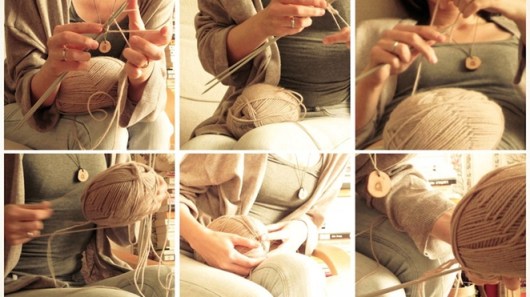
Taking time to destress and be creative has great benefits, both physically and mentally. Take knitting, for example:
It turns out that knitting has incredible health benefits. It makes people feel good in just about every way. A bit of research has revealed a wide range of ways in which knitting helps humans cope, physically and mentally.
1. Knitting is used for therapy. It’s a powerful distractant, helping people manage long-term physical pain. For those who are depressed, knitting can motivate them to connect with the world. It is a conversation starter, allowing people to interact politely without making eye contact. It builds confidence and self-esteem.
2. Knitting is supremely relaxing, which is extremely important for reducing stress and anxiety. Dr. Herbert Benson, founder of Harvard’s Mind/Body Medical Institute, wrote The Relaxation Response, in which he recommends the repetition of a word, sound, phrase, prayer, or muscular activity to elicit “the relaxation response” – decreased heart rate, muscle tension, and blood pressure. Knitting is likened to meditation, sometimes described by knitters as “spiritual” and “Zen-like.”
I have always felt like I SHOULD learn how to knit, but I actually find the idea of having to keep count and keep track of where I’m at stressful, but maybe I should just give it a try. Thoughts? Leave them in the comments below.
I’m working on an article for work, and came across this article as part of my research for the article. It pretty much sums up everything I wanted to say (darn it!).
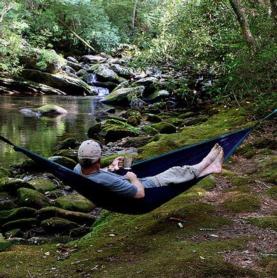
Americans and their brains are preoccupied with work much of the time. Throughout history people have intuited that such puritanical devotion to perpetual busyness does not in fact translate to greater productivity and is not particularly healthy. What if the brain requires substantial downtime to remain industrious and generate its most innovative ideas? “Idleness is not just a vacation, an indulgence or a vice; it is as indispensable to the brain as vitamin D is to the body, and deprived of it we suffer a mental affliction as disfiguring as rickets,” essayist Tim Kreider wrote in The New York Times. “The space and quiet that idleness provides is a necessary condition for standing back from life and seeing it whole, for making unexpected connections and waiting for the wild summer lightning strikes of inspiration—it is, paradoxically, necessary to getting any work done.”
In contrast to the European Union, which mandates 20 days of paid vacation, the U.S. has no federal laws guaranteeing paid time off, sick leave or even breaks for national holidays. In the Netherlands 26 days of vacation in a given year is typical. In America, Canada, Japan and Hong Kong workers average 10 days off each year. Yet a survey by Harris Interactive found that, at the end of 2012, Americans had an average of nine unused vacation days. And in several surveys Americans have admited that they obsessively check and respond to e-mails from their colleagues or feel obliged to get some work done in between kayaking around the coast of Kauai and learning to pronounce humuhumunukunukuapua’a.
The article focuses on mental downtime options like naps and meditation, which are awesome, but I would argue that being awake and aware, but also not actively engaged, like going for a walk or just sitting down and observing a garden, are good options too, especially since getting outside has also shown to be mentally reinvigorating.
This is one of the best descriptions of the power of pretend play, especially dissecting how pretend play is hard work, and can be overwhelming, especially to someone who doesn’t have practice, which is why lots of play is important for practicing real-world feelings and situations like power, restraint, and questioning assumed priors.
Power is intoxicating.
It is also dangerous.
And it is especially dangerous when applied to four-year-olds.
Four-year-olds lack the experience to wield power responsibly. They have no idea what to do with it or how to control it.
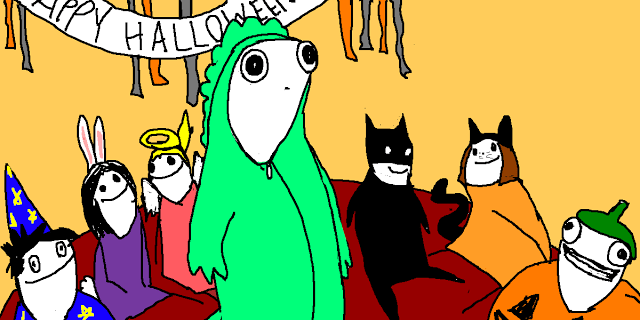
The dinosaur costume was the greatest thing that had ever happened to me.
…All I knew was that being a dinosaur felt very different from being a person, and I was doing things that I had never even dreamed of doing before. …Of course, I had always had the ability to do these things — even as a person — but I didn’t know that. I’d just assumed that I was unable. As a dinosaur, I didn’t have any of those assumptions. It felt like I could do whatever I wanted without fear of repercussions.
Now that we’re officially into fall, with the weather getting colder and wetter by the day, and all back to school or indoors,it’s important to remind ourselves of opportunities to get out and play.
Idea is Free Museum and Park Day tomorrow; September 28: over 1500 museums, and national and state parks, are opening up their doors to the public for free!
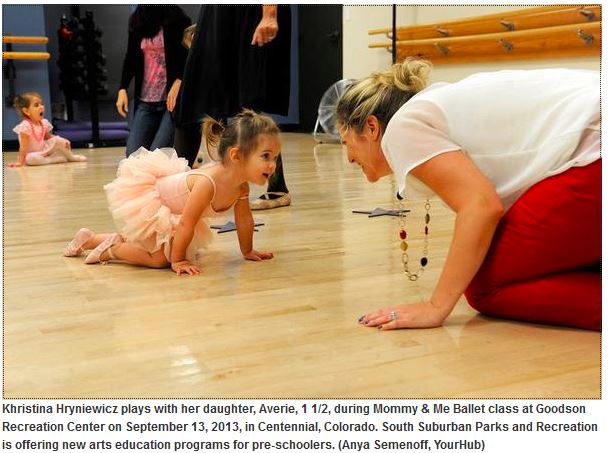
For some more structured play, there are great art, dance, and play-based programs for little and big kids. One just opened up in Colorado, and definitely understands the value of play:
The Curious About Art program is just one of many preschool arts education programs the South Suburban Parks and Recreation District offers throughout the year. It’s not so much about the final product the kids create, but the journey and experiencing sensory exploration with their parents.
“It will probably look like something you expect an 18-month-old to make, something unrecognizable but still pretty wonderful,” said Vickie Willis, culture and enrichment supervisor for South Suburban.
“Everyone needs to play,” Willis said. “It makes us feel good, it unleashes possibilities in our brain, it makes us think better.”
Aside from encouraging play, the purpose of the classes is to prepare kids for a school environment by getting them socialized to being around other children, as well as developing motor skills.
“It’s to develop the motor skills, and the little ones just want to explore their world so music and art is a good way of doing that,” said Janice Schindler, the culture and enrichment coordinator at Goodson Recreation Center
Seattle has a newly-minted hip-hop program for little kids that also focuses on the value of play and silliness in education:
Mini BREAKS is the original hip-hop dance class (breakin’ or “break dance”) for toddlers and preschoolers.
In this unique class, young students will have fun while they exercise, express themselves, think creatively, build self-esteem, practice respect, learn discipline and make new friends!
Outside of a dance studio, hip-hop culture (including breakin’) is not taught through choreography or 8-counts but more intuitively through interactive demonstration. Mini BREAKS focuses on encouraging young children to be creative and courageous – to come up with their own ideas and be able to express themselves by sharing those ideas with others. All children are artists – Mini BREAKS helps them remain artists as they grow up!
Do you notice you have different moods depending on how bright or dark it is outside? Do you notice the warmth or cold feeling emitting from a light bulb? Whether you consciously notice them or not, they do have an effect on your brain and body. Since these days most of us don’t get to work outside and absorb natural light, scientists are working on the right kind of artificial light for us.
The light emitted from our lamps and fixtures at home doesn’t just spruce up a room; it has the power to significantly augment our mood and lift our spirits.To explore further the link between lighting and personal wellbeing, glass engineering company Cantifix and Oxford University have collaborated to create the Photon Project. This scientific study comes to life at this month’s London Design Festival in the form of the Photon Pod, an all-glass living space that will help the Photon Project gather data and insights on the links between light and health.Resembling a futuristic bedroom, the pod invites visitors to experience what life is like in a completely translucent living space, as well as take part in simulations that measure levels of alertness or relaxation under varied light conditions.
Robyn Rosenberger makes capes for only the fiercest of fighters.
Have you ever had days where you felt you had super powers, or felt you needed them? One woman in Seattle is making that a reality for over 1,700 kids with illnesses and disabilities in 50 states and 14 countries, with a new workshop opening to help out more kids:
Gabby has epilepsy and is completely dependent: She cannot talk, walk or eat on her own. But she is a tiny superhero — her superpowers include perseverance, courage and strength — and she has the cape to prove it. A purple number, with a blue letter “G” hand-sewn on by Robyn Rosenberger.
Rosenberger is the powerhouse behind TinySuperheroes, which makes capes as a form of empowerment. “Our mission is to empower these kids to feel as extraordinary as we see they are,” Rosenberger explained.
On the surface this may seem a little fluffy, but it exemplifies the power of play, particularly imaginary play and pretending. First, it gives the kids a chance to take a break from their illness and maybe laugh a little, which is good for everyone. Second, the crazy thing is researchers are finding that by pretending to be big, strong, dominant, and super-hero-esque, it can train your body to actually be more strong, dominant, and super-hero-esque. Even healthy kids can feel pretty powerless, so by imagining what it feels like to be strong and healthy it can help their minds and bodies map out what that might look and feel like and maybe even help along the road the recovery.
So by giving these kids superhero capes, these volunteers are in fact giving these kids some pretty strong medicine.
Now I want a cape, or at least a magic wand.
If you are interested in helping out, visit the Tiny Superheroes site.
One hospital has a goat on their property that patients can see. One way to keep things engaging and fun and not feel like “a hospital.” (Photo credit: Jen R)
It’s not as silly as it sounds; in fact it’s genius!
Hospitals could improve patients’ quality of life, satisfaction and even health outcomes if they simply model adult hospitals after the ones designed for children, according to an opinion piece written by a fourth-year medical student in this week’s Journal of the American Medical Association.
Mark A. Attiah, who attends Perelman School of Medicine at the University of Pennsylvania in Philadelphia, writes in the piece, “Treat Me Like a Child,” that adult hospitals should take a page from pediatric facilities by creating surroundings that distract and reduce stress and making clinical practices more patient- and family-oriented rather than more convenient for caretakers.
Attiah was inspired to write the opinion piece after encounters with two pediatric patients during a rotation and another who transitioned into an adult hospital, according to an announcement about the editorial. The children’s hospital was bright, had longer visiting hours and allowed families to stay at the child’s bedside throughout the night. In addition, pediatric patients enjoyed the distractions of group activities, arts and crafts, and concerts. “If I ever get sick, I’d want to be taken here,” he writes.
Kid’s hospitals keep stuff light, upbeat, and optimistic. which is exactly what we need to get healthier, and want to go back to a particular hospital for our next ailment, since most hospitals care about that sort of thing.





 Mental Flowers