autism · behavior · children · health · Social

Dogs trained to help disabled kids lead more enriching lives

Your feel good story of the day, brought to you by the New York Times: a nonprofit organization trains dogs to help kids with all kinds of disorders, from autism to muscular dystrophy to seizures.

In October 1998, Shirk assembled a board and founded 4 Paws for Ability, a nonprofit corporation. She rescued Butler, a German shepherd mix, from a shelter; hired a trainer to prepare him for mobility work with the 12-year-old; and became a pioneer among service-dog agencies. “People started calling from all over to ask, Am I too young? Am I too old? Am I too disabled? Am I disabled enough?” she says. “I said, ‘If your life can be improved by a dog, and if you and your family can take good care of a dog, we’re going to give you a dog.’…” “We place dogs with kids in wheelchairs, kids on ventilators, kids with autism, kids with dwarfism, kids with seizure disorder and cognitive impairments; but if your dog does tricks, other kids want to meet you. Kids will ignore your disability if you’ve got a cool dog.”

Watch the video at the New York Times:
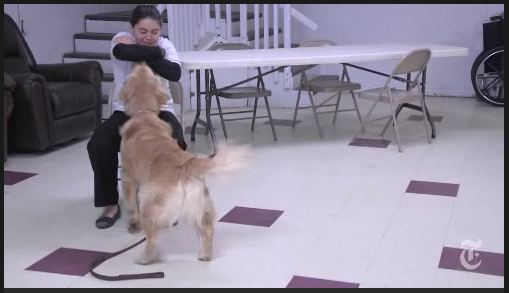
A trainer works with a dog on behavior modification techniques. Click the image to see the video.

It is also an amazing relationship dynamic to see occur between the children and their dogs, how the children with cognitive disabilities in particular are helped to see the world, in a way, through their dog’s eyes:

Alan M. Beck, the director of the Center for the Human-Animal Bond at Purdue University’s College of Veterinary Medicine, is among those intrigued by it. “There is a real bond between children and animals,” he told me. “The younger the child, the greater the suspension of disbelief about what an animal understands or doesn’t understand.” According to Beck, more than 70 percent of children confide in their dogs, and 48 percent of adults do. “The absolutely nonjudgmental responses from animals are especially important to children,” he says. “If your child with F.A.S.D. starts to misbehave, your face may show disapproval, but the dog doesn’t show disapproval. The performance anxiety this child may feel all the time is absent when he’s with his dog. Suddenly he’s relaxed, he’s with a peer who doesn’t criticize him.”

behavior · education · happiness · health · Social

Non-Elimination Games Leads to More Physically Active Children, Researchers Say | MomsTeam

A typical game of tic tac toe English: Tic tac...
Non-competitive games also have benefits. Image via Wikipedia

Interesting article about the value of non-elimination games (the original author focused on “non-competitive” but there are many competitive games that don’t involve elimination):

A study presented in May 2008 established that the structuring of children’s games has a significant effect on energy expenditure.

A research team led by Karla Bruggeman and David Dzewaltowski, Ph.D., measured activity during both elimination- and non-elimination games, using accelerometers, in 29 children in grades four through six. Both normal weight and overweight children participated in the study, but were not separated for analysis.

In non-elimination games, kids accrued more overall physical activity due to not having to spend time on the sidelines as a result of elimination. They also accumulated significantly more moderate and vigorous physical activity than elimination games. Both sets of games were adopted from a children’s program devised by a nonprofit group that uses various pieces of equipment to facilitate non-competitive play; elimination games were modified from non-competitive versions.

Children were surveyed for self-efficacy, enjoyment, and peer victimization following both types of games. Results showed that enjoyment was somewhat higher following elimination games, although enjoyment scores were high in non-elimination games as well. There were no reports of peer victimization in either set of games, but were significant increases in self-efficacy after both sets.

“The games in this study were part of fun and enjoyable day camp,” Bruggeman said. “It is likely that a well organized and positive game experience increases a kid’s confidence regardless of elimination or non-elimination game conditions.”

Again, the article author was focusing on non-competitive sports, but really the evidence is looking at non-elimination sports. While I don’t find anything wrong with competitive sports, I know they’re not everybody’s cup of tea, and I think it’s great to emphasize the fact that you don’t need to be playing on a team sport or competing against others in order to gain the same benefits from play. And there are lots of non-competitive physical activities that kids can and do partake in: parkour, running, climbing, digging in the dirt, parachute play, biking… what else? Name your favorite non-competitive physical activity in the comments.
behavior · brain · happiness · health · learning · neuroscience

It really is the journey rather than destination

HappinessNice interview from Salon with scientist Shimon Edelman about how scientists are discovering neural patterns to the behaviors and activities that make humans happy; turns out the act of learning is often more rewarding than what we learn:

Shimon Edelman, a cognitive expert and professor of psychology at Cornell University, offers some insight in “The Happiness of Pursuit: What Neuroscience Can Teach Us About the Good Life.” In his new book, Edelman walks the reader through the brain’s basic computational skills – its ability to compute information, perform statistical analysis and weigh value judgments in daily life – as a way to explain our relationship with happiness. Our capacity to retain memories and develop foresight allows us to plan for the future, says Edelman, by using a mental “personal space-time machine” that jumps between past, present and future. It’s through this process of motivation, perception, thinking, followed by motor movement, that we’re able not only to survive, but to feel happy. From Bayes’ theorem of probability to Shakespeare’s “Romeo and Juliet,” Edelman offers a range of references and allegories to explain why a changing, growing self, constantly shaped by new experiences, is happier than the satisfaction any end goal can give us. It turns out the rewards we get for learning and understanding the workings of the world really make it the journey, not the destination, that matters most.

Read the interview.

behavior · happiness · health · mental health

Playing with the piggies

Pigs are incredibly intelligent creatures that need enrichment and play just like we do. This is a great story about providing enriching environments and play to livestock, similar to what Temple Grandin advocates here in the U.S.

“[R]esearchers at Wageningen University [in the Netherlands], in the course of their research on ethical livestock farming, noticed that pigs like to play with dancing lights…European regulations currently require that pig farmers provide mentally-stimulating activity for their pigs in order to reduce boredom…” (via mother jones)

The coolest part is, HUMANS would get to interact and play with pigs:

“As a farmer, you’d get to play video games with your hogs, and the gameplay might actually have the added benefit of making the animal’s life happier and healthier.

The system includes a giant screen that broadcasts a swirl of glittering colors and lights next to the pigpen. The human participant controls the wall-sized screen remotely with an iPad, and the pigs react by touching and following the light designs with their snouts. Clement notes that researchers hope that this will all “open up new questions in debates about animal farming and welfare in the digital age…”  (via mother jones)

Check out the video:

The Playing with Pigs project is researching the complex relationship we have with domesticated pigs by designing a game. Designing new forms of human-pig interaction can create the opportunity for consumers and pigs to forge new relations as well as to experience the cognitive capabilities of each other. The game is called Pig Chase.

For additional background, visit the Playing with Pigs project website: playingwithpigs.nl

Pretty cool idea to let humans and livestock interact with each other in different ways.

children · education · happiness · health · learning · play

Play is a crucial part of learning

Great article from The Atlantic about how squeezing recess and playtime out of education is a really bad idea:

Play is important for the emotional, social, cognitive, and physical development of children. In addition to being critical for general health and a preventative against overweight, play develops life skills for children and communication skills among peers and family members.

But because of over-scheduling, over-supervision, lack of appropriate play environments, and too many entertaining screens many children have less access to play time and play spaces than children in the past.

Children living in poverty experience these barriers and more, according to a recent clinical report from the American Academy of Pediatrics. Underprivileged children often have less access to recess and school-based creative arts, music, and physical education programs. Additionally, the socioeconomic stressors on poor families often conspire against parents having the time, energy, or skills to engage in play with their children.

Poor children’s access to outdoor play spaces may be compromised by the safety of their neighborhoods and the decrease in parks and open spaces in urban areas. Children who are unable to play outside tend to spend more time on screen-based activities such as watching TV or playing video games. Excessive screen time takes a huge toll on mental and physical health and academic achievement

Many urban schools have replaced recess and purely recreational after-school activities with academic enrichment activities to help close the academic achievement gaps between lower-income children and their more privileged peers. While improved academics is an important goal, the report emphasizes that the developmental role of play should not be forgotten and the benefits of play should not be traded off in favor of academics.

According to the report, play’s benefits extend to psychological well-being. Play provides an opportunity for a student to shine in areas that are not strictly academic and thus contributes to the child’s personal sense of pride and belonging in her school environment. This has the potential to discourage truancy and encourage children to remain in school to complete their education

Twenty-eight percent of schools with children in the highest poverty levels have no recess at all. This impacts a population of children who already have limited opportunities for creative experiences and social play, especially since research that has shown that physical education periods and recess enhance a child’s readiness for academic pursuits during the school day. They suggest that the elimination of these pace-changing opportunities may in fact be counterproductive for academic success.

More at Recreational Play Can Be Far More Important Than Academics

behavior · environment · health · mental health

How to Find a Quiet Space for Meditation

Levitating, Meditating, Flute-playing Gnu
How do you find space to relax and/or meditate? Image via Wikipedia

Work has been really hectic lately, and I’m finding it can be hard to find a quiet place for myself, not only metaphorically, but even physically. My house is full of dog or husband, the bus is impossible, and it seems like there isn’t an empty spot anywhere in the whole 20-story building I work in.

Here is some great advice from blog Quieting the Mind “for finding a quiet space for meditation:”

Make sure everyone in the house knows not to disturb you. If you have young children who can’t understand this, make sure to meditate when your spouse or someone else is home, so they can care for the children during this time. It’s only ten minutes. Surely, someone can ward off any distractions.

Find the quietest room in your house and set a little area that is designated for meditation. Always use the same room and close the door when you meditate. This way, people will know not to disturb you.

Meditate at the same time every day. If your household knows that you wake up at 5 a.m. to get your daily meditation in every day, they’ll learn to respect your privacy during that time.

If all else fails, put up a sign: “Meditating: Do not disturb!” If you get a distraction (one that isn’t an emergency) pretend you don’t hear the person. They won’t continue interrupting you if they don’t ever get a response.

Invite others to meditate with you. They may enjoy it, but best of all, you’ll all have some quiet time. It may take some getting used to for everyone, so allow an adjustment period, but it can really be worth it.

more via How to Find a Quiet Space for Meditation.

How do you make space, both using time and physical space, to find a piece of quiet? I know of more than a few people who use their commute as their quiet time, but that doesn’t work for others (myself included). Where else?

anthropology · behavior · brain · community · happiness · health · mental health · psychology

Life Lessons Passed On

English: Elderly Muslim during the Republic of...

I was really inspired by that blog post I shared a couple of months ago about cancer survivors and what they’d learned about life. I also posted a survey done with older folks last year giving advice on what NOT to do.

Well, thankfully all of that hard-earned knowledge is coming out in book form. Many of the interviews can also be at legacyproject.human.cornell.edu. From the NYTimes:

Eventually, most of us learn valuable lessons about how to conduct a successful and satisfying life. But for far too many people, the learning comes too late to help them avoid painful mistakes and decades of wasted time and effort…

Enter an invaluable source of help, if anyone is willing to listen while there is still time to take corrective action. It is a new book called “30 Lessons for Living” (Hudson Street Press) that offers practical advice from more than 1,000 older Americans from different economic, educational and occupational strata who were interviewed as part of the ongoing Cornell Legacy Project.

Its author, Karl Pillemer, a professor of human development at the College of Human Ecology at Cornell and a gerontologist at the Weill Cornell Medical College, calls his subjects “the experts,” and their advice is based on what they did right and wrong in their long lives.

You can also read a summary of their advice in the article: Advice From Life’s Graying Edge on Finishing With No Regrets

What are your life lessons?

environment · health

Porous Roadways for Better Runoff

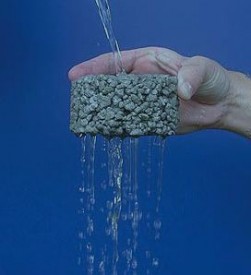
Water flowing through pervious concrete, courtesy of the National Ready Mixed Concrete Association.

This post is more focused on conservation and environmental preservation than usual, but I’m a sucker for a good “save the planet” technology story. Plus, I believe pretty much anything we can do to conserve the environment makes for an overall better, healthier, happier us.

When I first read the headline for this article, I thought it was going to be a complaint about the poor quality of several streets in major cities like Seattle and Portland that are supposedly “bike friendly,” where even a seemingly small series of potholes in a street can mean trouble for bikers like myself.

But no, this is better; a type of concrete that actually lets rain water and other liquid runoff through to the soil beneath, preventing flash floods, bad puddling and worse erosion:

Permeable pavement can make old-school road engineers and pavement builders anxious. To them, the idea of water seeping through roads like they’re made of Swiss cheese just doesn’t seem right. Water runs off roads, not through them. Or at least it used to.

In the Northwest, there’s a growing acceptance of the use of pervious concrete and porous asphalt for roads, sidewalks, parking lots, and driveways. The unconventional pavement does a great job reducing the amount of polluted stormwater runoff that damages homes, streams and lakes. Instead of gushing from the roads carrying a slug of toxic chemicals, the water seeps through small pores in the pavement, soaking into the gravel and dirt beneath the road. Some of the pollutants get trapped inside or beneath the pavement, or are consumed by organisms living in the ground below it.

Those who’ve used the pavement praise the technology. Advocates can be found around the region, including a 32-acre eco-friendly development near Salem called Pringle Creek, where all of the roads and alleys were built with porous asphalt.

Read more at: The Porous Road Less Traveled | Sightline

I’ve heard of this technology being used in driveways with great success, so it’s nice to hear it being used in larger applications.

behavior · creativity · health · youtube

30 minutes of play a day!

*edit*: NOW with working YouTube link. Thanks for NOT telling me, people, gosh! 😛

In case you’re still trying to come up with a new year’s resolution, or even if you think you’ve got your goals for 2012 all set, you might want to make room for one more.

Ryan Ford, the man behind the DemonDrills workouts on YouTube and owner of Apex Movement, a Parkour and Crossfit gym in Colorado, makes a very convincing argument for just how easy it is to incorporate 30 minutes of fun exercise, i.e. play, into your day:

You’d be amazed at how easy it is to add a little play into your day, and how quickly that play adds up. It also helps get the creative juices flowing and helps you see the world in new ways, so it’s also good brain exercise.

architecture · design · disease · health

Designing and Building for Wellness

An overlay of two images: one of a river delta...
What does it mean to design with a person's wellness in mind? One architect has an idea. Image via Wikipedia

Great blog post from The Patron Saint of Architecture about what it means for her to be an architect and build and design things for people’s overall health and wellness:

As architects, we seek to inspire those who move through the environments we create.  It’s also our job to understand how the space will be used and create elements that support that use.  The last leg of the stool, a part we often overlook, is the need to make buildings that support wellness.  Even architects who design healthcare buildings often forget about this one as they work to meet many other challenges related to budget, program, operational  and code requirements.  Maybe it’s because wellness is such a slippery term.  Much like the term “green,” “wellness” is often bandied about, a buzzword that makes some aspect of a product, design or organization sound like it’s good for us. So how do we know if it really is- much less translate that into design elements?  I have been thinking about this issue for a while and even found an interesting website devoted to defining wellness complete with helpful questionnaires.

I’ve come to the conclusion that true wellness is multidimensional and positively impacts our physical, mental and social state of being.  With that in mind, I have also observed that, as a profession, we kind of, sort of, dip our toe in the waters of designing for wellness.  We embrace sustainable building standards, evidence-based design, lean design, even socially conscious strategies.  However, these are just quantifiers.  Building blocks of the wellness leg of the architecture stool, but not enough as stand-alones.  True architecture of wellness must incorporate all of these measures, but spring from a much deeper intent.

Read her recommendations for building spaces that promote wellness at her blog post: architecture of wellness