architecture · community · environment · happiness · health

Seattle Neighbors Fight Stormwater Pollution by Building Rain Gardens · Oregon Public Broadcasting

This post is a total plug on my part of an activity meant to encourage people to go out and get their hands dirty, improve their environment, and help nature at the same time: Rain gardens!

Gardening season is coming to an end for most of us, but it’s not too late to plant a rain garden for this winter’s torrents.

Rain gardens are becoming more popular, especially in places like Seattle with significant rain and run-off, and I suspect also because they’re very low maintenance; you simply plant, water them until they’re established, and let nature to the rest. They also make the neighborhood look nicer than just having a strip of grass between your car and the sidewalk.

The West Seattle neighborhood is actively encouraging residents to plant rain gardens:

The gardens are part of a campaign by Washington State University and the non-profit Stewardship Partners. Their goal is to install 12,000 rain gardens in Puget Sound communities by 2016. So far, more than 700 gardens have been installed (see a map of them) and more are being added every week.

“Twelve thousand gardens will absorb approximately 160 million gallons of stormwater each year,” said Stacey Gianas, who is with Stewardship Partners.

That much water would fill 250 Olympic swimming pools. And its stormwater, which washes over roofs and streets, picking up all kinds of pollution. Usually that contaminant-filled water runs into storm drains that empty into waterways and rivers.

more via Neighbors Fight Stormwater Pollution by Building Rain Gardens · Oregon Public Broadcasting · EarthFix.

Rain gardens can be as small as a couple of feet, or take up the entire yard. They also promote wildlife (the good kind!) to stop and visit.

behavior · brain · environment · neuroscience

Human Brain Responds To Animals, Cute Or Creepy : NPR

Koala
Humans are hard-wired to spot animals in our environment. Image by Rennett Stowe via Flickr

Have you ever sworn you knew what your cat was thinking? You may have been right. It turns out we are more tuned into animals and their emotional status than we might think:

Animals have a special place in the human heart. Now, researchers are reporting that creatures great and small also have a special place in our heads.

A team led by researchers at Caltech has found individual brain cells that respond when a person sees an animal, but not when that person sees another person, a place, or an object.

The cells were found in the amygdala, an almond-shaped part of the brain involved in emotions, including fear. And they responded to any kind of animal, including spiders, dogs and rodents, says Christof Koch, a researcher at Caltech and the lead author of the study, published in Nature Neuroscience.

One reason present-day humans have these cells may be because some animals posed a threat to our ancestors, Koch says. Specialized cells could have helped the brain respond quickly to danger, he says.

more via Human Brain Responds To Animals, Cute Or Creepy : NPR.

I love the idea that urge to cuddle puppies comes from the amygdala, often referred to as the “lizard” part of our brain! It makes sense that as humans we’d survive better if we were more in tune with the animals in our surroundings and whether they wanted to eat us or not.

behavior · environment · happiness · health · mental health · Nature

The healing effects of forests, gardens, greenery

Hopetoun Falls, Beech Forest, near Otway Natio...
Visiting natural environments even for a short time can be beneficial for one's health. Image via Wikipedia

After spending some time this weekend in my garden, lounging in the dappled sunlight, it reminded me just how powerful nature is to rejuvenate and heal both physically and emotionally.

Many studies show that after stressful or concentration-demanding situations, people recover faster and better in natural environments than in urban settings. Blood pressure, heart rate, muscle tension and the level of “stress hormones” all decrease faster in natural settings. Depression, anger and aggressiveness are reduced in green environments and ADHD symptoms in children reduce when they play in green settings.

via The healing effects of forests.

So remember the next time you’re stressed, just staring at a house plant can help destress you.

architecture · behavior · community · creativity · environment · happiness · play

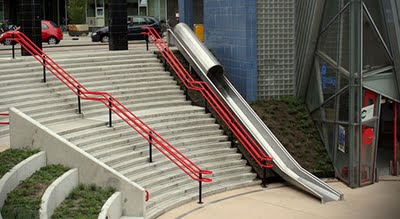
Slide into work with the subway slide in Holland

Thanks to the blog Cup of Jo for finding this:

Leave it to the Dutch to install a slide in a subway station. Commuters are encouraged to use it if they’re running late, and the official name is a “transfer accelerator.” At night they play Bach. How rad is that?!

more via A CUP OF JO: Dutch subway slide.

I love the idea of putting a little fun in your commute, in the community, and just keeping your environment fun in general.

Where else have you seen a little fun put into everyday surroundings? I’ve posted about the musical stairs before, but what else is out there? Some silly graffiti? Colorful cars? Share in the comments below.

disease · environment · health

Noise pollution

A landing Qantas Boeing 747-400 passes close t...
Image via Wikipedia

Great editorial about the effects of noise pollution on people in populated areas, and from a source who would know; Burma, or Myanmar, a country with over 55 million people crammed into a relatively small space:

The Manipur Pollution Control Board has been making efforts to lessen pollution in this fast growing city of ours. However one dimension of pollution seems to be neglected comparatively speaking, and that is noise pollution. Most citizens are unaware that prolonged exposure to noise pollution can lead to deafness or hearing impairment.

To get a clearer picture of the menace of noise pollution let us get down to a few facts. Noise is measured by its loudness and the technical measuring unit is decibel (dB).

The quietness we get in a library is surprisingly measured at 30 dB. Perhaps the flipping of pages are responsible for that. The quietness in a garden, far from the madding crowd, is slightly higher.

It is not known how many decibles are registered by a nagging wife. But it is bound to make a few neighbours raise their eyebrows and plead for calm. However Rip Van Winkle left his wife and slept in quiet and solitude for twenty years.

On the other hand a pair of young lovers will of course, make sure that at least sound does not betray their presence.

City traffic, heard from inside a car is measured at 85 dB. A police whistle is measured above 90 dB. The level at which sustained exposure may result in hearing loss is between 90-95 dB.

What is of concern, particularly related to our children, is that even short term exposure to excessive loudness can cause permanent damage.

more at The Menace of Noise Pollution.

I have moved from a couple of different apartments because of the associated noise pollution from busy streets or freeway noises, and I can’t work with super loud music on (although a little white noise is actually useful for me).

What are some of the biggest noise polluters where you live?

behavior · environment · Nature · technology

ParksByNature Smart Phone Apps Make State Parks Accessible Like Never Before | Inhabitat

Buffalo appWe hear stories of people getting lost or running into dead end streets because they are too religiously following their GPS or smart phone directions. And I’ve definitely been to dinner a couple of times in groups with one or two people who wouldn’t get off their phone. However, some smart phone apps can be useful and engaging, such as apps that encourage people to get out into nature. Inhabitat offered a write-up of one such app that’s tied into the U.S. park system.

Okay, so the article is totally written as a pitch to sell the app, but why not? This is an actually somewhat useful app that gets people more engaged with nature!

Many of us remember spending summers driving to lakes, hiking with the family and camping in the great outdoors, but some of today’s kids would rather spend some alone time with their iPhones than with Mother Nature. ParksByNature’s apps engage the gaming set with an interactive tour guide called The Pocket Ranger. Available in the free Lite Version or the upgraded Pro Version ($3.99), the app features park information, weather alerts, a social network to share favorite spots and photos in real time, and safety features like Friend Finder and Alert Feature, which helps coordinate rescues if a natural disaster were to strike.

The Pro version has guided tours and hikes with GPS tracking, downloadable detailed maps and best of all, supports the park directly. ParksByNature shares the fee with the parks system and Friends of State Parks, a nonprofit partner.

more via ParksByNature Smart Phone Apps Make State Parks Accessible Like Never Before | Inhabitat – Green Design Will Save the World.

They are also planning to expand to zoos, museums, and other nature experiences.

Now I just wish they’d make one for all us non-iPhone aficionados.

behavior · environment · Nature

Can’t Eliminate an Invasive Species? Try Eating It. – NYTimes.com

Pterois volitans, also known as red or common ...
Can you imagine this guy for dinner? Image via Wikipedia

NOAA recently issued a warning that ocean warming may push common fish staples into more northern climes, causing a shift for fisherman and an introduction of “invasive” species. There are also several species of fish that have invaded lakes and rivers that gobble up juvenile local breeds. It’s proven very hard to eliminate only one kind of fish from an environment. One solution may be “If you can’t beat ’em, eat ’em”?

An invasive species, the lionfish is devastating reef fish populations along the Florida coast and into the Caribbean. Now, an increasing number of environmentalists, consumer groups and scientists are seriously testing a novel solution to control it and other aquatic invasive species — one that would also takes pressure off depleted ocean fish stocks: they want Americans to step up to their plates and start eating invasive critters in large numbers.

“Humans are the most ubiquitous predators on earth,” said Philip Kramer, director of the Caribbean program for the Nature Conservancy. “Instead of eating something like shark fin soup, why not eat a species that is causing harm, and with your meal make a positive contribution?”

“We think there could be a real market,” said Wenonah Hauter, the executive director of Food and Water Watch, whose 2011 Smart Seafood Guide recommends for the first time that diners seek out invasive species as a “safer, more sustainable” alternative to their more dwindling relatives, to encourage fisherman and markets to provide them.

more via Can’t Eliminate an Invasive Species? Try Eating It. – NYTimes.com.

Unfortunately I’ve heard the lionfish doesn’t taste very good, but if they get the right marketing campaign on this, lionfish sushi may become all the rage!

behavior · community · culture · education · environment

Bicycling our way into work and out of the Great Recession | Grist

Ringstraße, Vienna, Austria, 2005
A commuter in Austria. Image via Wikipedia

I am always interested in how organizations promote healthier, more enriching, more environmentally friendly practices, and I think this article makes a good point, that a lot of the bike commuter programs are geared towards the middle to upper class, yet the people who NEED to use bikes, and in many college towns I’ve lived in DO use bikes but need the support and information, are poor young folks:

The way we work has been changing for a long time, and our transportation needs and options along with it. With the recent recession, fewer people are working as much or for as much money, or as regularly — or at all. More of us are, in a word, poor.

We’re the ones who need bicycling the most. Yet the broke and the tenuously employed aren’t always reached by bicycle transportation advocacy, education, and services. When they are, the messages being promoted are not always relevant or welcome.

The mainstays of bike advocacy organizations are the three E’s: engineering, enforcement, and education — with a fourth E, encouragement, becoming increasingly popular.

U.S. bike advocacy is also imbued with a heavy focus on individual responsibility as more important — or perhaps more readily achievable — than social and infrastructure change, as exemplified by the until-recently prominent vehicular cycling movement.

Such initiatives tend to reach out to the people who ride — or don’t — out of choice rather than economic necessity, whose only barrier to getting on a bike is motivation.

When you’re already broke, you don’t need to be encouraged to adopt someone else’s lifestyle. You need solutions that arise from your own circumstances and community.

That means that simply choosing to hop on a bike isn’t actually that straightforward. Even as your car is sucking your savings dry and pummeling your credit, at least it’s the devil you know.

People living in low-income households are less likely to have access to a working bicycle (only 29 percent of households making less than $15,000 do, according to the NHTSA’s most recent survey). Aside from the cost and learning curve of acquiring, outfitting, and maintaining a reliable everyday bicycle, if you’re broke your neighborhood is also less likely to be graced by bike lanes, calmed traffic, and other facilities that are lauded for their ability to raise property values. You’re also less likely to have easy, central access to grocery stores and other amenities.

more via Bicycling our way into work and out of the Great Recession | Grist.

I’m curious to hear what solutions people may have for this. How do we focus more on getting the poor, or more accurately the broke, onto bikes safely and effectively?

behavior · community · culture · environment

Making Sustainability Legal | Sightline Daily

Low Impact Development
Image by American Planning Association - Virginia Chapter via Flickr

We all know of a few laws that have outlived their usefulness that haven’t been taken off the books yet; where I grew up there was technically a law that while traveling the Cuesta Grade “trail” in a car, you had to blow your horn five times before cresting the hill to scare the cows away; it is now the major 101 Freeway and there are few cows anywhere near the top of the Cuesta Grade.

It turns out that in many places these outdated laws may be inhibiting our ability to instigate more sustainable practices.

Some of the smartest, most innovative solutions for building thriving and sustainable communities in the Northwest are, at present, simply illegal.

Take the problem of the urban stormwater runoff that threatens the health of Puget Sound and other waterbodies throughout the Northwest. Low Impact Development (LID) solutions—including such strategies as rain gardens, street-side swales, porous pavement, and green roofs—can treat stormwater more effectively, and for less money, than the costly “hard” infrastructure of downspouts, pipes, and sewers. Yet many development codes mandate the more-expensive, less-effective plumbing solution. If only codes would allow LID as an alternative, the region could see a proliferation of lower-impact techniques that could spare government coffers in lean times, and give developers and homeowners a financial break—even while providing cleaner water and patches of urban habitat.

more via Making Sustainability Legal | Sightline Daily.

The question, then, is how to remove or buffer these laws in order to encourage sustainable practices and make sure residents and construction companies alike are compliant with the law while also being forward thinking and adopting better practices. Thoughts? Have you seen a town actually remove an outdated law or ordinance? Share it hear in the comments below.

architecture · community · culture · environment · Social

Bathrooms, Internet part of revitalization plan for Pioneer Square

101 S Jackson St in the Pioneer Square neighbo...
Example of architecture in Pioneer Square Neighborhood. Image via Wikipedia

Revitalizing a neighborhood, i.e. growing a community or keeping it from leaving, can be difficult, even if everybody’s in agreement on what needs to get done. I’m seen a couple of revitalization plans for neighborhoods *cough* *Alameda* *cough* *cough* go nowhere fast. Seattle’s plan for one of its oldest neighborhoods, Pioneer Square, involves free Internet and better parking.

Comcast has been chosen to provide high-speed Internet service to businesses in Pioneer Square, Mayor Mike McGinn said Wednesday, one of several efforts aimed at reanimating a neighborhood perceived to be in trouble.

McGinn also announced that Onehub, a business-file sharing company from Bellevue, was moving into the city’s oldest community next month. Charles Mount, Onehub CEO, said juiced-up Internet was a key factor in the decision to bring his 10-person business across Lake Washington…

The Comcast and Onehub announcements were part of the unveiling of a new plan (PDF) to revitalize Pioneer Square, the product of a panel of more than two dozen business, neighborhood and city leaders. Among the ideas are to increase residential density, streamline permits, improved lighting, better manage parking increase public safety.

“We by no means think we have the problems licked in Pioneer Square, we know it’s going to take a lot more work,” McGinn said.

more via Bathrooms, good Internet: Can they save Pioneer Sq.? – seattlepi.com.

Last summer they also had a “Pioneer Square” craft festival with food trucks and all sorts of crafty items. I have no idea if they’re doing it again this year (I guess not?), but if they are going to try and keep it as a tourist attraction for the people who jump off the ferries, then bathrooms and better lighting are a good start.

What else would you do to improve the feel of Pioneer Square? Cleaner streets? Different kinds of shops? Leave your ideas in the comments below.