behavior · brain · emotion · mental health

The One Minute Vacation from The Business School of Happiness

Animation of a diaphragm exhaling and inhaling
Follow this cartoon's directions and fill your lungs all the way to your diaphragm, and push the air out from the same place. Image via Wikipedia

Just a nice reminder to breathe every once in a while, courtesy of the Business School of Happiness:

The mere thought of taking a vacation can bring a smile to almost anyone’s face. The idea of getting away from work loads, demanding children, school and any and all other commitments that make up daily life is immensely appealing.

Unfortunately, time and money may hamper making those visions of relaxation reality. This need not be the case because that the same relaxing benefits of taking a vacation can be found in minutes of simple meditation interspersed throughout the day. In fact, three one minute sessions of deep breathing–taken at pre-set intervals throughout the day may indeed deliver the deep sense of peacefulness that might have seemed elusive.

The secret? Schedule a minute of relaxation every two to three hours–just like you would an appointment or meeting. Mark it on your calendar so you don’t forget. Then, find a quiet place. Lock yourself in a bathroom stall if it is your only option or pull over while driving. Close your eyes and take a series of 10-20 very deep, thoughtful breaths.

more tips on breathing via The One Minute Vacation » The Business School of Happiness.

In all honesty I am the worst when it comes to taking time for myself, even a minute. But I posted this exercise, or at least one very similar, to my desk cubicle at work, and even if I don’t give myself a relaxing vacation every couple of hours, it does remind me that that is an option, and it is much more productive than fretting for those two or three minutes.

It may feel weird at first, but give it a shot: breathe innnn sloooooowwwly until you think you can’t fill your lungs any fuller, and then let sloooooowwwly let it out. There, I bet you feel better already. Remember, the more breathing you do the better it is for your brain.

behavior · brain · community · emotion · happiness · mental health · Social

Yes, you can now be addicted to social media

Illustration of Facebook mobile interface
Social media keeps us connected with friends, but for some can be detrimental to everyday life. Image via Wikipedia

I love being able to connect to old friends, classmates, and coworkers via social media, as well as share thoughts, ideas, and new developments. But some people can take it too far, and while I have my weaknesses as much as the next gal, I don’t think I’d consider myself addicted as they describe it. Apparently people can receive intense highs from the social interactions and feel like they need a “fix” if they go on too long without checking in to one of their social media networks.

When you hear the word ‘addiction’ perhaps you think of alcohol, drugs and sex. But what about social media? Over recent years there’s been an emergence of studies into social media as a new form of addiction.

Research by Retrevo Gadgetology looked into how people use social networking sites. Out of those asked, 45% said they check Facebook or Twitter after getting into bed. People under the age of 25 were the more extreme with 19% saying they log on any time they wake up during the night, 27% said they sometimes check when they wake up during the night and 32% check in first thing in a morning.

via Social Media: The Pursuit of Happiness.

To me this indicates just how detached and isolated many of us are, that instead of going to a local gathering or even a bar or club when we’re feeling lonely, we go online. It’s been shown that Americans feel more isolated and alone than at any other time in our history (or at least history of checking for this kind of thing), and I would hypothesize we’re turning to these social media networks as some way to retain communities we’ve established in other physical locales, or create new ones that are entirely virtual. I also wonder if the meta-interaction makes people feel less fulfilled than dealing with people in real, physical life and make them anxious to get more. I believe social media networks are useful, no doubt, but I do wonder if we are using them as a crutch rather than actually meeting people in person. Granted a lot of social media sites encourage actual in-person meetings, from online dating sites to the new GrubwithUs startup that acts as matchmaker for hungry social types in various cities across the U.S.

What are your thoughts about social media networks and people who can’t seem to unplug from them? Leave your thoughts and/or experiences in the comments below.

architecture · behavior · emotion · health

New WA hospitals are more open, less foreboding – seattlepi.com

St. Elizabeth Hospital
Old hospital style: not very healing. Image by reallyboring via Flickr

Getting sick and not feeling well is scary, so it’s good to see hospitals becoming more in-tune to the whole user experience. Here is one such case, with a new hospital opening up in Enumclaw, WA.

“The innovative designs at Swedish/Issaquah and St. Elizabeth Hospital in Enumclaw, like other new hospitals, include big windows that let in natural light, rooms with pullout couches for overnight visitors, and even hospital beds that ask patients questions in different languages…

…The design highlights food and spa and wellness products. The hospital opens into a five-story atrium surrounded by a mall, and its lobby includes a fireplace and a destination restaurant with a wood-burning oven.

The changes are driven in part by competition for patients with good insurance, the Seattle Times reported, Outpatient services, giving prime space to medical offices and centers that provide chemotherapy and radiology were emphasized.

The new St. Elizabeth in Enumclaw opened in February with beds programmed to provide information and to ask questions in 20 languages. For example, a bed might tell a patient in Spanish: “You have a tube in your throat to help you breathe.” The realization that critically ill patients may not speak English prompted the purchase.

St. Elizabeth and the new $365 million Swedish campus are part of a U.S. hospital building boom in suburbs and fast-growing communities that is now evident in urban areas as well.”

more via New WA hospitals are more open, less foreboding – seattlepi.com.

More research is also finding that people who have views of nature heal faster when they’re sick or recovering from surgery, so bring on the light, bring on the green!

architecture · behavior · brain · design · emotion · environment · happiness · health · mental health · Nature · psychology

Using Nature Therapy in Prisons and Hospitals

I’m seeing lots of different examples of people using nature to help heal, from the physically injured to those with aggression issues cut off from the rest of the world.

For example, I was just listening to a program this weekend on the local NPR station about a biologist at Evergreen State College who is greenifying a local prison, as well as working with inmates to grow new prairie grass and frogs (I can’t find the original story but here’s some similar coverage):

The frog rearing program here pairs inmates with scientists from the Evergreen State College as part of the Sustainable Prisons Project. So far, the frogs grown at Cedar Creek Correctional Center are doing better than those grown by professional zoologists.

LIESL PLOMSKI, graduate student, The Evergreen State College says, “They have a lot more time here to care for the frogs that a zoo wouldn’t have. I mean they’re here all day with them, so they change the water frequently. They feed them more frequently than a zoo could ever do.”

And then this morning stumbled upon this story:

Henning Larsen Architects recently won an international design competition with their plans for the new Odense University Hospital in Denmark. Situated close to the city center amidst a scenic old-growth forest, the OUH will use the surrounding landscape as a way to heal its patients. The holistic facility features a light footprint that incorporates nature at every turn to create an environment replete with peace and serenity. Daylight floods in through the glass-lined buildings, and rainwater will be collected to feed the many ponds and surrounding landscape.

more via Denmark’s New Odense Hospital is a Healing City of Glass Amid the Forest | Inhabitat – Green Design Will Save the World.

I am blown away by all the different applications of nature into therapy and recovery practices.

anthropology · brain · emotion · happiness · health · mental health · psychology

Jobs, including losing one, can kill you

Dos albañiles desempleados esperan ofertas de ...
Losing your job can have a profound effect on your physical health. Image via Wikipedia

My new year’s resolution this year was to start taking better care of myself; more sleep, healthier food (no more sneaking chocolate out of the secretary’s candy dish!) and getting regular exercise if for nothing else just to move and remember what it feels like to use your muscles.
But up until recently I had never acknowledged some of the things that had caused me the most stress. One of them was changing jobs after seven years and becoming a freelance writer/editor, while also moving away from a city I’d lived in for that long as well. That loss of identity, of sense of self and how you fit into the world, can have a profound effect on mental and physical health, as one New York Times article recently discussed, focused more on job loss, but very similar emotionally and the physical repercussions:

The first to have a heart attack was George Kull Jr., 56, a millwright who worked for three decades at the steel mills in Lackawanna, N.Y. Three weeks after learning that his plant was closing, he suddenly collapsed at home… Less than a month later, Don Turner, 55, a crane operator who had started at the mills as a teenager, was found by his wife, Darlene, slumped on a love seat, stricken by a fatal heart attack.

It is impossible to say exactly why these men, all in relatively good health, had heart attacks within weeks of one another. But interviews with friends and relatives of Mr. Kull and Mr. Turner, and with Mr. Smith, suggest that the trauma of losing their jobs might have played a role.

A growing body of research suggests that layoffs can have profound health consequences. One 2006 study by a group of epidemiologists at Yale found that layoffs more than doubled the risk of heart attack and stroke among older workers. Another paper, published last year by Kate W. Strully, a sociology professor at the State University of New York at Albany, found that a person who lost a job had an 83 percent greater chance of developing a stress-related health problem, like diabetes, arthritis or psychiatric issues. In perhaps the most sobering finding, a study published last year found that layoffs can affect life expectancy…

Continue reading at the New York Times.

It was hard to explain to people why I wasn’t thrilled and exhilarated to be living with my husband again, out of a seemingly dead end job and taking my life into my own hands. I wasn’t thrilled or exhilarated. And I wasn’t even scared in that good kind of way; I was just scared and isolated. At least now I know I wasn’t as weird as I was made to feel.

anthropology · behavior · community · emotion · happiness · Social

The State of Happiness in Washington State

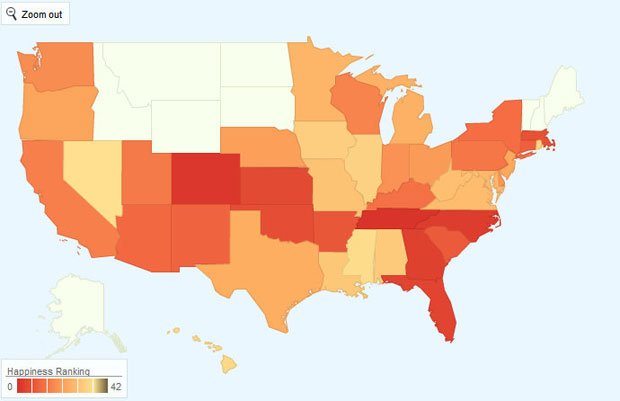
Well, I was having a good day…but enough about me, what’s going on in with the rest of the world? Pretty miserable stuff, actually: Libyan rebels, Japan’s earthquake, tsunami, and nuclear meltdown, the government shut down barely avoided…well, how are individual states doing? Now we know! A map on alexdavies.net used Twitter to determine just how happy each of our fifty nifty states are. Illinois seems darned happy. Washingtonians are – apparently only kinda sorta happy. From the Seattle PI:

On a scale of one to 42 — where one is ecstatically mirthful — Washington state has a happiness index of 21. In other words, it could go either way.

A map from alexdavies.net uses Twitter keywords to pinpoint just how positive or negative states are.

So, if lots of people are using words like “love” and “amazing” when they tweet, their states might get a better ranking.

Oddly enough, sad words for Washington include “Phillies” and “presale,” according to the site. “Starcraft” and “gentleman” also show up as negative words.

Read more at alexdavies.net.

community · education · emotion · happiness · hugs · mental health · Uncategorized

Yale law students can (maybe?) check out a dog for stress relief

For me, it is soooo one of those Fridays where everything is blowing up after a long week and you have a doctor’s appointment that took a month to schedule so you really don’t want to miss it, and the coffee’s worked a little TOO well this morning…

For days like this, I have my dog waiting for me at home (assuming I ever get home); for students away at school, they may not have that option.

There are now rumors circulating about Monty, a border terrier at Yale who is available for some quality time with Yale Law students who really need some good adorable animal therapy. While Yale has officially denied this, unofficially they announced he is available for therapy services.

The myth of Monty—short for “General Montgomery“—first surfaced last fall on the popular blog Above the Law. The border terrier was allegedly in a basket behind the circulation desk, but the school later issued a denial about Monty’s existence. Now New York Magazine’s reporting that Yale students have received a memo saying that, Monty is back and available for checkout.

It sounds like they’ve made Monty fully available to students now:

And, even though Monty is hypoallergenic, “visits will be confined to a dedicated non-public space in the library to eliminate potential adverse reactions from any library user who might have dog-related concerns. Kauffman also says they’ll be looking for student feedback on whether to have therapy dogs available “during stressful periods of the semester, for example during examinations.”

My firs thought? Why don’t they have this instituted in MORE high-stress places like graduate school? I can understand businesses not wanting people to bring their dogs into work, but a fully vetted and therapy-trained dog for as-needed therapy? Brilliant!!!!

autism · behavior · brain · children · emotion · learning · Mental · psychology · robotics · Social

AP News: Kaspar the friendly robot helps autistic kids

I have heard of this kind of therapy before, how autistic kids tend to respond better to robots teaching them emotions and proper social responses; the robot acts as a sort of bridge, or neutral third party for the kid:

STEVENAGE, England (AP) – Eden Sawczenko used to recoil when other little girls held her hand and turned stiff when they hugged her. This year, the 4-year-old autistic girl began playing with a robot that teaches about emotions and physical contact – and now she hugs everyone.

“She’s a lot more affectionate with her friends now and will even initiate the embrace,” said Claire Sawczenko, Eden’s mother.

The girl attends a pre-school for autistic children in Stevenage, north of London, where researchers bring in a human-looking, child-sized robot once a week for a supervised session. The children, whose autism ranges from mild to severe, play with the robot for up to 10 minutes alongside a scientist who controls the robot with a remote control.

The robot, named Kaspar, is programmed to do things like smile, frown, laugh, blink and wave his arms. He has shaggy black hair, a baseball cap, a few wires protruding from his neck, and striped red socks. He was built by scientists at the University of Hertfordshire at a cost of about 1,300 pounds (US$2,118).

http://m.apnews.com/ap/db_6418/contentdetail.htm?contentguid=X0CCVnY5

It’s also nice to hear a story about robots helping people, rather than the usual scenarios we hear and see like from Matrix and Terminator.

emotion · psychology

Physical language

From NYT: Psychologists have long studied the grunts and winks of nonverbal communication, the vocal tones and facial expressions that carry emotion. A warm tone of voice, a hostile stare — both have the same meaning in Terre Haute or Timbuktu, and are among dozens of signals that form a universal human vocabulary.

But in recent years some researchers have begun to focus on a different, often more subtle kind of wordless communication: physical contact. Momentary touches, they say — whether an exuberant high five, a warm hand on the shoulder, or a creepy touch to the arm — can communicate an even wider range of emotion than gestures or expressions, and sometimes do so more quickly and accurately than words.
“It is the first language we learn,” said Dacher Keltner, a professor of psychology at the University of California, Berkeley, and the author of “Born to Be Good: The Science of a Meaningful Life” (Norton, 2009), and remains, he said, “our richest means of emotional expression” throughout life.

Read full NYT articles

emotion · psychology

Abstract thoughts prompt literal physical response

From New York Times:

Researchers at the University of Aberdeen found that when people were asked to engage in a bit of mental time travel, and to recall past events or imagine future ones, participants’ bodies subliminally acted out the metaphors embedded in how we commonly conceptualized the flow of time.
As they thought about years gone by, participants leaned slightly backward, while in fantasizing about the future, they listed to the fore. The deviations were not exactly Tower of Pisa leanings, amounting to some two or three millimeters’ shift one way or the other. Nevertheless, the directionality was clear and consistent.
“When we talk about time, we often use spatial metaphors like ‘I’m looking forward to seeing you’ or ‘I’m reflecting back on the past,’ ” said Lynden K. Miles, who conducted the study with his colleagues Louise K. Nind and C. Neil Macrae. “It was pleasing to us that we could take an abstract concept such as time and show that it was manifested in body movements.”
The new study, published in January in the journal Psychological Science, is part of the immensely popular field called embodied cognition, the idea that the brain is not the only part of us with a mind of its own.
“How we process information is related not just to our brains but to our entire body,” said Nils B. Jostmann of the University of Amsterdam. “We use every system available to us to come to a conclusion and make sense of what’s going on.”
Research in embodied cognition has revealed that the body takes language to heart and can be awfully literal-minded.
Read full post