Another great story about public artwork and interactive public space. This time courtesy of Design*Sponge:
Mike Perry (who was part of Design by the Book four years ago) is launching a new project via Kickstarter called Wondering Around Wandering. It’s a three-month FREE community exhibition and event space where Mike will teach workshops and host screenings, discussions and more. The space will welcome artists and art appreciators alike and, because of the time span, would be a great way for visiting artists and design enthusiasts to learn and experience on a more intimate level.
Holiday Zine, one example of what you’d get as part of your support via Kickstarter
Every kid can get overwhelmed playing on the playground. But imagine that for you, or your child, it happens way, way too easily.
Play is usually beneficial, not just for exercise and fun but for learning and therapy. So it’s interesting to see how people are using play, and playgrounds, to help kids who can often get overwhelmed in normal play situations.
A Kansas State University graduate student is creating a schoolyard that can become a therapeutic landscape for children with autism.
Chelsey King, master’s student in landscape architecture, St. Peters, Mo., is working with Katie Kingery-Page, assistant professor of landscape architecture, to envision a place where elementary school children with autism could feel comfortable and included.
“My main goal was to provide different opportunities for children with autism to be able to interact in their environment without being segregated from the rest of the school,” King said. “I didn’t want that separation to occur.”
The schoolyard can be an inviting place for children with autism, King said, if it provides several aspects: clear boundaries, a variety of activities and activity level spaces, places where the child can go when overstimulated, opportunities for a variety of sensory input without being overwhelming and a variety of ways to foster communication between peers.
“The biggest issue with traditional schoolyards is that they are completely open but also busy and crowded in specific areas,” King said. “This can be too overstimulating for a person with autism.”
King researched ways that she could create an environment where children with autism would be able to interact with their surroundings and their peers, but where they could also get away from overstimulation until they felt more comfortable and could re-enter the activities.
For so long playgrounds have been designed to be “safe,” but now they’re being designed and adapted to be “inclusive” to kids with all sorts of limitations, which I think is a much better focus, especially since it reintroduces play equipment like…wait for it…dirt! Or more specifically, gardens:
King designed her schoolyard with both traditional aspects — such as a central play area — and additional elements that would appeal to children with autism, including:
A music garden where children can play with outdoor musical instruments to help with sensory aspects.
An edible garden/greenhouse that allows hands-on interaction with nature and opportunities for horticulture therapy.
A sensory playground, which uses different panels to help children build tolerances to difference sensory stimulation.
A butterfly garden to encourage nature-oriented learning in a quiet place.
A variety of alcoves, which provide children with a place to get away when they feel overwhelmed and want to regain control.
Unfortunately there are currently no plans to actually build this playground, since these sensory elements are beneficial to all kids (and grown-ups). Where do you see this kind of design being the most welcome? In schools, city parks? Leave your thoughts in the comments below.
With Memorial Day weekend right around the corner, it’s time to think about getting outdoors and dining al fresco. But what if you live in a place that is rainy all through Memorial Day weekend (not pointing fingers, Seattle!), or you don’t have a lot of green space to play with? Fear not! From Inhabitat:
Haiko Cornelissen‘s lush, living PicNYC Table is a brilliant plant-growing furnishing that brings a taste of the outdoors to every meal. The aluminum table is deep enough to double as a planter bed, and it can grow everything from grass to herbs and flowers. We caught up with Haiko at this year’s Wanted Design exhibition during NY Design Week to ask him about his inspiration and snap some firsthand photo.
Getting some greenery, even with something as simple as a grassy table, can work wonders for picking up mood and feeling refreshed. Even having an indoor plant on your desk has been shown to improve productivity. Bon Appetit!
Thaisa Way, a UW associate professor of landscape architecture, and several of her design students have curated “Experimenting in Public Space,” on exhibit May 9 to June 24 at the American Institute of Architecture design gallery in downtown Seattle. The exhibit explores Gas Works and 11 subsequent parks and public spaces in a series of sketches, photographs and architectural renderings.
In 1962, a parcel at the northern tip of Lake Union was a toxic waste dump, the result of an industrial plant that turned coal to natural gas. By 1976, however, it was Gas Works Park, the result of a gutsy experiment in landscape architecture led by Richard Haag, a University of Washington emeritus professor of architecture.
Gas Works and subsequent projects established Seattle as one of the first American cities willing to recast industrial sites into places to celebrate.
“Gas Works was a radical move, especially since Rachel Carson’s book, ‘Silent Spring,’ had just been published, and people were alerted about environmental pollution,” Way said.
Haag convinced the city that not only could unusual and sometimes polluted land be reclaimed but that it should be. Instead of the wide, rolling vistas of trees and flowers created across the country by the Olmsted brothers in the late 19th and early 20th centuries, however, Haag celebrated the city and all its right angles. The gas works boiler house eventually sheltered grills and picnic tables, and the gas compressor became a play barn, all with a water’s edge view of Lake Union and the downtown Seattle skyline.
I’m excited to see a celebration of open public park spaces, especially those reclaimed from formerly unappealing and otherwise unusable spaces. I find myself at Gas Works Park a lot in the summer, and love having so much green open space in the city I live in!
A little more play for your Friday. Via Inhabitat and PSFK:
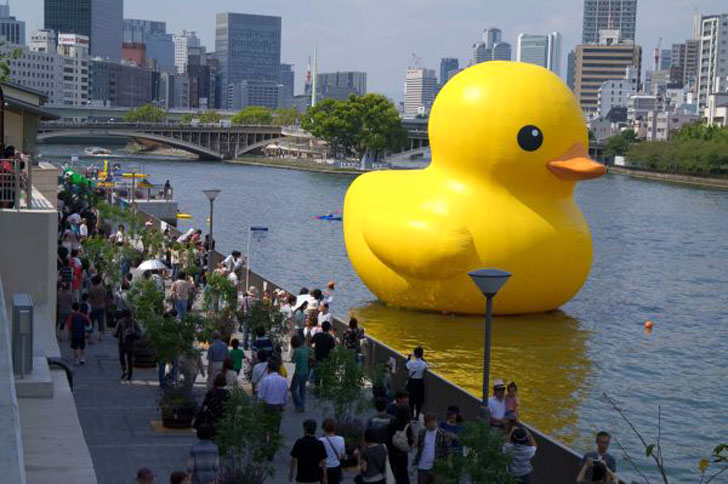
Artist Florentin Hofman’s giant yellow duckie puts a smile on the faces of passers-by as it floats from city to city along the Loire river in France. The hilarious and striking sight has already traveled the world before through cities such as Osaka and Sao Paulo.
The 25 meters tall and 25 meters wide friendly creature’s mission is to provide a joyful interruption to people’s daily routines. People from all over the world connect the rubber duck with their childhood memories and are brought up with positive sensations.
Famous for his humoristic pieces, the Dutch artist Florentin Hofman used rubber coated PVC to built the duck on a pontoon with a generator. Hofman believes that the soft giant can relieve global tensions through delighting people coming from different countries and backgrounds. Hofman has generated smiles many times before. In 2011, the Kobe Frog, an enormous frog wearing a party hat, was sitting on the edge of Hyogo Prefectural Museum of Art in Kobe, Japan.
The duck itself is a durable vessel, made from inflatable rubber-coated PVC, a pontoon boat, and generator to help propel it forward downstream.
Happy Friday! I hope you get a chance to go out and play this weekend. Speaking of play, here is another great find from Milan’s Design week (remember the edible mini furniture from earlier this week?). This exhibit of design focused specifically on children’s spaces, with a focus that was very playful, creative, and also a great idea for grown-ups to incorporate into their own environments.
Students from the HDK master program Child Culture Design created an exhibit to explore new ways of bringing play into everyday objects to help foster imagination and creativity. Dubbed “Play In Progress“, the exhibit was one of our favorites at the Salone Mobile.
Johanna Larsson‘s cool table features transparent color plates that can be arranged and rearranged to create different tabletop scenes that push imaginative thinking.
At first look of Hide||show appears to be nothing special, but just put a kid in front of one of these and you’ll realize that there is definitely something more to this cabinet. The cabinet features two pairs of handles — one ordinary set for adults and a pint-sized set of hole-like handles for children. The variation indicates different accesses to function, and give children the feeling of exclusivity in their own world.
Inspired by the game of “hide and seek”, Behind the Curtain blocks out part of a white curtain with color to create a secret space for a child to be alone in his/her world.Griet Boucique has designed an ‘Alternative Playground’ – a landscape of soft seats – that questions what is a ‘good’ play environment for a child? The design considers material usage, its impact on the environment, and how different textiles can the way a child engages in play.
Check out more great designs at Inhabitat (I love the block table, for example!)
On this blog we often talk about the importance of being more playful and fun. Two great ways to be more playful are with design and food. One designer decided to combine both!
I was glad to see that this year’s [Milan Furniture Fair] show offered more tongue-in-cheek pieces that played around with the idea of furniture in a fun and fresh way. This “furniture tasting” waffle iron is from Ryosuke Fukusada and Rui Pereira, and it allows you to produce, essentially, a completely edible collection of dollhouse living room furniture. Is this a super functional design? Perhaps not (although you can eat what you make), but it’s a clever way to play with design while bringing up the topic of mass production. Although I may have to be in favor of mass production if it means plates full of tasty furniture-shaped waffles. Click here for more information and details over at the 2DM Magazine blog. Thanks to our resident foodie, Kristina, for the tip.
Great story from TreeHugger about self-proclaimed “Urban Hacktivist” Florian Riviere and some of the various “hacks” he’s done:
When it comes to redefining public space and objects, Florian Rivière is a master. The self-described “urban hacktivist” transforms parking spots into hockey rinks, sidewalk barriers into tables, and uncomfortable benches into lounge chairs for the homeless.
I absolutely agree with TreeHugger when they say:
I love it when people re-imagine how urban space is used; it’s a fantastic way to make cities more liveable, practical and fun, without needing major construction projects or the hassle of red tape.
This is just one example of “hacking” public space in a fun creative way. I still remember the yarn-bombing movement that really took off a couple of years ago but seems to have died down for now.
There was also the Swing at the bus stop.
What other examples of urban “hacktivism” have you seen? Share them in the comments below.
I love the fact that playgrounds are incorporating the stuff that kids love to play with the most – dirt, rocks, and sticks!
Children won’t find new monkey bars and bright plastic play structures at the upgraded Donnan Park.
Instead, the aging playground at 9105 80th Ave. will become Edmonton’s first “natural playground,” part of a growing trend in playground design.
Children in the redesigned Donnan Park will entertain themselves with such timehonoured playthings as rocks, sticks, sand and dirt. The overhauled space will feature a slide built into a hill, a sideways-growing tree, a boulder spiral, a hand pump to pour water into a small stream and plenty of plants, trees and greenery.
It will be “a beautiful garden that everyone plays in,” says Kory Baker-Henderson, co-chair of the neighbourhood committee that worked on the preliminary playground design with expertise from Ontario-based Bienenstock Natural Playgrounds.
“Around us there are already some typical playground structures, so we wanted to have something different that blends in with the (Mill Creek) ravine,” Baker-Henderson says.
“Studies have shown imaginative play is much more stimulated (in natural settings) and children actually will play longer and become much more involved than on a typical red, plastic slide structure. Their games will just get much more imaginative. There’s that connection with nature. We have plans for a community garden, so it’s a learning and teaching tool, too.”
The playground at Donnan Park currently has swings and a slide that will remain for now, but won’t be replaced, she says.
Most of us these days work in a cubicle, although the past ten years have really seen a transformation of space and place at the workplace in order to create happier, and therefore more productive, workers. This article in the NYTimes focused on some organizations in Seattle that have embraced a more open work floor plan:
Is this your idea of a perfect work environment?
MARTHA CHOE’S ideal working space is not her private office, nice though it is, but rather a long, narrow table in the vast atrium of the Bill & Melinda Gates Foundation headquarters here.
Ms. Choe, a former member of the City Council here, is the foundation’s chief administrative officer, and she had considerable input in the building’s design. One objective from the start was to give the 1,000 employees a variety of spaces to accommodate different kinds of work. “There’s a recognition that we work in different modes, and we’ve designed spaces to accommodate them,” she says. “I think one of the lessons is to understand your business, and understand what your people need to do their best work.”
The building was designed by NBBJ, a 700-employee architecture firm whose largest operation is in Seattle. The structure is a culmination of ideas about the 21st-century workplace that NBBJ has been exploring in corporate office designs worldwide, including its own offices here.
These are the main concepts: Buzz — conversational noise and commotion — is good. Private offices and expressions of hierarchy are of debatable value. Less space per worker may be inevitable for cost-effectiveness, but it can enhance the working environment, not degrade it. Daylight, lots of it, is indispensable. Chance encounters yield creative energy. And mobility is essential.
This isn’t a suddenly exploding trend. NBBJ’s research has found that two-thirds of American office space is now configured in some sort of open arrangement. But even as these designs save employers space and money, they can make office workers feel like so many cattle. So how to humanize the setting?
SEATTLE serves as a test tube because of several converging factors: There’s a lot of money here to experiment with projects. The work force is relatively young and open to innovation. And the local culture places a high value on informality, autonomy and egalitarianism. People will put in long hours under high pressure if they feel respected, but they won’t tolerate being treated like Dilberts.
Most office workers in Seattle and elsewhere labor in environments much less inspiring than Ms. Choe’s. And most employers have much less to spend to make things pleasant. (Bill and Melinda Gates personally contributed $350 million of the campus’s $500 million cost.) But staying competitive requires coming up with the best ideas, and the office environment can be the incubator for them.
I am all for creating spaces that encourage collaboration and make workers feel comfortable and ready to get down to business. My only question is lack of meeting space. In my last two jobs it has been very hard to find private spaces to meet, although both were cubicle-based workspaces so that layout doesn’t necessarily solve things either. And I’m not alone in my concerns, as the article points out:
NOT all of NBBJ’s corporate clients have boarded the informality-and-buzz bandwagon. When the R.C. Hedreen Company, a real estate development firm based in Seattle, commissioned a renovation of a 10,800-square-foot floor in an old downtown office building five years ago, it specified a perimeter of private offices. Collaborative spaces are provided for creative teamwork, but the traditional offices remain the executives’ home ports.
“Individually, a lot of our workday is taken up with tasks that are better served by working alone in private offices,” says David Thyer, Hedreen’s president.
What are your thoughts on work space? Do you like having an open space to share, or do you prefer your own cubicle or booth? How do you handle the meeting privacy issues at your office? Leave your thoughts in the comments below.





 Mental Flowers