The nearly mile-long Superkilen park in Denmark is a bold attempt to create a new identity for an “ethnically diverse and socially challenged” neighborhood in Copenhagen, Denmark. An in-depth community outreach process organized by the city has led to a place like no other, with a sequence of plazas that honor different ethnics groups living in the area. Designed by Bjarke Ingels’ firm, BIG, landscape architecture firm, Topotek 1, and artists’ group, Superflex, the massive project also accomplished a lot with a little budget: at just $34 per square foot, the landscape “packs a lot of bang for the buck.” The project, which has recently been all over the design press, also just took home the AIA Institute Honor Award for urban and regional design and an annual design award from Architect Magazine in the “play” category.
The AIA jury, which included Ellen Dunham Jones, author of Retrofitting Suburbia
It already feels like Thursday, and it’s only Monday, ooy!
Thankfully my office space is a great space to work in and take a breather every now and then, and even play a little. And that idea of creating playful work spaces is catching on more and more.
The project accommodates the headquarters of two companies in Paris – PONS and HUOT – with a total of fifteen executives. Consequently the unit has seven individual rooms for each director and one open-space-office for the remaining eight clerks.
Happy Monday. Most of us are probably back at work now after the holidays. But for many of us, our work space has changed fairly dramatically in the past few years, in large part due to advances in technology. What used to be office-bound work can now be done at home in one’s slippers while simultaneously playing with your child (not that I’ve ever done that!). What does the future of work spaces look like? This article tackles that very question. The subject isn’t specifically related to playful environments, but creating spaces that are more conducive to creativity and productivity are incredibly intertwined with playful environment:
The company Teknion has been doing a serious amount of research into where the office is going, and what they should be designing and building to furnish it, and have published Phonebooths and Mailboxes to look at the future of the office.
Phonebooths and Mailboxes is a discussion about new technologies. Consider how quickly the cell phone replaced the pager, how quickly the fax machine was replaced by email. Mobile technology now signals one of the biggest transformations within the modern office.
As awesome as flexibility with one’s work space is, there is also value with face-to-face, tangible collaboration. Plus spaces for creative work and data analysis work, or whatever kind of work, may need very different spaces.
What are your thoughts about how technology is changing what our offices look like?
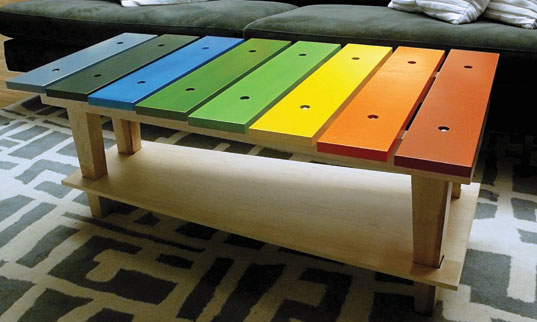
I looooved my xylophone as a kid. It was just fun to bang on every once in awhile. And I love the idea of being musical before I’ve finished my first cup of coffee:
The designers behind Manhattan based Jellio have dreamed up yet another uber-cool, kid-friendly home decor piece: a coffee table that doubles as a rainbow colored, working xylophone that is just begging to played by tots and adults alike! Jellio’s Music Table is a much larger version of the tiny xylophones we all tinkered away on as tots — and we think the designers have lived up to their mission to ‘combine childhood fun with interior design… and make you smile.’ Made of solid pine with a natural finish base, Jellio’s Music Table would not only be a lively focal point in a nursery or child’s bedroom, it would also be a unique and entertaining coffee table for the family room. We’d sure love to tap away to a spirited rendition of ‘Twinkle Twinkle Little Star’ on this beauty.
A recent article in the online magazine Co.EXIST discussed a study that found children benefit from being in natural environments, even if the environment is designed to appear natural but is actually human-made:
Dawn Coe, an assistant professor in the Department of kinesiology, recreation, and sport studies at the University of Tennessee spent time observing the behavior and time children spent playing on a local playground. After playground renovations added a gazebo, slides, trees, a creek, and a natural landscape of rocks, flowers and logs, Coe returned a year later to observe differences. Working with a statistician, Coe found children spent twice as much time playing in the natural landscape, and were less sedentary after the renovation and more active.“Natural playscapes appear to be a viable alternative to traditional playgrounds for school and community settings,” said Coe in a university statement. “Future studies should look at these changes long-term as well as the nature of the children’s play.”
I attended a conference a couple of years ago where playground designers were reporting discovering the exact same thing – if you give a kid a pile of dirt and tree bark to play with and a bucket of water, they will have WAY more fun, play more, and learn some things as well.
This shouldn’t come as a surprise based on previous research on us humans:
For decades, scientists have reported our species exhibits a consistent, if not quite understood, response to spending time around nature: it boosts our mental and physical well being.
The scattering of findings have held in hospital beds, public housing, and Japanese forests. A 2001 study of public housing found the mere presence of trees and grass reduced reduced reported aggression and violence. Another showed people shown a stressful movie recovered to a normal state–as measured by metrics such as heart rate, muscle tension, and blood pressure–“faster and more complete[ly]” when exposed to natural rather than urban environments.
However, a lot of cities and schools are reluctant to install these kinds of playgrounds since they are considered “untested” or approved by several school or city boards. Thankfully, according to the article, cities are beginning to adopt and install these types of playgrounds:
“Natural playscapes are part of a growing trend appearing in cities across the US including Boston, Phoenix, Chicago, New York, Auburn and others.”
I hope to see more of these pop up around major cities. Do you have a natural playscape near your home? Tell us about it in the comments below.
ASLA blog The Dirt has been reporting on their annual meeting, and mentioned a talk discussing why public art is important. I couldn’t agree more!
…art occupies a unique position within the art world. In comparison with big-name gallery shows, public art is often “under appreciated” much like landscape architecture. But there’s lots to laud: “It’s free. There are no tickets. People don’t have to dress up. You can view it alone or in groups. It’s open to everyone.”
Community art can also create attachment to one’s community. According to Bach, studies have looked at the economic development benefits of art, but only just recently have there been wider examinations of the effect of art on a community’s sense of place. The Knight Foundation’s Soul of the Community initiative surveyed some 43,000 people in 43 cities and found that “social offerings, openness and welcome-ness,” and, importantly, the “aesthetics of a place – its art, parks, and green spaces,” ranked higher than education, safety, and the local economy as a “driver of attachment.” Indeed, the same story may be playing out locally in Philly: a survey of local residents found that viewing public art was the 2nd most popular activity in the city, ranking above hiking and biking.
An example of public art; “Tree Futures” by Suze Woolf. Photo from the Heaven and Earth Exhibition in Carkeek Park, Seattle, 2012.
It creates community by creating a sense of place, it is available for all to enjoy, and it makes a place more enjoyable in which to hang out. All of these are important for creating enriching environments. Also, by making the art public, people often feel they have ownership of the art, or a right to play with it. This can be good and bad; if they art is designed to be engaged with, more power to the people. However, some people do act upon the art in a destructive way, either accidentally or intentionally, which is play to them but ruins it for the rest of the public.
This brings of the life cycle of art, and it being taken care of or abandoned over time, which was also discussed at the meeting:
Bach also made a point of discussing the “afterlife of public art,” what happens once it’s out there. As an example, she pointed a work by Pepon Osorio, a pavilion at a Latino community center that features historical photos of people from the community. Today, kids from the neighborhood take photos of themselves with photos of their ancestors. Another project called Common Ground in a footprint of a church that burnt down was hosting weddings just a week after it opened. While these works became part of their communities, Bach said the group still has to work hard to ensure that all works remain relevant to their communities and aren’t “orphaned.”
Some art is meant to be abandoned; at Carkeek Park in Seattle there is an annual public art exhibit where often the installed art pieces are left at the end of the summer to decay or be destroyed by the elements.
Art installation at Carkeek Park, Seattle, 2012
Overall though I think interaction with public art is a good thing. Do you or have you ever played in fountains, posed with statues or art pieces, or altered them in some way (like the Fremont people in Seattle)? These are all forms of play inspired by public art, which I think are valuable methods of play and should be encouraged so long as it doesn’t damage the artwork.
Waiting for the Interurban is memorial to the trolley/rail line that once ran between Everett and Tacoma. Standing at the north end of the Fremont Bridge, these five aluminum commuters (and one dog) have waited since 1978 for a ride that never came. Decorating the statues with seasonal apparel, political signs and other props has become a Seattle tradition.
What is your experience with public art? Do you find it a good use of real estate? Do you have a statue or fountain or public art piece that speaks to you, that you think of as “yours”?
Playful design in an urban environment? My favorite!
Clever and talented Danish artist Jeppe Hein has been custom-making his “Modified Social Benches” for museums, arts festivals, and plazas since the mid-2000s. Most recently, he created a unique set of art you can sit on for Beaufort04, the fourth Triennial of Contemporary Art by the Sea this summer in Belgium. Kids, cool kids, and adults all seem to love playing with these.
Hein says his powder-coated aluminium “social benches” borrow their basic form from the standard park bench, but are altered to make the “act of sitting on them a conscious physical endeavor.” As they mutate, the benches become spaces to “inhabit,” rather than just places to park it and relax for a moment.
The pieces may seem like fun one-offs, but something then happens between the work and the community: “As is the case with much of Hein’s work, the Modified Social Benches on the dyke in De Haan seem to hide behind a disguise of fun and entertainment. But what they actually evoke is a process of interaction and communication that works on different levels.”
After all the great stories about zoos adapting their spaces for their animals I’ve stumbled across recently, I was starting to feel a little sad for us humans. Thankfully, here’s another story I found from Inhabitat about re-purposing spaces for human play:
On the Plaza Luis Cabrera in Mexico City, two 1960’s Mitsubishi trolleybuses have been permanently parked for public use as part of a larger arts initiative in the Roma, Condesa and Hipodromo districts of Mexico City. The gutted and repurposed trolleys currently serve the city as vibrant spaces that engage residents and visitors in new art and cultural activities.
The vintage rides, which were donated to Mexico City by the government of Japan in the year 2000, were originally used to host the Galeria Trolebus initiative — a space used to showcase non-traditional art projects. Today the repurposed busses are public spaces for everyone to enjoy. On weekends and afternoons, visitors may stumble upon sculpture arts, free theater, music workshops, as well as concerts. The cultural activities on the trolleybuses even help to activate adjacent public parks, encouraging locals to take advantage of the ample and free space right before their eyes.
In order to keeps things dynamic, each month the buses on Plaza Luis Cabrera are re-painted in mural styles, with bright colors and bold prints by artists, community members and advertisers who volunteer their talents.
In brilliant fashion, the city has come up with a community-sustaining way to keep an outdated trolleybus model in style and out of the junkyard!
Soon this guy will be able to take his own self-guided tours of Philadelphia zoo. (Photo credit: epSos.de)
I am so excited about this I’m practically jumping out my seat to tell people. I first read about it in USA Today; animals are getting to wander outside of their exhibits, share spaces with other animals, and over all just chill around the zoo. Yup, that’s right:
The Philadelphia Zoo on Thursday opens the first leg of an ambitious enclosed trail system designed to allow large animals such as great apes, bears and big cats to roam throughout the zoo. It will give them access to one another’s habitats in a kind of time-share arrangement and offer visitors a closer look at wild animals behaving like wild animals.
Other U.S. zoos have created paths between exhibits, mixed habitats, elevated paths or rope swings for apes.
“This is an emerging trend” among zoos accredited by the Association of Zoos & Aquariums, says the group’s senior vice president for external affairs, Steve Feldman. “Great animal care means providing for animals’ physical and psychological welfare. These pathways and rotations really allow them that kind of stimulation.”
The Philadelphia Zoo’s program is the first to encompass the entire zoo. “This campus-wide effort to build this trail system is unique,” Feldman says. “It’s innovative and is really taking that trend to the next level.”
Because it’s the first effort of its kind, “we don’t have a road map to see how others have done it,” says Vik Dewan, the Philadelphia Zoo’s chief executive officer. The system “puts animal well-being first and foremost,” he says, and gives visitors “an experience here, that when combined with other experiences, paints the bigger picture of how they could be more effective stewards of the world.”
The critters will have to “timeshare” so the orangutans won’t be hanging out with the brown bears. In fact the bears might not get a chance to use the pathways until winter when it’s too cold for the primates. But that said, it’s sure to be a boon for the animals, as well as for the people. The zookeepers already report seeing a positive result from a similar vine system in their primate exhibit.
The article mentions other zoos starting to move in this direction. But which ones, and what exactly are they up to? I’m curious to learn more. Any hints? Leave them in the comments below.
animals given access to the new trail are expected to be more active and
to benefit from the stimulation of being able to see visitors and other
animals from a new perspective.
Picture from Science Gallery’s Makeshop. (Photo credit: David Ramalho)
I used to write about Science Gallery in Dublin, Ireland, a lot on my now defunct blog The Art of Science. They have now been open for a couple of years, and are huge proponents of hands-on science, art, and learning. This week they’re debuting their new MAKESHOP.
MAKESHOP is a new collaborative workshop space where you can learn everything from cross-stitching to DIY robotics, from origami to 3D printing. It’s for everyone from novices to advanced makers, the only thing you need to get involved is a curious mind and a yearning to make stuff.
We’ll be running these free, drop-in workshops over the weekend to celebrate the opening:
LED throwies – LED throwies were developed by the Grafitti Research lab at Eyebeam’s R&D OpenLab. LED throwies are a simple combination of a magnet, LEDs and some sticky tape and allow you to attach coloured lights to any (ferromagnetic) metal surface. They are called throwies because they can be thrown in clusters to attach to high up metal objects and structures for impressive colourful interventions in public space or simply to liven up your fridge door.
Paper Toys – The status of the paper toy lies somewhere between an art object, admired for it’s ultra cool design and a quirky DIY aesthetic. Choose from a range of templates in the form of flat 2D pattern that you can fold together and transform into awesome paper toys by some of the worlds best paper toy designers. Alternatively you can colour in your own blank template to give your paper toy a unique look.
Extract your DNA – Ever wonder what your made up of? In this simple extraction workshop you will be able to isolate your own DNA strands from your saliva and take home a sample to keep.
8 bit Cross Stitch – Inspired by the simple grid layout of retro computer characters, 8 bit cross stitch combines old world craft with old school aesthetic. You’ll learn the basics of needle work and take home a starter kit that will get you well on your way to making a wonderful wearable.
Drawing Robots – Drawing Robots are autonomous drawing robots that people can make without any knowledge of electronics. Participants connect a battery pack to a weighted motor, some paper cups and magic markers and watch as the drawbots begin to draw incredible images by bouncing around on paper.
What a great space to explore and play! The Science Gallery is one of the many reasons I’d love to visit Dublin someday. Science Gallery has lots of exhibits rotating in and out throughout the year, and a coffee shop to hang out at after your science-y/artistic adventures.
Have you ever been into the Science Gallery? What was it like? What about the one opening in London (see related articles below)? Share your experience in the comments below.





 Mental Flowers