I am often focused on efficiency walking from place to place. But cyclists, runners, and other athletes talk about taking the more scenic route on their commutes or exercise routes, and maybe we should all follow suite.
We’ve all [probably] taken a detour because the path is pleasant and scenic, even if it takes longer. But Google Maps and the like aren’t set up for that. They’re solely about speed and efficiency.Recent research led by Yahoo Labs shows how a planner-for-happiness might work. Using crowdsourced impressions of streets, Flickr data, and survey responses, it looks for a balance between “people’s emotional perceptions of urban spaces” and getting them to a destination in a reasonable amount of time.
Three art students in Germany have come up with a novel way to beautify ordinarily ugly urban environments. They turned a common electric tower into a makeshift stained glass lighthouse.The change was simple but effective. Ail Hwang, Hae-Ryaan Jeon and Ghung Ki Park, students at Klasse Löbbert in Münster, Germany, filled the gaps in the tower’s struts with panels of colored acrylic plastic, turning it into a dazzlingly colorful structure. It’s not quite as detailed and beautiful as true stained glass, but it is nonetheless a great approach for decorating an otherwise ugly structure. The resulting work is called Leuchtturm, or “lighthouse” in German.
more, including the original source, via Bored Panda.
It would also alert birds and other migratory animals that they might not want to hang out there. The only problem I can see with this is if the plastic acted as a prism for the grass and started a fire, but I’m sure there are ways you could engineer around that. Right?
Beautiful sculptures, and a great way of being playful with gardening and making gardens more engaging for everyone.
Mosaiculture is an excellent art form for those among us with the green thumbs and the space to do it. An excellent example of this complex but beautiful artistic process would be the “Imaginary Worlds” mosaiculture exhibition at the Atlanta Botanical Gardens – these elaborate and massive green structures create mystical and fantastic worlds that are lush with living foliage.There is more to these amazing works of living art than meets the eye. Most of them begin with a steel frame of some sort, which is covered with steel mesh. This mesh is then covered with sphagnum moss and soil, which is seeded with all sorts of plants. Underneath the mesh, a network of irrigation channels supply water to the plants on the surface, helping them grow.
These findings make sense to me and yet also don’t.
Image credit: Carnegie Mellon University
Few environments feature such a cacophony of decor as the elementary school classroom. Colorful bulletin boards, scientific posters, state maps, and student artwork tend to cover nearly every inch of wall space. Yet a new study on classroom design from researchers at Carnegie Mellon University suggests that all that educational flair may not be all that great for getting kids to learn.
The study, carried out over two weeks, examined 24 kindergarten students who were taught six lessons on topics they had not yet learned in school. Half the lessons were taught in a highly decorated classroom environment, with posters and art all over the walls, and the other half were taught in a classroom with no decoration.
CMU’s researchers found the kids spent more time off-task and were more distracted when the room was brightly decorated, and they tested better on subjects they learned in the sparser classroom compared to the ones they learned in the more visually stimulating environment.
Elementary school children typically stay in one room all day, so classroom decorations don’t necessarily match the subject matter they’re learning at any given time. If they’re sitting in front of a U.S. map, they’ll be looking at that all day whether the current lesson is on geography or math. This study, though very small, adds to previous research from the same psychologists showing that visual stimulation that’s irrelevant to on-going instruction can distract kids.
The study doesn’t go on to offer any ways to necessarily improve the classroom design, although the article does give other links discussing it.
Nature can be fairly visually cacophonous, so what is it about classroom designs that are so distracting? I also wonder how much of their distraction is from an unnatural learning style, and then other more engaging things to look at. That is not an attack on the teacher, I’m just skeptical whether any human is capable of sitting in one room for 6-8 hours, with a couple of lunch breaks, and concentrate the entire time, for an extended period of time. Even grown-ups have a hard time doing that, and suffer when they try to sustain that for too long.
What are your thoughts? Leave them in the comments below.
Nice to see toys being introduced that work with already existing toys (sticks!), and encourages kids to go find their own sticks and go play in nature.
As an inductee to the National Toy Hall of Fame, the stick doesn’t need much improving as a classic toy. For as long as there have been children and sticks, sticks have served as a versatile toy in outdoor play. But connecting sticks takes a bit of ingenuity.
Enter Christina Kazakia, a design student with a mission. As she explains, “I designed these flexible silicone connectors as part of my graduate thesis in Industrial Design at the Rhode Island School of Design. My goal was to create prompts to engage children with their surrounding natural environment.” Called Stick-lets™, these connectors help small children build big structures like forts, teepees, lean-tos, or other creations.
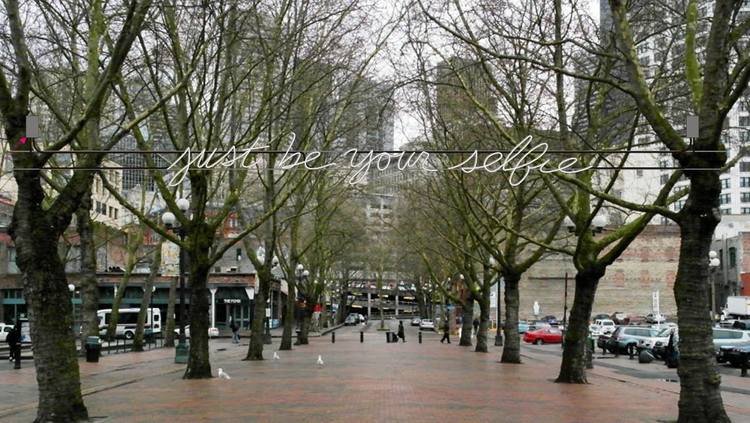
Public, collaborative art happening in Seattle. Go be a part of it!
Just Be Your Selfie in Occidental Park, Seattle by Dylan Neuwirth
I am pleased to announce a new large-scale public work coming to Seattle in late May and on display in Occidental Park from June to September, 2014 as a part of ArtSparks.
“JUST BE YOUR SELFIE” is a monumental neon status update rendered in cursive.
Designed to initiate personal and shared, web-based experiences; this social sculpture is an iconic contemporary work of real-time internet art embedded into an urban environment. Not necessarily a solid structure, or a pure concept; this slippery expression bridges the gap between existing in both the analog and digital realities we now accept as inseparable.
The work will have its own Instagram account, associated hashtags, and is intended to take on a life of its own.
Having fun, exciting spaces to play is important for both kids and grown-ups, so it’s nice to see what’s out there for kids, and hopefully grown-ups will follow suit.
When you’re a kid, visiting an amazing playground is the greatest experience ever. And these fantasy-themed playgrounds around the world have us wishing that we were kids again so we could run around in them like small, crazy people.
All of these are in more urban settings, and it would be cool to see some more natural playscapes, but the ideas behind some of these parks are fantastic!
Living in a big city like London, even with parks and trees, it can be hard to find a spot dedicated to just being quiet and taking in nature.
So the Finnish Institute of London, The Architecture Foundation and London Wildlife Trust just unveiled Viewpoint, a floating platform where Londoners can slow down and enjoy Regents’ Canal. Designed by Finnish architects Erkko Aarti, Arto Ollila and Mikki Ristola, this permanent structure serves as a placid retreat for visitors to nearby Camley Street Natural Park and as an outdoor learning environment for school children and adults.
Designating spaces as official rest areas is a great way to cue people to actually take breaks, and clue them in to their surroundings, to take a minute to stop and observe.
Taking time to destress and be creative has great benefits, both physically and mentally. Take knitting, for example:
It turns out that knitting has incredible health benefits. It makes people feel good in just about every way. A bit of research has revealed a wide range of ways in which knitting helps humans cope, physically and mentally.
1. Knitting is used for therapy. It’s a powerful distractant, helping people manage long-term physical pain. For those who are depressed, knitting can motivate them to connect with the world. It is a conversation starter, allowing people to interact politely without making eye contact. It builds confidence and self-esteem.
2. Knitting is supremely relaxing, which is extremely important for reducing stress and anxiety. Dr. Herbert Benson, founder of Harvard’s Mind/Body Medical Institute, wrote The Relaxation Response, in which he recommends the repetition of a word, sound, phrase, prayer, or muscular activity to elicit “the relaxation response” – decreased heart rate, muscle tension, and blood pressure. Knitting is likened to meditation, sometimes described by knitters as “spiritual” and “Zen-like.”
I have always felt like I SHOULD learn how to knit, but I actually find the idea of having to keep count and keep track of where I’m at stressful, but maybe I should just give it a try. Thoughts? Leave them in the comments below.
I loved Wallace and Grommet for all the creative inventions Wallace developed. Turns out artist Dominic Wilcox creates similar odd inventions in real life, and businesses are willing to donate space to display them.
This time it’s the turn of celebrated British department store Selfridges to let Wilcox’s creative wings spread and take over their prestigious windows on behalf of the store’s Festival of Imagination. For the project, Wilcox created the “Variations On Normal” where his eccentric yet logical inventions give physical form to figments of his imagination. Some of his specially made pieces include an umbrella with built-in flower pots and a suitcase with robotic legs that follows its owner.








 Mental Flowers