Should happiness and well being be considered a metric to measure overall success of a country? The UN just voted yes:
Imagine you open the paper tomorrow, and the headlines are not about the “sluggish economy,” but our nation’s quality of life. You turn to the business section, and find not just information about a certain company’s profitability, but also about its impact on community health and employee well-being.
Imagine, in short, a world where the metric that guides our decisions is not money, but happiness.
That is the future that 650 political, academic, and civic leaders from around the world came together to promote on April 2, 2012. Encouraged by the government of Bhutan, the United Nations held a High Level Meeting for Wellbeing and Happiness: Defining a New Economic Paradigm. The meeting marks the launch of a global movement to shift our focus away from measuring and promoting economic growth as a goal in its own right, and toward the goal of measuring—and increasing—human happiness and quality of life.
Not just for dreamers
Some may say these 650 world leaders are dreamers, but they are the sort that can make dreams come true. The meeting began with an address by Prime Minister Jigmi Thinley of Bhutan, where the government tracks the nation’s “Gross National Happiness.”…
UN Secretary-General Ban Ki-moon cited Aristotle and Buddha in calling for the replacement of our current economic system with one based on happiness, well-being, and compassion. “Social, economic, and environmental well-being are indivisible” he said.
Pretty exciting stuff. Bhutan has been using happiness as a metric for several years. so it’s nice to see the idea get picked up on. I believe emotional well-being and happiness is a very valuable metric. What about you? Leave your thoughts in the comments below.
Most of us these days work in a cubicle, although the past ten years have really seen a transformation of space and place at the workplace in order to create happier, and therefore more productive, workers. This article in the NYTimes focused on some organizations in Seattle that have embraced a more open work floor plan:
Is this your idea of a perfect work environment?
MARTHA CHOE’S ideal working space is not her private office, nice though it is, but rather a long, narrow table in the vast atrium of the Bill & Melinda Gates Foundation headquarters here.
Ms. Choe, a former member of the City Council here, is the foundation’s chief administrative officer, and she had considerable input in the building’s design. One objective from the start was to give the 1,000 employees a variety of spaces to accommodate different kinds of work. “There’s a recognition that we work in different modes, and we’ve designed spaces to accommodate them,” she says. “I think one of the lessons is to understand your business, and understand what your people need to do their best work.”
The building was designed by NBBJ, a 700-employee architecture firm whose largest operation is in Seattle. The structure is a culmination of ideas about the 21st-century workplace that NBBJ has been exploring in corporate office designs worldwide, including its own offices here.
These are the main concepts: Buzz — conversational noise and commotion — is good. Private offices and expressions of hierarchy are of debatable value. Less space per worker may be inevitable for cost-effectiveness, but it can enhance the working environment, not degrade it. Daylight, lots of it, is indispensable. Chance encounters yield creative energy. And mobility is essential.
This isn’t a suddenly exploding trend. NBBJ’s research has found that two-thirds of American office space is now configured in some sort of open arrangement. But even as these designs save employers space and money, they can make office workers feel like so many cattle. So how to humanize the setting?
SEATTLE serves as a test tube because of several converging factors: There’s a lot of money here to experiment with projects. The work force is relatively young and open to innovation. And the local culture places a high value on informality, autonomy and egalitarianism. People will put in long hours under high pressure if they feel respected, but they won’t tolerate being treated like Dilberts.
Most office workers in Seattle and elsewhere labor in environments much less inspiring than Ms. Choe’s. And most employers have much less to spend to make things pleasant. (Bill and Melinda Gates personally contributed $350 million of the campus’s $500 million cost.) But staying competitive requires coming up with the best ideas, and the office environment can be the incubator for them.
I am all for creating spaces that encourage collaboration and make workers feel comfortable and ready to get down to business. My only question is lack of meeting space. In my last two jobs it has been very hard to find private spaces to meet, although both were cubicle-based workspaces so that layout doesn’t necessarily solve things either. And I’m not alone in my concerns, as the article points out:
NOT all of NBBJ’s corporate clients have boarded the informality-and-buzz bandwagon. When the R.C. Hedreen Company, a real estate development firm based in Seattle, commissioned a renovation of a 10,800-square-foot floor in an old downtown office building five years ago, it specified a perimeter of private offices. Collaborative spaces are provided for creative teamwork, but the traditional offices remain the executives’ home ports.
“Individually, a lot of our workday is taken up with tasks that are better served by working alone in private offices,” says David Thyer, Hedreen’s president.
What are your thoughts on work space? Do you like having an open space to share, or do you prefer your own cubicle or booth? How do you handle the meeting privacy issues at your office? Leave your thoughts in the comments below.
Brazilian graffiti art is considered among the most significant strand[s] of a global urban art movement, and its diversity defies the increasing homogeneity of world graffiti.” – Design Week
In March 2009, the Brazilian government passed law 706/07 making street art and graffiti legal if done with the consent of building owners. As progressive of a policy as this may sound, the legislation is actually a reflection of the evolving landscape in Brazilian street art, an emerging and divergent movement in the global street art landscape.
Rio de Janeiro has been particularly progressive in its policy towards street art, with its 1999 “Não pixe, grafite” (Don’t Tag, Graffiti) project that brought together 35 graffiti artists to showcase diversity in local styles. But more unique is the evolution of a permission hierarchy, blurring the line between formal and informal. The new street art law merely reinforced these unique patterns of street art and legitimized an already flourishing form of artistic expression.
Retaining walls on the steep terrain provide canvases for artists.
In Rio de Janeiro, street art is ubiquitous. It exists in all corners of the city, from the favelasto upper class neighborhoods, from residential to institutional. It is bold in scale and aesthetics and is anything but graffiti. The urban fabric of Rio de Janeiro also figures prominently in the evolving street art scene. The high walls, whether for security or to contain the topography, provide ample surfaces for painting. But rather than location dictating art, the relationship between owner and artist has a direct impact on where street art occurs.
Owners of buildings, both residential and commercial, sometimes invite artists for commissions, which is done to protect from tagging, as an aesthetic choice or as an economic choice — painting a façade with art may be cheaper than another mode of beautification. In another case, street artists ask permission from the owner.
Tudo de cor para você, Santa Marta, Rio de Janeiro (photo source: favelapainting.com)
Thanks to the city’s openness to various forms of artwork, and specifically “street” art, Rio de Janeiro is now known for its colorfulness and art. In informal studies the art has also been found to make citizens more invested in their communities and overall happier.
Soon Seattle-ites will be able to harvest their own veggies from a large community "forest." Image via Wikipedia
Sorry it has been so long since my last post. I don’t have long, but I had to stop and share in more detail this great story about an urban food forest being proposed for a Seattle neighborhood:
A plot of grass sits in the middle of Seattle, feet from a busy road and on a hill that overlooks the city’s skyline. But it’s no ordinary patch of green. Residents hope it will become one of the country’s largest “food forests.”
The Beacon Hill park, which will start at 2 acres and grow to 7, will offer city dwellers a chance to pick apples, plums and other crops right from the branch.
“I think it’s a great opportunity for the people of Seattle to be able to connect to the environment,” said Maureen Erbe, who walked her two dogs next to the plot on a recent overcast day.
Would she pluck some fruit from the forest?
“Heck yes, I love a good blueberry. You’re not from Seattle if you don’t like a good blueberry,” she said.
For health-conscious and locally grown-food-loving Seattle, the park is a new step into urban agriculture. Cities from Portland to Syracuse, N.Y., already have their own versions. In Syracuse, for example, vacant lots were turned into vegetable gardens to be tended by local teens.
Seattle is an awesome place to have an urban garden. People already replace the little strips of grass between the sidewalk and the street with gardens, and in the summer Seattle is practically overrun with feral blackberry bushes and other fruit.
This is also a great way to improve your environment and make it just a little bit healthier and happier.
This idea has been getting a lot of attention in the media (see related links below), and I hope it will inspire other cities to do the same. Even in cities where it doesn’t rain allll the time, it is more than possible to create spaces for people to garden or for crops to grow feral and let nature take its course.
In recent years, child development experts, parents, and scientists have been sounding an increasingly urgent alarm about the decreasing amount of time that children – and adults, for that matter – spend playing. A combination of social forces, from a No Child Left Behind focus on test scores to the push for children to get ahead with programmed extracurricular activities, leaves less time for the roughhousing, fantasizing, and pretend worlds advocates say are crucial for development.
Meanwhile, technology and a wide-scale change in toys have shifted what happens when children do engage in leisure activity, in a way many experts say undermines long-term emotional and intellectual abilities. An 8-year-old today, for instance, is more likely to be playing with a toy that has a computer chip, or attending a tightly supervised soccer practice, than making up an imaginary game with friends in the backyard or street.
But play is making a comeback. Bolstered by a growing body of scientific research detailing the cognitive benefits of different types of play, parents such as Taylor are pressuring school administrations to bring back recess and are fighting against a trend to move standardized testing and increased academic instruction to kindergarten.
Our sense of place, and particularly our home, can be very intricately woven into our identities. Image via Wikipedia
As the weekend, approaches, many of us are making plans to go out to events in our local cities, or work around the house, or just sleep in our own beds after several weeks of visiting and traveling. The psychology of home is very important to us humans, and was captured really well in an article by Julie Beck in The Atlantic:
Susan Clayton, an environmental psychologist at the College of Wooster, says that for many people, their home is part of their self-definition, which is why we do things like decorate our houses and take care of our lawns. These large patches of vegetation serve little real purpose, but they are part of a public face people put on, displaying their home as an extension of themselves. It’s hardly rare, though, in our mobile modern society, to accumulate several different homes over the course of a lifetime. So how does that affect our conception of ourselves?
When you visit a place you used to live, these cues can cause you to revert back to the person you were when you lived there.
For better or worse, the place where we grew up usually retains an iconic status, Clayton says. But while it’s human nature to want to have a place to belong, we also want to be special, and defining yourself as someone who once lived somewhere more interesting than the suburbs of Michigan is one way to do that. “You might choose to identify as a person who used to live somewhere else, because it makes you distinctive,” Clayton says. I know full well that living in Paris for three months doesn’t make me a Parisian, but that doesn’t mean there’s not an Eiffel Tower on my shower curtain anyway.
We may use our homes to help distinguish ourselves, but the dominant Western viewpoint is that regardless of location, the individual remains unchanged. It wasn’t until I stumbled across the following notion, mentioned in passing in a book about a Hindu pilgrimage by William S. Sax, that I began to question that idea: “People and the places where they reside are engaged in a continuing set of exchanges; they have determinate, mutual effects upon each other because they are part of a single, interactive system.”
I definitely feel like I have a connection and identify with every place that I’ve lived, although some have felt more like home and have shaped me more than others. A lot of that has been due to how safe or at peace I feel in a place, and how much I have bonded with the people around me.
I also think one thing that was so traumatic about the housing bubble was that sense of losing your home. Not just a piece of property you owned, but this landmark of who you were, the space where you kept all of your memories and built new ones, your safe house, literally.
What is your experience with home? What makes a place “home” for you?
Happy New Year! This has been a pretty crazy year for me. One of change, growth, more change, more growth… but hopefully all of it has paid off to create a better, more enriching space for me both at work and at home.
In honor of enriching spaces, I figured I’d share Inhabitat’s top six (why six? Not sure) architecture stories of the year:
2011 saw more exciting, innovative and record-breaking green buildingsthan ever before, and judging from the popularity of our eco architecture stories, many of you agree! From the world’s largest wooden structure in Seville to the world’s first vertical forest beginning construction in Milan, if you want to see some of the most mind-blowing designs that made waves this year, then check out 2011′s most popular stories below — and be sure to vote for your favorite!
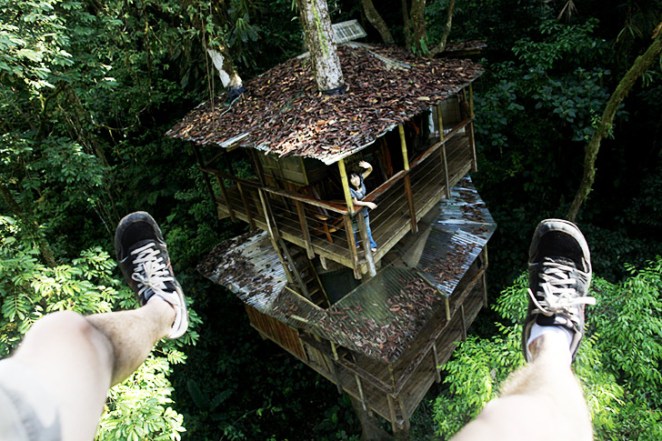
Where do Ewoks go when they're bored with Endor? Why, to Finca Bellavista village of course.
Bosco Verticale
sunken pedestrian bridge in the netherlands parts moat waters like moses
The holidays are a time to reflect on our lives, our jobs, and what we want for the new year. It might also be a good time to think about ways to cut back on our obligations and “must dos”. Especially for our children at school.
I appreciated this op-ed piece questioning the value of play versus academic work in kindergarten, pre-k, and the lower grades. The piece is US-oriented but it does refer to data from elsewhere, and to the ‘ethnographic record’ :0)
While the U.S. pushes their kids to excel earlier and earlier, science is finding it might not be the most efficient way to learn:
Students from countries where reading is not taught until age six actually do better on standardized reading tests than those from countries that begin at five or earlier, as in the USA. Children who start even later catch up quickly: Suggate collected extensive data from about 400 students in New Zealand – some in public schools and some in private “Waldorf” schools, where reading teaching doesn’t even begin until age seven. Difference in reading achievement between the two groups disappeared by age 10.
Research comparing Waldorf school students’ academic skills to those of public school students shows even more encouraging results. In a report exploring the value of the Waldorf approach for public school reform, Ida Oberman found that second-graders from four Waldorf-style schools underperformed in comparison to 10 “peer-alike sites.” Yet by eighth grade, these students could match and even outperform comparison sites on state school achievement tests.
If nothing is lost from academic achievement when training starts later, and some competencies even may be gained, why then the rush to begin it? Why buy toddler flash-cards, fund pre-K academies, and start kindergartners on reading and math when children could be otherwise engaged, developing other kinds of skills and dispositions, such as empathy and creativity?
There is also great research coming out of Denmark vs. the U.S. that find kids that aren’t taught to read until 6 or 7 (Denmark) vs. 4 or 5 (U.S.) do better overall, similar to the study in New Zealand.
Interesting to see how taking it easy can sometimes be better for learning.
I’m a huge fan of toys in the workplace. They help me think, they can trigger creative ideas, and they make me smile. But some people consider thema distraction.
What’s your opinion of toys in your cubicle? Do they delight or distract you? Leave your thoughts in the comments.
Interesting study to keep you motivated while I’m off in the woods:
Kids are spending less and less time outdoors. Why? We’re becoming more and more wired in and dependent on technology:
There is a growing disparity between the time kids spend indoors wired to technology and the time they spend outside enjoying nature. The vast majority of today’s kids use a computer, watch TV, or play video games on a daily basis, but only about 10 percent say they are spending time outdoors every day, according to a new nationwide poll from The Nature Conservancy.Why? Lack of access to natural areas and discomfort with the outdoors are two primary factors identified by the Conservancy’s poll.The poll was conducted from July 28 through August 4, and asked 602 kids between the ages of 13 and 18 about their attitudes toward nature, outdoor activity and environmental issues.





 The holidays are a time to reflect on our lives, our jobs, and what we want for the new year. It might also be a good time to think about ways to cut back on our obligations and “must dos”. Especially for our children at school.

 Mental Flowers