anthropology · creativity · culture · learning

Slow school movement

lutin waldorfThe holidays are a time to reflect on our lives, our jobs, and what we want for the new year. It might also be a good time to think about ways to cut back on our obligations and “must dos”. Especially for our children at school.
I appreciated this op-ed piece questioning the value of play versus academic work in kindergarten, pre-k, and the lower grades. The piece is US-oriented but it does refer to data from elsewhere, and to the ‘ethnographic record’ :0)

While the U.S. pushes their kids to excel earlier and earlier, science is finding it might not be the most efficient way to learn:

Students from countries where reading is not taught until age six actually do better on standardized reading tests than those from countries that begin at five or earlier, as in the USA. Children who start even later catch up quickly: Suggate collected extensive data from about 400 students in New Zealand – some in public schools and some in private “Waldorf” schools, where reading teaching doesn’t even begin until age seven. Difference in reading achievement between the two groups disappeared by age 10.

Research comparing Waldorf school students’ academic skills to those of public school students shows even more encouraging results. In a report exploring the value of the Waldorf approach for public school reform, Ida Oberman found that second-graders from four Waldorf-style schools underperformed in comparison to 10 “peer-alike sites.” Yet by eighth grade, these students could match and even outperform comparison sites on state school achievement tests.

If nothing is lost from academic achievement when training starts later, and some competencies even may be gained, why then the rush to begin it? Why buy toddler flash-cards, fund pre-K academies, and start kindergartners on reading and math when children could be otherwise engaged, developing other kinds of skills and dispositions, such as empathy and creativity?

more at: What can slow schools teach us?

There is also great research coming out of Denmark vs. the U.S. that find kids that aren’t taught to read until 6 or 7 (Denmark) vs. 4 or 5 (U.S.) do better overall, similar to the study in New Zealand.

Interesting to see how taking it easy can sometimes be better for learning.

creativity · environment

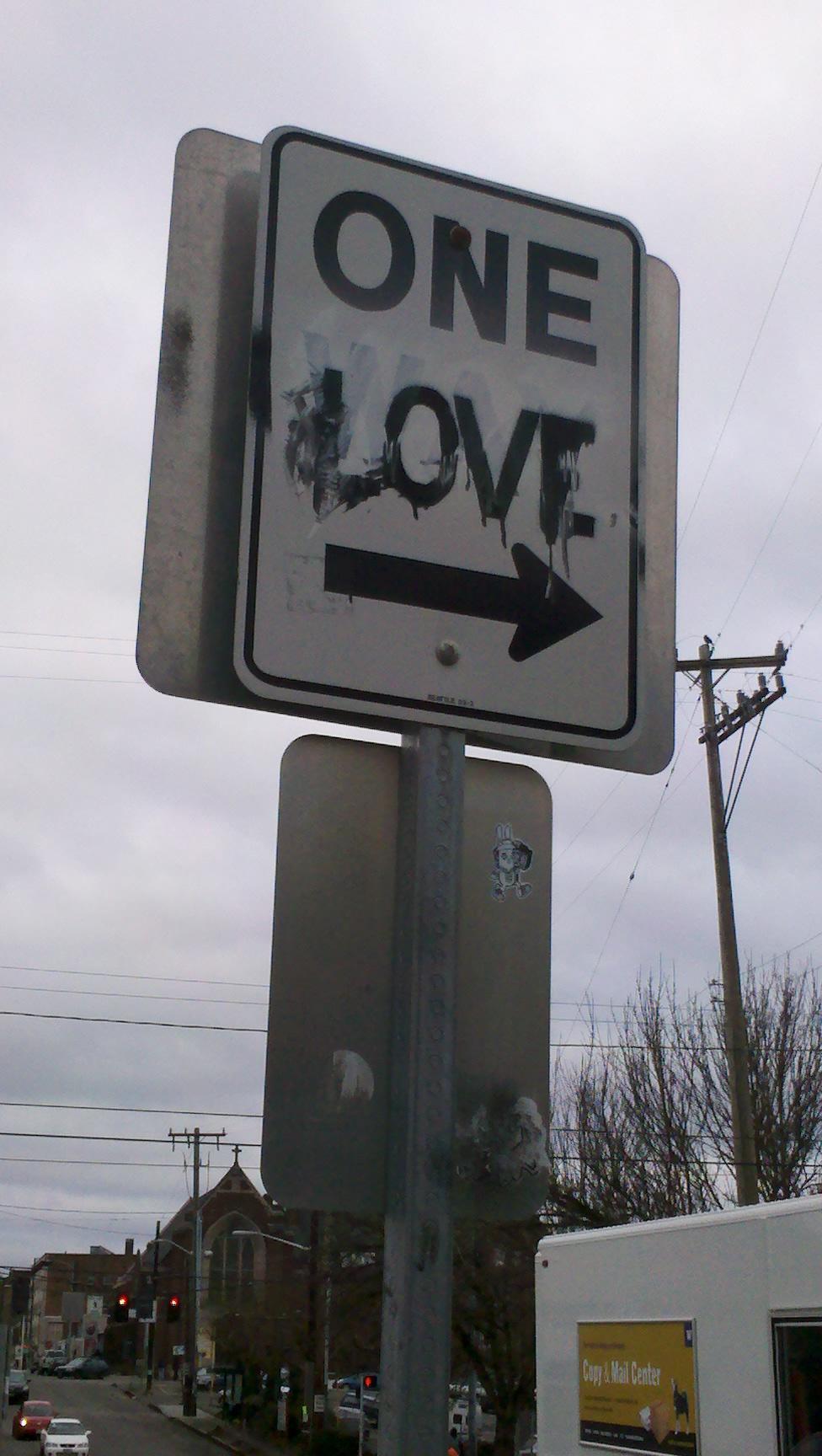
Friday guerilla art

While I don’t condone defacing public street signs, I liked the sentiment. It made me think about how easy it is to make people smile and make a space more friendly with a word.
Happy Friday!

behavior · community · creativity · Mental · psychology

How Knitting Behind Bars Transformed Maryland Convicts – News – GOOD

Prisoners show off their knitting progress. Photo courtesy of the program.

Creating something with your hands, learning a craft, and being successful with something even as simple as crochet can have huge positive effects on people. That effect that be even more significant if you’ve been a screw-up your whole life, as many people behind bars feel they have been. This story about bringing knitting workshops to prisons is a great example, similar to the Puppies Behind Bars program or helping to raise endangered frogs, of how doing something as simple as a pearl and stitch can have huge psychologically positive impacts.

In late 2009, Lynn Zwerling stood in front of 600 male prisoners at the Pre-Release Unit in Jessup, Maryland. “Who wants to knit?” she asked the burly crowd. They looked at her like she was crazy.

Yet almost two years later, Zwerling and her associates have taught more than 100 prisoners to knit, while dozens more are on a waiting list to take her weekly class. “I have guys that have never missed one time in two years,” Zwerling says. “Some reported to us that they miss dinner to come to class.”

Zwerling, 67, retired in 2005 after 18 years of selling cars in Columbia, Maryland. She didn’t know what to do with her time, so she followed her passion and started a knitting group in her town. No one came to the first meeting, but the group quickly grew to 500 members. “I looked around the room one day and I saw a zen quality about it,” Zwerling says. “Here were people who didn’t know each other, had nothing in common, sitting together peacefully like little lambs knitting. I thought, ‘It makes me and these people feel so good. What would happen if I took knitting to a population that never experienced this before?’”

Her first thought was to bring knitting to a men’s prison, but she was turned down repeatedly. Wardens assumed the men wouldn’t be interested in a traditionally feminine hobby and worried about freely handing out knitting needles to prisoners who had been convicted of violent crimes. Five years passed before the Pre-Release Unit in Jessup accepted her, and Knitting Behind Bars was born. “I [wanted to teach] them something that I love that I really believe will make them focus and happy,” Zwerling says. “I really believe that it’s more than a craft. This has the ability to transform you.”

via How Knitting Behind Bars Transformed Maryland Convicts – News – GOOD.

brain · creativity · mental health

8 Counter-Intuitive Ways to Improve Your Well-Being and Creativity

I’m having quite the brain block at work today, but I did find this article helpful; in fact, I went right out and bought myself an early lunch (or late brunch) after reading this.

To help you break the busy-ness cycle and work happier, we’ve rounded up a handful of counter-intuitive ways to tweak your habits and your mindset. They range from obvious-but-oft-ignored tips to the slightly more eccentric.
1. Eat breakfast.
According to New York magazine, “between 1965 and 1991, the number of adults who regularly skip breakfast increased from 14 to 25%.” We all know that “breakfast is the most important meal of the day” but few of us act on it. The truth is there are few better one-stop options for improving general well-being. Numerous studies have linked eating breakfast with better general health, increased productivity, and a lower body mass index. If you want to feel better, look better, or just work better, there’s one simple solution: eat breakfast — preferably foods with a low glycemic index.

2. Sit less.
Most of us spend the greater part of our day sitting in front of a computer. In fact, the average person sits 9.3 hours a day — more than they sleep. All of this sedentary work is leading to increased cardiovascular disease, obesity, diabetes, and lots of other unhealthy side effects. Like death…

more at 8 Counter-Intuitive Ways to Improve Your Well-Being & Creativity

I wouldn’t call them counter-intuitive, per say, but definitely not the usual ideas, like getting an office pet (#4) or distancing yourself from a problem (#7). And many of them really do focus on overall well-being, not just creativity and collaboration in the workplace.

What other “odd” ways do you use to improve your well-being? Leave it in the comments.

anthropology · architecture · community · creativity · design · environment

Coloring inside the lanes: Art that creates community | Grist

The Fremont Turtle - Grist

I found another great article from Grist magazine about how something as simple as a bucket of paint, or several different colored, buckets of paint, can have a huge positive impact on a neighborhood:

Sunnyside Piazza, it is called, which may seem a bit much for a splash of color on asphalt, but in person, it seemed fitting. This whimsical design, interrupting the functional but monotonous gray of Portland’s street grid, felt like a somewhere. It seemed like a place deserving a name. It even felt like a “piazza.”

That was in 2002. I later learned that the Sunnyside Piazza was the second painted public square in Portland, facilitated by the nonprofit City Repair Project. Now, dozens of painted plazas, dubbed Intersection Repairs, pepper the map not just of Portland but also of Los AngelesNew YorkSt. Paul, and Seattle.

It all started in the mid-1990s with Share-It-Square, in Portland’s Sellwood neighborhood, where architect and City Repair co-founder Mark Lakeman lives. After visiting villages in Central America where residents gather around common spaces, Lakeman decided to bring similar spaces to Portland. “Putting the public space back where it’s supposed to be may not sound like a huge change,” Lakeman says, “but it has a profound effect on the social culture … We know that Americans are more lonely and isolated than ever before, but we don’t realize that the absence of cohesion in American communities is totally related to the absence of places where people can actually build that.”

more via Coloring inside the lanes: Art that creates community | Grist.

The article goes on to discuss how creating a group mural creates a sense of community:

“It’s not about the paint,” says professor Jan Semenza, a professor of public health at Portland State University who lives near the Sunnyside Piazza and has researched intersection repairs. “It’s about neighbors creating something bigger than themselves.” As an everyday intersection becomes someplace special, residents begin to experience the value of community. Neighbors paint themselves out of a corner — of the intersection, of their individual homes — and into the middle of the street. By turning an intersection from a dividing line between neighbors into a gathering place, residents begin to solve the problems that plague neighborhoods and cities. Where isolation existed, they find community. Where cars dominated, they create a people place. With a little paint, neighbors are solving big problems.

I have seeen some great community spaces also created out of roundabouts, water fountains at outdoor shopping centers, and often at landmarks like stairs or trees. Sometimes, if a natural landmark or meeting space isn’t in place, all it takes is some paint, chalk, or even ribbon to make a place significant and identify it as a community gathering space.


architecture · community · creativity

Recycled houses from around the world

I saw this article about a house made out of plastic bottles…

With a serious housing shortage but no shortage of plastic bottles littering the streets, the Development Association for Renewable Energies (DARE) – an NGO based in Nigeria – decided to build this incredible two-bedroom bungalow entirely out of plastic bottles! Although many in Kaduna were dubious when the project began construction in June this year, the nearly-complete home is bullet and fireproof, earthquake resistant, and maintains a comfortable interior temperature of 64 degrees fahrenheit year round!

This led to further searches, and found some other cool houses made out of reused materials:

Architects and homeowners are gradually discovering the benefits of shipping container homes. It turns out that the strong, cheap freight boxes make pretty useful building blocks. They can be loaded with creature comforts and stacked to create modular, efficient spaces for a fraction of the cost, labor and resources of more conventional materials. Shipping containers can be easily insulated and climate controlled, and they are being deployed as disaster relief shelters and modest vacation homes. In stacking configurations they are appearing as student housing and even luxury condos.


Plus for all you survivalists out there, they would be a great start to a less conspicuous (if left au naturale on the outside), possibly fit with a grounding net against EMPs, and generally fire proof.


Salvaged wine corks, which are easy to come by, provide an inexpensive form of cork flooring.
This Boeing 727 carried in the past passengers for South Africa Air and Avianca Airlines (Columbia). Today it is suspended on a 50 foot pedestal on the edge of the National Park, in Manuel Antonio, Costa Rica.

Lots more here and here. What other houses made out of recycled houses have you seen?

One question I have, however, is how well some of these houses actually blend into the environments they’re built. Are they actually beneficial to the Earth because they keep this stuff out of the landfill? Does it make the families who live in these places’ lives better? Thoughts?

anthropology · behavior · community · creativity · environment · health

Making money off the land

A swaledale ewe on the rolling fells of the La...
You may be looking at a model of your next lawnmower. Image via Wikipedia

After the last post about dumpster diving, I thought we could focus on something a little more fresh, like growing your own food. Or your own sheep.

From renting out goats and sheep in order to naturally trim lawns and hillsides, to teaching other people how to raise chickens and bees, “urban homesteading” is becoming a way of life that is not only natural and makes people feel good, it’s also profitable.

As an uncertain economy and a stagnant hiring climate continue to freeze people out of the traditional job market, a number of entrepreneurs like Mr. Miller, many of them in their 20s and 30s, are heading back to the land, starting small agricultural businesses. And in the process, they are discovering that modern homesteading offers more rewarding work, and possibly more security, than entering the white-collar fray.

Mr. Miller, who supplements his income by working on a local farm, has resisted raising his prices because he wants his services to be available to all. And while Heritage Lawn Mowing is not yet in the black, he says he has found a better way of life.

“It’s a gateway to that whole rural dream,” he said. “And with the type of recession we’re having, there’s stability in it.”

Other yeoman start-ups are charting a more traditional path to profits.

Carrie Ferrence, 33, and Jacqueline Gjurgevich, 32, were in business school at Bainbridge Graduate Institute in Washington State when they noticed that many local neighborhoods were “food deserts,” without easy access to fresh local produce and other grocery staples.

Their answer was StockBox Grocers, a company that repurposes old shipping containers as small grocery stores. The company won $12,500 in a local business plan competition and raised more than $20,000 online in a Kickstarter campaign to finance its first store, which opened in the Delridge neighborhood of Seattle in September.

“It’s a tough job market, and you have really few instances in your life to do something that you really love,” Ms. Ferrence said. “It’s not that this is the alternative. It’s the new plan A.”

Read more: Sheep Lawn Mowers, and Other Go-Getters (New York Times)

What is it that is so appealing to this (my) generation about growing gardens, knitting, and owning a sheep-rental mowing company? Why are we so drawn to this idea of keeping bees, growing our own vegetables, and sewing our own clothes? I have some ideas, but I’d be curious to hear yours in the comments below.

architecture · creativity · design

Bob Cassilly Remembered: Part Sculptor, Part Kid : NPR

City Museum
Image of Cassilly's City Museum. Image by Northfielder via Flickr

A great remembrance of Bob Cassilly, who died last week, and who was well known for being a forever kid and player. It’s always great to hear stories of people who never lost their love of play and used it to inspire others; too often this kind of playful exploration and love of sharing it with others is not truly appreciated until after they die or are near death (Jim Henson and Randy Pausch come to mind).

“If you can’t climb on it and you can’t slide on it, what good is it?” asks J. Watson Scott, summing up the approach of the man responsible for the spectacle. Scott knew and worked with Bob Cassilly for decades, and says the artist never lost his inner kid. Today, with many in St. Louis, he’s mourning Cassilly, who died last month in an accident while working on his latest creation.

Cassilly’s City Museum, which opened in 1997, is a fantastical place that features caves, a jungle gym and lots of slides. As the Ferris wheel squeaks in the background, Scott says the artist loved to reuse discarded items to create unique spaces that children and adults could climb over, under and through.

more via Bob Cassilly Remembered: Part Sculptor, Part Kid : NPR.

behavior · creativity · design · happiness

“You’ve got to find what you love” » Steve Jobs’ 2005 Stanford Commencement Speech

Reposted from “You’ve got to find what you love” » The Business School of Happiness, and the Stanford Report, June 14, 2005

‘You’ve got to find what you love.’ Jobs says

This is the text of the Commencement address by Steve Jobs, CEO of Apple Computer and of Pixar Animation Studios, delivered on June 12, 2005.

I am honored to be with you today at your commencement from one of the finest universities in the world. I never graduated from college. Truth be told, this is the closest I’ve ever gotten to a college graduation. Today I want to tell you three stories from my life. That’s it. No big deal. Just three stories.

The first story is about connecting the dots.

I dropped out of Reed College after the first 6 months, but then stayed around as a drop-in for another 18 months or so before I really quit. So why did I drop out?

It started before I was born. My biological mother was a young, unwed college graduate student, and she decided to put me up for adoption. She felt very strongly that I should be adopted by college graduates, so everything was all set for me to be adopted at birth by a lawyer and wife. Except that when I popped out they decided at the last minute that they really wanted a girl. So my parents, who were on a waiting list, got a call in the middle of the night asking: “We have an unexpected baby boy; do you want him?” They said: “Of course.” My biological mother later found out that my mother had never graduated from college and that my father had never graduated from high school. She refused to sign the final adoption papers. She only relented a few months later when my parents promised that I would someday go to college.

And 17 years later I did go to college. But I naively chose a college that was almost as expensive as Stanford, and all of my working-class parents’ savings were being spent on my college tuition. After six months, I couldn’t see the value in it. I had no idea what I wanted to do with my life and no idea how college was going to help me figure it out. And here I was spending all of the money my parents had saved their entire life. So I decided to drop out and trust that it would all work out OK. It was pretty scary at the time, but looking back it was one of the best decisions I ever made. The minute I dropped out I could stop taking the required classes that didn’t interest me, and begin dropping in on the ones that looked interesting.

It wasn’t all romantic. I didn’t have a dorm room, so I slept on the floor in friends’ rooms, I returned coke bottles for the 5¢ deposits to buy food with, and I would walk the 7 miles across town every Sunday night to get one good meal a week at the Hare Krishna temple. I loved it. And much of what I stumbled into by following my curiosity and intuition turned out to be priceless later on. Let me give you one example:

Reed College at that time offered perhaps the best calligraphy instruction in the country. Throughout the campus every poster, every label on every drawer, was beautifully hand calligraphed. Because I had dropped out and didn’t have to take the normal classes, I decided to take a calligraphy class to learn how to do this. I learned about serif and san serif typefaces, about varying the amount of space between different letter combinations, about what makes great typography great. It was beautiful, historical, artistically subtle in a way that science can’t capture, and I found it fascinating.

None of this had even a hope of any practical application in my life. But ten years later, when we were designing the first Macintosh computer, it all came back to me. And we designed it all into the Mac. It was the first computer with beautiful typography. If I had never dropped in on that single course in college, the Mac would have never had multiple typefaces or proportionally spaced fonts. And since Windows just copied the Mac, its likely that no personal computer would have them. If I had never dropped out, I would have never dropped in on this calligraphy class, and personal computers might not have the wonderful typography that they do. Of course it was impossible to connect the dots looking forward when I was in college. But it was very, very clear looking backwards ten years later.

Again, you can’t connect the dots looking forward; you can only connect them looking backwards. So you have to trust that the dots will somehow connect in your future. You have to trust in something — your gut, destiny, life, karma, whatever. This approach has never let me down, and it has made all the difference in my life.

My second story is about love and loss.

I was lucky — I found what I loved to do early in life. Woz and I started Apple in my parents garage when I was 20. We worked hard, and in 10 years Apple had grown from just the two of us in a garage into a $2 billion company with over 4000 employees. We had just released our finest creation — the Macintosh — a year earlier, and I had just turned 30. And then I got fired. How can you get fired from a company you started? Well, as Apple grew we hired someone who I thought was very talented to run the company with me, and for the first year or so things went well. But then our visions of the future began to diverge and eventually we had a falling out. When we did, our Board of Directors sided with him. So at 30 I was out. And very publicly out. What had been the focus of my entire adult life was gone, and it was devastating.

I really didn’t know what to do for a few months. I felt that I had let the previous generation of entrepreneurs down – that I had dropped the baton as it was being passed to me. I met with David Packard and Bob Noyce and tried to apologize for screwing up so badly. I was a very public failure, and I even thought about running away from the valley. But something slowly began to dawn on me — I still loved what I did. The turn of events at Apple had not changed that one bit. I had been rejected, but I was still in love. And so I decided to start over.

I didn’t see it then, but it turned out that getting fired from Apple was the best thing that could have ever happened to me. The heaviness of being successful was replaced by the lightness of being a beginner again, less sure about everything. It freed me to enter one of the most creative periods of my life.

During the next five years, I started a company named NeXT, another company named Pixar, and fell in love with an amazing woman who would become my wife. Pixar went on to create the worlds first computer animated feature film, Toy Story, and is now the most successful animation studio in the world. In a remarkable turn of events, Apple bought NeXT, I returned to Apple, and the technology we developed at NeXT is at the heart of Apple’s current renaissance. And Laurene and I have a wonderful family together.

I’m pretty sure none of this would have happened if I hadn’t been fired from Apple. It was awful tasting medicine, but I guess the patient needed it. Sometimes life hits you in the head with a brick. Don’t lose faith. I’m convinced that the only thing that kept me going was that I loved what I did. You’ve got to find what you love. And that is as true for your work as it is for your lovers. Your work is going to fill a large part of your life, and the only way to be truly satisfied is to do what you believe is great work. And the only way to do great work is to love what you do. If you haven’t found it yet, keep looking. Don’t settle. As with all matters of the heart, you’ll know when you find it. And, like any great relationship, it just gets better and better as the years roll on. So keep looking until you find it. Don’t settle.

My third story is about death.

When I was 17, I read a quote that went something like: “If you live each day as if it was your last, someday you’ll most certainly be right.” It made an impression on me, and since then, for the past 33 years, I have looked in the mirror every morning and asked myself: “If today were the last day of my life, would I want to do what I am about to do today?” And whenever the answer has been “No” for too many days in a row, I know I need to change something.

Remembering that I’ll be dead soon is the most important tool I’ve ever encountered to help me make the big choices in life. Because almost everything — all external expectations, all pride, all fear of embarrassment or failure – these things just fall away in the face of death, leaving only what is truly important. Remembering that you are going to die is the best way I know to avoid the trap of thinking you have something to lose. You are already naked. There is no reason not to follow your heart.

About a year ago I was diagnosed with cancer. I had a scan at 7:30 in the morning, and it clearly showed a tumor on my pancreas. I didn’t even know what a pancreas was. The doctors told me this was almost certainly a type of cancer that is incurable, and that I should expect to live no longer than three to six months. My doctor advised me to go home and get my affairs in order, which is doctor’s code for prepare to die. It means to try to tell your kids everything you thought you’d have the next 10 years to tell them in just a few months. It means to make sure everything is buttoned up so that it will be as easy as possible for your family. It means to say your goodbyes.

I lived with that diagnosis all day. Later that evening I had a biopsy, where they stuck an endoscope down my throat, through my stomach and into my intestines, put a needle into my pancreas and got a few cells from the tumor. I was sedated, but my wife, who was there, told me that when they viewed the cells under a microscope the doctors started crying because it turned out to be a very rare form of pancreatic cancer that is curable with surgery. I had the surgery and I’m fine now.

This was the closest I’ve been to facing death, and I hope its the closest I get for a few more decades. Having lived through it, I can now say this to you with a bit more certainty than when death was a useful but purely intellectual concept:

No one wants to die. Even people who want to go to heaven don’t want to die to get there. And yet death is the destination we all share. No one has ever escaped it. And that is as it should be, because Death is very likely the single best invention of Life. It is Life’s change agent. It clears out the old to make way for the new. Right now the new is you, but someday not too long from now, you will gradually become the old and be cleared away. Sorry to be so dramatic, but it is quite true.

Your time is limited, so don’t waste it living someone else’s life. Don’t be trapped by dogma — which is living with the results of other people’s thinking. Don’t let the noise of others’ opinions drown out your own inner voice. And most important, have the courage to follow your heart and intuition. They somehow already know what you truly want to become. Everything else is secondary.

When I was young, there was an amazing publication called The Whole Earth Catalog, which was one of the bibles of my generation. It was created by a fellow named Stewart Brand not far from here in Menlo Park, and he brought it to life with his poetic touch. This was in the late 1960′s, before personal computers and desktop publishing, so it was all made with typewriters, scissors, and polaroid cameras. It was sort of like Google in paperback form, 35 years before Google came along: it was idealistic, and overflowing with neat tools and great notions.

Stewart and his team put out several issues of The Whole Earth Catalog, and then when it had run its course, they put out a final issue. It was the mid-1970s, and I was your age. On the back cover of their final issue was a photograph of an early morning country road, the kind you might find yourself hitchhiking on if you were so adventurous. Beneath it were the words: “Stay Hungry. Stay Foolish.” It was their farewell message as they signed off. Stay Hungry. Stay Foolish. And I have always wished that for myself. And now, as you graduate to begin anew, I wish that for you.

Stay Hungry. Stay Foolish.

Thank you all very much.

Thank you, Steve. RIP (1955 – 2011)

architecture · children · creativity · design · play

Playground designs curated on Flickr

One job that has always sounded super fun is playground designer. Playgrounds can be fun, exciting, inspiring places, full of color, creative design, and above all inspire play.  Some of the different playground designs from around Sweden got the spotlight recently on Flickr.

[Last week], @megrosker shared a link to Swedish Aesthetic, a gallery featuring colorful and very creative Swedish playground designs and play structures… be sure to visit the gallery for all photos curated by PlayGroundology.

view the gallery via Swedish playground design « Flickr Blog. PlayGroundology’s photostream includes photos from Canada and other adventures around the world.

Flickr has quite a few different playground designs scattered throughout the Flickrverse:


I even got so inspired I started my own Playground gallery on Flickr. Check it out, and if you have any photos you’d like to contribute, let me know.