community · creativity · environment · play · Social

99 Tiny Games Project in London Brings Play to the Streeets

Sometimes we just need a little spark to get us to play.

In 2012, Hide&Seek installed 99 tiny games around London:

http://hideandseek.net/projects/99-tiny-games/

Tiny Games began life at the Southbank Centre in 2011 and are a collection of very small, very quick-to-understand games. They sit in the real world, inviting participation from any interested passer-by. Their rules can be summarised in just a couple of sentences.

In the spirit of the “big” games in London this summer, Hide & Seek created 99 wee-tiny games and stuck them all over the city, transforming buildings, sidewalks, tube stations and more into impromptu game sites. The rules are all quick and simple and each game takes almost no time to play – anyone can play, anytime they want. Players will be tested on everything from wits to creativity to cooperation to determination, all within immediate reach of their home, workplace, or favorite pub.

It’s great to watch the Olympians do what they do best and admire their near-superhuman abilities, but it’s also important to bring this spirit of competition and fun to non-superhumans like us. We bet that if everyone stopped to play even for just a few minutes everyday the world would undoubtedly be a better place. 99 Tiny Games serves as a reminder to everyone to always be playful, no matter where you are.

In the past year, the team has since created a Kickstarter to try and get an app built so you can find fun games wherever you go. Hooray for using technology to create playful spaces wherever you are! Unfortunately it only looks like it’s available in the UK market, but it’s great inspiration to look for play wherever you go.

community · creativity · environment · music

Want to support music? Support green space and parks!

OK, maybe that’s overstating it a bit, but that’s the headline/thesis that Grist Editor Jess Zimmerman proposes in his short article about Seattle rapper Macklemore, and I gotta admit I like his thinking…

In this video for the Nature Conservancy, rapper Macklemore explains how municipal green space in his home city of Seattle influenced his career: He and his friends didn’t want to kick it at their parents’ houses, so they went and freestyled in parks. (Side note: Do people really still say “kick it,” or is Macklemore even older than I am?) We knew, of course, that Macklemore was into creative reuse, but who knew he had so many ideas about urban infrastructure?

The moral here is clear: Want more rappers? Make more parks. It’s just science.

I also love the fact that a hip hop artist is “kicking it” with the Nature Conservancy.

Do you know of any other artists who got their start playing in parks, beaches, or other urban green spaces? Leave your thoughts in the comments below.

architecture · creativity · design

15 Amazing Creatively Themed Office Spaces

Hopefully it gets them in the right mindset and right kind of play (i.e. working rather than "goofing off")

If you’re part of a business that prizes creativity and innovation, inspiring surroundings might not go amiss. Luckily, some companies are moving away from the sterile-looking cubicles, bland layout and generally humdrum designs that can still be seen in many workplaces. The following 15 workspaces take a non-traditional approach to office design, and we love the results, whether they feature orchards or cupcakes. Check out some of these incredible places that people get to work in – although you might get a little green with envy.

See them all here.

architecture · creativity · play

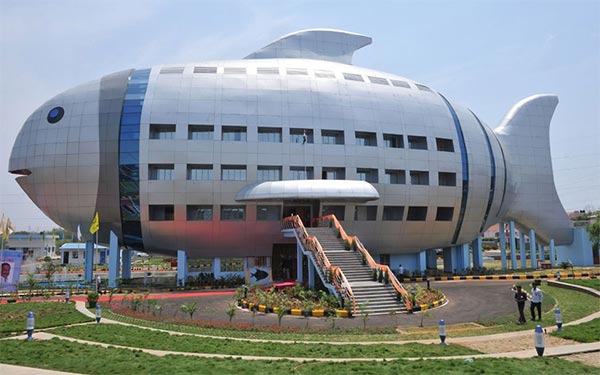
Fish-shaped Building Inaugurated in Hyderabad, India

The newly opened National Fisheries Development Board building in Hyderabad, India, designed to resemble a fish.

via Fish-shaped Building Inaugurated in Hyderabad, India.

I like the playfulness of the Fisheries team, at least. And it’s actually clever advertising to boot. Hopefully they won’t want to move for a few years, since I’m not sure who else might need a fish-shaped building. But it sure is a fun thing to see as you walk into work everyday.

behavior · brain · creativity · environment

How Acting Like a Scientist Can Help You Play

playing in the woods and acting like a scientist look pretty similar
I heard this story on NPR recently, and I think it’s the best advice I’ve heard in awhile on how to get out in the woods and explore, relax, and as they say in the article, take time to smell the roses! The answer: make an exploratory game out of it. “Pretend” to be a naturalist. Yes!

In this permanent state of hyperventilation, the issue for us all is not stopping to smell roses. It’s not even noticing that there are roses right there in front of us. Joseph Campbell, the great scholar of religion, hit the core of our problem when he wrote, “People say that what we’re all seeking is a meaning for life. I don’t think that’s what we’re really seeking. I think that what we’re seeking is an experience of being alive.”

But how can we experience “being alive” in the midst of the crushing urgencies that make up modern life?

Well, it might seem strange, but one answer to that question is “science,” at least science with a lowercase “s.” Science, you see, is all about noticing. This is where it begins, with simple act of catching seeing the smallest detail as an opening to a wider world of wonder and awe. And here is the good news. You don’t need a particle accelerator or well-equipped genetics lab in your basement to practice noticing (that would be science with a capital “S”).

You already are a scientist. You have been since you were a kid playing with water in the tub, or screwing around in the backyard with dirt and sticks and stuff.

If you want to rebuild your inner-scientist-noticing-skills, the best place to begin is with a walk in the woods.

There are lots of reasons to take a walk in the woods. To get away from it all, clear your head, smell the fresh air. The problem, of course, is that even if we get ourselves into a park or a forest, we might still be so lost in our heads that we miss what’s right in front of us. Practicing noticing, like a scientist, can change that by binding us to experience in ways that are thrilling, even in their ordinariness.

Noticing can take many forms. One trick is to count things. Scientists love to count stuff. How many trees are there on the sides of a steep hill compared with its crest? How many leaves are there on the stalks of the blue flowers compared to the yellow ones? How many different kinds of birdsong do you hear when you stop and listen, (by the way, this requires really stopping and really listening, which is awesome). Counting things forces you to pay attention to subtleties in the landscape, the plants, the critters.

Other things scientists love: shapes, colors, patterns. Do the rocks at the stream’s edge look different from the ones near the trail? Do the big cattails have the same color as the small ones? Get your naturalist on and bring a notebook. Pretend you are or John Muir. Jot down your findings, make little drawings and always, always ask your yourself those basic questions: why, how, when?

Read the full article.

It may seem counter-intuitive, but scientists are all about creativity and exploration, and noticing things outside of the ordinary, so acting like a scientist is great way to see the world in a whole new way by playing with things, seeing what happens when you mess with something. Kids are natural players/explorers/scientists, so you can even bring one along as it might be helpful to get you in the explorer mode.

I would also argue that it doesn’t have to be “the woods” necessarily to get the same playful/exploratory benefits, it can also be short walks around the block, whatever works to get your observational juices flowing.

behavior · creativity · play · psychology · work

How Play Makes You A Better Adult

I Watch them watch them play the game Then I w...
Adults at play. (Photo credit: Wikipedia)

Happy Friday. The weather is turning beautiful in many places around the U.S., with lots of sun. In fact one school in Washington gave kids the day off so they could go out and play. Some places get snow days, the principal figured, so why not a sun day? Perfect reasoning to me.

Unfortunately a lot of adults don’t take these opportunities to go out and play, thinking it’s a “waste” of their time. But, as I constantly argue on this blog, play is vital for healthy grown-ups too.

Erika Andersen explores the intersection between work and play for grown-ups, and how play makes us better grown-ups.

Sadly, by the time most of us reach our teens, play has been replaced as our primary learning mode by competition, memorization, practice and recitation – otherwise known as “sports” and “school.”  And we come to think of play as something we do when there’s nothing more urgent to be done – as time stolen from more critical things. However, the elements that make play such a great way to learn when we’re kids still work for us when we’re adults.  The happiest and most creative adults I know regularly bring play into their lives as a way to stretch, evolve, innovate and – this is important – enjoy.  Here’s a great example – two guys named Jay Silver and Eric Rosenbaum have created a kit called MaKey MaKey, that allows you to control any electronic device using household objects.

…When you play, you’re making up the world.  You’re saying, “Let’s imagine that…”  or “Why don’t we…?”  or “What if….?” And that’s where freshness, learning and innovation live.

Full article at: How Play Can Make You a Better Grown-up | Forbes

Andersen offers up some ideas on how to be more playful as a grown-up, although as she points out the whole point of being playful is to think outside the box, so just think of these as starting places:

Be the littlest kid.  You know how when kids play, the littler kids usually follow the older kids’ lead?  When you play with actual kids, let them call the shots, rather than you, adult-like, defining the play.  You’ll get drawn into wonderful worlds you would never have considered.

Declare a no win-zone.  Occasionally, when trying someone new, agree with yourself that the goal isn’t to ‘get good at it’ or ‘be better at this than so-and-so’ – but rather ‘to look like a fool’ or ‘have as much fun as possible.’ Remember what Bettelheim says about play including “the absence of any goals outside the activity itself.”

Lose the watch.  Little kids have no sense of time.  When they’re engrossed in something, hours could pass and they’d never know it. Try moving all your time-based commitments out of a day (or at least part of a day), and give yourself permission to do whatever you want for as long as you want.  Get fascinated about your choices.

Bring play to work.  Sometime during the next week, approach a work problem through the rules of play, that is “characterized by freedom from all but personally imposed rules (which are changed at will).”  Start thinking about it by asking “What if we didn’t have any constraints – how would we think about this?”  If you really get into that “play” mindset, you just might come up with a crazy notion that contains the germ of greatness.

anthropology · behavior · community · creativity · culture · mental health · play

Offices move towards more playful space design, but what kind of play is best for workspace environments?

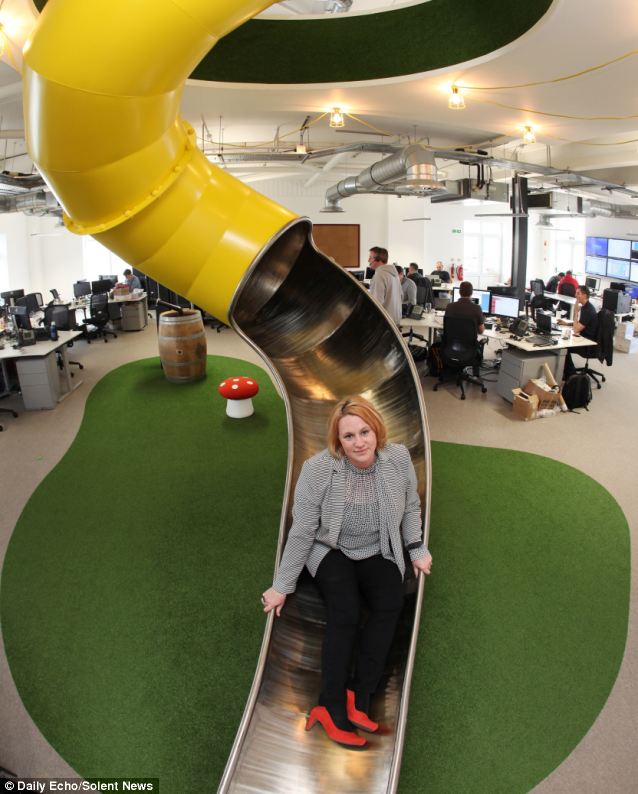
More and more office spaces are trying to become more playful, offering employees a way to destress and/or get more creative. Usually that takes the form of having ping pong tables or video game consoles set up for breaks, but more and more offices are adding slides, swing sets, picnic tables, or other more active and engaging apparatus. They are also bringing in more greenery for workers.

This office may be the most fun in Britain as it comes kitted out with a giant helter skelter slide, a tree house and even a pub.

The unique workplace also boasts a pool table, a putting green, a giant swing and a cinema.

Office designers Space & Solutions were tasked with turning a former pub in Southampton into the home for IT company, Peer 1 Hosting.

‘If you don’t feel comfortable sitting at a desk you can sit on a picnic bench. The reality is that you can do your work from anywhere.’

Read more: UK Daily Mail

The article points out that some people may find all this fun a little distracting to actually work around. Some kinds of play are probably great at cutting stress but may be more of a time suck than creativity inducer. I’m curious what readers think. Are you one of those people who does their best work sitting on a couch, or heck, a swing? Do you prefer quiet and focus without any noise? Do you have a toy or plant on your desk you fiddle with when you’re trying to think or just need to destress?

Another question; do you actually use the toys and playful apparatus in the office? The office I currently work in has a ping pong and air hockey table, but only two people ever use the ping pong table, and I have only seen the air hockey table turned on once for a promo video.

Leave your thoughts in the comments below.

architecture · community · creativity · disease

Adding art to Belltown, Seattle

This is an ongoing project in Seattle of sprucing up vacant office or retail space with art. It’s a plus for the artists, the building managers since it brings attention to their space, and the passersby who are charging to and from work or tourists who stop and linger a little bit longer to view. Always love seeing updates on new projects by this group.

storefrontsseattle's avatarStorefronts

Storefronts Seattle is proud to announce the first two of three projects in the Belltown neighborhood!

Ingrid Lahti
One Pacific Tower, 2006 First Avenue, Belltown
Through June 2013

IMG_3742

Ingrid Lahti traditionally works in neon, but has branched out into illuminated lighting gels in her new installation at First and Virginia.  Inspired by the saturated color in Matisse paintings and Chinese artwork, Ingrid views the illuminated window pieces as a study on the emotional effects of color and light, fitting seamlessly into the vibrant neighborhood in Belltown.  

These installations glow brightly at night, adding to the street-level nightlife of Belltown and kicking off a summer in Seattle with a burst of color.

Chris Papa
2505 Second Avenue
Through June 2013

IMG_0059

Chris Papa, a local printmaker and sculptor, has installed 5 sculptures at Second and Wall, featuring playful sewn wood sculptures conflating art, craft, and architecture.   Interested in the…

View original post 86 more words

community · creativity · environment

Creating Open & Collaborative Cultures through Play

A really great look at playfulness in a corporate environment.

annemariesteen's avatarAnnemarie Steen

worrySince 2004 IBM conducts every two years a Global CEO Survey among global business and public sector leaders to research what keeps them busy (at night in bed). The survey consists of in-person interviews with (in 2012) over 1700 CEO’s worldwide.

More than half of all CEO’s see Human Capital, Customer Relationships and Innovation as key sources of sustained economic value (report 2012).

The findings (2010 & 2012) show a fast growing need for some critical capabilities of employees, in order to deal with the complexity of operating in an increasingly volatile and uncertain world. These include; creativity and creative leadership, collaborativeness, connectedness, communication and flexibility.

To foster these capabilities “CEO’s are creating more Open & Collaborative cultures – encouraging employees to connect, learn from each other and thrive in a world of rapid change. The emphasis on Openness is even higher among Outperforming organizations(*) – and they have the changemanagement-capabilities to make it…

View original post 220 more words

architecture · community · creativity · culture

In Gritty Sao Paulo, Artists Take To The Streets : NPR

A great example of actively adding art in urban settings in order to create enrichment for its inhabitants:

Urban landscapes have always inspired art, and Brazil is no exception. A new crop of artists like Matos not only is taking inspiration from Sao Paulo‘s streets but also is trying to give something back.

Matos covers trees and street poles with woolen sleeves and small, colorful pompoms. Her works look like whimsical webs of rainbow yarn; the effect is surprising and oddly comforting.

“I want people to have something familiar in the city. Here in Brazil we teach knitting from mother to daughter,” Matos says. “When they see my art, they suddenly feel comfortable walking these cold streets. And you can feel better.”

The newest and the biggest urban art project here is called , and it has an impressive list of corporate sponsors. The idea is to connect graffiti artists with individuals or business owners who have a wall they want covered with original art.

Artist Guilherme Matsumoto says he saw the website and signed up to say he was available to paint a space. Walter Orsati, owner of the Purple House Hostel, responded.

It was that easy, they say.

via In Gritty Sao Paulo, Artists Take To The Streets : NPR.