architecture · children · community · creativity · design · health

Energy drink maker Red Bull proposes skate-able art investment for Myrtle Edwards Park


The Seattle City Government Parks & Recreation site recently hosted a public meeting to gather input on a proposed public art piece in Myrtle Edwards Park that will be used for skateboarding.

Energy drink maker Red Bull has approached Seattle Parks and Recreation about making a community investment that would include commissioning an artist to design and fabricate a unique piece of skate-able art. At the meeting, Seattle Parks presented the history of the proposed project, followed by an opportunity for the public to weigh in on the idea.

Myrtle Edwards Park is located at 3130 Alaskan Way on the shoreline of Elliott Bay, north of the Olympic Sculpture Park.

The Citywide Skatepark Plan, developed in 2006 and 2007 with extensive public process, designated Myrtle Edwards as a recommended site for a skatedot [editor: which is apparently smaller than a skatepark]. Since 2007, Seattle Parks and Recreation has constructed eight new skate parks and skatedots. Two more are in construction and design.

4Culture is administering the Call for Artists associated with this project. The artist will coordinate the design with Seattle Parks and Recreation.

A second follow-up meeting is planned in June.

I love the idea of creating public art that is actually usable, whether it’s by skaters, kids, or even animals. I understand that some art is best appreciated by not messing with it, but especially in a public space sometimes it’s hard to not want to interact with sculptures or murals. I also appreciate Red Bull’s focus on supporting play in all its forms, although private sponsorship of public spaces is always a touchy, tricky gray area.

Is there a public art piece, or artistic skatedot, fountain, whatever, that you really enjoy sitting on, playing on, or just watching others play? Let me know about it in the comments below.

children · environment · happiness · hugs · Nature · neuroscience · psychology

Tree Hugging Now Scientifically Validated – Uplift

hugging trees can be good for us

The term “tree hugger” has been applied to people viewed as uber-liberal or too idealistic, however… “it has been recently scientifically validated that hugging trees is actually good for you.”

Research has shown that you don’t even have to touch a tree to get better, you just need to be within its vicinity has a beneficial effect.

In a recently published book, Blinded by Science, the author Matthew Silverstone, proves scientifically that trees do in fact improve many health issues such as Attention Deficit Hyperactivity Disorder (ADHD), concentration levels, reaction times, depression and other forms of mental illness. He even points to research indicating a tree’s ability to alleviate headaches in humans seeking relief by communing with trees.

The author points to a number of studies that have shown that children show significant psychological and physiological improvement in terms of their health and well being when they interact with plants and trees. Specifically, the research indicates that children function better cognitively and emotionally in green environments and have more creative play in green areas. Also, he quotes a major public health report that investigated the association between green spaces and mental health concluded that “access to nature can significantly contribute to our mental capital and wellbeing”.

full article via Tree Hugging Now Scientifically Validated – Uplift.

I”m sorry the article only looked at research in children, as more and more findings are showing the same improvements in adults from interacting and playing with nature, and even results that some would term “nature deprivation” or as Richard Louv calls it “Nature Deficit Disorder.”

One of my favorite little trivia facts is that there are microbes in soil that induce positive emotions in people, so digging in the dirt actually makes you happier. Plus helps you learn and concentrate more.

Hospital patients with a view of a tree or greenery from their room window were found to heal faster.


Those kinds of benefits are for everybody!

While I do feel like it’s important to make sure children get enough outdoor time, I continually want to drive home the message that not only should you encourage children to go outside and play, but adults too. We ALL need fresh air and nature and flowers and bugs and dirt.

brain · children · creativity · neuroscience

Photographer Takes a Boy with Muscular Dystrophy on an Imaginary Adventure | Colossal

Undoubtedly inspired by Mila’s Daydreams series, an awesome interpretation:

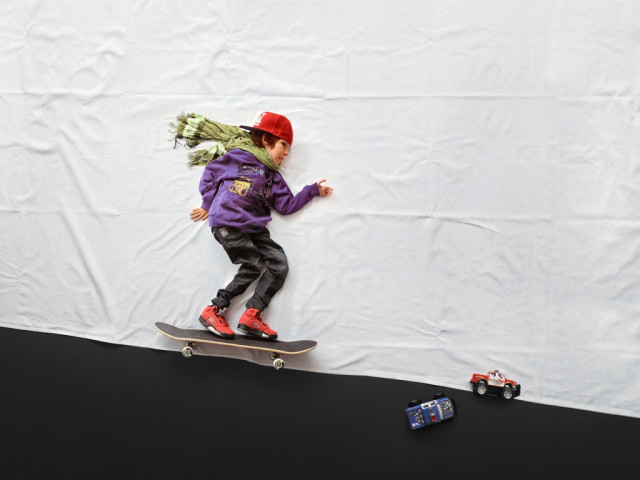
Slovenia-based photographer Matej Peljhan recently teamed up with a 12-year-named Luka who suffers from muscular dystrophy, to create a wildly imaginative series of photos depicting the boy doing things he is simply unable to do because of his degenerative condition. While he can still use his fingers to drive a wheelchair and to draw, things like skateboarding and swimming are simply not possible.

more via Photographer Takes a Boy with Muscular Dystrophy on an Imaginary Adventure | Colossal.

behavior · children

Playborhoods: Why Children Playing Street Games Is the Best Measure of a Healthy Neighborhood | Education on GOOD

English: Children playing in snow
Children playing outside in the snow (Photo credit: Wikipedia)

This weekend, take a look around to see if you see any kids running or biking around in your neighborhood. Children playing, or not playing, can be seen as a litmus test for overall neighborhood health. Yes physical health, but also the cultural and economic health.

Neighborhoods are suffering these days largely because children are absent. Instead of playing in their neighborhoods, they’re either staring at screens eight hours a day, according to a Kaiser Family Foundation study!, doing lots of homework, or attending numerous adult-led activities outside their neighborhoods.How are the children faring with these differently structured lives?They’re suffering, too, perhaps even worse. Pretty much every pediatrician and child psychologist will tell you that children need to play outside, every day. Without frequent outdoor play, children have been getting fatter, sadder, and less socially adept, and all that homework isn’t making them any smarter.

Children’s immediate neighborhoods—right on their block, outside their front door—are the ideal places for them to play outside. These are the safest, most comfortable places for children outside their homes because they can stay within earshot of their parents, and they can also get to know dozens of neighbors.

via Playborhoods: Why Children Playing Street Games Is the Best Measure of a Healthy Neighborhood | Education on GOOD.

brain · children · community · education · play · school

The New Exploratorium Opens in San Francisco – NYTimes.com

Exploratorium
Exploratorium (Photo credit: rvr)

Yippee! I loved the old Exploratorium, and it sounds like I’ll love the new one!

The new home, with all of those characteristics (and a 200-seat cabaret), is opening on Wednesday, and while it doesn’t deserve unalloyed acclaim, the achievement is remarkable. Under its executive director, Dennis Bartels, the Exploratorium has preserved and expanded what it was when the physicist Frank Oppenheimer created it. It remains the most important science museum to have opened since the mid-20th century because of the nature of its exhibits, its wide-ranging influence and its sophisticated teacher training program.

Yet the new Exploratorium remains eccentrically original. Technology is scarce. There are few video screens. There are fewer computers. There are circuits but no evident circuit boards. Woodworking and metalworking take place on the museum floor. There are more than 600 exhibits, but the emphasis remains on the laws of physics and motion, elementary principles of perception, and elegantly designed machines that conceal nothing.

You can still play with pendulums that were designed for the museum’s original opening. You can spin disks atop a whirling wheel; you can try to get a bicycle’s pedals to move using a sequence of buttons; you can gaze at the physicality of inverted reflections created by a finely polished parabolic mirror; you can position toy robots to create spinning animations.

more via The New Exploratorium Opens in San Francisco – NYTimes.com.

via The New Exploratorium Opens in San Francisco – NYTimes.com.

children · creativity · environment

Play and Creativity Require Space and Time

I found this video courtesy of Creativitea. They were using it to explain how they don’t believe in creating things under a time pressure. It really does a great job of illustrating how we all need to give ourselves more time, and space in our lives, to get creative and think about things.

Have a happy weekend, and make sure to make some space for play and creativity.

behavior · children

Art as Play – The Indoors – Outdoors Playground

This blog post is from two years ago but still relevant…

PlayGroundology's avatarPlayGroundology

In the interior courtyard of Ottawa’s City Hall there is a place where the door is always open. The Living Room is a multiple piece static sculpture by the design duo at Urban Keios .

This is art as playground, an open invitation for children to make believe and scamper about slightly oversize chairs with out of kilter door and window frames defining the space. It looks like a set prepped for the shooting of a claymation adventure where we’re just waiting for the action to begin. There in the near distance is a TV permanently piping in the imagination station.

Although The Living Room is not designed as a playground per se, what kids could resist stopping off momentarily for a touch of make believe, of playing house, of filling the blue sky space with movement and laughter?

Somebody’s having fun. The grass is worn away down to hard…

View original post 107 more words

architecture · children · design · environment · happiness · Nature · play

The Best Playground Is The One Nature Provided | Co.Exist: World changing ideas and innovation

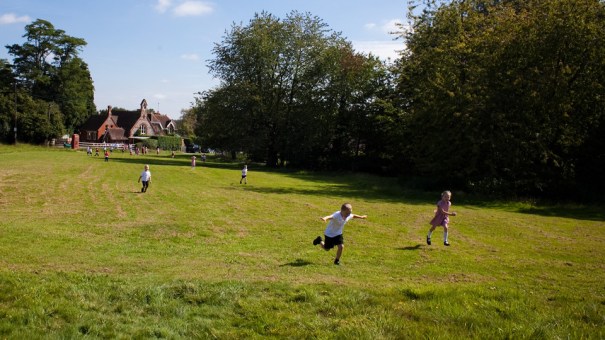
children lawn running

A recent article in the online magazine Co.EXIST discussed a study that found children benefit from being in natural environments, even if the environment is designed to appear natural but is actually human-made:

Dawn Coe, an assistant professor in the Department of kinesiology, recreation, and sport studies at the University of Tennessee spent time observing the behavior and time children spent playing on a local playground. After playground renovations added a gazebo, slides, trees, a creek, and a natural landscape of rocks, flowers and logs, Coe returned a year later to observe differences. Working with a statistician, Coe found children spent twice as much time playing in the natural landscape, and were less sedentary after the renovation and more active.“Natural playscapes appear to be a viable alternative to traditional playgrounds for school and community settings,” said Coe in a university statement. “Future studies should look at these changes long-term as well as the nature of the children’s play.”

via The Best Playground Is The One Nature Provided | Co.Exist: World changing ideas and innovation.

I attended a conference a couple of years ago where playground designers were reporting discovering the exact same thing – if you give a kid a pile of dirt and tree bark to play with and a bucket of water, they will have WAY more fun, play more, and learn some things as well.

This shouldn’t come as a surprise based on previous research on us humans:

For decades, scientists have reported our species exhibits a consistent, if not quite understood, response to spending time around nature: it boosts our mental and physical well being.

The scattering of findings have held in hospital beds, public housing, and Japanese forests. A 2001 study of public housing found the mere presence of trees and grass reduced reduced reported aggression and violence. Another showed people shown a stressful movie recovered to a normal state–as measured by metrics such as heart rate, muscle tension, and blood pressure–“faster and more complete[ly]” when exposed to natural rather than urban environments.

However, a lot of cities and schools are reluctant to install these kinds of playgrounds since they are considered “untested” or approved by several school or city boards. Thankfully, according to the article, cities are beginning to adopt and install these types of playgrounds:

“Natural playscapes are part of a growing trend appearing in cities across the US including Boston, Phoenix, Chicago, New York, Auburn and others.”

I hope to see more of these pop up around major cities. Do you have a natural playscape near your home? Tell us about it in the comments below.

anthropology · behavior · children · community · creativity · Social

Halloween, the most playful time of year

Cute Kids in Children's Costumes
Kids in Halloween Costumes (Photo credit: epSos.de)

Ah, Halloween, originally considered the betwixt and between time of year when ghosts and souls past could pass over into our world and scare the crud out of their relatives.

But these days, Halloween is really a celebration of play. No, really! When else is it perfectly acceptable to dress up in funny costumes, stay up late on a week night running around banging on peoples doors, play tricks on people, and create food that looks spooky or gross but is really just lots of sugar?

The tradition of dressing up and playing for Halloween is alive and well in the tradition of Dia de los Muertos, for example. To deal with and make light of mortality, grown-ups and kids will put on make-up and costumes that represent death and the dead. They’ll make and eat sugary confections, parade down the street, play music, sing songs, and overall try to make a party out of a normally scary and sad phenomenon. Yes, there is some sadness involved, such as visiting relatives’ graves and setting up alters to reflect their passing, but for some even the act of creating the alter, i.e. being creative, is cathartic and helps with the loss of a loved one.

In the play deprived United States, Halloween has become one big kid’s night out for adults as well as kids. Children and grown-ups alike look forward to dressing up, pretending to be a character, and be silly with friends. Often the costume is a parody or commentary on something political, but that’s just as playful as covering yourself as marshmallows, although potentially socially sticky instead of just physically sticky.

That’s why it makes me sad that so many K – 12 schools have banned Halloween for fear of these socially sticky situations or fear of kids bringing weapons to school as part of their costumes, plus some religious groups find Halloween offensive. While I understand and respect all of these concerns, I disagree with the idea that we should just get rid of it outright. How are we going to learn to get along and get over differences if we just avoid them? Play and school are both supposed to be about learning, so why not turn Halloween into a learning opportunity?

As a proponent of play, I feel like Halloween is an important holiday, not because of what it originally stood for, but for what it stands for now. Being socially allowed to play and pretend, even for one day, is important for humans’ mental health. It also creates bonds between people who share in the activity, not just from sharing the experience but learning more about each other through their costumes.

I will definitely be buying candy and supporting Halloween this year, not for the sweet tooth but for the costumes. Play on!

anthropology · brain · children · education · health · learning · mental health

Attention Disorder or Not, Children Prescribed Pills to Help in School – NYTimes.com

English: Adderall
Doctor’s are prescribing Aderall to kids without ADHD (Photo credit: Wikipedia)

I find this article in today’s New York Times extremely disturbing:

When Dr. Michael Anderson hears about his low-income patients struggling in elementary school, he usually gives them a taste of some powerful medicine: Adderall.

The pills boost focus and impulse control in children with attention deficit hyperactivity disorder. Although A.D.H.D is the diagnosis Dr. Anderson makes, he calls the disorder “made up” and “an excuse” to prescribe the pills to treat what he considers the children’s true ill — poor academic performance in inadequate schools.

“I don’t have a whole lot of choice,” said Dr. Anderson, a pediatrician for many poor families in Cherokee County, north of Atlanta. “We’ve decided as a society that it’s too expensive to modify the kid’s environment. So we have to modify the kid.”

via Attention Disorder or Not, Children Prescribed Pills to Help in School – NYTimes.com.

Sadly the doctor is correct that many schools refuse to change a child’s environment to improve academic success, namely that they are cutting out activities like recess and P.E. in order to make more time for studying.

However, P.E., recess, and just getting outside for a quick breath of fresh air have all shown to also be extremely effective ways to improve attention and academic success. Yet because these activities are getting cut out of the school day, doctor’s feel like they must prescribe these incredibly strong, brain-chemistry changing medications to growing brains, many of these drugs with strong side effects .

I have no problem with using these drugs for what they were originally intended for, but prescribing them basically as “performance-enhancing” drugs just seems unethical to me. We frown upon athletes and grown-ups in the business world from taking speed and other kinds of drugs that are supposed to improve performance (other than coffee of course, that seems pretty much like a must-have for adults), but it’s okay for students so they can do well in elementary and middle school? To put in mildly, yuck!

I hope other people will be as outraged as I am and stand up for a child’s right to recess and P.E., and actually NOT studying from time to time, rather than encouraging giving them strong medications in order to perform well on standardized tests.