I celebrated my daughter’s third birthday this past weekend.
She asked for a train-themed party, so of course we had to have the obligatory pink train cake (it sure felt obligatory based on how insistently she asked for it).
Pink Chocolate Choo Choo Train cake, as requested by the birthday girl.
Although we had it at the park intentionally so the kid guests (and grown ups) could run around and climb on things, I also wanted to offer some sort of “activity” the kids could do while the parents actually sat down to relax and enjoy other adults’ company.
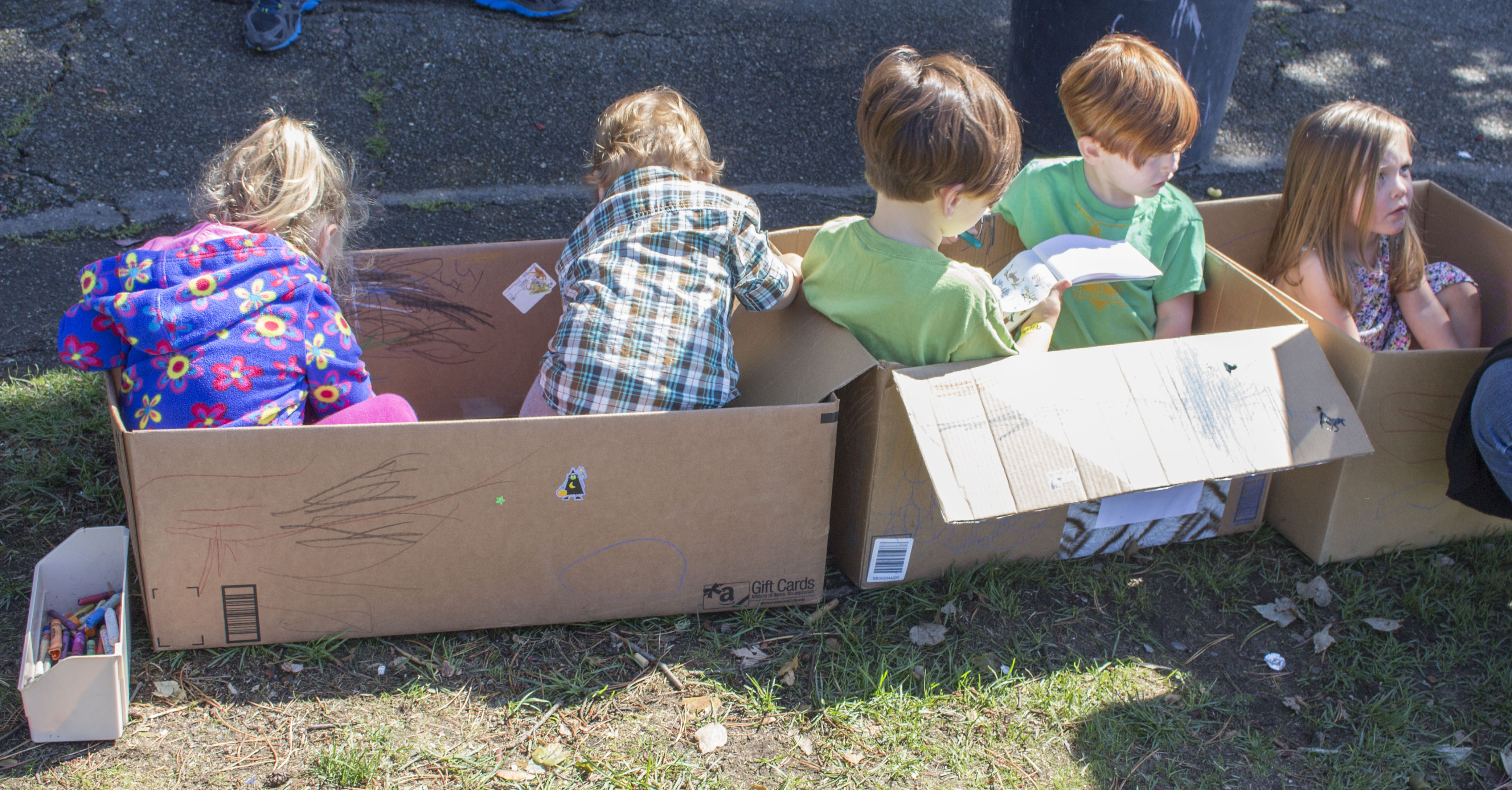
I grabbed four largish boxes and brought them to the park, along with crayons and stickers. I set the boxes up to look vaguely like a train, with one taped to the front box like it was a smoke stack, and invited everyone who wanted to to decorate the train as they saw fit. After they ate their cake (because, priorities), the kids all jumped into the train, from the one-year-old to the five-year-old, and proceeded to stay there for almost an hour jumping in and out of the boxes, decorating, adding stickers, often tipping the boxes over and falling out onto the grass, but laughing and getting right back in.
It was definitely the highlight of the birthday party.
I am glad that I took a chance and brought these boxes and crayons for the kids. It cost no money (I had all of these items laying around my house already), and it let the kids do some creative make believe play that they might not have gotten to do otherwise. It was something that all ages of kids could do independently or collaboratively as they so chose.
Parents lament that kids tend to like the box more than the present that came in it. I say bring on the box!
This is a great example of how easy it is to create playful spaces, especially temporary ones, which can in many ways add to the fun.
Also a good reminder that PARKing Day is happening in the US next week!
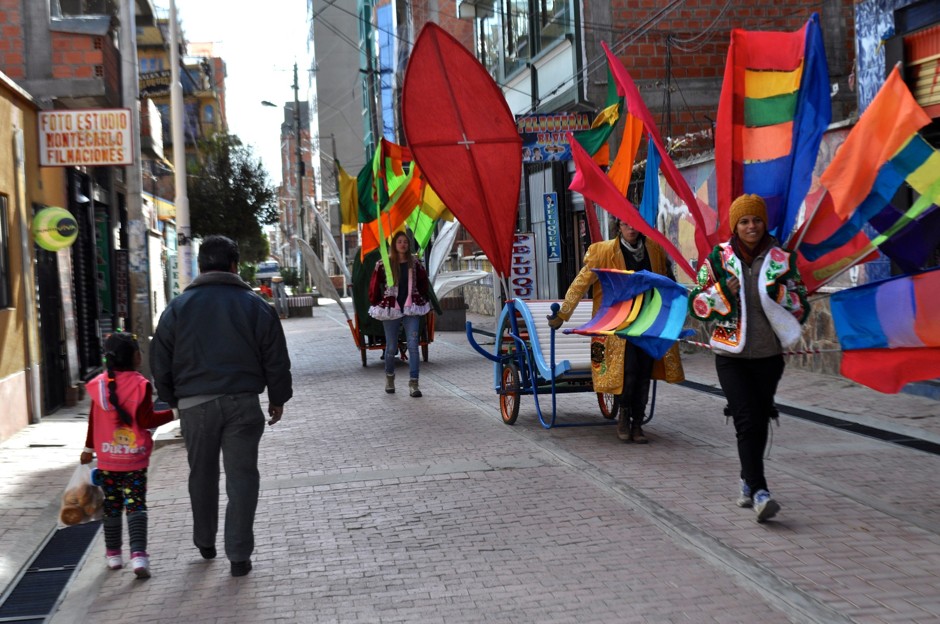
The mobile park on parade in El Alto this summer. (Megan Hoffman)
Working in the harsh sunlight, they set about disassembling the carts. The shell of the bee became a series of green mounds, while the elephant trunk revealed itself as a slide.
In a matter of minutes a playground was born, and the sounds of children playing rippled across the plaza.
By most urban timelines, El Alto itself is a pop-up construction of sorts. The grid that spreads across the barren altiplano was a tiny informal settlement, perched above La Paz, in the early 1950s. Following its establishment as an independent municipality in 1985, its population jumped, by 54 percent from 2000 to 2010 alone. El Alto now has more than 1 million people, approximately 75 percent of whom identify as members of the indigenous Aymara people. (In Bolivia overall, 25 percent of the population is indigenous.) It has even given rise to a bold new architecture, evidence of Bolivia’s recent economic boom.
In this dense city, driven by commerce at all scales, streets, sidewalks, and communal spaces are often transformed into informal markets, where vendors and minibuses compete for real estate. While this competition brings vitality, it requires novel methods of occupying urban space for play.
The pop-up playground aims to do just that. Over three summers, the International Design Clinic (IDC), a “guerrilla design” collective, has collaborated with Teatro Trono to design and build a pair of mutable, movable playspaces that will help the organization expand its activism into El Alto’s public space. The areas currently designated for children in El Alto are scant and often ill-maintained.
Headed by Scott Shall, an architecture professor at Lawrence Technological University near Detroit, the IDC works closely with groups already embedded within communities, lending its own design expertise to support what they do well. “We try to contribute to and intersect their work for a strategic moment, but we always have an exit plan,” says Shall. “We aren’t permanent, they are.”
Crews of juvenile inmates have been sent to fight wildfires in Washington state since the 1960s.
Their mission: Make sandwiches, dig trenches and build fire lines to keep flames at bay. They can pull 16-hour shifts and earn between 70 cents and $1.60 an hour. The youngest are 15; the eldest, 20.
“The kids go to fires all over the state,” said David Griffith of the Juvenile Rehabilitation Administration in Olympia. “It’s something they want to do.”
When I first read this article I was shocked that they would send teenagers out to do this job. And then I realized what a great opportunity and program this was actually an amazing opportunity.
The teenagers get outside into nature, which has been shown to have a ridiculous amount of benefits around concentration, calming and serenity. It gets them exercising, which also has amazing physical and psychological benefits. They learn skills they can use as grown-ups, they learn to work as a team, they learn to take orders, and they are giving back to other people in need, like someone who’s house is in danger of being burned down.
This is not exactly play, but it is an applied real-world education, and while some commenters have been upset by the small amount of money they make, frankly I don’t think that matters, especially if we think of this program as an addition to the regular traditional education that they’d be receiving in public school or in correctional facilities. In fact I suspect if you offered this program to public high schools it would fill up in a matter of days.
There are also programs like this in California. With the scary fires and kid escaping this past month Washington is reevaluating whether to keep it going. I hope they continue this program and encourage similar programs for kids “in the system.”
The kids take a break from walking to analyze a babbling brook.
Kids are amazing explorers. Their drive for exploration and play can overpower their desires for sleep, food, and general grumpiness.
This past Monday we had a sitter sick day, and I was in charge of the kids. To get them out of the house we took a four hour round-trip hike down to the park near our house. This park is more like a nature preserve, with a trail that follows a quick drop down from street level into a canyon where a small creek that still supports a salmon run every year slowly meanders down to a mostly sandy beach and the Puget Sound, where local families dig their plastic shovels in the gravely soil and watch sail boats, freight ships, and the occasional harbor seal, bald eagle, or osprey fishing off the shore.
My daughter loved walking over the wooden bridges, stomping her feet to make the boom boom echo noise that only comes from wooden bridges. We went at her pace, taking as much time as she wanted at each spot, stopping at every bridge to look over its edge into the babbling brook or stream below, stopping to touch a cool tree, as well as the fire trucks that happened to be at the park. A few times I got bored and suggested we move on, and if she said yes we went and if not we stayed. Even towards the end of our adventures, although she was simultaneously starting to complain about being hungry and thirsty, she was the one demanding that we go down to the beach to at least sit on a log for awhile and touch the sand. She also wanted to go swimming in the creek and the sound, but we skipped those activities mostly because I did not feel like adding “wet” to the description of things I had to lug back out of the canyon, and she didn’t protest too much.
She balanced, climbed, slid, see-sawed, and ran up and down hills, falling and tripping a couple of times but brushing herself off each time and only needing one kiss to make a finger better before moving on to the next activity. She got to try an apple that fell off the park’s apple orchard, picked up leaves, and analyzed different rocks strewn on the beach. She walked more than half of the time down and around the canyon and park, and returning walked all the way down the hill from the beach cliff and towards the lower parking lot. She had an amazing time and had lots of things to share with her dad when we got back from our adventure.
But my son, my son enjoyed the day on an entirely different level. My son was so happy during our walk through the woods he looked like an animal released from its cage and realizing it has been returned into its home forest.
He would just lean over, reaching down over the edge of his stroller trying to touch the ground as it whizzed by him, feeling any dirt kick up off the path with those pudgy little hands that an instant later were reaching up up up into the sky, trying to touch the leaves high above and sunlight sparkling through them.
He was always sitting literally at the edge of his seat, at times riding his stroller like a chariot, bracing his feet against the step and grabbing the guard rail, standing straight up and wiggling his body to urge his rickety chariot to go faster. He would lean back into his chair, arching his back to look up at the tops of the trees, and look back at me as if to say “Mom, this is so cool!”
He wanted to taste and experience everything, and although he tired much more quickly than his sister he still grabbed for various sticks, rocks, and chunks of wood to taste as we sat on the beach. He would understand when I told him no and take the rock out of his mouth, but would then start searching for another one, thinking, “maybe this cracker shaped piece of wood is okay.” When he found an apple on the ground in the orchard, He was so proud and protective of it he struggled with wanting to show me but wanting to keep it for himself. He actually tried to pick up all the apples while holding on to his tiny little apple, but I tossed the rotten ones further into the field and tried to get him to focus on his precious little apple that he had already started chewing. He spent a long time nibbling at it, getting it about half eaten, and when I finally snuck it away from him to bite away a wormy spot I found that in fact it was pretty good, better than the one I picked off the tree for my daughter.
He had exhausted himself by the time we walked through the woods again and looked dazedly up into the sparking tree canopy before he drifted to sleep about half way up the canyon trail. My daughter rested in her seat, chatting here and there but was overall surprisingly quiet for a two year old.
After I made us a very late lunch and we sat around the kitchen table hungrily munching our pasta and sausages, I was still, and am still, blown away by just how long the kids both wanted to be out there in the park, playing, exploring, and just how happy they were to be out experiencing nature. I try to let the kids explore on their own at their own pace, but this day took that experience to a whole new level for me, one I will try to remember as we continue to explore and learn about our world together.
This is a great blog post from a teacher re-learning the value of creative free play and specifically outside.
I highly recommend you read the whole post, but for me this sentence summed up the whole experience:
“…As I witnessed these projects I realised that children and adults can only be as creative as their environment allows them to be and that by letting children spend time in a natural environment like the woods or to be surrounded by loose parts, we can but only help them to become or remain creative.”
Okay, ignore that this is a granola company’s commercial.
And they may have cherry-picked to prove a point.
YET…
The fact that even these kids exist is terrifying.
Just watch the video. And cringe. Mourn. Cry. Then go do something about it!
Children are obsessed with technology, and Nature Valley wants us to be afraid. Very afraid.
That seems to be the message of this new ad for the granola bar company, which asks three generations of families: “When you were a kid, what did you do for fun?”
The elder two generations share memories of blueberry picking, sledding, fishing trips, and playing baseball as airy music plays in the background.
But then it’s the younger generation’s turn, and ominous music suggests these kids aren’t exactly frolicking in the grass and soaking in the sunshine. The kids detail that they spend five hours a day texting, emailing, tweeting, browsing the computer, or playing video games as the parents cry or lament the death of the good old days.
This is not okay people. So, so, the opposite of okay!
Go volunteer to take your niece or nephew to the park, or go hunt for cool leaves and flowers in the park. Grow a flower or even spider plant and give it to a kid! Take action!
York County School of Technology student Lisa Nguyen, 15, painted this colorful artscape, “Step Across the Rainbow,” along North Beaver Street in front of Central Market.
The piece is part of the Bring on Play program as part of the Eat Play Breathe York initiative to add interactive play opportunities for children along regular walking routes downtown.
“The goal is to have playful sidewalk artscapes throughout the city, especially in neighborhoods, so we can reach children who might not have the opportunity to go to a park or play on school playground equipment,” Eat Play Breathe York chairwoman Cori Strathmeyer said. “We want to really encourage creativity and socialization as well as the physical aspect.”
The plan is to complete 20 permanent sidewalk murals downtown by the end of summer.
Three kids, now all high school graduates, dedicated their recesses to digging up a gigantic rock out of their elementary school yard. The principal decided to keep it and now future generations of kids are getting a chance to play with the “magical” rock.
The kids started working on the gift unwittingly. It was 10 years ago. They were in second grade and out on the playground during recess when one of them saw a little rock — or what looked like a little rock — sticking up out of the ground.
But year after year they returned to the project. Digging mostly with sticks and plastic spoons they got from the cafeteria, the kids dug down — through second grade, third grade, fourth grade and fifth grade — until finally, just before moving on to middle school, they finished.
The principal brought in heavy equipment to lift it out of the hole for them. That was 2008. Now the three are like rock stars around Kittredge, partly because of the accomplishment itself, but mostly for what the rock has become.
The kids now use the rock as a “neutral” zone, or a spot to hang out and wait for kids to come invite you to play, which as a former kid I can tell you does indeed feel magical.
It is amazing the dedication that kids can show in play and exploration. They spent years! digging up this rock with improvised tools. An amazing lesson in perseverance, creativity, and teamwork.
Incredible props to the elementary school principal who let the kids dig up the yard to get to the rock, so many may have discouraged the behavior.
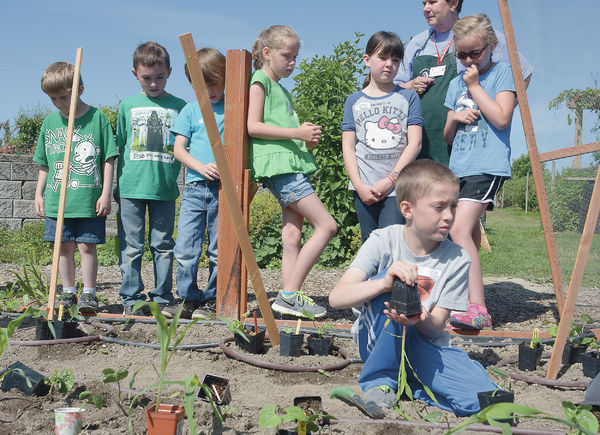
This is a great example of how even “country kids” – all of these kids come from communities surrounded by farmland and agriculture – enjoy and appreciate hands-on experiences and learning about gardening and the natural environment.
About 70 classmates participated Thursday in the Washington State University Skagit County Extension Master Gardener’s “Discovery In Gardening — Is Terrific” (DIG-IT) youth education program.
“It introduces kids to how the garden works, from the growth of the plants to how it arrives in your kitchen and what to do with the scraps,” said Master Gardener Chuck Howell.
The program was started in 2002 by two teachers, Master Gardener Gail Messett said.
The format of the program has changed over the years, Messett said, but the goal has remained the same: Get kids outside and into the garden.
“They’re learning respect for insects and bees and flowers,” Messet said. “I think they go home pretty awestruck, actually.”
Learning is fun. Or at least it should be fun. Little kids are always exploring, experimenting, asking “why, why, where, when, why?!” (can you tell I have a toddler at home?). This is a great example of trying to keep learning fun.
Coding is a great skill for kids to learn but it can be a lonely, sedentary endeavor. Hackaball, a new toy created from a partnership between the design agencies MAP and Made By Many, promises to get kids off their butts and playing outside—all while teaching basic coding skills and empowering kids to invent their own kind of play.
It’s a lot to ask from one product which is why Hackaball had to be meticulously designed. The ball is bigger than a baseball but smaller than a soccer ball, and it comes with several simple parts that can be put together using basic instructions, so kids understand what’s inside, and get the chance to start creating from the get-go. Once it’s put together, the toy can glow different colors, make noises, and even vibrate. As for how to use it? The kids get to decide.
Using a space-themed app, kids write if-then rules, learning the syntax of basic coding. An example: if you drop a ball, then it turns red. Or if the ball hits something, then it will make a noise. These games can be as complicated or as simple as kids want.




 Mental Flowers