Undoubtedly inspired by Mila’s Daydreams series, an awesome interpretation:
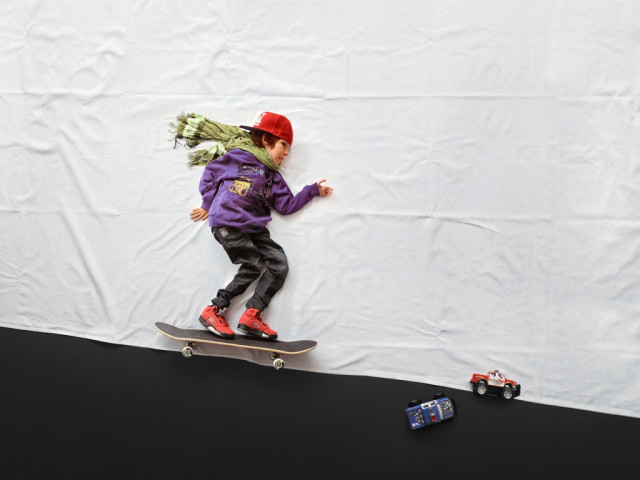
Slovenia-based photographer Matej Peljhan recently teamed up with a 12-year-named Luka who suffers from muscular dystrophy, to create a wildly imaginative series of photos depicting the boy doing things he is simply unable to do because of his degenerative condition. While he can still use his fingers to drive a wheelchair and to draw, things like skateboarding and swimming are simply not possible.
Yippee! I loved the old Exploratorium, and it sounds like I’ll love the new one!
The new home, with all of those characteristics (and a 200-seat cabaret), is opening on Wednesday, and while it doesn’t deserve unalloyed acclaim, the achievement is remarkable. Under its executive director, Dennis Bartels, the Exploratorium has preserved and expanded what it was when the physicist Frank Oppenheimer created it. It remains the most important science museum to have opened since the mid-20th century because of the nature of its exhibits, its wide-ranging influence and its sophisticated teacher training program.
Yet the new Exploratorium remains eccentrically original. Technology is scarce. There are few video screens. There are fewer computers. There are circuits but no evident circuit boards. Woodworking and metalworking take place on the museum floor. There are more than 600 exhibits, but the emphasis remains on the laws of physics and motion, elementary principles of perception, and elegantly designed machines that conceal nothing.
You can still play with pendulums that were designed for the museum’s original opening. You can spin disks atop a whirling wheel; you can try to get a bicycle’s pedals to move using a sequence of buttons; you can gaze at the physicality of inverted reflections created by a finely polished parabolic mirror; you can position toy robots to create spinning animations.
Happy Friday! After a looooong work week, here’s a little more incentive to make sure you get some time to play this weekend.
[Okay, fine, for all of you who are too “busy” to read the article, here’s a basic breakdown: you need free play in order to recover from stress, and that if we don’t we’re basically setting ourselves up for early brain deterioration and death.
Now will you take a second to read the article?] 🙂
“A playful brain is a more adaptive brain,” writes ethologist Sergio Pellis in The Playful Brain: Venturing to the Limits of Neuroscience. In his studies, he found that play-deprived rats fared worse in stressful situations.
In our own world filled with challenges ranging from cyber-warfare to infrastructure failure, could self-directed play be the best way to prepare ourselves to face them?
In self-directed play, one structures and drives one’s own play. Self-directed play is experiential, voluntary, and guided by one’s curiosity. This is different from play that is guided by an adult or otherwise externally directed.
What does it take to reduce on-the-job depression and create an overall happier work environment? (Photo credit: Modern_Language_Center)
A recent study of health factors and their associated costs at seven companies, published in the journal Health Affairs, found that “depression is the most costly among 10 common risk factors linked to higher health spending on employees.”
The analysis, found that these factors — which also included obesity, high blood sugar and high blood pressure — were associated with nearly a quarter of the money spent on the health care of more than 92,000 workers.
First the employees were assessed for health risks, then researchers tracked their medical spending from 2005 through 2009.
The average medical spending for each employee was $3,961 a year. In total, $82 million, or 22 percent, of the $366 million annually spent on health care for the workers was attributed to the 10 risk factors, the study found.
The relationship between higher spending and depression was the strongest, with 48 percent more spending for workers with a propensity for that widespread problem.
Now, to be fair, this is a fairly small study of just seven companies, and the article didn’t say how many employees worked at these companies. However, this is definitely a trend that has been spotted at least anecdotally by many HR managers, so it’s nice to see that there is some “official” analysis being done on the issue.
So what can employers do about this? My fear is that employers would discriminate, unintentionally or intentionally, against people who suffer from depression. But these days many people will be diagnosed with depression due to a temporary life situation such as a death in the family, or their jobs, so being fired for temporary sadness is probably not a good idea for companies.
Instead, my hope is that companies would invest more on making people’s job satisfaction higher. As of two years ago, Americans reported the lowest job satisfaction ever recorded. That means employers can be doing A LOT more to improve their employees’ lives at work. And a lot of that has to do with feeling supported by their managers, and feel like they are heard and respected and overall a part of the team. A lot of that comes from having fun at work.
This philosophy has been spouted in several different books and magazines, and has been shown to work well in classrooms as well, referred to as the “Responsive Classroom” approach.
The Responsive Classroom approach centers on several ostensibly mundane classroom practices. Each morning students form a circle, greet one another, share bits of news, engage in a brief, fun activity and review the day’s agenda. The idea is to build trust, ensure a little fun (which adolescents crave) and confront small problems before they become big. Students might welcome one another with salutations from a foreign language. An activity might involve tossing several balls around a circle in rapid succession. Students share weekend plans or explore topics like bullying before lessons begin. (New York Times)
This approach could very easily be applied to a business setting, in fact it sounds like a team kick-off meeting one might see in a corporate environment. Taking time to connect with other coworkers and laugh a little before diving in to the day’s work has been shown to work wonders for productivity and boost morality in both school and work settings.
There is definitely a drive and expectation in many industries to work longer, faster, harder hours, and be available and working at all hours. But that drive is unsustainable, demonstrated by the low job satisfaction and high burnout rates in many industries, from high-tech to physicians. Taking time to play a little bit at work, or just connect with coworkers, is being shown as an effective way to reduce depression related to work and job burnout, increase productivity, and create a more cohesive company with more loyalty overall to the company’s mission.
So long story short: remember to bring the koosh ball to your next meeting.
You temperature impacts your perceptions and job performance (Photo credit: Wikipedia)
The rain, wind, and falling leaves make it feel like fall is officially upon us in most of the United States (although some regions are still experiencing an Indian Summer). This makes many of us think of warm beverages and sweaters, unless you work in an office that turns the heat up WAY too high all winter long. In fact, working in a space that is either too hot or too cold can effect productivity:
One of the painful ironies of office life is that we can never quite get the temperature right. We spend our summers shivering in meat lockers and our winters sweating in saunas.
Central air hasn’t made us comfortable, so much as made us uncomfortable in a different way.
The experience isn’t simply unpleasant. It comes with a real financial cost… [according to one study], when temperatures were low 68 degrees, employees committed 44% more errors and were less than half as productive as when temperatures were warm a cozy 77 degrees.
Cold employees weren’t just uncomfortable, they were distracted. The drop in performance was costing employers 10% more per hour, per employee. Which makes sense. When our body’s temperature drops, we expend energy keeping ourselves warm, making less energy available for concentration, inspiration, and insight.
This importance of creating comfortable work environments is interesting to me. I know a lot of freelance workers that have a favorite coffee shop to camp out in, often one of the criteria being it’s warm and cozy in the fall and winter.
I also vaguely recall a couple of studies that found play did not occur for animals outside of certain temperature ranges. (If anyone can find one of the studies please let me know).
As humans, we are adaptable to almost all climates from the Arctic to the Serengeti. So I think it is surprising to people to discover just how fragile we are.
Speaking of fragile, the article also mentions the connection between feeling cold and feeling lonely:
In a fascinating study reported in the prestigious journal Science, psychologists uncovered a link between physical and interpersonal warmth. When people feel cold physically, they’re also more likely to perceive others as less generous and caring.
When we’re warm, on the other hand, we let our guard down and view ourselves as more similar to those around us. A forthcoming paper from researchers at UCLA even shows that brief exposure to warmer temperatures leads people to report higher job satisfaction.
The unconscious desire for physical warmth is thought to be the reason lonely people bathe longer, more frequently, and use higher temperatures.
We often describe people as “cold” or “warm,” so it makes sense our perceptions would match our physical sensations. I wonder if this has anything to do with the reported “Seattle Freeze” phenomenon and in contrast the southern United States’ reputation for being open and hospitable.
While the article in Fast Company focused on job productivity, I think this is an interesting observation into overall well-being and improving environments in general.
Do you find you perform better at certain temperatures? Is one temp better for working over playing? For example, I like it to be warm but not hot while doing non-creative work, but if I’m doing an art or construction project or something creative I actually like it a little bit warmer. Leave your complaints or comments below.
Doctor’s are prescribing Aderall to kids without ADHD (Photo credit: Wikipedia)
I find this article in today’s New York Times extremely disturbing:
When Dr. Michael Anderson hears about his low-income patients struggling in elementary school, he usually gives them a taste of some powerful medicine: Adderall.
The pills boost focus and impulse control in children with attention deficit hyperactivity disorder. Although A.D.H.D is the diagnosis Dr. Anderson makes, he calls the disorder “made up” and “an excuse” to prescribe the pills to treat what he considers the children’s true ill — poor academic performance in inadequate schools.
“I don’t have a whole lot of choice,” said Dr. Anderson, a pediatrician for many poor families in Cherokee County, north of Atlanta. “We’ve decided as a society that it’s too expensive to modify the kid’s environment. So we have to modify the kid.”
Sadly the doctor is correct that many schools refuse to change a child’s environment to improve academic success, namely that they are cutting out activities like recess and P.E. in order to make more time for studying.
However, P.E., recess, and just getting outside for a quick breath of fresh air have all shown to also be extremely effective ways to improve attention and academic success. Yet because these activities are getting cut out of the school day, doctor’s feel like they must prescribe these incredibly strong, brain-chemistry changing medications to growing brains, many of these drugs with strong side effects .
I have no problem with using these drugs for what they were originally intended for, but prescribing them basically as “performance-enhancing” drugs just seems unethical to me. We frown upon athletes and grown-ups in the business world from taking speed and other kinds of drugs that are supposed to improve performance (other than coffee of course, that seems pretty much like a must-have for adults), but it’s okay for students so they can do well in elementary and middle school? To put in mildly, yuck!
I hope other people will be as outraged as I am and stand up for a child’s right to recess and P.E., and actually NOT studying from time to time, rather than encouraging giving them strong medications in order to perform well on standardized tests.
A good way to stay playful: be open to new creatures and experiences. (Photo credit: Wikipedia)
Happy Friday! Lately on Fridays I’ve been sharing my next great adventure destination, but this weekend that destination is staying put! And boy am I gonna have fun doing it! 🙂
For those of you who are also staying home this weekend and don’t know what to do about it, or maybe you had a loooooong week and you know you need to inject some fun into your day but your brain is so fried you can barely talk or type straight, here are some great suggestions from Remembering to Play. In fact, they recommend these tips for living an overall playful life, not just a playful day or two (although that is certainly a good start):
1. Play with movement: Children have a wider range of body expression than adults. We tend to move our bodies in the same, often rigid and predictable way. When walking down the street try moving your body differently. Start in small ways. Swing your hands in a different way, bounce your head from side to side, or shift your shoulders back and forth, one at a time. After a while try something bigger. Zig zag or walk backwards or sideways, or skip over the lines on the sidewalk. Or while walking in your office hallway twirl around one time…or perhaps more than once, tap the walls, or strut like you just made a million dollars for your organization! Walk like you are the bees knees…because you are!
2. Play with perspective: Instead of always looking straight ahead, or in your usual direction, look up or down, and in a direction you would not normally point your eyes. You may notice something different that you have never seen before. A bird, a lovely coloured leaf, a funny looking cloud, a happy couple cuddling. It is easy, especially in big cities, to point our nose to ground and plow forward. Let’s remember that life is not about getting there but rather enjoying the ride. As you point your eyes in new directions, you never know what you might see, and what may come about from this new perspective.
3. Play with words/conversation: Whether it is, How’s it going, How was your day, or our conventional ways of starting a Monday morning meeting, we have many verbal or conversational routines. It takes awareness and creativity to inject something new and fresh into the mix. For instance, instead of saying Hello to your friend, you could say Hey Hey, what do you say!? Instead of calling your friend by their name, give them an unexpected nickname. Call them Sunshine or Peaches. (For over three years, a friend and I have consistently called each other Steve. It still brings us and others a good chuckle!) Or start your meeting off by having everyone share the last time they had a really good laugh. Read Creative Connections for more ideas.
4. Play with your surroundings: What you surround yourself with either feeds or depletes your creative, authentic Self. How often do you watch the news? Is the TV blaring in the background? What books do you read? Do they inspire you? What colour are your walls and what pictures do you hang from them. What music do you listen to? Could you play more music in the background, say when cooking dinner or cleaning your home? Do you have plants, or earth coloured tones in your home? Who do you spend your time with? Do your friends support your playful, authentic Self? Can they hold space for the fullness of You? Part of living a playful life is creating the container for playful living, and this means being clear on what supports or does not support authentic living.
5. Play with diverse activities: As creatures of habit, it is easy to always order the same food, buy the same groceries, visit the same theatre and run the same route. Play means looking up when we normally look down, turning left when right is our regular choice. As we expand our range of choices and travel down new paths, we improve our brain functioning by building new neural pathways, and open to new possibilities. So instead of always seeing a movie, go to a live show instead. Instead of always eating the same meals, try to make one new meal a week. Join a class, take a spontaneous road trip, visit a local museum, volunteer your time for a good cause, talk to a homeless person, pay for your friend’s meal, stop to smell a flower, play with a dog that is waiting for its owner, organize a games night, or start a book club. Do one thing different and you never know who you might meet or what adventure may unfold!
6. Play with your smile: A single smile can change someone’s day for the better. I have experienced this when feeling a bit down, someone offers me a warm smile and suddenly I can feel my heart again. Life is not so bad anymore. In the same way that a picture is worth a thousand words, so too is a smile. So share your smile freely and fully. And share your smile with You as well. When feeling down, close your eyes and imagine a soft, warm, loving smile slowly appearing inside you. Allow it to get brighter, filling you with joy and light. Let your inner, playful spirit smile at you from the inside.
Why aren’t American kids allowed to play outside anymore; Children in Khorixas, Namibia (Photo credit: Wikipedia)
While summer may just be getting into full swing in my neck of the woods, it’s almost over for most everyone else (*sob!*). It seems everyone is trying to take advantage of a few last weekends of summer before school starts back up. But for some kids, that is a lot harder than it sounds. Free Range Kids recently posted about separate instances of a mom and a dad getting in trouble for letting their kids play outside unattended.
Today the police visited my home after one of my neighbors called in about my children being outside alone…in our yard with a home on two sides and six foot fence on the other two sides. The officer said, “Don’t have me called back out.” So now, do I have to go outside with my children every time they go out? I have a chronic illness and sitting outside all day sucks for me. They love being outside. They come in for bathroom breaks, they come in to tattle, they come in to say “I Love You”… they are in and out every 5-10 minutes. I check on them anytime I pass the door, and I lay or sit next to an open window. If I call for them, they come to the door/window and answer as a “check in.” They will literally stay outside from wake up to 9 pm, when I force them to come in, with breaks for the above and for food. They were perfectly safe. I don’t know what to do.
Dear Lenore: A neighbor of mine called the Texas CPS (Child Protective Services) and the Police on my wife and I because we allow our children, ages 6 and 8, to play in the courtyard directly in front of our apartment. CPS has been investigating my family since April 4th 2012, it is now August 12 2012, and all they have come up with is the one report to Police about my 6-year-old being outside in front of his home. Now we are dealing with the courts in a “Negligent Supervision” case, which makes absolutely no sense because my child wasn’t hurt or asking anyone for help. I was outside with my son when the Police arrived, but the CPS caseworker insists that I take drug tests and parenting classes. People are not neighbors anymore, they are just @$$holes. – A Texas Dad
Unfortunately the Free Range Kids blog has waaaay too many examples of this kind of reaction from authorities.
I find this really concerning, since we’re basically telling children they can’t be responsible for themselves when parents are trying to teach their children independence and responsibility, we’re not allowing them unstructured play time which is crucial for learning and brain development, that it is a way more dangerous world out there than it really is, AND it discourages them from exploring and getting exposure to nature and natural sunlight, both things that are crucial for growing bodies.
Why are children no longer allowed to play in their own front yards? I’m sorry if this comes off as a rant, but I feel not letting children play outside and learn on their own is a serious problem if we are simultaneously so concerned about “winning” the education race against other nations.
Aside from yelling at CPS and the police, what can we do as concerned citizens, either with children or without, to encourage and enable children to play outside and allow parents to let their children roam a little bit freer and get the unstructured, unsupervised play time they need in order to develop normally? Ideas welcome in the comments below.
For the past month I have been staying in a surprisingly noisy apartment. The neighborhood itself is very quiet, but just my luck to be staying over a night club and all-night grocery store. After this month the importance of being able to find quiet, peaceful places in a city rings all the more true and important to me (and it’s not just the ringing in my ears). From Inhabitat:
Cities have always been bustling environments, and with more and more of us living in them it can be difficult to find a quite place to relax or contemplate. Sound ArtistJason Sweeney‘s winning proposal for the TED Imagining the City 2.0 Prize is a crowdsourcing project that seeks to locate and map the places that provide silence in the urban din. The Stereopublic Project will be a public guide for those who crave a retreat from the crowds.
Based in Melbourn’s city center, Sweeney found himself attracted to tucked-in corners, where the city’s sound fades into the background and where the built environment is experienced as a sound environment. Inspired by his own experiences, he’s looking to create a platform where others can geo-tag and share their favorite quiet space. Sweeney is interested in helping those who are sensitive to noises, with disabilities, or just seeking respite from the constant din of the streets.
The TED City 2.0 prize will help his team develop a digital tool for crowdsourcing those places, adding a new layer of awareness to the cityscape for its occupants.
Cities are large, complex environments and the project is a unique way to understand the acoustic dynamic of city life. Stereopublic is based on active users sharing their findings, but ironically, the project’s success will likely make those quiet spaces busier, further pushing inhabitants to explore new places. The idea may become a failed experiment if it becomes too successful, but it also very well might help create new venues that improve the “sonic health” of a city — adding a vital resource to urban life.
Know of a quiet place in your city? Add it to the list, or leave it in the comments below and I’ll add it for you and if it’s in the Pacific Northwest may just try it out first. You know, for research).
Every kid can get overwhelmed playing on the playground. But imagine that for you, or your child, it happens way, way too easily.
Play is usually beneficial, not just for exercise and fun but for learning and therapy. So it’s interesting to see how people are using play, and playgrounds, to help kids who can often get overwhelmed in normal play situations.
A Kansas State University graduate student is creating a schoolyard that can become a therapeutic landscape for children with autism.
Chelsey King, master’s student in landscape architecture, St. Peters, Mo., is working with Katie Kingery-Page, assistant professor of landscape architecture, to envision a place where elementary school children with autism could feel comfortable and included.
“My main goal was to provide different opportunities for children with autism to be able to interact in their environment without being segregated from the rest of the school,” King said. “I didn’t want that separation to occur.”
The schoolyard can be an inviting place for children with autism, King said, if it provides several aspects: clear boundaries, a variety of activities and activity level spaces, places where the child can go when overstimulated, opportunities for a variety of sensory input without being overwhelming and a variety of ways to foster communication between peers.
“The biggest issue with traditional schoolyards is that they are completely open but also busy and crowded in specific areas,” King said. “This can be too overstimulating for a person with autism.”
King researched ways that she could create an environment where children with autism would be able to interact with their surroundings and their peers, but where they could also get away from overstimulation until they felt more comfortable and could re-enter the activities.
For so long playgrounds have been designed to be “safe,” but now they’re being designed and adapted to be “inclusive” to kids with all sorts of limitations, which I think is a much better focus, especially since it reintroduces play equipment like…wait for it…dirt! Or more specifically, gardens:
King designed her schoolyard with both traditional aspects — such as a central play area — and additional elements that would appeal to children with autism, including:
A music garden where children can play with outdoor musical instruments to help with sensory aspects.
An edible garden/greenhouse that allows hands-on interaction with nature and opportunities for horticulture therapy.
A sensory playground, which uses different panels to help children build tolerances to difference sensory stimulation.
A butterfly garden to encourage nature-oriented learning in a quiet place.
A variety of alcoves, which provide children with a place to get away when they feel overwhelmed and want to regain control.
Unfortunately there are currently no plans to actually build this playground, since these sensory elements are beneficial to all kids (and grown-ups). Where do you see this kind of design being the most welcome? In schools, city parks? Leave your thoughts in the comments below.




 Mental Flowers