According to blogger Hansi Johnson, it used to mean someone who likes going outdoors. But now, Hansi argues, the outdoors have become elitist to the point of making it seem inaccessible to most.
I’ve observed how the outdoor industry and the media have portrayed getting outside for nearly my entire life, and what used to be a very “volkssport,” inclusive, hippy-like identity has transformed into a super-elitist and entitled one. The destinations presented in the media are generally so unattainable by most people that they might as well be on the moon–and don’t even bother going if you’re not wearing expensive, high-tech apparel and using modern, high-priced gear.
Why does this matter? Because the majority of people in both the developed and developing world already feel like they don’t have time, energy, or resources to “go outside” and get exposure to nature, whether that’s to hike, bike, or just have a picnic. Creating this illusion of exclusivity is bad for everyone. Feeling like you don’t belong – of all places – in NATURE is frankly inhumane. Research has demonstrated over and over how our bodies and brains NEED nature and natural environments.
Get outside, hug a tree, pick a flower, fall into some snow, stomp in puddles.
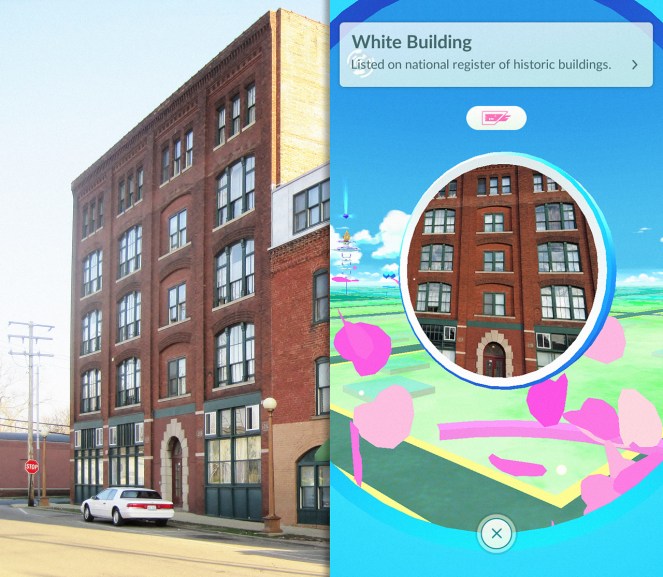
I have been fascinated with the incredible popularity of Pokemon Go. Some people are seeing it as an “annoying” new game, but I see it as an amazingly powerful tool to trick people into exercising and getting outside, and as author Mark Wilson observes, discovering your city.
In our collective hunt for silly cartoon monsters, Pokémon Go players are discovering history and architecture left and right. Users described their discoveries over the weekend, from Korean pagodas, to a Donner Party memorial in California, to the urban landscape of Perth at night, all documented on Twitter.
So often we hear about technology disrupting play and stunting or being less effective than “traditional” types of education. Rarely do we see technology blending in with education and children’s play and really supporting child development and learning.
This is one exception.
A school in Australia that works with autistic kids has adopted several Sphero robots (like BB8 from Star Wars), and has incorporated Sphero into both indoor and outdoor play.
Not only is it robust enough to be taken outside and played with alongside building blocks, it can also be used to teach coding away from a basic screen. “For kids with autism … around 90% of the information processed is what they can see. They’re very visual learners,” he said.
It can also help kids feel more comfortable in the school environment. Smith explained how some young students, around six and seven years old, often find it stressful to leave their classroom and travel to other parts of the school.”Early on, we found that if we let them guide Sphero: ‘Let’s take Sphero for a little adventure around the school,’ they would actually, with no trouble, go into the assembly or sport hall if they had Sphero with them,” he said. “It’s almost like they were brave and overcame their anxieties for the sake of showing Sphero.”
Sphero is robust enough that it can be used for paint projects, or just exploring in the dirt.
Just like Christopher Robin and his Winnie the Pooh, being able to use a proxy like Sphero to help explore the world can be very powerful and enabling for kids of all abilities, but especially kids on the autism spectrum.
Obviously there is a lot that goes into a “good” job – coworkers, supportive managers, and work you believe in. But there is also a surprising amount you can do within your own environment and office surroundings that will make your day-to-day grind better.
Here are a few compiled by Mashable (P.S.: Manatees are awesome!):
Beautify your work space. You personalize your home; why not personalize your desk? Make your cube or office a pleasant place to work with a few framed photos, a decorative pen holder or a tiny cactus. Image: Mashable/Vicky Leta
Spending time in nature, even in urban areas like Central Park, is associated with a greater degree of social cohesion and lower crime rates. Lucas Jackson / REUTERS
A wealth of research shows that just being in nature, even a city park, can make us feel better, both psychologically and physically. Such contact with nature can improve mood, reduce pain and anxiety, and even help sick or injured people heal faster. But what effect does it have on groups of people and society at large? New research suggests that nature can actually improve the degree to which people feel connected to and act favorably toward others, specifically their neighbors, says Netta Weinstein, a senior psychology lecturer at Cardiff University in Wales.
Looking at all the things they measured, there could be multiple factors that contributed to this correlation, but no matter what they found that nature played some signficant level of impact, and that is a very valuable finding.
Fall is finally upon us here in the Pacific Northwest. I’m not going to deny it anymore. But even as the weather gets cooler, my family and I are still finding ways to get outside and play.
I have always loved playing outside, climbing on rocks, trees, hiking, and splashing in puddles, and really want to pass this love of nature and outdoor movement on to my kids. It is so great to see other parents encourage their kids, and other grown-ups, to discover and recover their biophilia and love of playing outdoors.
One of the best outdoor play advocates I have met in a long time is Katy Bowman, although for her, moving and exploring the outdoors is simply behaving like a normal human.
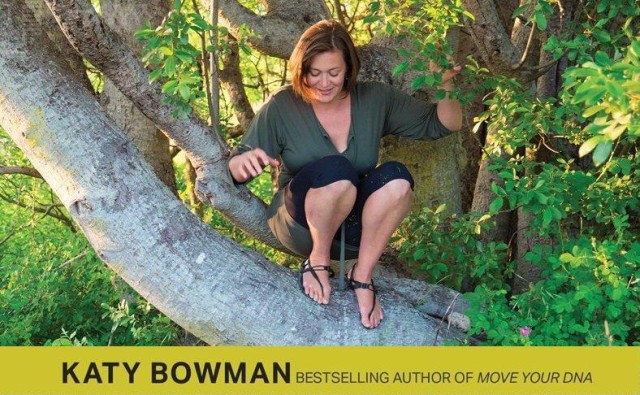
Katy Bowman doing her thing
Katy is a biomechanist with a deservedly large following of movement practitioners using her Restorative Exercise program. Katy is a huge advocate of natural movement and getting outside as much as possible, and encourages it with her kids as well. Katy talks about their experience in their outdoor “nature” preschool on her blog and podcast, but the enriching environments she has set up for her kids at home is in a class by itself.
Katy graciously invited my family out to her house outside of a small town on the Olympic Peninsula earlier this summer.
When we pull up to her house, the front yard looks fairly typical for any house containing small children; a few toys are strewn around the yard, slightly hidden by the uncut grass. Her husband and children have just headed off down the road for a walk. She helps us unload our brood out of the car after the long drive and immediately invites my daughter to explore, with me in tow.
We step out of the house into the backyard, and it is perfect.
My three-year-old daughter’s eyes light up like she’s hit the motherlode.
The lawn is littered with toys – costumes, stuffed animals, balls, a Little Tyke’s scooter car. There is a big basket of LEGOs sitting on the porch waiting to be dumped over and played with.
There are also complex toys laid out intentionally by Katy and her husband Michael for her kids to play with. A tippy rope ladder strung between two trees with a foam mat underneath; ladders laid on the ground for balancing, a jungle gym, a circle swing, large wooden ramps placed strategically up to table tops. The cherry tree is also filled with cherries, for good measure.
The kids have gotten creative with some of their building materials, including taking a couple of blocks from the flower box and made a corral for their plastic farm animals. They have also left little illustrations stealthily added around inside the house: on the wooden bed frame, the balance ball in Katy’s office, and on a couple of door frames.
And that’s before we even meet the chickens or go down to the Dungeness River to throw rocks, wade, climb, and make structures in the sand.
It is obvious the kids have the run of the house, and its affect is wonderful.
Katy has created a practice based on her high level training in biomechanics and years of teaching experience centered on creating a healthy, mobile human being, and this practice is reflected in how she and Michael have set up their home environment. Every space is open for movement, jump, climb, and play. There are edges and imperfectly balanced steps and slight risks everywhere. The kids must learn to navigate their environment safely, and have a blast doing it.
Katy often talks about getting her kids outside and exposed to new, playful challenges. And yet, when I ask her about it, she almost baulks at the idea she is supporting a primarily “playful” environment. For her, this is simply survival, teaching her little humans how to be human. She is merely creating and supporting healthy behaviors, what kids and grownups should be doing all the time.
They let their children go slow, at their pace. Their kids learn by doing, by experiencing. As do we all, really. It’s true that, thanks to the visit, I now have more confidence in being able to ford a fast-moving stream carrying my toddler. And it wasn’t part of a survival training camp or an emergency. It was part of our Sunday family outing. It may sound small or frivolous or “not necessary,” but for the survival of our species, that skill is a big deal.
To me, this kind of activity is not just good for restoring our body and capability to move, it is also restorative to our psyches and filling that need to explore and play at our own pace and learn in a playful way.
Finally my family has to head home. We take the time to let our kids say good night to the chickens before we load back into our car, driving away with the sunset on our backs. After getting to see and play in Katy’s backyard, both the grown-ups and the kids in our family feel renewed, replenished, and ready to play and explore our own backyard and our home environment in a new way.
I highly recommend digging in to Katy’s materials. She has some great ideas and thoughts around leading a healthy, restorative, and in my mind playful movement practice, whether it’s in nature or just in your own backyard.
I celebrated my daughter’s third birthday this past weekend.
She asked for a train-themed party, so of course we had to have the obligatory pink train cake (it sure felt obligatory based on how insistently she asked for it).
Pink Chocolate Choo Choo Train cake, as requested by the birthday girl.
Although we had it at the park intentionally so the kid guests (and grown ups) could run around and climb on things, I also wanted to offer some sort of “activity” the kids could do while the parents actually sat down to relax and enjoy other adults’ company.
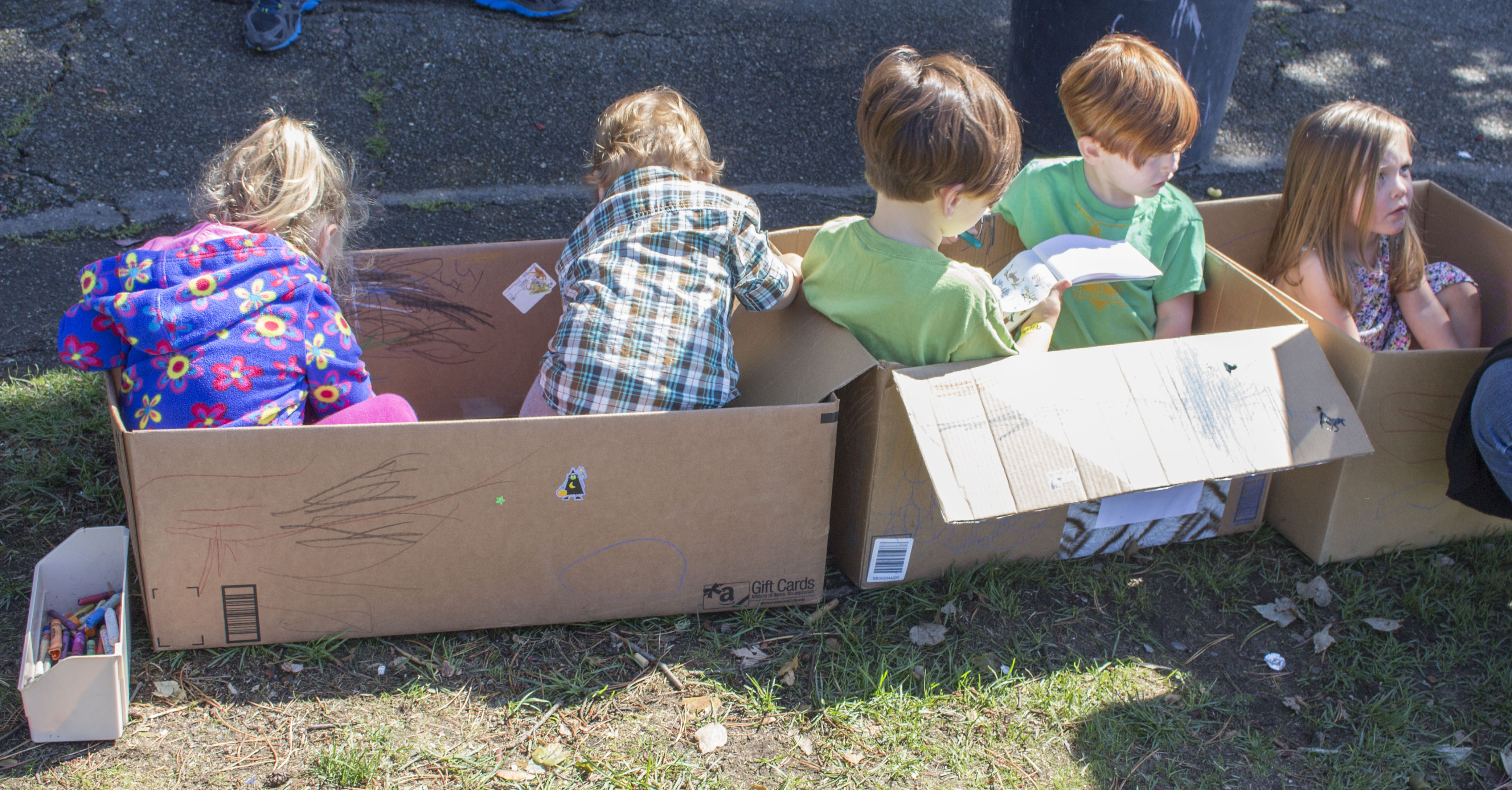
I grabbed four largish boxes and brought them to the park, along with crayons and stickers. I set the boxes up to look vaguely like a train, with one taped to the front box like it was a smoke stack, and invited everyone who wanted to to decorate the train as they saw fit. After they ate their cake (because, priorities), the kids all jumped into the train, from the one-year-old to the five-year-old, and proceeded to stay there for almost an hour jumping in and out of the boxes, decorating, adding stickers, often tipping the boxes over and falling out onto the grass, but laughing and getting right back in.
It was definitely the highlight of the birthday party.
I am glad that I took a chance and brought these boxes and crayons for the kids. It cost no money (I had all of these items laying around my house already), and it let the kids do some creative make believe play that they might not have gotten to do otherwise. It was something that all ages of kids could do independently or collaboratively as they so chose.
Parents lament that kids tend to like the box more than the present that came in it. I say bring on the box!
Crews of juvenile inmates have been sent to fight wildfires in Washington state since the 1960s.
Their mission: Make sandwiches, dig trenches and build fire lines to keep flames at bay. They can pull 16-hour shifts and earn between 70 cents and $1.60 an hour. The youngest are 15; the eldest, 20.
“The kids go to fires all over the state,” said David Griffith of the Juvenile Rehabilitation Administration in Olympia. “It’s something they want to do.”
When I first read this article I was shocked that they would send teenagers out to do this job. And then I realized what a great opportunity and program this was actually an amazing opportunity.
The teenagers get outside into nature, which has been shown to have a ridiculous amount of benefits around concentration, calming and serenity. It gets them exercising, which also has amazing physical and psychological benefits. They learn skills they can use as grown-ups, they learn to work as a team, they learn to take orders, and they are giving back to other people in need, like someone who’s house is in danger of being burned down.
This is not exactly play, but it is an applied real-world education, and while some commenters have been upset by the small amount of money they make, frankly I don’t think that matters, especially if we think of this program as an addition to the regular traditional education that they’d be receiving in public school or in correctional facilities. In fact I suspect if you offered this program to public high schools it would fill up in a matter of days.
There are also programs like this in California. With the scary fires and kid escaping this past month Washington is reevaluating whether to keep it going. I hope they continue this program and encourage similar programs for kids “in the system.”
It is in our nature to pick up interesting rocks, sticks, and leaves as part of our exploration of our surroundings. Some people bring their treasures home and display them on a fireplace mantle or little shadow box.
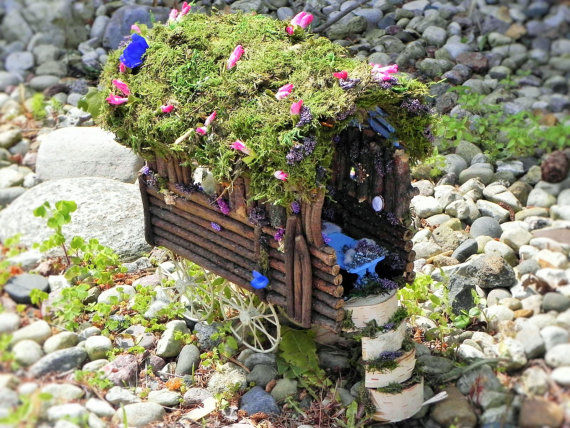
For a husband and wife team, they have been turning their little finds into fairy houses, which is another playful way of exploring their surroundings and getting to engage in make believe play as a grown up. They are also one of the lucky few people who get to sell their play creations. They were interviewed on the Etsy blog about their creations:
Etsy: When did you make your first fairy house? And had you ever heard of one before you made one?
Debbie: I grew up writing poetry and playing musical instruments and I had always loved doing different kinds of crafts like making dolls, handmade books and cards. But no, we’d never really heard of fairy houses before we started doing this 25 years ago. At the time, our sons had just started going to grade school, and when I found I had more time to myself, I was excited to use my creative talents again. The first project I tried was making a full-size Adirondack chair; when that didn’t work out, Mike suggested that I try making a miniature chair instead. I used some materials I had gathered from a couple of acres near my mom and dad’s place in Washington, and it was so much fun I kept doing it.
Mike: We have always loved nature. When we would go for hikes, Debbie was always picking up things she found, so we already had quite a collection of wild grasses and flowers. And Debbie’s mom was our biggest mentor. She always said, “You have so much talent. I wish you would use your talent.” She really encouraged us.
How wonderful that Debbie’s mom continued to encourage to play and explore with creating these miniatures.
Have you ever built little fairy houses when you go for a walk? Or seen someone else’s creation? Do you build with LEGOs or other miniatures? Or K’nex (Connector) Sets or Lincoln Logs or other building set? Do you wish you still did? Share in the comments below.
I wanted to share a great list from full time mom/worker/author/etc. Katrina Alcorn about how to fit in some play and laughs into a busy schedule.
Whether or not laughter is the best medicine, it’s certainly a great coping technique. It may not make you less busy, but it will boost your immune system, protect your heart, help you handle stress, lower your blood pressure, and improve your intake of oxygen. Also, it has zero calories, zero negative side effects, and it’s free.
Katrina also wrote a great book about her experience being Maxed Out and ways that we can all fight for more time and space to play and be balanced in our lives. It is a wonderful, fast, engaging read. Go check it out.








 Mental Flowers