architecture · behavior · culture · design · happiness · mental health · Social

New Office Designs in Seattle Trend Towards Open, Social Spaces

Most of us these days work in a cubicle, although the past ten years have really seen a transformation of space and place at the workplace in order to create happier, and therefore more productive, workers. This article in the NYTimes focused on some organizations in Seattle that have embraced a more open work floor plan:

Is this your idea of a perfect work environment?

MARTHA CHOE’S ideal working space is not her private office, nice though it is, but rather a long, narrow table in the vast atrium of the Bill & Melinda Gates Foundation headquarters here.

Ms. Choe, a former member of the City Council here, is the foundation’s chief administrative officer, and she had considerable input in the building’s design. One objective from the start was to give the 1,000 employees a variety of spaces to accommodate different kinds of work. “There’s a recognition that we work in different modes, and we’ve designed spaces to accommodate them,” she says. “I think one of the lessons is to understand your business, and understand what your people need to do their best work.”

The building was designed by NBBJ, a 700-employee architecture firm whose largest operation is in Seattle. The structure is a culmination of ideas about the 21st-century workplace that NBBJ has been exploring in corporate office designs worldwide, including its own offices here.

These are the main concepts: Buzz — conversational noise and commotion — is good. Private offices and expressions of hierarchy are of debatable value. Less space per worker may be inevitable for cost-effectiveness, but it can enhance the working environment, not degrade it. Daylight, lots of it, is indispensable. Chance encounters yield creative energy. And mobility is essential.

This isn’t a suddenly exploding trend. NBBJ’s research has found that two-thirds of American office space is now configured in some sort of open arrangement. But even as these designs save employers space and money, they can make office workers feel like so many cattle. So how to humanize the setting?

SEATTLE serves as a test tube because of several converging factors: There’s a lot of money here to experiment with projects. The work force is relatively young and open to innovation. And the local culture places a high value on informality, autonomy and egalitarianism. People will put in long hours under high pressure if they feel respected, but they won’t tolerate being treated like Dilberts.

Most office workers in Seattle and elsewhere labor in environments much less inspiring than Ms. Choe’s. And most employers have much less to spend to make things pleasant. (Bill and Melinda Gates personally contributed $350 million of the campus’s $500 million cost.) But staying competitive requires coming up with the best ideas, and the office environment can be the incubator for them.

Read the full article.

I am all for creating spaces that encourage collaboration and make workers feel comfortable and ready to get down to business. My only question is lack of meeting space. In my last two jobs it has been very hard to find private spaces to meet, although both were cubicle-based workspaces so that layout doesn’t necessarily solve things either. And I’m not alone in my concerns, as the article points out:

NOT all of NBBJ’s corporate clients have boarded the informality-and-buzz bandwagon. When the R.C. Hedreen Company, a real estate development firm based in Seattle, commissioned a renovation of a 10,800-square-foot floor in an old downtown office building five years ago, it specified a perimeter of private offices. Collaborative spaces are provided for creative teamwork, but the traditional offices remain the executives’ home ports.

“Individually, a lot of our workday is taken up with tasks that are better served by working alone in private offices,” says David Thyer, Hedreen’s president.

Susan Cain, author of “Quiet: The Power of Introverts in a World That Can’t Stop Talking,” is skeptical of open-office environments — for introverts and extroverts alike, though she says the first group suffers much more amid noise and bustle.

What are your thoughts on work space? Do you like having an open space to share, or do you prefer your own cubicle or booth? How do you handle the meeting privacy issues at your office? Leave your thoughts in the comments below.

anthropology · behavior · community · environment · happiness · Nature · psychology · technology

Mappiness: Mapping Happiness

A shot of the app.

From the blog How Do you Landscape; a group from the UK has created an app that can be used to measure our happiness based on our surroundings, and using maps to look at the data:

“People feel better outside than inside”. “People feel better in the park/woods/nature than in the city”. These are some of the conclusions from a project with the telling title ‘Mappiness’ Good news for landscape and Landscape Architecture on first sight. But are these only one-liners or firmly based scientific statements? Well, that depends on the quality of the empirical evidence of course. Most experience sample methods (ESM) have a hard time getting a representative group (in the end almost only colleagues) that has to struggle trough tedious interview forms (“it will take only twenty minutes”) to step-by-step end up with modest results. How about a sample group of 47.331 people (and growing by the day) who willingly support their data three times a day to the researchers that by now collected over three million forms in a few months? I stumbled upon these remarkable Experience research feats in a TedxBrighton 2011. In this “Twenty minutes lectureGeorge MacKerron explains why and how he and Susana Mourato (both from the Department of Geography & Environment at the London School of Economics and Political Science) created ‘mappiness’. They want to better understand how people’s feelings are affected by features of their current environment. Things like air pollution, noise, and green spaces influence your well being is their hypothesis.

This is how it works. They developed an app that can be downloaded for free. It must be one of the most irritating apps around on the web because it rings you (with your approval, you can influence the settings) three times a day to ask you three simple questions.

When put through a big regression model they can gauge the happiness as the function of habitat type, activity, companionship, weather conditions (there is of course a link between meteorological data and the GPS data), daylight conditions, location type (in, out, home, work, etc), ambient noise level, time of the day, response speed, and individual ‘fixed-effects’ (that come out of your personal Mappiness-history). Factors can be plotted out against each other.

How awesome is that? What a neat piece of technology to measure our surroundings and how they influence us!

behavior · brain · children · culture · education · learning · mental health · play · technology

Toddlers to tweens: relearning how to play

Español: Guiliana moreno Jugando en bogota
Free play is finally getting the recognition it deserves. Image via Wikipedia

Great article from the Christian Science Monitor about the value of play:

In recent years, child development experts, parents, and scientists have been sounding an increasingly urgent alarm about the decreasing amount of time that children – and adults, for that matter – spend playing. A combination of social forces, from a No Child Left Behind focus on test scores to the push for children to get ahead with programmed extracurricular activities, leaves less time for the roughhousing, fantasizing, and pretend worlds advocates say are crucial for development.

Meanwhile, technology and a wide-scale change in toys have shifted what happens when children do engage in leisure activity, in a way many experts say undermines long-term emotional and intellectual abilities. An 8-year-old today, for instance, is more likely to be playing with a toy that has a computer chip, or attending a tightly supervised soccer practice, than making up an imaginary game with friends in the backyard or street.

But play is making a comeback. Bolstered by a growing body of scientific research detailing the cognitive benefits of different types of play, parents such as Taylor are pressuring school administrations to bring back recess and are fighting against a trend to move standardized testing and increased academic instruction to kindergarten.

more at: Toddlers to tweens: relearning how to play.

behavior · brain · cognition · health · play

Make your cells cleaner by exercising

Cells stained for keratin and DNA: such parts ...
For cleaner cells, work up a sweat. Image via Wikipedia

We joke about getting the cobwebs out of our brain, but it turns out there really is some truth to that. And one of the best ways to give our bodies a thorough spring (or winter, or fall…) cleaning, is not through cleansing diets or saunas, but exercise! It’s beneficial on so many levels, including making you cleaner and a better environment for yourself down to the cellular level!

In the new research, which was published last month in Nature, scientists at the University of Texas Southwestern Medical Center in Dallas gathered two groups of mice. One set was normal, with a finely tuned cellular scrubbing system. The other had been bred to have a blunted cleaning system.

It’s long been known that cells accumulate flotsam from the wear and tear of everyday living. Broken or misshapen proteins, shreds of cellular membranes, invasive viruses or bacteria, and worn-out, broken-down cellular components, like aged mitochondria, the tiny organelles within cells that produce energy, form a kind of trash heap inside the cell.

In most instances, cells diligently sweep away this debris. They even recycle it for fuel. Through a process with the expressive name of autophagy, or “self-eating,” cells create specialized membranes that engulf junk in the cell’s cytoplasm and carry it to a part of the cell known as the lysosome, where the trash is broken apart and then burned by the cell for energy.

Without this efficient system, cells could become choked with trash and malfunction or die. In recent years, some scientists have begun to suspect that faulty autophagy mechanisms contribute to the development of a range of diseases, including diabetes, muscular dystrophy, Alzheimer’s and cancer. The slowing of autophagy as we reach middle age is also believed to play a role in aging.

Read the full article at the New York Times: Exercise as Housecleaning for the Body

The best part is it doesn’t seem to matter what kind of exercise, so anything from hop scotch to marathons will give you some benefit!

autism · behavior · children · health · Social

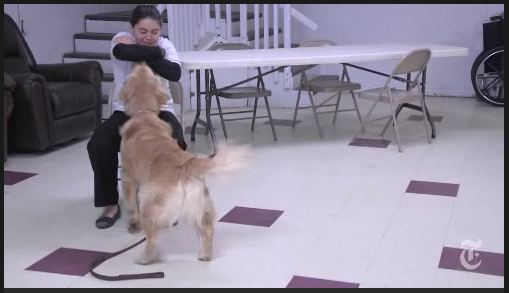
Dogs trained to help disabled kids lead more enriching lives

Your feel good story of the day, brought to you by the New York Times: a nonprofit organization trains dogs to help kids with all kinds of disorders, from autism to muscular dystrophy to seizures.

In October 1998, Shirk assembled a board and founded 4 Paws for Ability, a nonprofit corporation. She rescued Butler, a German shepherd mix, from a shelter; hired a trainer to prepare him for mobility work with the 12-year-old; and became a pioneer among service-dog agencies. “People started calling from all over to ask, Am I too young? Am I too old? Am I too disabled? Am I disabled enough?” she says. “I said, ‘If your life can be improved by a dog, and if you and your family can take good care of a dog, we’re going to give you a dog.’…” “We place dogs with kids in wheelchairs, kids on ventilators, kids with autism, kids with dwarfism, kids with seizure disorder and cognitive impairments; but if your dog does tricks, other kids want to meet you. Kids will ignore your disability if you’ve got a cool dog.”

Watch the video at the New York Times:

A trainer works with a dog on behavior modification techniques. Click the image to see the video.

It is also an amazing relationship dynamic to see occur between the children and their dogs, how the children with cognitive disabilities in particular are helped to see the world, in a way, through their dog’s eyes:

Alan M. Beck, the director of the Center for the Human-Animal Bond at Purdue University’s College of Veterinary Medicine, is among those intrigued by it. “There is a real bond between children and animals,” he told me. “The younger the child, the greater the suspension of disbelief about what an animal understands or doesn’t understand.” According to Beck, more than 70 percent of children confide in their dogs, and 48 percent of adults do. “The absolutely nonjudgmental responses from animals are especially important to children,” he says. “If your child with F.A.S.D. starts to misbehave, your face may show disapproval, but the dog doesn’t show disapproval. The performance anxiety this child may feel all the time is absent when he’s with his dog. Suddenly he’s relaxed, he’s with a peer who doesn’t criticize him.”

behavior · education · happiness · health · Social

Non-Elimination Games Leads to More Physically Active Children, Researchers Say | MomsTeam

A typical game of tic tac toe English: Tic tac...
Non-competitive games also have benefits. Image via Wikipedia

Interesting article about the value of non-elimination games (the original author focused on “non-competitive” but there are many competitive games that don’t involve elimination):

A study presented in May 2008 established that the structuring of children’s games has a significant effect on energy expenditure.

A research team led by Karla Bruggeman and David Dzewaltowski, Ph.D., measured activity during both elimination- and non-elimination games, using accelerometers, in 29 children in grades four through six. Both normal weight and overweight children participated in the study, but were not separated for analysis.

In non-elimination games, kids accrued more overall physical activity due to not having to spend time on the sidelines as a result of elimination. They also accumulated significantly more moderate and vigorous physical activity than elimination games. Both sets of games were adopted from a children’s program devised by a nonprofit group that uses various pieces of equipment to facilitate non-competitive play; elimination games were modified from non-competitive versions.

Children were surveyed for self-efficacy, enjoyment, and peer victimization following both types of games. Results showed that enjoyment was somewhat higher following elimination games, although enjoyment scores were high in non-elimination games as well. There were no reports of peer victimization in either set of games, but were significant increases in self-efficacy after both sets.

“The games in this study were part of fun and enjoyable day camp,” Bruggeman said. “It is likely that a well organized and positive game experience increases a kid’s confidence regardless of elimination or non-elimination game conditions.”

Again, the article author was focusing on non-competitive sports, but really the evidence is looking at non-elimination sports. While I don’t find anything wrong with competitive sports, I know they’re not everybody’s cup of tea, and I think it’s great to emphasize the fact that you don’t need to be playing on a team sport or competing against others in order to gain the same benefits from play. And there are lots of non-competitive physical activities that kids can and do partake in: parkour, running, climbing, digging in the dirt, parachute play, biking… what else? Name your favorite non-competitive physical activity in the comments.
behavior · brain · happiness · health · learning · neuroscience

It really is the journey rather than destination

HappinessNice interview from Salon with scientist Shimon Edelman about how scientists are discovering neural patterns to the behaviors and activities that make humans happy; turns out the act of learning is often more rewarding than what we learn:

Shimon Edelman, a cognitive expert and professor of psychology at Cornell University, offers some insight in “The Happiness of Pursuit: What Neuroscience Can Teach Us About the Good Life.” In his new book, Edelman walks the reader through the brain’s basic computational skills – its ability to compute information, perform statistical analysis and weigh value judgments in daily life – as a way to explain our relationship with happiness. Our capacity to retain memories and develop foresight allows us to plan for the future, says Edelman, by using a mental “personal space-time machine” that jumps between past, present and future. It’s through this process of motivation, perception, thinking, followed by motor movement, that we’re able not only to survive, but to feel happy. From Bayes’ theorem of probability to Shakespeare’s “Romeo and Juliet,” Edelman offers a range of references and allegories to explain why a changing, growing self, constantly shaped by new experiences, is happier than the satisfaction any end goal can give us. It turns out the rewards we get for learning and understanding the workings of the world really make it the journey, not the destination, that matters most.

Read the interview.

behavior · youtube

Cute play fix: baby otter playing

Happy Thursday! To get you over the “week’s almost over” hump, here is an adorable baby otter doing what otters, and young critters in general, do best: play!

I like the playful human/otter interactions as well.

behavior · brain · mental health · neuroscience · play · psychology

Playing leads to lower Alzheimer’s risk

English: PET scan of a human brain with Alzhei...
Brain with Alzheimer's. Image via Wikipedia

From USA Today:

People who engage in activities such as reading and playing games throughout their lives may be lowering levels of a protein in their brains that is linked to Alzheimer’s disease, a new study suggests.

Although whether the buildup of the protein, beta amyloid, causes Alzheimer’s disease is debatable, it is a hallmark of the condition, the researchers noted.

“Staying cognitively active over the lifetime may reduce the risk of Alzheimer’s by preventing the accumulation of Alzheimer’s-related pathology,” said study author Susan Landau, a research scientist at the Helen Wills Neuroscience Institute at the University of California, Berkeley.

“Some of the literature has hypothesized this finding, but this is the first study to report that lifetime cognitive activity is directly linked to amyloid deposition in the brain,” she said. “We think that cognitive activity is probably one of a variety of lifestyle practices — occupational, recreational and social activities — that may be important.”

Read more at Keeping brain sharp, active may ward off Alzheimer’s

There have been several different studies that find the correlation between play and a healthy brain less susceptible to dementia, disease, and overall decay. Literally use it or lose it. So you might as well have fun using it!

behavior · happiness · health · mental health

Playing with the piggies

Pigs are incredibly intelligent creatures that need enrichment and play just like we do. This is a great story about providing enriching environments and play to livestock, similar to what Temple Grandin advocates here in the U.S.

“[R]esearchers at Wageningen University [in the Netherlands], in the course of their research on ethical livestock farming, noticed that pigs like to play with dancing lights…European regulations currently require that pig farmers provide mentally-stimulating activity for their pigs in order to reduce boredom…” (via mother jones)

The coolest part is, HUMANS would get to interact and play with pigs:

“As a farmer, you’d get to play video games with your hogs, and the gameplay might actually have the added benefit of making the animal’s life happier and healthier.

The system includes a giant screen that broadcasts a swirl of glittering colors and lights next to the pigpen. The human participant controls the wall-sized screen remotely with an iPad, and the pigs react by touching and following the light designs with their snouts. Clement notes that researchers hope that this will all “open up new questions in debates about animal farming and welfare in the digital age…”  (via mother jones)

Check out the video:

The Playing with Pigs project is researching the complex relationship we have with domesticated pigs by designing a game. Designing new forms of human-pig interaction can create the opportunity for consumers and pigs to forge new relations as well as to experience the cognitive capabilities of each other. The game is called Pig Chase.

For additional background, visit the Playing with Pigs project website: playingwithpigs.nl

Pretty cool idea to let humans and livestock interact with each other in different ways.