Really interesting article about the concept of biophilic design, something I’ve brought up a lot on this sight. In summary, humans love natural environments, so why haven’t our buildings and other spaces moved more in that direction? It’s all broken out very nicely in this post:
Really interesting article about the concept of biophilic design, something I’ve brought up a lot on this sight. In summary, humans love natural environments, so why haven’t our buildings and other spaces moved more in that direction? It’s all broken out very nicely in this post:
Simple: I saw some inspirational work, and had some immensely rewarding conversations.
We took a meandering and surprisingly green route across most of the NDC area to Radnor Street Gardens.
This is one of London’s best examples of a ‘playable space’ – in other
words, a space where offering opportunities for play is only one of the
jobs that has to be done. My work for the GLA
[pdf link] helped to embed this idea in London’s planning system. In my
view, it is fundamental to the success of public play facilities in
almost any urban area.
What struck me was how the programme combined park, amenity space and
play projects, along with streetscape and highways initiatives, so that
the whole far exceeded the sum of its parts. The ingredients we saw
included [*deep breath*]: new play spaces and toilet blocks in parks and
estates, new public squares from reclaimed street space and car parks, ‘home zone’-style
shared road surfaces, landscaped road closures, greening up an adventure playground, estate-based allotment projects, cycle lanes,
shared use ball game areas, pushchair-friendly pavements, even (on one
estate) new refuse bin sheds with green roofs. Her approach to
engagement was revealing. Local people were closely involved at all
levels, right up to the NDC board. However, they were seen not simply as
‘stakeholders’ or ‘consumers’, but as people who needed to be inspired,
debated with, and (hopefully) won over.
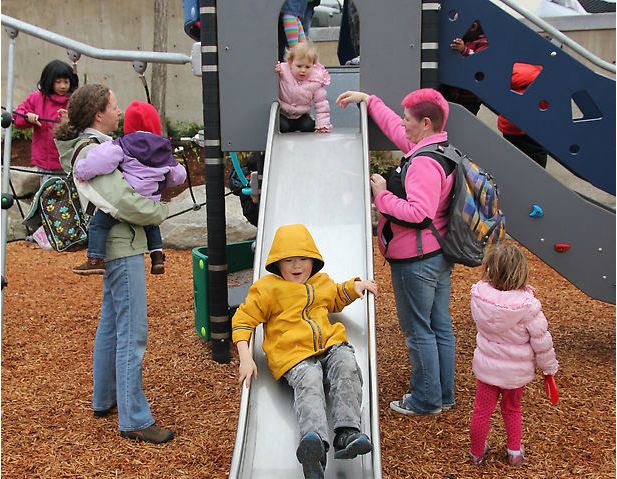
I think this is a great idea; just as we have garden tours, we should have playground tours! Areas that introduce parents and officials alike to playful, fun spaces to take their kids.
This blog actually has some great conversations about play and the need for children to get outside and play more.
Most of us these days work in a cubicle, although the past ten years have really seen a transformation of space and place at the workplace in order to create happier, and therefore more productive, workers. This article in the NYTimes focused on some organizations in Seattle that have embraced a more open work floor plan:
Is this your idea of a perfect work environment?
MARTHA CHOE’S ideal working space is not her private office, nice though it is, but rather a long, narrow table in the vast atrium of the Bill & Melinda Gates Foundation headquarters here.
Ms. Choe, a former member of the City Council here, is the foundation’s chief administrative officer, and she had considerable input in the building’s design. One objective from the start was to give the 1,000 employees a variety of spaces to accommodate different kinds of work. “There’s a recognition that we work in different modes, and we’ve designed spaces to accommodate them,” she says. “I think one of the lessons is to understand your business, and understand what your people need to do their best work.”
The building was designed by NBBJ, a 700-employee architecture firm whose largest operation is in Seattle. The structure is a culmination of ideas about the 21st-century workplace that NBBJ has been exploring in corporate office designs worldwide, including its own offices here.
These are the main concepts: Buzz — conversational noise and commotion — is good. Private offices and expressions of hierarchy are of debatable value. Less space per worker may be inevitable for cost-effectiveness, but it can enhance the working environment, not degrade it. Daylight, lots of it, is indispensable. Chance encounters yield creative energy. And mobility is essential.
This isn’t a suddenly exploding trend. NBBJ’s research has found that two-thirds of American office space is now configured in some sort of open arrangement. But even as these designs save employers space and money, they can make office workers feel like so many cattle. So how to humanize the setting?
SEATTLE serves as a test tube because of several converging factors: There’s a lot of money here to experiment with projects. The work force is relatively young and open to innovation. And the local culture places a high value on informality, autonomy and egalitarianism. People will put in long hours under high pressure if they feel respected, but they won’t tolerate being treated like Dilberts.
Most office workers in Seattle and elsewhere labor in environments much less inspiring than Ms. Choe’s. And most employers have much less to spend to make things pleasant. (Bill and Melinda Gates personally contributed $350 million of the campus’s $500 million cost.) But staying competitive requires coming up with the best ideas, and the office environment can be the incubator for them.
I am all for creating spaces that encourage collaboration and make workers feel comfortable and ready to get down to business. My only question is lack of meeting space. In my last two jobs it has been very hard to find private spaces to meet, although both were cubicle-based workspaces so that layout doesn’t necessarily solve things either. And I’m not alone in my concerns, as the article points out:
NOT all of NBBJ’s corporate clients have boarded the informality-and-buzz bandwagon. When the R.C. Hedreen Company, a real estate development firm based in Seattle, commissioned a renovation of a 10,800-square-foot floor in an old downtown office building five years ago, it specified a perimeter of private offices. Collaborative spaces are provided for creative teamwork, but the traditional offices remain the executives’ home ports.
“Individually, a lot of our workday is taken up with tasks that are better served by working alone in private offices,” says David Thyer, Hedreen’s president.
What are your thoughts on work space? Do you like having an open space to share, or do you prefer your own cubicle or booth? How do you handle the meeting privacy issues at your office? Leave your thoughts in the comments below.
A nice story about a redesign of a park in Seattle so children could actually, you know, play in it:
Located on the northeast corner of Seventh Avenue and South Lane streets in the Chinatown-International District, the park is small – about one-fifth of an acre — but in a key spot.
Vegetation had grown up around the periphery of the 30-year-old park, obscuring views and raising concerns about safety. There were few amenities for adults who bring kids to the park, and no accommodations for people with disabilities. A rock mound posed a hazard, and during the winter, the grass was often soggy.
Cultural and language differences were also part of the landscape, making decisions about the park complicated.
But renewal made sense because the neighborhood has seen increasing residential and commercial development, leading to more active community places such as the Wing Luke Asian Museum and a branch of the Seattle Public Library.
To involve stakeholders young and old, Hou’s group, along with the city and several neighborhood groups, held an intergenerational design workshop in 2007.
“I think the most difficult challenge was to incorporate as much of the feedback we got from the community while still allowing the park to have a clear and concise design,” said student Patrick Keegan.
Engaging multiple generations of users was the most interesting part of the redesign, said Joyce Pisnanont, manager of IDEA Space, which promotes and develops the Chinatown-International District. Desires were consistent across age groups, she said, and the adults “really wanted to ensure that the park was fun for kids to play in.”
The final design by landscape architect Karen Kiest includes an expanded children’s area with a play structure big enough for a dozen kids, a dragon sculpture restored by artist Gerard Tsutakawa, a stainless steel pagoda with seats for grown-ups and a three-level rockery that serves as both gathering space and a climbing area.
Public art by Stuart Nakamira includes a brushed stainless steel top the size of a typical 4-year-old.
In a Lane Street corner, pink viburnum are budding, surrounded by circles of black mondo grass.
Brazilian graffiti art is considered among the most significant strand[s] of a global urban art movement, and its diversity defies the increasing homogeneity of world graffiti.” – Design Week
In March 2009, the Brazilian government passed law 706/07 making street art and graffiti legal if done with the consent of building owners. As progressive of a policy as this may sound, the legislation is actually a reflection of the evolving landscape in Brazilian street art, an emerging and divergent movement in the global street art landscape.
Rio de Janeiro has been particularly progressive in its policy towards street art, with its 1999 “Não pixe, grafite” (Don’t Tag, Graffiti) project that brought together 35 graffiti artists to showcase diversity in local styles. But more unique is the evolution of a permission hierarchy, blurring the line between formal and informal. The new street art law merely reinforced these unique patterns of street art and legitimized an already flourishing form of artistic expression.
Retaining walls on the steep terrain provide canvases for artists.
In Rio de Janeiro, street art is ubiquitous. It exists in all corners of the city, from the favelasto upper class neighborhoods, from residential to institutional. It is bold in scale and aesthetics and is anything but graffiti. The urban fabric of Rio de Janeiro also figures prominently in the evolving street art scene. The high walls, whether for security or to contain the topography, provide ample surfaces for painting. But rather than location dictating art, the relationship between owner and artist has a direct impact on where street art occurs.
Owners of buildings, both residential and commercial, sometimes invite artists for commissions, which is done to protect from tagging, as an aesthetic choice or as an economic choice — painting a façade with art may be cheaper than another mode of beautification. In another case, street artists ask permission from the owner.
Tudo de cor para você, Santa Marta, Rio de Janeiro (photo source: favelapainting.com)
Thanks to the city’s openness to various forms of artwork, and specifically “street” art, Rio de Janeiro is now known for its colorfulness and art. In informal studies the art has also been found to make citizens more invested in their communities and overall happier.
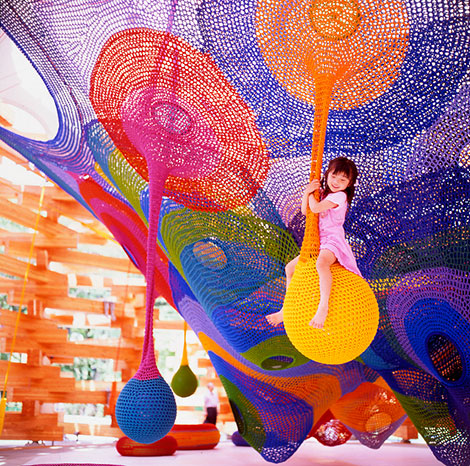
I love the story of how she came to be engaged with children’s play: “It all happened quite by accident. Two children had entered the gallery where she was exhibiting ‘Multiple Hammock No. 1’ and, blissfully unaware of the usual polite protocols that govern the display of fine art, asked to use it. She watched nervously as they climbed into the structure, but then was thrilled to find that the work suddenly came alive in ways she had never really anticipated. She noticed that the fabric took on new life – swinging and stretching with the weight of the small bodies, forming pouches and other unexpected transformations, and above all there were the sounds of the undisguised delight of children exploring a new play space.”
From that point, her work shifted out of the gallery and a subdued, monochromatic pallet into a riotous rainbowof colors for children’s playscapes.
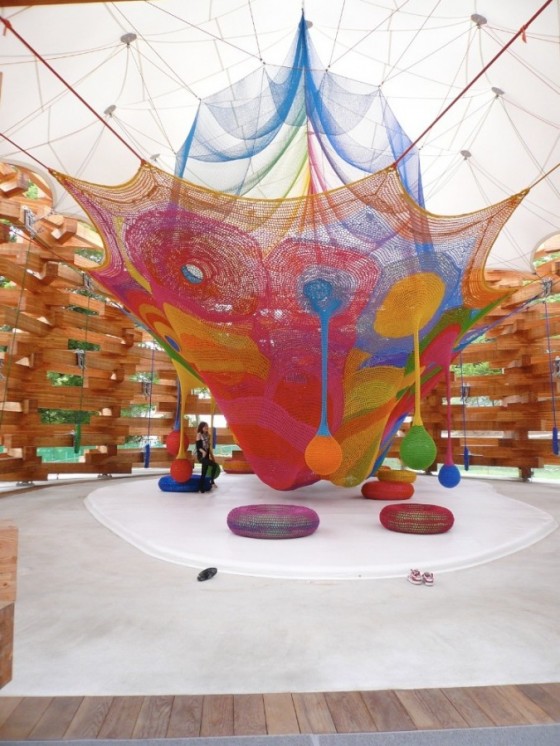
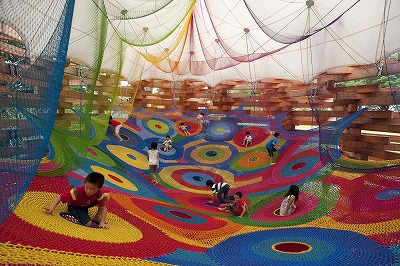
Rainbow Net was produced in close collaboration with structural engineers TIS & Partners and landscape architects Takano Landscape Planning and opened in July of 2000 after three years of planning, testing, and building.
Note that the project began with a brief not for a playground, but simply for ‘public art‘. Wouldn’t it be great if when we heard ‘public art’ we automatically thought ‘play’?
But innovative playscapes require an enormous commitment: “…endless cycles of discussion and approval, with meticulous attention to detail…[including] an actual scale wooden replica of the space in Horiuchi’s studio and accurately scaled crocheted nets using fine cotton thread. Even then, it was difficult to assess many things. What difference, for instance, would the weight of the real yarn make when everything increased in scale? All of these factors had to be calculated in order to arrive at a scientific methodology that could eradicate any risk of unacceptable danger.”During final assembly, Toshiko crocheted ten hours a day, often on her knees, until the installation was complete.”
With the current revival of the textile arts and yarn bombings everywhere, I’d love to see more crochet on the playground!
Signs of spring are just starting to appear – birds are getting more active, tulips are just starting to show off green shoots – but even in my neck of the woods I know it’ll be awhile before spring is actually here. In New York, one group is fighting the gray and dark with an installed insta-park:
photo courtesy of laughing squid
Welcome to New York City in winter, with a cure for cold-weather blues: a pop-up indoor park in lower Manhattan that’s open through Valentine’s Day.
Despite temperate temperatures so far this year, “it’s our rebellion against winter,” says Jonathan Daou, founder and CEO of Openhouse Gallery, a company that holds a 20-year lease on the space at 201 Mulberry St.
On a recent chilly weekday afternoon, babies played barefoot in the 75-degree world of Park Here while their mothers and fathers sipped tea, eating cookies and sandwiches.
One night, a movie is planned on the lawn; other days bring a ping pong competition, a trivia contest, wine tastings and soccer workshops.
The 5,000-square-foot artificial habitat in the downtown Nolita neighborhood is filled with trees, rocks, picnic benches and the recorded ambient sounds of Central Park in spring. There are giant cushions and even a hammock, plus a baby elephant.
But the park will be gone by mid-February.
The rest of the year, the 200-year-old former police precinct is a stage for business that plays on the “pop-up” retail method mushrooming around the world in recent years: a quick presentation of a product, performance or personality, with no commitment to a lease or contract.
It’s usually set up in a mobile unit that can be assembled and disappear.
Some call it guerrilla retail. “You’re not stuck with a 10-year lease if the product doesn’t sell,” Daou says. “People are looking for novelty, off the beaten path, and this space tests the ‘legs’ of a business concept.”
The space was part of a police precinct in the late 1890s under New York Police Commissioner Theodore Roosevelt, who later became U.S. president.
But there’s nothing historic about what’s going on inside. On the contrary, it’s all the rage in retail.
What a nice way to slough off that winter feeling and take a break and add some fun to your day. What is happening in your area that reminds you of spring?
It’s cold and wet here in the northwest, so it’s nice to be reminded that somewhere relatively nearby (ok, 800 miles, but still!), it’s warm and sunny:
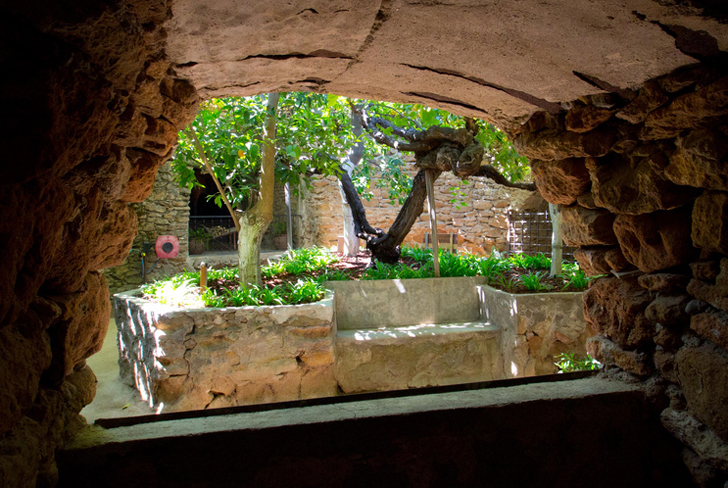
Fresno’s Forestiere Underground Gardens are one of California’s most beautiful feats of historical environmental design. Built by Sicilian immigrant Baldasare Forestiere over 40 years of his life, the subterranean gardensare fed with skylights and catch basins. Working totally on impulse, Forestiere designed the retreat without blueprints or plans – and his only tools were a pick, shovel, and wheelbarrow.
Happy New Year! This has been a pretty crazy year for me. One of change, growth, more change, more growth… but hopefully all of it has paid off to create a better, more enriching space for me both at work and at home.
In honor of enriching spaces, I figured I’d share Inhabitat’s top six (why six? Not sure) architecture stories of the year:
2011 saw more exciting, innovative and record-breaking green buildingsthan ever before, and judging from the popularity of our eco architecture stories, many of you agree! From the world’s largest wooden structure in Seville to the world’s first vertical forest beginning construction in Milan, if you want to see some of the most mind-blowing designs that made waves this year, then check out 2011′s most popular stories below — and be sure to vote for your favorite!
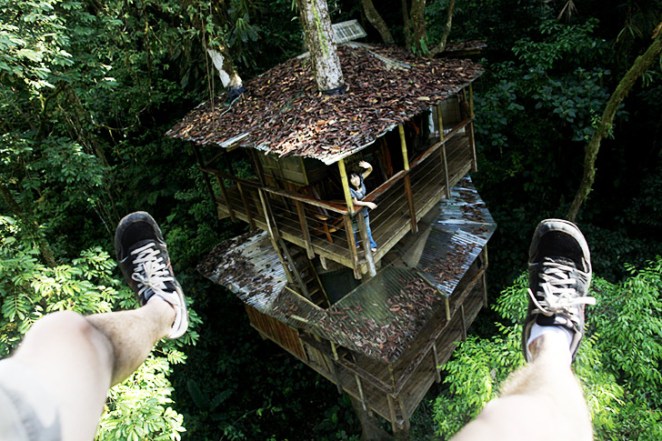
Where do Ewoks go when they're bored with Endor? Why, to Finca Bellavista village of course.
Bosco Verticale
sunken pedestrian bridge in the netherlands parts moat waters like moses
What does it mean to design with a person's wellness in mind? One architect has an idea. Image via Wikipedia
Great blog post from The Patron Saint of Architecture about what it means for her to be an architect and build and design things for people’s overall health and wellness:
As architects, we seek to inspire those who move through the environments we create. It’s also our job to understand how the space will be used and create elements that support that use. The last leg of the stool, a part we often overlook, is the need to make buildings that support wellness. Even architects who design healthcare buildings often forget about this one as they work to meet many other challenges related to budget, program, operational and code requirements. Maybe it’s because wellness is such a slippery term. Much like the term “green,” “wellness” is often bandied about, a buzzword that makes some aspect of a product, design or organization sound like it’s good for us. So how do we know if it really is- much less translate that into design elements? I have been thinking about this issue for a while and even found an interesting website devoted to defining wellness complete with helpful questionnaires.
I’ve come to the conclusion that true wellness is multidimensional and positively impacts our physical, mental and social state of being. With that in mind, I have also observed that, as a profession, we kind of, sort of, dip our toe in the waters of designing for wellness. We embrace sustainable building standards, evidence-based design, lean design, even socially conscious strategies. However, these are just quantifiers. Building blocks of the wellness leg of the architecture stool, but not enough as stand-alones. True architecture of wellness must incorporate all of these measures, but spring from a much deeper intent.
Read her recommendations for building spaces that promote wellness at her blog post: architecture of wellness








 Mental Flowers