Oh, all right, but only because you asked soooo nicely; for Earth Day, an example of how communities in the Puget Sound are coming together to protect the Earth and improve their own personal environments as well.
Researchers have pointed the finger at stormwater runoff as the top source of pollution that’s getting into Puget Sound and other Northwest waterways. And because runoff comes from just about everywhere — roofs, roadways, parking lots, farms, and lawns — the solution has to be just as widespread.
Enter 12,000 Rain Gardens.
This week Washington State University and Stewardship Partners, a nonprofit working on land preservation, announced a campaign to promote the installing of 12,000 rain gardens around Puget Sound by 2016. The website even has a counter tracking the number of gardens and encourages folks to enter their rain garden into the database.
Happy Earth Day! I feel like I should have a blog post dedicated to the benefits of nature and why we need the Earth, but to be perfectly frank none of those environmental changes we talk about are going to happen unless we get everybody on board and engaged!
So, instead, here is one example of getting people, and particularly kids, involved and engaged, thinking critically about what they did or did not like about their experience, and giving it credibility and recognition by posting it to a public forum, and not just the online kind:
Flights of fancy, lively drawings, dreams of piloting the Bell helicopter, disdain for a museum with no dinosaurs… many of our absolute favorite “MoMA stories” were left by kids, from toddlers to teenagers. So for our second post about the “I went to MoMA and…” project, it wasn’t hard to pick a theme.
Some people think modern and contemporary art is too “hard” or “weird” for kids to understand and get excited about. Not the way our younger visitors tell it, though! It made us incredibly happy to hear from so many kids who thoroughly enjoyed their day at MoMA: admiring colors and shapes, learning new things, trying out Material Lab, picking a favorite artist, getting inspired to draw, and spending time with friends, parents, and grandparents. Take a look at some of the responses below, and a big thank you to all the kids who participated!
Losing your job can have a profound effect on your physical health. Image via Wikipedia
My new year’s resolution this year was to start taking better care of myself; more sleep, healthier food (no more sneaking chocolate out of the secretary’s candy dish!) and getting regular exercise if for nothing else just to move and remember what it feels like to use your muscles.
But up until recently I had never acknowledged some of the things that had caused me the most stress. One of them was changing jobs after seven years and becoming a freelance writer/editor, while also moving away from a city I’d lived in for that long as well. That loss of identity, of sense of self and how you fit into the world, can have a profound effect on mental and physical health, as one New York Times article recently discussed, focused more on job loss, but very similar emotionally and the physical repercussions:
The first to have a heart attack was George Kull Jr., 56, a millwright who worked for three decades at the steel mills in Lackawanna, N.Y. Three weeks after learning that his plant was closing, he suddenly collapsed at home… Less than a month later, Don Turner, 55, a crane operator who had started at the mills as a teenager, was found by his wife, Darlene, slumped on a love seat, stricken by a fatal heart attack.
It is impossible to say exactly why these men, all in relatively good health, had heart attacks within weeks of one another. But interviews with friends and relatives of Mr. Kull and Mr. Turner, and with Mr. Smith, suggest that the trauma of losing their jobs might have played a role.
A growing body of research suggests that layoffs can have profound health consequences. One 2006 study by a group of epidemiologists at Yale found that layoffs more than doubled the risk of heart attack and stroke among older workers. Another paper, published last year by Kate W. Strully, a sociology professor at the State University of New York at Albany, found that a person who lost a job had an 83 percent greater chance of developing a stress-related health problem, like diabetes, arthritis or psychiatric issues. In perhaps the most sobering finding, a study published last year found that layoffs can affect life expectancy…
It was hard to explain to people why I wasn’t thrilled and exhilarated to be living with my husband again, out of a seemingly dead end job and taking my life into my own hands. I wasn’t thrilled or exhilarated. And I wasn’t even scared in that good kind of way; I was just scared and isolated. At least now I know I wasn’t as weird as I was made to feel.
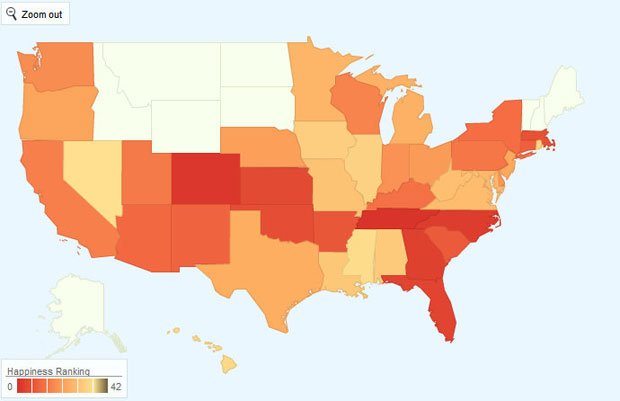
Well, I was having a good day…but enough about me, what’s going on in with the rest of the world? Pretty miserable stuff, actually: Libyan rebels, Japan’s earthquake, tsunami, and nuclear meltdown, the government shut down barely avoided…well, how are individual states doing? Now we know! A map on alexdavies.net used Twitter to determine just how happy each of our fifty nifty states are. Illinois seems darned happy. Washingtonians are – apparently only kinda sorta happy. From the Seattle PI:
On a scale of one to 42 — where one is ecstatically mirthful — Washington state has a happiness index of 21. In other words, it could go either way.
A map from alexdavies.net uses Twitter keywords to pinpoint just how positive or negative states are.
So, if lots of people are using words like “love” and “amazing” when they tweet, their states might get a better ranking.
Oddly enough, sad words for Washington include “Phillies” and “presale,” according to the site. “Starcraft” and “gentleman” also show up as negative words.
From NYT: Ms. Bosco, 95, spends much of her time at Seaside with Delores Brown, 73.
This New York Times article about budget cuts in New York State affecting senior community centers struck a nerve with me. In a good way. I am a strong advocate for promoting quality of life even into old age, especially into old age, and I think we youngsters forget just how important these community spaces can be for old folks.
In these places seniors can get a cheap meal, planned activities like games or fitness classes (we’re talking more Tai Chi than Tai Bo) but also companionship, and opportunities to do new things and learn. They also get experiences they never would have gotten to do otherwise; they realize they love to dance, or simply fall in love again.
However, with states and cities as cash strapped as they are, these places are in jeopardy of closing.
Last year, [New York] state and city budget cuts threatened 75 of the centers… and 29 were ultimately closed. The centers are intended to serve New Yorkers over age 60. This January, the dance began again: Gov. Andrew M. Cuomo proposed redirecting $25 million from the centers to child welfare; that, said the city’s Department for the Aging, would mean closing about a third of its centers; on March 15, the centers got a reprieve, with the Assembly and the State Senate voting to restore the money.
In a country where we are already isolating generations away from each other, it seems all the more important to at least offer a place for this demographic of people to meet and have some kind of community.
My grandparents belonged to a retirement home that practically forced them to go out and socialize with each other, be involved in community efforts, and participate in outreach to youth. I was thrilled to see new activities and challenges thrust upon my grandparents; learning new skills and taking on new responsibilities at 80 plus was revitalizing for them. However, that retirement home also ate up a lot of money, money that most folks don’t have, and soon-to-be-old folks are in worse shape as far as savings go due to the economy.
Some people may argue that it’s not worth investing in a demographic that isn’t giving back to our society. Besides the argument that they already GAVE to our society for 50 or more years, I’d argue that many of them could give back if we gave them the opportunity. There are lots of volunteer and time-bank programs where retired folks can donate their skills, from fixing leaky faucets to knitting to mentoring.
One of the programs my grandfather was in was a mentor for “troubled kids” as he’d call them who were bussed into the retirement home every other week or so to sit for an hour to talk to an old person. It was community service that a lot of them probably didn’t like the idea of at first, and to their friends they probably didn’t get all that excited about it. But when you actually saw the kids interact with the older folks, these kids opened up and really enjoyed their time with him. This was the first time in a long time that a lot of these kids got to say what was on their minds, and were really listened to. My grandfather also just happened to be a guidance counselor for many, many years, so for him this was also a treat to brush up on his old guidance counseling skills and feel like he was helping kids along the path “to the straight and narrow.” But even without that training, the older mentors felt like they were contributing to society, and so did the kids, as well as both getting something in return.
So before we look to cutting budgets on senior community centers, I argue we should look at these as possible hubs for other community activities, or community focal points. Just like lots of groups rent out the church basement for meetings or choir rehearsals, city planners should be looking at these spaces as community centers, not just senior centers. These centers offer a chance for a human being, of any age, to feel like a party of a community again, to feel human.
So much for my New Year’s Resolution “Eat Healthier,” and good reminder that it’s all relative; although, in my defense, my definition of healthy may be a little more stringent than the average American:
Nine in 10 Americans say their diet is healthy but only a quarter limit the amount of fat or sugar they eat, and two-thirds don’t eat enough fruit and vegetables, a poll published Tuesday found.
“Americans tend to give themselves high marks for healthy eating, but when we asked how many sugary drinks, fatty foods, and fruits and veggies they consumed, we found that their definition of healthy eating was questionable,” said Nancy Metcalf of Consumer Reports Health, which conducted the poll.
Of the 1,234 American adults polled, 89.7 percent said their diet was “somewhat” (52.6 percent), “very” (31.5 percent), or “extremely” healthy (5.6 percent).
A very nice essay about what it takes to be a happy, healthy man, woman, or general human being:
Men have a certain innate restlessness. We’re always looking for a new adventure, wanting to feel like we’re progressing in life, and wondering if the grass might be greener somewhere else.Our ever-searching nature can be a good thing if it’s channeled into pursuits that really lead to greater happiness and satisfaction. But restlessness can also get us terribly off track if we expend our energy journeying down avenues that are really dead ends.
…the key to finding the truly greener pastures is to concentrate on going after the right things-the things that really will make you happier-instead of expending your energy in pursuit of a happiness mirage.
This is where the economics of happiness comes in. Numerous studies have revealed what factors in life are correlated with greater happiness. Now granted, these things correlate to greater happiness; they don’t necessarily cause happiness. But I always say it’s at least worth checking out where the happy people congregate. Below we highlight eight areas of a man’s life that we often associate with increasing or decreasing our happiness and analyze if the grass really is greener in those pastures.
Living in the Pacific Northwest I can definitely appreciate the idea of adding more color to one’s life! Interestingly, it tends to be warmer climates that have the more colorful buildings, although Denmark and Finland has some of the most colorful interiors (and now exteriors) I’ve seen. Color has an amazing effect on human mental health and mood. People often talk about getting back into nature to see all the colors. Now, the colors can come to you (unless you live in a community with a rule against bright colors).
Urban life doesn’t have to be bleak and gray — in fact, many of the world’s cities pride themselves upon the bright palettes used to liven up their architecture. From the garish blue-walled buildings of Jodhpur, India, to the gentler pastels of Charleston, S.C., these cities are far from monotonous.
Charleston, SCNyhavn, DenmarkBuenos Aires, Argentina





 Mental Flowers