architecture · community · creativity · culture · design · environment

Designers Stretch Out Imaginations on Park Benches – NYTimes.com

Several great scientists, philosophers, and kids alike know the power of a good park bench. Thankfully park designers are learning that too:

That most prosaic of public furnishings, the New York City park bench, has morphed into a blank canvas on which designers, landscape architects and artists have unleashed their fantasies.

Architects and park officials say the trend has gained momentum as the city has reclaimed its waterfront and turned forgotten public nooks into plazas.

park furniture has the power to stop people in their tracks and have them take a seat. Abigail Hansen, a 24-year-old graduate student who lives on the Upper West Side, set out recently to walk along the Hudson River all the way to Chelsea. But she was sidetracked when she happened upon a group of curvaceous chaise longues made from molded fiberglass in Riverside Park South at West 62nd Street near the river. “When I saw these I decided to stop,” said Ms. Hansen, who was flipping through an Italian fashion magazine. “The surface is nice and smooth and the material doesn’t get too hot.”

via Designers Stretch Out Imaginations on Park Benches – NYTimes.com.

What parks do you visit that have amazing benches? Tell us in the comments below.

behavior · creativity · culture · happiness · health · mental health · play

Adults are reclaiming playtime

Dr. Norman Bethune (centre) watching a game of...
A lively game of checkers among friends (Photo credit: BiblioArchives / LibraryArchives)

From Dodgeball to pillow fights to roller derby, adults are reclaiming time to play in their lives:

It was all fun and games until someone smacked Don Norman in the head — hard — with a feather pillow. Walking into his first two-hour “Playing in the Deep” session, a weekly organized event in Portland, Maine that engages stressed-out grownups in childlike activities, Norman, a 48-year-old database administrator, didn’t know what to expect. Then he saw the pillows, a big pile of them, stacked high. Everyone around him grabbed one and was suddenly roughhousing like over-caffeinated kids at summer camp. Someone handed him his own pillow, but he simply held on to it, too inhibited to let his freak flag fly. He considered bolting.

“And then I got hit!” Norman recalls. “I figured, ‘If they’re going to hit me, I’ll hit them!’ By the end of the night, I was running around like a madman, and I forgot all about my self-consciousness. I forgot about everything. It was liberating.”

“I’ve seen a steady increase in invitations for adult play,” says game designer and self-proclaimed “fun theorist” Bernie De Koven, author of The Well-Played Game. “Now that we no longer have the same sense of community at work or in our neighborhoods as we did twenty or thirty years ago, these opportunities for play are filling the gap.”

The events may consist of kiddie games, but there’s often a serious psychological, even spiritual purpose behind them. “People need to feel they’re connected to other people,” says Cary Umhau, the cofounder of Spacious, who says she was inspired by the adage “Love Thy Neighbor.” “Most people are trying to numb themselves out from just the pain of life. If they don’t have addictions, they spend much of their life watching TV. They need places to come together, to step out of the box and out of their social silo.”

more via Stories: Playing For Keeps – Life Reimagined.

More and more adults are understanding the psychological benefits to playing and making time to let their hair down (or pull it up into a ponytail and go hog wild!), from less sick days to a larger community to helping solve a project problem at work. Even if it’s something as small as giving the barista a silly name the next time you order coffee (I am Batman!), it’s enough to get your brain cells firing and keep it healthy.

How do you squeeze in playtime for yourself? Share your ideas in the comments below.

behavior · mental health · work

The Surefire Way To Be Happier At Work: Chat With Your Coworkers | Co.Design: business + innovation + design

Stock photo of ridiculously happy coworkers. Mine don’t usually wear ties to the office, but they do usually look this happy (ok, only sometimes).

I spend a lot of time on this blog talking about making happy, playful spaces. But in the end the most important thing to making a space playful and happy is the people that fill that space.

According to a new study by Alex Bryson and George MacKerron, published through the Centre for Economic Performance at the London School of Economics and Political Science, of all the things we choose to do at work (other than work!), it’s casually interacting with our colleagues that makes us happiest. From the study:
The largest positive net effect of combining work and another activity on happiness relates to ‘Talking, chatting, socialising’. . . . There are clearly positive psychological benefits of being able to socialise whilst working. It is the only activity that, in combination with working, results in happiness levels that are similar to those experienced when not working.

more via The Surefire Way To Be Happier At Work: Chat With Your Coworkers | Co.Design: business + innovation + design.

Now, according to this same study they found the strongest correlation between reducing stress and working was watching videos (film, TV), which indicates to me the study may not be the most robust, but to be fair other studies have found a strong correlation between watching cute things and destressing and an increase in the ability to concentrate, so if these study participants were watching cute puppies and kittens then that makes perfect sense.

I certainly know that having good coworkers makes a huge difference in how much I enjoy my work (and lucky for me I’ve got great coworkers!)

What do you think? Does your personal work happiness depend on your coworkers? Share your work stories in the comments below.

anthropology · architecture · behavior · community · creativity · design · work

Workstations Designed For Collaboration, Modeled On Friendly Neighborhoods | Co.Design: business + innovation + design

This article brings up an interesting idea of a “forced” playful space. You can certainly encourage creativity and playfulness, but forcing the issue can backfire in a bad way.

“We have recently seen many offices that try to evoke a kind of forced playfulness,” says Sam Hecht, founder of London-based Industrial Facility. “Slides, chill-out zones, ping-pong, or a kind of home-like interior. We were very suspicious of this.”

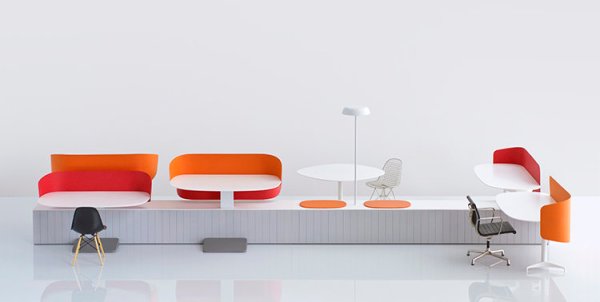
For his own take on the flexible office system, Hecht and his partner, Kim Colin, adopted a more nuanced approach to getting employees to think fondly of their office–and not view them as places of mandatory drudgery. Locale, for Herman Miller, uses modular pieces that easily adjust in place and height to create what Hecht calls neighborhoods.

more via 1 | Workstations Designed For Collaboration, Modeled On Friendly Neighborhoods | Co.Design: business + innovation + design.

I definitely agree that everyone has to buy in or the “playful” environment doesn’t truly exist. A space designated for “play” just becomes a dead zone at work if nobody wants to hang out there, or knows they’ll be scolded by fellow workers for disrupting work, or viewed as “lazy.”

I’m curious to hear more of why the Locale design would make people feel more neighborly. Thoughts? Ideas? Leave them in the comments below.

behavior · community · environment · work

Creative Leadership Grows in the Garden

English: Photo of Robert Hart's forest garden ...
English: Photo of Robert Hart’s forest garden by Graham Burnett (Photo credit: Wikipedia)

Great insight from Tim Brown of IDEO on how playing in the dirt can forge great leadership skills:

Over the years, I’ve given a lot of thought to what gardening, design, and creative leadership have in common.

Gardening is generative, iterative, and user-centered
When designers in our Chicago studio first planted a roof garden, they noticed people were picking and eating the strawberries and tomatoes and leaving the eggplants and tomatillos to rot on the vine. They soon realized that planting a work garden for 60 busy people is very different from planting a home garden for a family of four. Project deadlines simply took priority over cooking, so any plants that took extra steps to prepare were ignored. The next year, the designers planted a “Grab and Go Garden” that contained only fruits and vegetables that could be eaten straight away. This time, more plants were eaten, less were wasted. A good garden, like good design, needs to meet the needs of its users.

Full article:
http://www.linkedin.com/today/post/article/20130626172846-10842349-want-to-be-a-creative-leader-look-to-the-garden?trk=mp-details-rr-rmpost

autism · behavior · brain · children · learning · mental health · Nature · play · school

Outdoor Play Helps Improve Autistic Symptoms

Reposting this from a fantastic blog Free Range Kids, run by Lenore Skenazy, a huge advocate for letting children be children and just playing, especially outdoors:

Readers — In our desperation to create “smarter” kids, we have practically pinned them to their desks. Now educators are realizing this may be just the opposite of what is best for kids — including those with special needs, as Andrea Gordon writes in Toronto’s TheStar.com (a paper run by my favorite editor-in-chief from back when he and I were at the NY Daily News, Michael Cooke). – L.

It was a crisp March day outside Blaydon Public School when teachers discovered that 4-year-old Alex Wong could spell his name.There were no pencils or paper in sight. Everyone was bundled in winter jackets. Alex, who has autism, was in the outdoor classroom where his special-needs class played and explored for at least an hour every day, alongside 25 kids from the mainstream kindergarten class.

Teacher Sue Cooper noticed Alex march over to a pile of wood, put three sticks in a small wheelbarrow and push it to a spot on the pavement. One by one, he placed the sticks on the ground, forming the letter A. He made three more trips and came back with sticks to make three more letters, which he placed in a row: L, E and X.

Cooper’s jaw dropped. The teachers ran for a camera.

Alex is non-verbal and for a long time, his only interactions had been to throw things or hit. But in the fresh air, day after day, something started to change. Over several months Alex had watched the other children making structures. And that March morning, he was ready to take his turn.

The teachers say his is one example of how daily outdoor time is changing the way their young students — including those autism and other special needs — learn and behave.

Full post.

Obviously more research needs to be done, but there has been strong correlations drawn between outdoor time and decreasing of ADD and dementia symptoms, so it makes sense that putting humans in our natural surroundings would also help other mental disabilities and ailments.

There are a growing number of outdoor preschools, and I’d argue that there should be more outdoor elementary and even middle schools.

architecture · creativity · design · environment · health · work

LEED Gold Firm With a Picnic Green | Inc.com

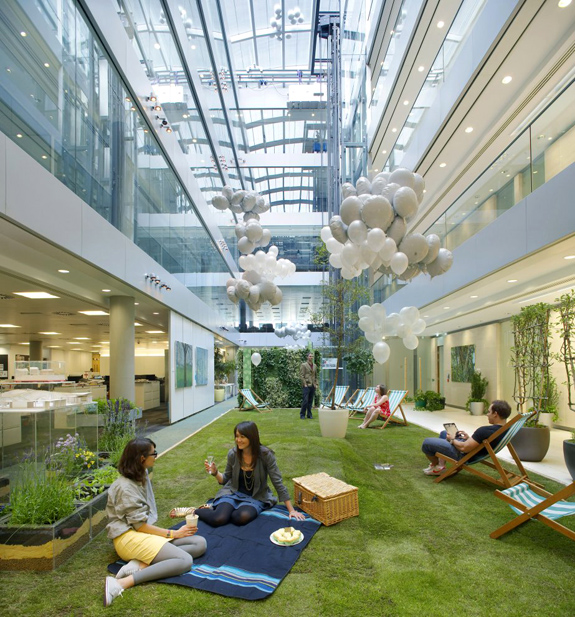
Bringing the great outdoors indoors for mental destressing, and maybe a little fun.

HOK’s London branch features a central patch of grass. But despite all the greenery, perhaps the greenest feature was its construction method and materials.

more via LEED Gold Firm With a Picnic Green | Inc.com.

anthropology · community · creativity · culture

Critical City Upload, Edgeryders create games for urban public spaces

Augusto Pirovano, in Milan, Italy with 2 other friends we made a project called Critical City Upload:

A game of urban transformation that uses a web platform and asks its players to perform creative missions. So far CCU is not very different from Edgeryders, the fact is that the missions are – instead of stories and reflections to write and share with others as it is on Edgeryders – creative actions that are generally performed in the public spaces of cities. The player picks the mission, shuts down the computer, gets out on the street, plays the mission, collects the necessary proof of his experience and then, after returning home, publishes the mission attaching photos and videos. As the player gets points, he levels up until he reaches level 7 and wins the Mechanical Box (a mysterious box that is delivered at his home).

Some examples of missions:

more via We create games for urban public spaces | Edgeryders.

architecture · community · creativity · design · environment · play

Dalston House: where every visitor becomes Spider-Man – video | Art and design | guardian.co.uk

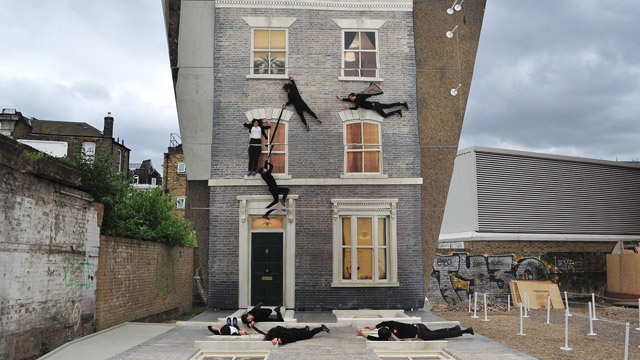
A Victorian terrace has popped up in east London that lets you swing from its ledges, run up its walls and generally defy gravity. Architecture critic Oliver Wainwright hangs loose at Dalston House, the novelty installation by Argentinian artist Leandro Erlich.

The artist talks about “enjoyable discovery” and playing with spaces that you might not otherwise think of.

I love how it is an interactive piece of art that only exists when people play with it.

more at Dalston House: where every visitor becomes Spider-Man – video | Art and design | guardian.co.uk.

architecture · community · creativity · culture · design

Teatro del Mare celebrates public space, community

A fun way to encourage public participation in space and creativity.

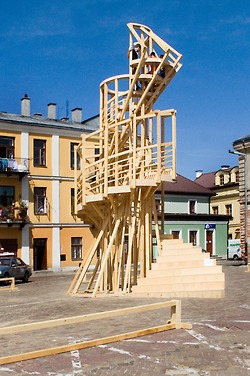
In order to celebrate its 10 years of activity, the artistic centre Lungomare in Bolzano Italy has recruited the ConstructLab/exyzt team composed by Alexander Römer, Gonzague Lacombe, Patrick Hubmann and Mattia Paco Rizzi. The result is the creation of Teatro del Mare, a wooden temporary structure, both a contemporary stage and street furniture, hosting a series of events, meetings and screenings until the end of June.

LIEU d’ÊTRE by the French Compagnie Acte is more than a performance. The project is an urban collective experience involving, both in the creation and the production of the event, professionals as well as inhabitants of a block of flats or of a whole neighbourhood. It uses the tool of dance to explore the pattern of the city.

more via In public space we trust.