community · creativity · design · education · Social

Public Art Project That Shares, Teaches Art

Another great story about public artwork and interactive public space. This time courtesy of Design*Sponge:

Mike Perry (who was part of Design by the Book four years ago) is launching a new project via Kickstarter called Wondering Around Wandering. It’s a three-month FREE community exhibition and event space where Mike will teach workshops and host screenings, discussions and more. The space will welcome artists and art appreciators alike and, because of the time span, would be a great way for visiting artists and design enthusiasts to learn and experience on a more intimate level.

Holiday Zine, one example of what you’d get as part of your support via Kickstarter

See the original story at Wondering About Wandering | Design*Sponge

Find out more at Wondering About Wandering | Kickstarter

community · creativity · design · environment · happiness · mental health · play

Remaking or “hacking” urban spaces

Great story from TreeHugger about self-proclaimed “Urban Hacktivist” Florian Riviere and some of the various “hacks” he’s done:

When it comes to redefining public space and objects, Florian Rivière is a master. The self-described “urban hacktivist” transforms parking spots into hockey rinks, sidewalk barriers into tables, and uncomfortable benches into lounge chairs for the homeless.

I absolutely agree with TreeHugger when they say:

I love it when people re-imagine how urban space is used; it’s a fantastic way to make cities more liveable, practical and fun, without needing major construction projects or the hassle of red tape.

Here are some of his best “hacktions.”

Visit Florian Riviere‘s site and see more of his work.

I particularly like these hurdles he’s set up:

parcourse

This is just one example of “hacking” public space in a fun creative way. I still remember the yarn-bombing movement that really took off a couple of years ago but seems to have died down for now.

There was also the Swing at the bus stop.

What other examples of urban “hacktivism” have you seen? Share them in the comments below.

community · creativity · Social

Walking to learn about your environment better

With gas prices going through the roof, many people are taking to walking more. But after being car-focused in our navigation for decades, it can be unusual for people to know how to get around by walking and how long it will take them. One student from Raleigh, North Carolina, has an idea:

On a rainy night in January, urban planning student Matt Tomasulo and two fellow schemers positioned 27 signs in three strategic locations across central Raleigh. In bold, authoritative letters, each sign indicates the number of minutes it would take for a pedestrian to reach a particular, popular destination.

And for the directionally challenged, the otherwise spartan signs are equipped with a high-tech surprise. By scanning the signs with a smartphone, pedestrians can receive a specially tailored Google Map that will keep them on the right path.

Tomasulo and his colleagues at City Fabric have dubbed their effort Walk Raleigh, and have submitted the project to the Spontaneous Interventions competition, a contest sponsored by the Institute for Urban Design. In terms of impressing judges, the group is off to a good start: far from being displeased by Tomasulo’s guerrilla antics, the city of Raleigh has expressed interest in permanently incorporating Walk Raleigh’s signs into the city’s landscape.

see more at A Walk to Remember.

I’m glad the city of Raleigh is encouraging this, and I hope it catches on in other places. I think it’s great to share our knowledge of neighborhoods with others and let them get to know their cities and environments a little bit better. Plus it’s just fun.

Have you seen similar signs in other cities? Tell me about it in the comments below.

architecture · children · community · design · play

UW professor and students help redesign International Children’s Park

A nice story about a redesign of a park in Seattle so children could actually, you know, play in it:

Located on the northeast corner of Seventh Avenue and South Lane streets in the Chinatown-International District, the park is small – about one-fifth of an acre — but in a key spot.

Vegetation had grown up around the periphery of the 30-year-old park, obscuring views and raising concerns about safety. There were few amenities for adults who bring kids to the park, and no accommodations for people with disabilities. A rock mound posed a hazard, and during the winter, the grass was often soggy.

Cultural and language differences were also part of the landscape, making decisions about the park complicated.

But renewal made sense because the neighborhood has seen increasing residential and commercial development, leading to  more active community places such as the Wing Luke Asian Museum and a branch of the Seattle Public Library.

To involve stakeholders young and old, Hou’s group, along with the city and several neighborhood groups, held an intergenerational design workshop in 2007.

“I think the most difficult challenge was to incorporate as much of the feedback we got from the community while still allowing the park to have a clear and concise design,” said student Patrick Keegan.

Engaging multiple generations of users was the most interesting part of the redesign, said Joyce Pisnanont, manager of IDEA Space, which promotes and develops the Chinatown­-International District. Desires were consistent across age groups, she said, and the adults “really wanted to ensure that the park was fun for kids to play in.”

The final design by landscape architect Karen Kiest includes an expanded children’s area with a play structure big enough for a dozen kids, a dragon sculpture restored by artist Gerard Tsutakawa, a stainless steel pagoda with seats for grown-ups and a three-level rockery that serves as both gathering space and a climbing area.

Public art by Stuart Nakamira includes a brushed stainless steel top the size of a typical 4-year-old.

In a Lane Street corner, pink viburnum are budding, surrounded by circles of black mondo grass.

See more images of the park:

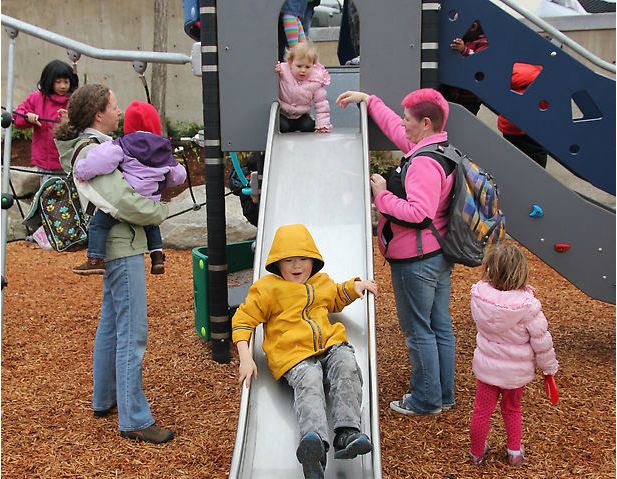
Kids play in the redesigned park.


architecture · behavior · culture · design · environment · happiness · Nature

Seattle has too many bleak public spaces | Crosscut.com

Seattle Skyline view from Queen Anne Hill.
View of Seattle's city skyline. In such a gorgeous part of the U.S., Seattle itself is lacking in pretty public spaces. Image via Wikipedia

In case y’all hadn’t noticed yet, I’m a huge proponent of utilizing public space for community use and creating an overall aesthetically pleasing environment for people. Cities have one of the greatest opportunities to provide that for their citizens. So I was thrilled when I read this article in Crosscut Magazine arguing the same thing, specifically for my hometown of Seattle.

Our landscape-oriented mindset should have been good preparation for what we need in the densifying city now, which is more design intelligence given to the open spaces between buildings — plazas, parklets, and awkward leftovers like the places under freeway overpasses. The more the air space around us becomes stuffed with architecture, the more acutely we need the relief of thoughtfully landscaped open spaces on the ground. Arguably, these spaces are more important in the built environment than most buildings because they’re public — people use them.

Or if they’re emotionally cold, dreary, or austere, people don’t use them, which is the case with a number of Seattle’s precious open spaces. On one of our desperately rare sunny spring days this month, I visited about a dozen open spaces in the dense city and found — no surprise — the bleak ones practically unused and the beautiful ones full of life. What is surprising is that we’re not demanding more graceful, humane, imaginative design — and raising hell over trends such as Seattle Parks and Rec’s inexplicable new fascination with concrete and gravel.

The article goes on to provide examples and suggest different fixes for a couple of spaces. More via Why does Seattle have so many bleak public spaces? | Crosscut.com.