community · culture · design · happiness

Ear Sculpture Listens To Citizen Complaints

Making space for listening and being heard…

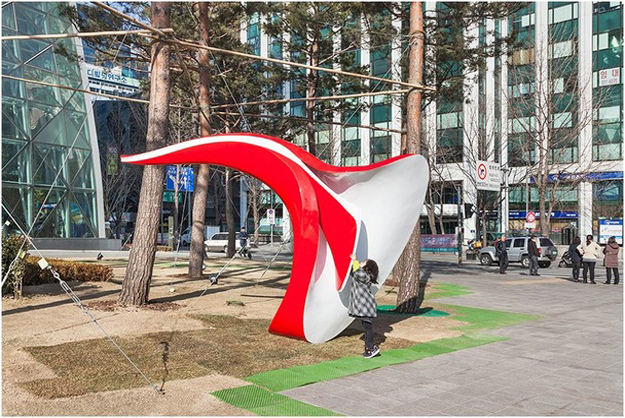
The normal procedure for submitting a complaint to the government is to write a letter, send an email, or make a long drawn-out phone call. In Seoul, South Korea, there’s an alternative – yelling into a giant sculpture shaped like an ear.

Designed by artist Yang Soo-in, and backed by the organization, Lifethings, the sculpture sits outside City Hall in Seoul. It symbolizes the fact that Mayor Park Won-soon and his administration are willing to listen to the people.Since it’s installation, Koreans have lined up to speak their woes or ideas for civic improvement into the impressively sized artificial ear.

more via Ear Sculpture Listens To Citizen Complaints [Pics] – PSFK.

anthropology · community · creativity · culture

Critical City Upload, Edgeryders create games for urban public spaces

Augusto Pirovano, in Milan, Italy with 2 other friends we made a project called Critical City Upload:

A game of urban transformation that uses a web platform and asks its players to perform creative missions. So far CCU is not very different from Edgeryders, the fact is that the missions are – instead of stories and reflections to write and share with others as it is on Edgeryders – creative actions that are generally performed in the public spaces of cities. The player picks the mission, shuts down the computer, gets out on the street, plays the mission, collects the necessary proof of his experience and then, after returning home, publishes the mission attaching photos and videos. As the player gets points, he levels up until he reaches level 7 and wins the Mechanical Box (a mysterious box that is delivered at his home).

Some examples of missions:

more via We create games for urban public spaces | Edgeryders.

architecture · community · creativity · culture · design

Teatro del Mare celebrates public space, community

A fun way to encourage public participation in space and creativity.

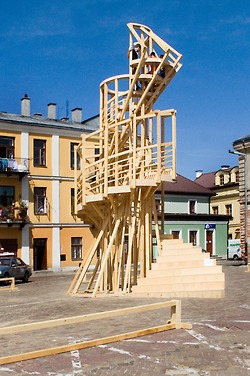
In order to celebrate its 10 years of activity, the artistic centre Lungomare in Bolzano Italy has recruited the ConstructLab/exyzt team composed by Alexander Römer, Gonzague Lacombe, Patrick Hubmann and Mattia Paco Rizzi. The result is the creation of Teatro del Mare, a wooden temporary structure, both a contemporary stage and street furniture, hosting a series of events, meetings and screenings until the end of June.

LIEU d’ÊTRE by the French Compagnie Acte is more than a performance. The project is an urban collective experience involving, both in the creation and the production of the event, professionals as well as inhabitants of a block of flats or of a whole neighbourhood. It uses the tool of dance to explore the pattern of the city.

more via In public space we trust.

architecture · children · community · creativity · design · health

Energy drink maker Red Bull proposes skate-able art investment for Myrtle Edwards Park


The Seattle City Government Parks & Recreation site recently hosted a public meeting to gather input on a proposed public art piece in Myrtle Edwards Park that will be used for skateboarding.

Energy drink maker Red Bull has approached Seattle Parks and Recreation about making a community investment that would include commissioning an artist to design and fabricate a unique piece of skate-able art. At the meeting, Seattle Parks presented the history of the proposed project, followed by an opportunity for the public to weigh in on the idea.

Myrtle Edwards Park is located at 3130 Alaskan Way on the shoreline of Elliott Bay, north of the Olympic Sculpture Park.

The Citywide Skatepark Plan, developed in 2006 and 2007 with extensive public process, designated Myrtle Edwards as a recommended site for a skatedot [editor: which is apparently smaller than a skatepark]. Since 2007, Seattle Parks and Recreation has constructed eight new skate parks and skatedots. Two more are in construction and design.

4Culture is administering the Call for Artists associated with this project. The artist will coordinate the design with Seattle Parks and Recreation.

A second follow-up meeting is planned in June.

I love the idea of creating public art that is actually usable, whether it’s by skaters, kids, or even animals. I understand that some art is best appreciated by not messing with it, but especially in a public space sometimes it’s hard to not want to interact with sculptures or murals. I also appreciate Red Bull’s focus on supporting play in all its forms, although private sponsorship of public spaces is always a touchy, tricky gray area.

Is there a public art piece, or artistic skatedot, fountain, whatever, that you really enjoy sitting on, playing on, or just watching others play? Let me know about it in the comments below.

community · creativity · environment · music

Want to support music? Support green space and parks!

OK, maybe that’s overstating it a bit, but that’s the headline/thesis that Grist Editor Jess Zimmerman proposes in his short article about Seattle rapper Macklemore, and I gotta admit I like his thinking…

In this video for the Nature Conservancy, rapper Macklemore explains how municipal green space in his home city of Seattle influenced his career: He and his friends didn’t want to kick it at their parents’ houses, so they went and freestyled in parks. (Side note: Do people really still say “kick it,” or is Macklemore even older than I am?) We knew, of course, that Macklemore was into creative reuse, but who knew he had so many ideas about urban infrastructure?

The moral here is clear: Want more rappers? Make more parks. It’s just science.

I also love the fact that a hip hop artist is “kicking it” with the Nature Conservancy.

Do you know of any other artists who got their start playing in parks, beaches, or other urban green spaces? Leave your thoughts in the comments below.

environment · Nature

Quantification of how urban green spaces deliver big happiness boost

There have been studies that have found a correlation between nature and calming, relaxation, and an ability to concentrate. But is this effect quantifiable? And how much of an impact is there?

A lot, according to a new study in Psychological Science. The researchers estimate that green urban areas provide a life satisfaction boost roughly equivalent to one-fifth to one-quarter of the increase associated with being married or having a job.

Several studies have suggested that people living near green spaces are less anxious and depressed. But these studies generally don’t account for the possible effects of personality. For example, perhaps more upbeat people tend to live in greener places.

To avoid that problem, the study authors analyzed survey data from more than 10,000 people in the UK over an 18-year period, noting changes in the participants’ well-being and health as they moved from place to place. That way, the researchers could compare happiness in the same person while living in a green and not-so-green area. The team also controlled for factors such as crime rates, income level, and the type of housing.

More at Conservation Magazine.

architecture · community

Landscapes Can Be Open-ended « The Dirt

University of Toronto
University of Toronto (Photo credit: Wikipedia)

An academic take on creating inviting, communal public spaces:

In Operative Landscapes: Building Communities Through Public Space, Alissa North, Assistant Professor in the Landscape Architecture Program at the University of Toronto, argues that the best contemporary landscape designs are concerned with more than just aesthetics. Instead of striving for fixed, static designs, the goals of these landscapes are “operational”: they aim to guide “the transformation of urban environments over time.” By moving away from fixed form, landscapes can be open-ended and non-prescriptive, changing in response to — but also influencing — the development of their communities.

continue reading Landscapes Can Be Open-ended « The Dirt.

community · creativity · design · environment · play · Social

Buses converted to portable public art spaces

After all the great stories about zoos adapting their spaces for their animals I’ve stumbled across recently, I was starting to feel a little sad for us humans. Thankfully, here’s another story I found from Inhabitat about re-purposing spaces for human play:

On the Plaza Luis Cabrera in Mexico City, two 1960’s Mitsubishi trolleybuses have been permanently parked for public use as part of a larger arts initiative in the Roma, Condesa and Hipodromo districts of Mexico City. The gutted and repurposed trolleys currently serve the city as vibrant spaces that engage residents and visitors in new art and cultural activities.

The vintage rides, which were donated to Mexico City by the government of Japan in the year 2000, were originally used to host the Galeria Trolebus initiative — a space used to showcase non-traditional art projects. Today the repurposed busses are public spaces for everyone to enjoy. On weekends and afternoons, visitors may stumble upon sculpture arts, free theater, music workshops, as well as concerts. The cultural activities on the trolleybuses even help to activate adjacent public parks, encouraging locals to take advantage of the ample and free space right before their eyes.

In order to keeps things dynamic, each month the buses on Plaza Luis Cabrera are re-painted in mural styles, with bright colors and bold prints by artists, community members and advertisers who volunteer their talents.

In brilliant fashion, the city has come up with a community-sustaining way to keep an outdated trolleybus model in style and out of the junkyard!

What a great reuse of an item, that is dynamic and allows the public to truly get creative together.
architecture · children · creativity · design · education · play

Modular play and building sets for all ages

I loved playing with Legos and building blocks as a kid (and actually still do); all the possibilities of what to build, and the ability to tear it all down and start over. Well here are two different ideas from Inhabitat about using that same concept of moveable, removable, and piece-meal design (in a good way):

First, a build-your-own park or patio area:

A green initiative called Softwalks has come up with a way to use existing scaffolding as support stations for fun and lively modular public spaces using their awesome little DIY kits that contain easy-to-build pieces such as a chair, a counter, and a green trellis. The components latch onto the metal beams to create simple impromptu hang-outs and rest stops for busy city dwellers, making the possibilities for sidewalk beautification endless.

The project’s greatest aspect is that anyone can get involved. The kit pieces are modular and lightweight, making them easy to install, take down, and reuse in new areas. The kits also create a public art activity, involving the community to brighten up their construction-heavy areas.
Walrus Toys’s Chimeras is a new line of plush toys that allows your little creative genius to build his [or her] own wacky stuffed animal critters with different interchangeable snap-in ears, arms, legs and wings each day as the mood strikes.
What if a bat really wants to have giant elephant ears to match its wings? You’ll end up with a Batephant! What if a bunny wanted to swing on tree branches, but needed the monkey’s long arms? You’ll have a Bunkey.
These are really adorable, and definitely a step up from Mr. Potato Head. I love how kids’ toys are moving away from the electronic “can only do one thing and LOUDLY” mentality and moving back to more creative play. Robotics toys and robotic dance competitions seemed to be a huge thing a couple of years ago, which is also very modular.
What other creative, modular ideas have you seen pop up lately, either as urban architecture, toys, or other arenas? Leave a note about it in the comments below. If we’re lucky, we’ll be able to make this a new series in the blog!
design · play

Abandoned park becomes interactive art installation

Thanks Inhabitat for featuring this great story about reclaiming unused public space and making it more playful:

Berlin’s Spreepark Planterwald amusement park, also called Kulturpark, has been abandoned since 2001, but this summer several curators took over the overgrown park and transformed it into a big, interactive art installation. The park reopened at the end of June, letting visitors tour the ruins and witness nature’s takeover of the Soviet-era amusement park. Inhabitat was on hand to check out the park and explore the art installations at the perimeter of the park.

For ambitious curators, Anthony SpinelloGeorge Scheer,  Stephanie Sherman and Agustina Woodgate (an Inhabitat favorite) were stationed at Kulturpark for the summer, organizing site-specific installations around the park, as well as artistic programming to engage the community once again with this abandoned place. With help from the curators, the fate of the park, which goes up for auction next year, may veer toward a place for public consumption, and hopefully create a place for the public to enjoy the grounds and non-profits to conduct cultural programming for the community.

+ Kulturpark

What unused spaces would you like to have seen turned into a public art space or public park? Leave your ideas in the comments below.