architecture · behavior · community · creativity · environment · happiness · health · play · Social

Adults for playgrounds? Yes, please!

Playground
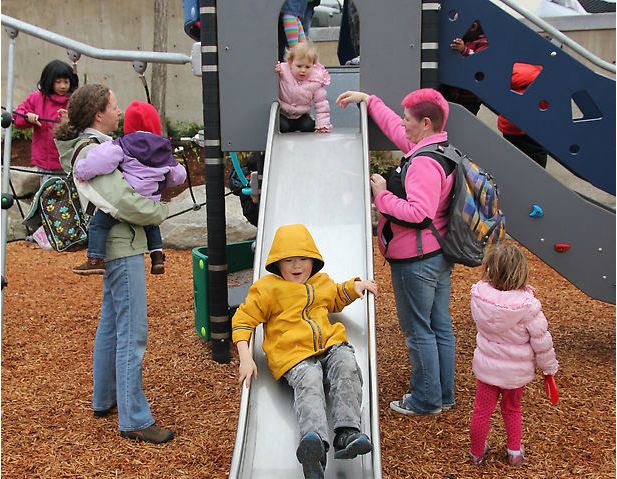
Grown-ups often need a little more persuasion to play than kids. (Photo credit: phalinn)

Earlier this week I brought up the importance of spaces for play in the city, and then yesterday mentioned a scientific study that used traceurs or people who practice parkour, a sport that basically makes any space into a play space. Unfortunately park playgrounds are often verboten to grown-ups without a kid companion. But often grown-ups like the play equipment, or similar play equipment, as much as kids do. Now, the cities of New York and Detroit are determining where and whether to put in playgrounds specifically for adults:

New York City is installing adult playgrounds for fitness-hungry grown-ups, touting the benefits of a grade-school workout. …the Big Apple parks are geared more toward workouts than whiling away the summer hours. There aren’t any slides or swings yet at these outdoor gyms.

The City of New York built its first adult playground in the Bronx’s Macomb Dam Park. The New York Times reports as many as 24 playplaces for grown-up kids could be installed by 2014.

In Europe, where playtime seems to be more a more capricious venture, adult playgrounds tempt grown-ups to get off the couch with detailed outdoor mazes, rock climbing walls, elephant slides and swimming canals.

Philip Lauri is the founder of Detroit Lives!, the media company with the mission of bringing creativity to the streets of Detroit (through an apparel line, murals and the “After The Factory” documentary). Detroit Lives! has recently started experimenting with making places in the city that inspire that same joie de vivre and fun — like the Georgia Street Community Collective’s remote-control racetrack for kids living in the nonprofit’s target neighborhood. He thinks adult playgrounds could be smart additions to neighborhoods who have already installed thriving community gardens.

“In those areas, we install an adult playground as an addendum to that successful effort, and use the kind of neighborhood engagement that the garden created to successfully initiate the adult playground,” Lauri wrote. “Then, both sites grow with participation and we get healthier people and neighborhoods. That’s a simplified progression, but still tangible enough to act upon quite quickly.”

Most people taking the Huffington Post poll are all for adult playgrounds.

In some ways I find it sad that we need to create playgrounds specifically for grown-ups. Don’t we teach our kids to share and cooperate? But, in many ways it makes sense: for one thing, adults are bigger and therefore need different sized equipment. They also tend to play rougher, more competitively, and less cooperatively than children (according to numerous studies I’ll find and source later), so keeping the two play groups separated is probably a safer idea. Finally, grown-ups also need to be given explicit permission to goof off, at least much more so than kids, so giving them a space devoted entirely to play will help them get creative and playful in their movement.

What kind of equipment would you want on an adult playground? Rope swings? Fireman’s pole? Leave your thoughts in the comments below?

anthropology · architecture · behavior · community · creativity · culture · design · education · learning · play

More projects on Play and the City

TED (conference)

I posted last week about Jason Sweeney and his TED City2.0 plan to map out quiet spaces in cities.

After doing some more poking around I found some other great projects all grouped under “Play in the City.”

First, I commend TED and the participants of this project for recognizing the need for play in all environments and for all ages.

Second, they have some really cool ideas to check out:

Bruno Ruganzu, 10k prize winner and the first TED Prize recipient of 2012 in Doha, Qatar at the TEDxSummit


All of these great ideas and more are captured on the Play theme page of the TED City2.0 project.

I think people often think of play as done out in the woods or on playgrounds, and often forget that cities can contain all the resources needed for play. Just look at parkour or buildering or urban mountain biking, or even yarn bombing. That said, it is absolutely crucial to allow people to play in cities and to create spaces dedicated entirely to play, as much for grown-ups as for kids.

What other projects promoting play in the city are you aware of? Let me know in the comments below.

anthropology · architecture · children · creativity · design · environment · health · Social · technology

6 Future Playgrounds That Harness Kids’ Energy While They Play | Co.Exist

What a great series from Co.Exist and Fast Company: play grounds, and other structures, that harness the energy of people’s movement. This may be the first time employees are actively encouraged to move around all day. 🙂

Kids have boundless energy. What if that energy could be put to some use besides just running around and having a good time. These new jungle gyms convert play to power.

When IBM came up with a list in 2011 of the five technologies it thinks will change the world in five years, kinetic energy–power from people–topped the list. Advancements could come, they say, from developments in devices that might harvest power from your shoes, your exercise, and even the soccer ball you kick. Green gyms are also cropping up. And now the idea has come to playgrounds, where kids’ movement can be harnessed and funneled into powering schools and toys.

Natural Energy Park
Natural Energy Park

This playground–designed by Hyundai engineering and construction–is part jungle gym and part renewable energy science experiment. After climbing a ladder into a laboratory, kids can spin a wheel that will illuminate “Benjamin Franklin’s kite.” An optical illusion will spin at varying speeds as children adjust a solar panel to different angles. Pedaling a bicycle powers a pinwheel and illuminates lights around the structure. Hyundai calls this the “Natural Energy Park” and it looks like a lot of fun.

Empower Playground
Empower Playground

Mixing fun and helping people, Empower Playgrounds is a non-profit organization that provides electricity-generating

playground equipment to villages in Ghana that are too remote to be on their nation’s electricity grid. The school children gain a playground as well as safe, rechargeable LED lanterns to light their homes so they can do their homework. Additionally, the play equipment doubles as part of a hands-on science lab that brings science concepts into their daily lives

See the whole series here.

For more on the future of playgrounds, check out 8 insane playgrounds, schools, and libraries of the future.

Know of other playful energy producers? Let us know in the comments below!

architecture · autism · behavior · brain · design · environment · happiness · mental health · play

Researcher Designs Schoolyard for Children with Autism

Every kid can get overwhelmed playing on the playground. But imagine that for you, or your child, it happens way, way too easily.

Play is usually beneficial, not just for exercise and fun but for learning and therapy. So it’s interesting to see how people are using play, and playgrounds, to help kids who can often get overwhelmed in normal play situations.

A Kansas State University graduate student is creating a schoolyard that can become a therapeutic landscape for children with autism.

Chelsey King, master’s student in landscape architecture, St. Peters, Mo., is working with Katie Kingery-Page, assistant professor of landscape architecture, to envision a place where elementary school children with autism could feel comfortable and included.

“My main goal was to provide different opportunities for children with autism to be able to interact in their environment without being segregated from the rest of the school,” King said. “I didn’t want that separation to occur.”

The schoolyard can be an inviting place for children with autism, King said, if it provides several aspects: clear boundaries, a variety of activities and activity level spaces, places where the child can go when overstimulated, opportunities for a variety of sensory input without being overwhelming and a variety of ways to foster communication between peers.

“The biggest issue with traditional schoolyards is that they are completely open but also busy and crowded in specific areas,” King said. “This can be too overstimulating for a person with autism.”

King researched ways that she could create an environment where children with autism would be able to interact with their surroundings and their peers, but where they could also get away from overstimulation until they felt more comfortable and could re-enter the activities.

More at http://www.autism-society.org/news/a-place-to-play-researcher.html.

For so long playgrounds have been designed to be “safe,” but now they’re being designed and adapted to be “inclusive” to kids with all sorts of limitations, which I think is a much better focus, especially since it reintroduces play equipment like…wait for it…dirt! Or more specifically, gardens:

King designed her schoolyard with both traditional aspects — such as a central play area — and additional elements that would appeal to children with autism, including:

  • A music garden where children can play with outdoor musical instruments to help with sensory aspects.
  • An edible garden/greenhouse that allows hands-on interaction with nature and opportunities for horticulture therapy.
  • A sensory playground, which uses different panels to help children build tolerances to difference sensory stimulation.
  • A butterfly garden to encourage nature-oriented learning in a quiet place.
  • A variety of alcoves, which provide children with a place to get away when they feel overwhelmed and want to regain control.

Unfortunately there are currently no plans to actually build this playground, since these sensory elements are beneficial to all kids (and grown-ups). Where do you see this kind of design being the most welcome? In schools, city parks? Leave your thoughts in the comments below.

anthropology · children · community · creativity · design · environment · learning · Nature · play

Kids’ playground goes back to nature – Edmonton Journal

I love the fact that playgrounds are incorporating the stuff that kids love to play with the most – dirt, rocks, and sticks!

Children won’t find new monkey bars and bright plastic play structures at the upgraded Donnan Park.

Instead, the aging playground at 9105 80th Ave. will become Edmonton’s first “natural playground,” part of a growing trend in playground design.

Children in the redesigned Donnan Park will entertain themselves with such timehonoured playthings as rocks, sticks, sand and dirt. The overhauled space will feature a slide built into a hill, a sideways-growing tree, a boulder spiral, a hand pump to pour water into a small stream and plenty of plants, trees and greenery.

It will be “a beautiful garden that everyone plays in,” says Kory Baker-Henderson, co-chair of the neighbourhood committee that worked on the preliminary playground design with expertise from Ontario-based Bienenstock Natural Playgrounds.

“Around us there are already some typical playground structures, so we wanted to have something different that blends in with the (Mill Creek) ravine,” Baker-Henderson says.

“Studies have shown imaginative play is much more stimulated (in natural settings) and children actually will play longer and become much more involved than on a typical red, plastic slide structure. Their games will just get much more imaginative. There’s that connection with nature. We have plans for a community garden, so it’s a learning and teaching tool, too.”

The playground at Donnan Park currently has swings and a slide that will remain for now, but won’t be replaced, she says.

Read the full article.

architecture · behavior · community · environment · Nature · play

Exploring some of London’s most playful spaces and places

Interesting exploration of the playful spaces around London:

an example of a playground toured in London last fall.

I’m still buzzing after last weekend’s Open House play space tours. Why?

Simple: I saw some inspirational work, and had some immensely rewarding conversations.

We took a meandering and surprisingly green route across most of the NDC area to Radnor Street Gardens.
This is one of London’s best examples of a ‘playable space’ – in other
words, a space where offering opportunities for play is only one of the
jobs that has to be done. My work for the GLA
[pdf link] helped to embed this idea in London’s planning system. In my
view, it is fundamental to the success of public play facilities in
almost any urban area.

What struck me was how the programme combined park, amenity space and
play projects, along with streetscape and highways initiatives, so that
the whole far exceeded the sum of its parts. The ingredients we saw
included [*deep breath*]: new play spaces and toilet blocks in parks and
estates, new public squares from reclaimed street space and car parks, ‘home zone’-style
shared road surfaces, landscaped road closures, greening up an
adventure playground, estate-based allotment projects, cycle lanes,
shared use ball game areas, pushchair-friendly pavements, even (on one
estate) new refuse bin sheds with green roofs. Her approach to
engagement was revealing. Local people were closely involved at all
levels, right up to the NDC board. However, they were seen not simply as
‘stakeholders’ or ‘consumers’, but as people who needed to be inspired,
debated with, and (hopefully) won over.

Read more of Exploring some of London’s most playful spaces and places.

I think this is a great idea; just as we have garden tours, we should have playground tours! Areas that introduce parents and officials alike to playful, fun spaces to take their kids.

This blog actually has some great conversations about play and the need for children to get outside and play more.

via Exploring some of London’s most playful spaces and places.

architecture · children · community · design · play

UW professor and students help redesign International Children’s Park

A nice story about a redesign of a park in Seattle so children could actually, you know, play in it:

Located on the northeast corner of Seventh Avenue and South Lane streets in the Chinatown-International District, the park is small – about one-fifth of an acre — but in a key spot.

Vegetation had grown up around the periphery of the 30-year-old park, obscuring views and raising concerns about safety. There were few amenities for adults who bring kids to the park, and no accommodations for people with disabilities. A rock mound posed a hazard, and during the winter, the grass was often soggy.

Cultural and language differences were also part of the landscape, making decisions about the park complicated.

But renewal made sense because the neighborhood has seen increasing residential and commercial development, leading to  more active community places such as the Wing Luke Asian Museum and a branch of the Seattle Public Library.

To involve stakeholders young and old, Hou’s group, along with the city and several neighborhood groups, held an intergenerational design workshop in 2007.

“I think the most difficult challenge was to incorporate as much of the feedback we got from the community while still allowing the park to have a clear and concise design,” said student Patrick Keegan.

Engaging multiple generations of users was the most interesting part of the redesign, said Joyce Pisnanont, manager of IDEA Space, which promotes and develops the Chinatown­-International District. Desires were consistent across age groups, she said, and the adults “really wanted to ensure that the park was fun for kids to play in.”

The final design by landscape architect Karen Kiest includes an expanded children’s area with a play structure big enough for a dozen kids, a dragon sculpture restored by artist Gerard Tsutakawa, a stainless steel pagoda with seats for grown-ups and a three-level rockery that serves as both gathering space and a climbing area.

Public art by Stuart Nakamira includes a brushed stainless steel top the size of a typical 4-year-old.

In a Lane Street corner, pink viburnum are budding, surrounded by circles of black mondo grass.

See more images of the park:

Kids play in the redesigned park.


architecture · children · creativity · design · play

Playground Crochet by Toshiko Horiuchi

This is from last November, but still amazing!

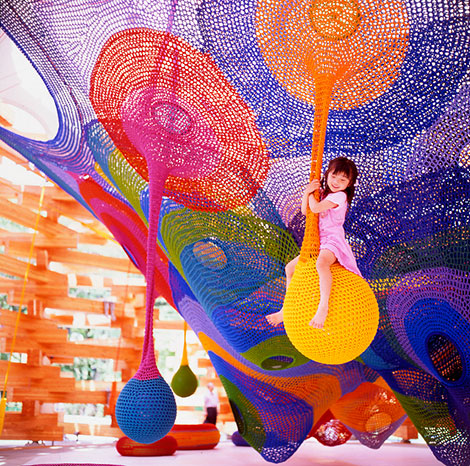
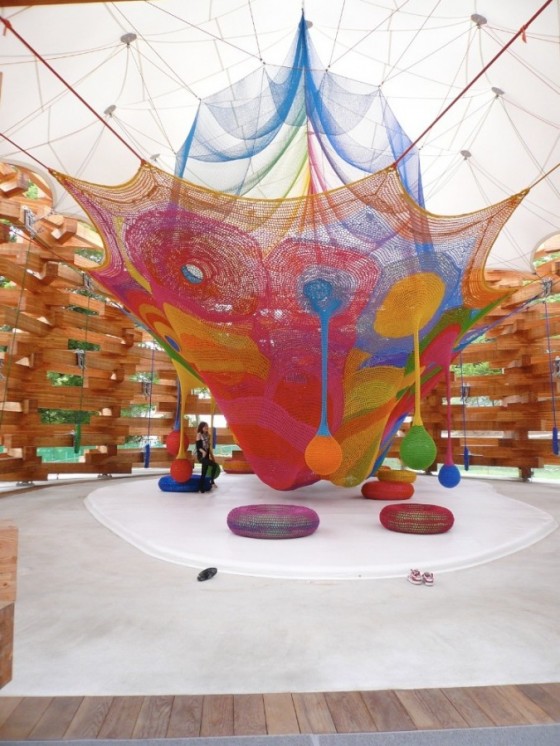
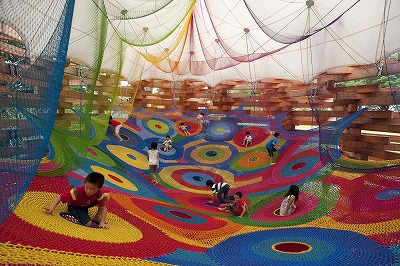
Toshiko Horiuchi MacAdam, who orders yarn by the ton for her creations, is the textile artist behind the oft photographed net constructions at the Hakone sculpture park in Sapporo Japan.

I love the story of how she came to be engaged with children’s play:  “It all happened quite by accident. Two children had entered the gallery where she was exhibiting ‘Multiple Hammock No. 1’ and, blissfully unaware of the usual polite protocols that govern the display of fine art, asked to use it. She watched nervously as they climbed into the structure, but then was thrilled to find that the work suddenly came alive in ways she had never really anticipated. She noticed that the fabric took on new life – swinging and stretching with the weight of the small bodies, forming pouches and other unexpected transformations, and above all there were the sounds of the undisguised delight of children exploring a new play space.”

From that point, her work shifted out of the gallery and a subdued, monochromatic pallet into a riotous rainbow of colors for children’s playscapes.

Rainbow Net was produced in close collaboration with structural engineers TIS & Partners and landscape architects Takano Landscape Planning and opened in July of 2000 after three years of planning, testing, and building.

Note that the project began with a brief not for a playground, but simply for ‘public art‘.   Wouldn’t it be great if when we heard ‘public art’ we automatically thought ‘play’?

But innovative playscapes require an enormous commitment: “…endless cycles of discussion and approval, with meticulous attention to detail…[including] an actual scale wooden replica of the space in Horiuchi’s studio and accurately scaled crocheted nets using fine cotton thread. Even then, it was difficult to assess many things. What difference, for instance, would the weight of the real yarn make when everything increased in scale? All of these factors had to be calculated in order to arrive at a scientific methodology that could eradicate any risk of unacceptable danger.”During final assembly, Toshiko crocheted ten hours a day, often on her knees, until the installation was complete.”

With the current revival of the textile arts and yarn bombings everywhere, I’d love to see more crochet on the playground!

More at: Playground Crochet by Toshiko Horiuchi.

What an amazing use of fabric to create an original, creative play space.

children · education · happiness · health · learning · play

Play is a crucial part of learning

Great article from The Atlantic about how squeezing recess and playtime out of education is a really bad idea:

Play is important for the emotional, social, cognitive, and physical development of children. In addition to being critical for general health and a preventative against overweight, play develops life skills for children and communication skills among peers and family members.

But because of over-scheduling, over-supervision, lack of appropriate play environments, and too many entertaining screens many children have less access to play time and play spaces than children in the past.

Children living in poverty experience these barriers and more, according to a recent clinical report from the American Academy of Pediatrics. Underprivileged children often have less access to recess and school-based creative arts, music, and physical education programs. Additionally, the socioeconomic stressors on poor families often conspire against parents having the time, energy, or skills to engage in play with their children.

Poor children’s access to outdoor play spaces may be compromised by the safety of their neighborhoods and the decrease in parks and open spaces in urban areas. Children who are unable to play outside tend to spend more time on screen-based activities such as watching TV or playing video games. Excessive screen time takes a huge toll on mental and physical health and academic achievement

Many urban schools have replaced recess and purely recreational after-school activities with academic enrichment activities to help close the academic achievement gaps between lower-income children and their more privileged peers. While improved academics is an important goal, the report emphasizes that the developmental role of play should not be forgotten and the benefits of play should not be traded off in favor of academics.

According to the report, play’s benefits extend to psychological well-being. Play provides an opportunity for a student to shine in areas that are not strictly academic and thus contributes to the child’s personal sense of pride and belonging in her school environment. This has the potential to discourage truancy and encourage children to remain in school to complete their education

Twenty-eight percent of schools with children in the highest poverty levels have no recess at all. This impacts a population of children who already have limited opportunities for creative experiences and social play, especially since research that has shown that physical education periods and recess enhance a child’s readiness for academic pursuits during the school day. They suggest that the elimination of these pace-changing opportunities may in fact be counterproductive for academic success.

More at Recreational Play Can Be Far More Important Than Academics

architecture · children · creativity · design · play

Playground designs curated on Flickr

One job that has always sounded super fun is playground designer. Playgrounds can be fun, exciting, inspiring places, full of color, creative design, and above all inspire play.  Some of the different playground designs from around Sweden got the spotlight recently on Flickr.

[Last week], @megrosker shared a link to Swedish Aesthetic, a gallery featuring colorful and very creative Swedish playground designs and play structures… be sure to visit the gallery for all photos curated by PlayGroundology.

view the gallery via Swedish playground design « Flickr Blog. PlayGroundology’s photostream includes photos from Canada and other adventures around the world.

Flickr has quite a few different playground designs scattered throughout the Flickrverse:


I even got so inspired I started my own Playground gallery on Flickr. Check it out, and if you have any photos you’d like to contribute, let me know.