architecture · behavior · community · environment · Nature · play

Exploring some of London’s most playful spaces and places

Interesting exploration of the playful spaces around London:

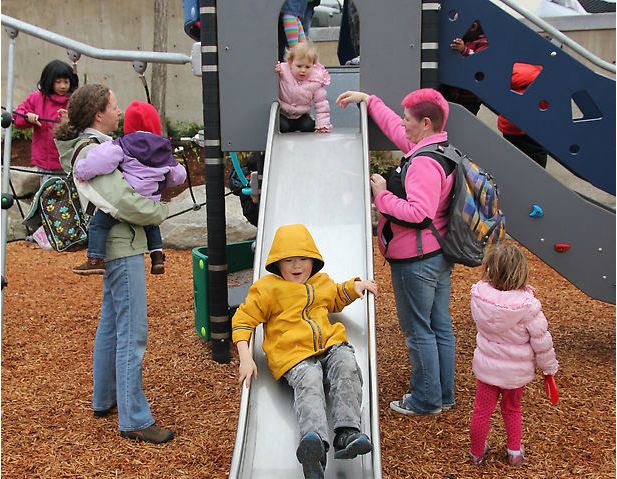
an example of a playground toured in London last fall.

I’m still buzzing after last weekend’s Open House play space tours. Why?

Simple: I saw some inspirational work, and had some immensely rewarding conversations.

We took a meandering and surprisingly green route across most of the NDC area to Radnor Street Gardens.
This is one of London’s best examples of a ‘playable space’ – in other
words, a space where offering opportunities for play is only one of the
jobs that has to be done. My work for the GLA
[pdf link] helped to embed this idea in London’s planning system. In my
view, it is fundamental to the success of public play facilities in
almost any urban area.

What struck me was how the programme combined park, amenity space and
play projects, along with streetscape and highways initiatives, so that
the whole far exceeded the sum of its parts. The ingredients we saw
included [*deep breath*]: new play spaces and toilet blocks in parks and
estates, new public squares from reclaimed street space and car parks, ‘home zone’-style
shared road surfaces, landscaped road closures, greening up an
adventure playground, estate-based allotment projects, cycle lanes,
shared use ball game areas, pushchair-friendly pavements, even (on one
estate) new refuse bin sheds with green roofs. Her approach to
engagement was revealing. Local people were closely involved at all
levels, right up to the NDC board. However, they were seen not simply as
‘stakeholders’ or ‘consumers’, but as people who needed to be inspired,
debated with, and (hopefully) won over.

Read more of Exploring some of London’s most playful spaces and places.

I think this is a great idea; just as we have garden tours, we should have playground tours! Areas that introduce parents and officials alike to playful, fun spaces to take their kids.

This blog actually has some great conversations about play and the need for children to get outside and play more.

via Exploring some of London’s most playful spaces and places.

architecture · children · community · design · play

UW professor and students help redesign International Children’s Park

A nice story about a redesign of a park in Seattle so children could actually, you know, play in it:

Located on the northeast corner of Seventh Avenue and South Lane streets in the Chinatown-International District, the park is small – about one-fifth of an acre — but in a key spot.

Vegetation had grown up around the periphery of the 30-year-old park, obscuring views and raising concerns about safety. There were few amenities for adults who bring kids to the park, and no accommodations for people with disabilities. A rock mound posed a hazard, and during the winter, the grass was often soggy.

Cultural and language differences were also part of the landscape, making decisions about the park complicated.

But renewal made sense because the neighborhood has seen increasing residential and commercial development, leading to  more active community places such as the Wing Luke Asian Museum and a branch of the Seattle Public Library.

To involve stakeholders young and old, Hou’s group, along with the city and several neighborhood groups, held an intergenerational design workshop in 2007.

“I think the most difficult challenge was to incorporate as much of the feedback we got from the community while still allowing the park to have a clear and concise design,” said student Patrick Keegan.

Engaging multiple generations of users was the most interesting part of the redesign, said Joyce Pisnanont, manager of IDEA Space, which promotes and develops the Chinatown­-International District. Desires were consistent across age groups, she said, and the adults “really wanted to ensure that the park was fun for kids to play in.”

The final design by landscape architect Karen Kiest includes an expanded children’s area with a play structure big enough for a dozen kids, a dragon sculpture restored by artist Gerard Tsutakawa, a stainless steel pagoda with seats for grown-ups and a three-level rockery that serves as both gathering space and a climbing area.

Public art by Stuart Nakamira includes a brushed stainless steel top the size of a typical 4-year-old.

In a Lane Street corner, pink viburnum are budding, surrounded by circles of black mondo grass.

See more images of the park:

Kids play in the redesigned park.


behavior · brain · children · culture · education · learning · mental health · play · technology

Toddlers to tweens: relearning how to play

Español: Guiliana moreno Jugando en bogota
Free play is finally getting the recognition it deserves. Image via Wikipedia

Great article from the Christian Science Monitor about the value of play:

In recent years, child development experts, parents, and scientists have been sounding an increasingly urgent alarm about the decreasing amount of time that children – and adults, for that matter – spend playing. A combination of social forces, from a No Child Left Behind focus on test scores to the push for children to get ahead with programmed extracurricular activities, leaves less time for the roughhousing, fantasizing, and pretend worlds advocates say are crucial for development.

Meanwhile, technology and a wide-scale change in toys have shifted what happens when children do engage in leisure activity, in a way many experts say undermines long-term emotional and intellectual abilities. An 8-year-old today, for instance, is more likely to be playing with a toy that has a computer chip, or attending a tightly supervised soccer practice, than making up an imaginary game with friends in the backyard or street.

But play is making a comeback. Bolstered by a growing body of scientific research detailing the cognitive benefits of different types of play, parents such as Taylor are pressuring school administrations to bring back recess and are fighting against a trend to move standardized testing and increased academic instruction to kindergarten.

more at: Toddlers to tweens: relearning how to play.

architecture · children · creativity · design · play

Playground Crochet by Toshiko Horiuchi

This is from last November, but still amazing!

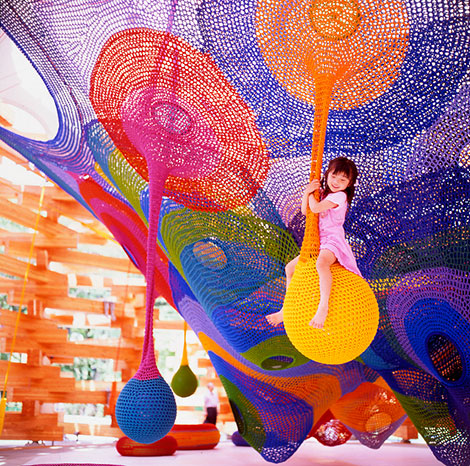
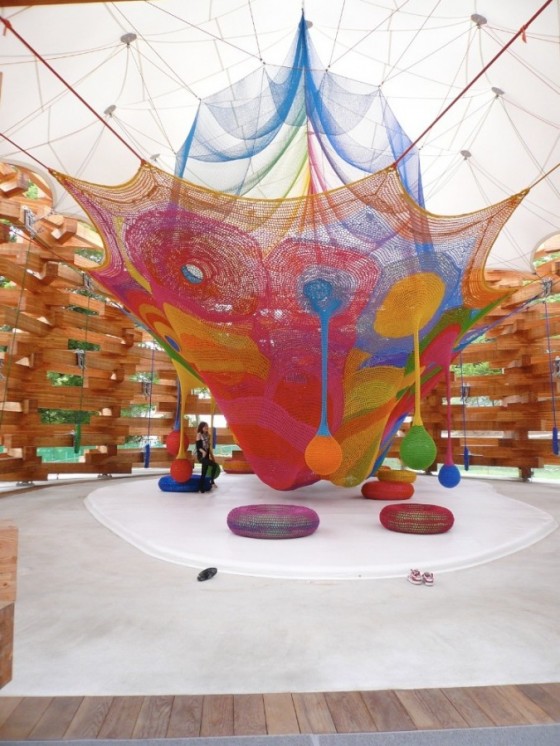
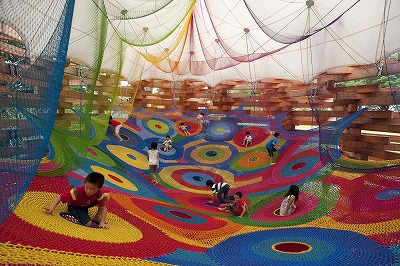
Toshiko Horiuchi MacAdam, who orders yarn by the ton for her creations, is the textile artist behind the oft photographed net constructions at the Hakone sculpture park in Sapporo Japan.

I love the story of how she came to be engaged with children’s play:  “It all happened quite by accident. Two children had entered the gallery where she was exhibiting ‘Multiple Hammock No. 1’ and, blissfully unaware of the usual polite protocols that govern the display of fine art, asked to use it. She watched nervously as they climbed into the structure, but then was thrilled to find that the work suddenly came alive in ways she had never really anticipated. She noticed that the fabric took on new life – swinging and stretching with the weight of the small bodies, forming pouches and other unexpected transformations, and above all there were the sounds of the undisguised delight of children exploring a new play space.”

From that point, her work shifted out of the gallery and a subdued, monochromatic pallet into a riotous rainbow of colors for children’s playscapes.

Rainbow Net was produced in close collaboration with structural engineers TIS & Partners and landscape architects Takano Landscape Planning and opened in July of 2000 after three years of planning, testing, and building.

Note that the project began with a brief not for a playground, but simply for ‘public art‘.   Wouldn’t it be great if when we heard ‘public art’ we automatically thought ‘play’?

But innovative playscapes require an enormous commitment: “…endless cycles of discussion and approval, with meticulous attention to detail…[including] an actual scale wooden replica of the space in Horiuchi’s studio and accurately scaled crocheted nets using fine cotton thread. Even then, it was difficult to assess many things. What difference, for instance, would the weight of the real yarn make when everything increased in scale? All of these factors had to be calculated in order to arrive at a scientific methodology that could eradicate any risk of unacceptable danger.”During final assembly, Toshiko crocheted ten hours a day, often on her knees, until the installation was complete.”

With the current revival of the textile arts and yarn bombings everywhere, I’d love to see more crochet on the playground!

More at: Playground Crochet by Toshiko Horiuchi.

What an amazing use of fabric to create an original, creative play space.

creativity · youtube

Superbowl ad actually encourages us to exercise (sorta)

Superbowl Sunday is almost upon us, and the Superbowl ads are already being released. Volkswagen has released an ad that features a dog getting in shape for his sport. While it’s obviously meant in jest, in some ways it’s great because it arguably sends the message that anyone can train for their personal goals, whether it’s chasing cars (and vaulting through trees), fitting through the doggie door, or whatever.
What are your goals? I’m participating in a 5k on Saturday, but what physical movement and enrichment do you hope to accomplish over the weekend?

behavior · education · happiness · health · Social

Non-Elimination Games Leads to More Physically Active Children, Researchers Say | MomsTeam

A typical game of tic tac toe English: Tic tac...
Non-competitive games also have benefits. Image via Wikipedia

Interesting article about the value of non-elimination games (the original author focused on “non-competitive” but there are many competitive games that don’t involve elimination):

A study presented in May 2008 established that the structuring of children’s games has a significant effect on energy expenditure.

A research team led by Karla Bruggeman and David Dzewaltowski, Ph.D., measured activity during both elimination- and non-elimination games, using accelerometers, in 29 children in grades four through six. Both normal weight and overweight children participated in the study, but were not separated for analysis.

In non-elimination games, kids accrued more overall physical activity due to not having to spend time on the sidelines as a result of elimination. They also accumulated significantly more moderate and vigorous physical activity than elimination games. Both sets of games were adopted from a children’s program devised by a nonprofit group that uses various pieces of equipment to facilitate non-competitive play; elimination games were modified from non-competitive versions.

Children were surveyed for self-efficacy, enjoyment, and peer victimization following both types of games. Results showed that enjoyment was somewhat higher following elimination games, although enjoyment scores were high in non-elimination games as well. There were no reports of peer victimization in either set of games, but were significant increases in self-efficacy after both sets.

“The games in this study were part of fun and enjoyable day camp,” Bruggeman said. “It is likely that a well organized and positive game experience increases a kid’s confidence regardless of elimination or non-elimination game conditions.”

Again, the article author was focusing on non-competitive sports, but really the evidence is looking at non-elimination sports. While I don’t find anything wrong with competitive sports, I know they’re not everybody’s cup of tea, and I think it’s great to emphasize the fact that you don’t need to be playing on a team sport or competing against others in order to gain the same benefits from play. And there are lots of non-competitive physical activities that kids can and do partake in: parkour, running, climbing, digging in the dirt, parachute play, biking… what else? Name your favorite non-competitive physical activity in the comments.
children · creativity · design · education · learning · Nature

Toys in space!

Toys are not only great for thinking outside the box with, they’re also great for thinking outside of our world! Two Canadian students recently sent a Lego man out to the edge of space:

Matthew Ho and Asad Muhammad used a weather balloon to carry a camera and a toy lego man high above the clouds.

(source: BBC News)

What the video here:

Image

behavior · youtube

Cute play fix: baby otter playing

Happy Thursday! To get you over the “week’s almost over” hump, here is an adorable baby otter doing what otters, and young critters in general, do best: play!

I like the playful human/otter interactions as well.

creativity · play

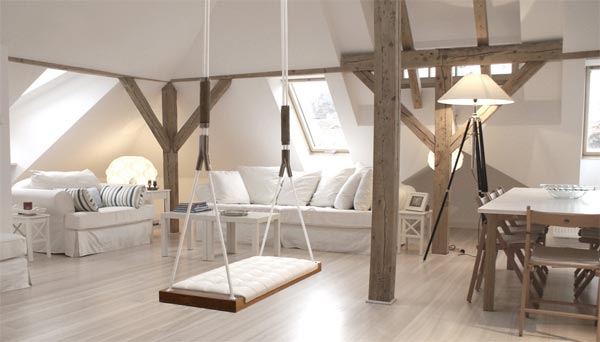
Swings for the home

This is so cool! Swings that you can install in your own home, designed specifically for grown-ups! Brought to you by Svvving.

more at Swings for the home: 2modern.

I love the idea that a company makes swings for grown-ups to use indoors. Introducing play into your space is important, and for this company profitable. 🙂

behavior · brain · mental health · neuroscience · play · psychology

Playing leads to lower Alzheimer’s risk

English: PET scan of a human brain with Alzhei...
Brain with Alzheimer's. Image via Wikipedia

From USA Today:

People who engage in activities such as reading and playing games throughout their lives may be lowering levels of a protein in their brains that is linked to Alzheimer’s disease, a new study suggests.

Although whether the buildup of the protein, beta amyloid, causes Alzheimer’s disease is debatable, it is a hallmark of the condition, the researchers noted.

“Staying cognitively active over the lifetime may reduce the risk of Alzheimer’s by preventing the accumulation of Alzheimer’s-related pathology,” said study author Susan Landau, a research scientist at the Helen Wills Neuroscience Institute at the University of California, Berkeley.

“Some of the literature has hypothesized this finding, but this is the first study to report that lifetime cognitive activity is directly linked to amyloid deposition in the brain,” she said. “We think that cognitive activity is probably one of a variety of lifestyle practices — occupational, recreational and social activities — that may be important.”

Read more at Keeping brain sharp, active may ward off Alzheimer’s

There have been several different studies that find the correlation between play and a healthy brain less susceptible to dementia, disease, and overall decay. Literally use it or lose it. So you might as well have fun using it!