anthropology · architecture · behavior · community · creativity · culture · design · education · learning · play

More projects on Play and the City

TED (conference)

I posted last week about Jason Sweeney and his TED City2.0 plan to map out quiet spaces in cities.

After doing some more poking around I found some other great projects all grouped under “Play in the City.”

First, I commend TED and the participants of this project for recognizing the need for play in all environments and for all ages.

Second, they have some really cool ideas to check out:

Bruno Ruganzu, 10k prize winner and the first TED Prize recipient of 2012 in Doha, Qatar at the TEDxSummit


All of these great ideas and more are captured on the Play theme page of the TED City2.0 project.

I think people often think of play as done out in the woods or on playgrounds, and often forget that cities can contain all the resources needed for play. Just look at parkour or buildering or urban mountain biking, or even yarn bombing. That said, it is absolutely crucial to allow people to play in cities and to create spaces dedicated entirely to play, as much for grown-ups as for kids.

What other projects promoting play in the city are you aware of? Let me know in the comments below.

behavior · creativity · environment · play

Boat Bumbers as elephant toys

An elephant named Chai carries a boat bumper around with her trunk. Photo by Ryan Hawk/Woodland Park Zoo.

This time of year we often think of playing in boats and recreation on the water. But sometimes one kind of play can inspire an entirely different kind. I came across this great blog post from Woodland Park Zoo in Seattle, WA, about how recycled objects like boat bumpers make great toys, especially for larger critters:

Our elephants have a number of toys, or, in zoo-speak, Environmental Enrichment Devices (EED) that are designed to bring out their instinctual behaviors, along with all the naturally enriching elements in their exhibit like trees, logs, leaf piles, water and different ground coverings. The elephants have quite an array of EEDs, and one of their favorites is a boomer ball, which we often fill with treats. But constantly purchasing more boomer balls (since the elephants can be a bit destructive with them) can be a little costly. So, what’s a zookeeper to do? We think outside the box, er, ball.

With a background working with marine mammals, I thought back to my days of playing with dolphins. We would throw boat bumpers and buoys in with the 800-pound critters, and play endless games with them. So, how would an 8,000-pound animal react to one?

To get my answer I ventured to West Marine to see if we could acquire a couple of boat bumpers to test out on these playful pachyderms. Lo and behold, I discovered that not only did the manager have a couple to spare, but that in the summertime, they often receive dozens each week. Finding a new and revitalized way to keep them out of the landfill was refreshing to him, and getting free toys for the animals at the zoo was exhilarating for me!

We hung a boat bumper up in the barn, and put another in an EED container to protect it from getting squished too soon. It didn’t take Bamboo long to figure out where the hole was located so she could get the treats out. It took a little encouragement from us for Bamboo to notice the hanging bumper, but once she realized it, too, held treats, it was game on, and she batted it non-stop until she was certain every morsel was out.

To see how the other elephants reacted, read the rest of the blog post.

Congrats to Woodland Park Zoo and West Marine for keeping stuff out of the landfill and making some elephants very happy!

Uncategorized

Playful Conference in London October 19

Conway Hall Humanist Centre, home of the South...

Does anybody know more about this event?

Playful 2012: It’s a one-day conference all about games, play, interaction, behaviour and everything that comes with looking at the world through fun eyes.

It’ll be incredible, enlightening, smart and gloriously silly. A bit like a really good game, or Born To Run by Bruce Springsteen.

Playful 2012 will be held on Friday the 19th of October at Conway Hall, London. Doors open at around 9:00am for a 10:00am start — don’t hang about. We’ll be done by 4:30 so that the tango class can get their hips shaking, when we’ll decamp to the pub.

Bring a pad, a pencil, your brain and a mug. Leave the rest behind.

If I had money and time I’d go just for the sheer awesomeness/curiosity factor. It’s sponsored by tech company Mudlark, but it looks like they’re pulling from pretty diverse areas of study/work.

Know anything more about it? Leave a comment below.

anthropology · architecture · children · creativity · design · environment · health · Social · technology

6 Future Playgrounds That Harness Kids’ Energy While They Play | Co.Exist

What a great series from Co.Exist and Fast Company: play grounds, and other structures, that harness the energy of people’s movement. This may be the first time employees are actively encouraged to move around all day. 🙂

Kids have boundless energy. What if that energy could be put to some use besides just running around and having a good time. These new jungle gyms convert play to power.

When IBM came up with a list in 2011 of the five technologies it thinks will change the world in five years, kinetic energy–power from people–topped the list. Advancements could come, they say, from developments in devices that might harvest power from your shoes, your exercise, and even the soccer ball you kick. Green gyms are also cropping up. And now the idea has come to playgrounds, where kids’ movement can be harnessed and funneled into powering schools and toys.

Natural Energy Park
Natural Energy Park

This playground–designed by Hyundai engineering and construction–is part jungle gym and part renewable energy science experiment. After climbing a ladder into a laboratory, kids can spin a wheel that will illuminate “Benjamin Franklin’s kite.” An optical illusion will spin at varying speeds as children adjust a solar panel to different angles. Pedaling a bicycle powers a pinwheel and illuminates lights around the structure. Hyundai calls this the “Natural Energy Park” and it looks like a lot of fun.

Empower Playground
Empower Playground

Mixing fun and helping people, Empower Playgrounds is a non-profit organization that provides electricity-generating

playground equipment to villages in Ghana that are too remote to be on their nation’s electricity grid. The school children gain a playground as well as safe, rechargeable LED lanterns to light their homes so they can do their homework. Additionally, the play equipment doubles as part of a hands-on science lab that brings science concepts into their daily lives

See the whole series here.

For more on the future of playgrounds, check out 8 insane playgrounds, schools, and libraries of the future.

Know of other playful energy producers? Let us know in the comments below!

architecture · autism · behavior · brain · design · environment · happiness · mental health · play

Researcher Designs Schoolyard for Children with Autism

Every kid can get overwhelmed playing on the playground. But imagine that for you, or your child, it happens way, way too easily.

Play is usually beneficial, not just for exercise and fun but for learning and therapy. So it’s interesting to see how people are using play, and playgrounds, to help kids who can often get overwhelmed in normal play situations.

A Kansas State University graduate student is creating a schoolyard that can become a therapeutic landscape for children with autism.

Chelsey King, master’s student in landscape architecture, St. Peters, Mo., is working with Katie Kingery-Page, assistant professor of landscape architecture, to envision a place where elementary school children with autism could feel comfortable and included.

“My main goal was to provide different opportunities for children with autism to be able to interact in their environment without being segregated from the rest of the school,” King said. “I didn’t want that separation to occur.”

The schoolyard can be an inviting place for children with autism, King said, if it provides several aspects: clear boundaries, a variety of activities and activity level spaces, places where the child can go when overstimulated, opportunities for a variety of sensory input without being overwhelming and a variety of ways to foster communication between peers.

“The biggest issue with traditional schoolyards is that they are completely open but also busy and crowded in specific areas,” King said. “This can be too overstimulating for a person with autism.”

King researched ways that she could create an environment where children with autism would be able to interact with their surroundings and their peers, but where they could also get away from overstimulation until they felt more comfortable and could re-enter the activities.

More at http://www.autism-society.org/news/a-place-to-play-researcher.html.

For so long playgrounds have been designed to be “safe,” but now they’re being designed and adapted to be “inclusive” to kids with all sorts of limitations, which I think is a much better focus, especially since it reintroduces play equipment like…wait for it…dirt! Or more specifically, gardens:

King designed her schoolyard with both traditional aspects — such as a central play area — and additional elements that would appeal to children with autism, including:

  • A music garden where children can play with outdoor musical instruments to help with sensory aspects.
  • An edible garden/greenhouse that allows hands-on interaction with nature and opportunities for horticulture therapy.
  • A sensory playground, which uses different panels to help children build tolerances to difference sensory stimulation.
  • A butterfly garden to encourage nature-oriented learning in a quiet place.
  • A variety of alcoves, which provide children with a place to get away when they feel overwhelmed and want to regain control.

Unfortunately there are currently no plans to actually build this playground, since these sensory elements are beneficial to all kids (and grown-ups). Where do you see this kind of design being the most welcome? In schools, city parks? Leave your thoughts in the comments below.

behavior · disease · health · neuroscience · play

How exercise affects the brain: Age and genetics play a role

Supervised physical therapy may be helpful to ...
Exercise effects the brain in multiple ways. (Photo credit: Wikipedia)

From Science Daily:

Exercise clears the mind. It gets the blood pumping and more oxygen is delivered to the brain. This is familiar territory, but Dartmouth’s David Bucci thinks there is much more going on.

“In the last several years there have been data suggesting that neurobiological changes are happening — [there are] very brain-specific mechanisms at work here,” says Bucci, an associate professor in the Department of Psychological and Brain Sciences.

From his studies, Bucci and his collaborators have revealed important new findings:

The effects of exercise are different on memory as well as on the brain, depending on whether the exerciser is an adolescent or an adult.

A gene has been identified which seems to mediate the degree to which exercise has a beneficial effect. This has implications for the potential use of exercise as an intervention for mental illness.

more via How exercise affects the brain: Age and genetics play a role.

creativity · design · play

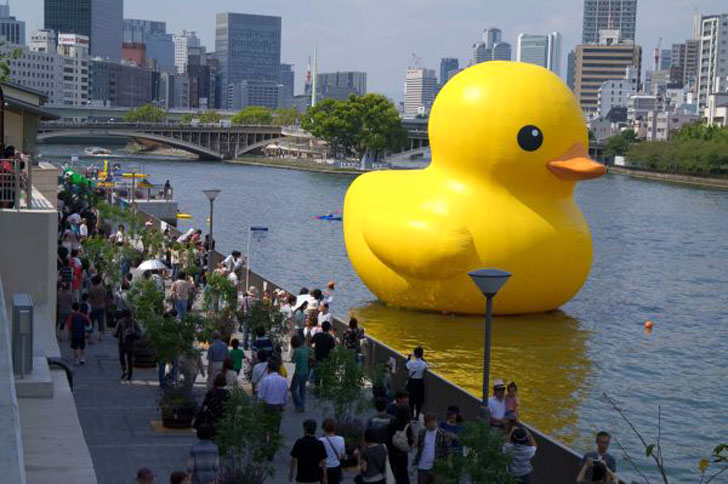
Giant Rubber Duckie Invades Loire River in France

A little more play for your Friday. Via Inhabitat and PSFK:

Artist Florentin Hofman’s giant yellow duckie puts a smile on the faces of passers-by as it floats from city to city along the Loire river in France. The hilarious and striking sight has already traveled the world before through cities such as Osaka and Sao Paulo.

The 25 meters tall and 25 meters wide friendly creature’s mission is to provide a joyful interruption to people’s daily routines. People from all over the world connect the rubber duck with their childhood memories and are brought up with positive sensations.

Famous for his humoristic pieces, the Dutch artist Florentin Hofman used rubber coated PVC to built the duck on a pontoon with a generator. Hofman believes that the soft giant can relieve global tensions through delighting people coming from different countries and backgrounds. Hofman has generated smiles many times before. In 2011, the Kobe Frog, an enormous frog wearing a party hat, was sitting on the edge of Hyogo Prefectural Museum of Art in Kobe, Japan.

The duck itself is a durable vessel, made from inflatable rubber-coated PVC, a pontoon boat, and generator to help propel it forward downstream.

more via PSFK.

Have a great weekend! Be sure to outside and explore your neighborhood, you might just see a giant rubber duckie or something else just as fantastic!


children · creativity · design · learning · play

Designs for Children Showcased at ‘Play In Progress’ During Milan Design Week

Happy Friday! I hope you get a chance to go out and play this weekend. Speaking of play, here is another great find from Milan’s Design week (remember the edible mini furniture from earlier this week?). This exhibit of design focused specifically on children’s spaces, with a focus that was very playful, creative, and also a great idea for grown-ups to incorporate into their own environments.

From Inhabitat:

Students from the HDK master program Child Culture Design created an exhibit to explore new ways of bringing play into everyday objects to help foster imagination and creativity. Dubbed “Play In Progress“, the exhibit was one of our favorites at the Salone Mobile.

Johanna Larsson‘s cool table features transparent color plates that can be arranged and rearranged to create different tabletop scenes that push imaginative thinking.
At first look of Hide||show appears to be nothing special, but just put a kid in front of one of these and you’ll realize that there is definitely something more to this cabinet. The cabinet features two pairs of handles — one ordinary set for adults and a pint-sized set of hole-like handles for children. The variation indicates different accesses to function, and give children the feeling of exclusivity in their own world.
Inspired by the game of “hide and seek”, Behind the Curtain blocks out part of a white curtain with color to create a secret space for a child to be alone in his/her world.
Griet Boucique has designed an ‘Alternative Playground’ – a landscape of soft seats – that questions what is a ‘good’ play environment for a child? The design considers material usage, its impact on the environment, and how different textiles can the way a child engages in play.

Check out more great designs at Inhabitat (I love the block table, for example!)

community · creativity · design · environment · happiness · mental health · play

Remaking or “hacking” urban spaces

Great story from TreeHugger about self-proclaimed “Urban Hacktivist” Florian Riviere and some of the various “hacks” he’s done:

When it comes to redefining public space and objects, Florian Rivière is a master. The self-described “urban hacktivist” transforms parking spots into hockey rinks, sidewalk barriers into tables, and uncomfortable benches into lounge chairs for the homeless.

I absolutely agree with TreeHugger when they say:

I love it when people re-imagine how urban space is used; it’s a fantastic way to make cities more liveable, practical and fun, without needing major construction projects or the hassle of red tape.

Here are some of his best “hacktions.”

Visit Florian Riviere‘s site and see more of his work.

I particularly like these hurdles he’s set up:

parcourse

This is just one example of “hacking” public space in a fun creative way. I still remember the yarn-bombing movement that really took off a couple of years ago but seems to have died down for now.

There was also the Swing at the bus stop.

What other examples of urban “hacktivism” have you seen? Share them in the comments below.

anthropology · children · community · creativity · design · environment · learning · Nature · play

Kids’ playground goes back to nature – Edmonton Journal

I love the fact that playgrounds are incorporating the stuff that kids love to play with the most – dirt, rocks, and sticks!

Children won’t find new monkey bars and bright plastic play structures at the upgraded Donnan Park.

Instead, the aging playground at 9105 80th Ave. will become Edmonton’s first “natural playground,” part of a growing trend in playground design.

Children in the redesigned Donnan Park will entertain themselves with such timehonoured playthings as rocks, sticks, sand and dirt. The overhauled space will feature a slide built into a hill, a sideways-growing tree, a boulder spiral, a hand pump to pour water into a small stream and plenty of plants, trees and greenery.

It will be “a beautiful garden that everyone plays in,” says Kory Baker-Henderson, co-chair of the neighbourhood committee that worked on the preliminary playground design with expertise from Ontario-based Bienenstock Natural Playgrounds.

“Around us there are already some typical playground structures, so we wanted to have something different that blends in with the (Mill Creek) ravine,” Baker-Henderson says.

“Studies have shown imaginative play is much more stimulated (in natural settings) and children actually will play longer and become much more involved than on a typical red, plastic slide structure. Their games will just get much more imaginative. There’s that connection with nature. We have plans for a community garden, so it’s a learning and teaching tool, too.”

The playground at Donnan Park currently has swings and a slide that will remain for now, but won’t be replaced, she says.

Read the full article.