behavior · happiness · health · play

Growth of playful fitness for grown-ups

IMG_6278
Adults are starting to turn fitness back into play. Image via Wikipedia

I have noticed a growing trend in fitness. Rather than taking Spin classes or training to run marathons, or even heavy weight lifting, many adults are starting to pay to play. They are buying gym memberships or punch cards for classes that offer an hour of having fun! Many classes that incorporate dance, parkour, or toys like hula hoops or trampolines, are starting to become very popular all over the United States.

The majority of these classes are geared towards women. Jazzercise has had a resurgence in popularity the past couple of years, while new fitness classes like Zumba or HoopDance are starting to surface. There are also trampolining classes offered in some places. Below are descriptions of some of these classes for those of you like me who had no idea what these classes were exactly, (thanks to Vibe Dance Studio and Sky High Sport for descriptions):

Zumba: This Adult Fitness class features easy-to-follow routines of interval training sessions where fast and slow Latin rhythms and resistance training are combined to tone and sculpt your body while burning fat. Add some Latin flavor and international zest into the mix and you’ve got a Zumba class!

HoopDance: This fun, low impact Adult Fitness class will tone the entire body while using a hula hoop on and off the body. You will explore dancing while hooping and linking moves together to create a feeling a flow. This class will build coordination, body awareness, and is great for any fitness level. You laugh and smile while learning a new skill and burning calories.

AIRobics, or trampolining: AIRobics is low impact fat burning exercise that improves balance and coordination and it is fun and energizing! The workout consists of moves from many different workout activities, and it incorporates some moves that can only be done on a trampoline.

For men, there are also options:  rock climbing has been around in the U.S. since the mid to late 70s, and  gyms geared towards those athletes opened up soon after. More recently sports like Parkour or Freerunning are also being offered in gym or class settings. Interestingly, at least anecdotally it seems that women are more likely to try these “manly” sports in the safe confines of a gym and with a coach’s guidance.

Adult recreational sports are also gaining popularity, from rugby and soccer to even roller derby.

Why the sudden increase in playful classes and gym offerings?

I suspect it’s because we adults are super stressed out (according to the American Psychological Association, Three quarters of Americans experience physical and psychological symptoms related to stress in a given month) and don’t get enough time to play and relax, but know we need to workout and at least attempt to stay healthy. Rather than do the traditional workout activities like running or lifting weights, which some find relaxing while others just find it tedious or stressful or even painful, I think many adults figure if they’re going to devote what little time they have to working out, it might as well be FUN!

What are your thoughts, experiences, attitudes towards fitness? Have you discovered other fun sports teams or classes that people wouldn’t usually think of as fitness-focused?

community · creativity · design · play

The Design Your Own Park Competition | American Journal of Play

Mitsuike Park03
How would you design the perfect park? Image via Wikipedia

The City of Binghamton, New York has a great solution for the empty lots and spaces in its area: parks! As David Sloan Wilson describes in his journal article published in the American Journal of Play:

“the thinking behind and the implementation of the Design Your Own Park (DYOP) Competition, a collaborative project of a university, a city, and a fund-raising organization to empower neighborhoods and restore outdoor play citywide in Binghamton, New York. The city makes vacant lots and other neglected spaces available for neighborhoods to turn into parks that residents design and build with the assistance of faculty and students from Binghamton University’s Binghamton Neighborhood Project.

The Design Your Own Park Competition (DYOP), launched in 2010, is a collaborative effort … to enhance opportunities for unstructured play on a citywide scale by empowering neighborhoods to create parks of their own design.

Neighborhoods typically are not well suited for collective action. From the richest gated communities to the poorest ghettos, most people scarcely know their neighbors. But there is nothing like a common goal such as creating a neighborhood park to bring people together.

more via The Design Your Own Park Competition | American Journal of Play.

The city of Seattle, WA, proposed a similar project, although it fizzled out somewhat after initial interest from various organizations (does anybody remember the name of that project? If so, leave it in the comments below, thanks!).

Check out some of the other articles published in the Spring edition of the American Journal of Play. They deal with some really interesting issues of play, child devleopment, and overall health.

anthropology · behavior · creativity · happiness · health · mental health · play

The Shape of Enrichment – ICEE conference taking place this weekend in Portland, Oregon

There are people who get paid to come up with games and toys for animals. Just like people, animals need something to do all day to keep themselves fit and healthy, both mentally and physically. This has been dubbed “enrichment” by people who study this kind of thing, but it basically is just looking at ways to encourage animals to play.

This weekend enrichment experts are all getting together to discuss different ways to provide better enrichment (i.e. toys, games, crossword puzzles) for animals that live in zoos, aquariums, research centers, and so on.

I am sorry I am missing this conference; it sounds amazing!

The mission of the ICEE is to improve the wellbeing of captive animals by providing a venue for the exchange of information among the many diverse groups that participate in environmental enrichment. A key feature of the ICEE is the participation and interaction of animal welfare scientists and all those responsible for the care of captive animals. To further this mission, the ICEE Committee organizes a biennial conference, with published proceedings, in locations around the globe.

more via The Shape of Enrichment – ICEE.

I wish I could go, but I’m doing a little bit of self-enrichment this weekend so am otherwise engaged (plus $400 is a bit steep for me), so I will just lurk on the website for awhile and see what updates pop up. OR, if you’re going you could post in the comments and let me know what I missed? Or, even better, if you know of other events coming up soon, share them here! Thanks!

autism · behavior · children · cognition · creativity · mental health · psychology · technology

Using Play and Technology for Therapy

Griffin Wajda and Juan Pablo Hourcade in Iowa City, IA, play a collaborative-storytelling app.

I truly think technology (and play) are underutilized when it comes to all kinds of therapy, partially because it’s expensive, and partially because people don’t know how to implement it. This article in the Wall Street Journal offers a great example of how people are integrating play AND technology into therapy.

Multitouch technology—which turned smartphones, iPads and other tablet computers into consumer sensations—has a new function: therapy for cerebral palsy and autism spectrum disorders, as well as a range of developmental disabilities. Researchers from at least three North American universities, including Iowa, are developing therapeutic applications for multitouch devices. Games developed by the Scientists’ Discovery Room Lab at Harvard University, and by University of Alberta researcher Michelle Annett, encourage children with cerebral palsy and stroke victims to stretch their range of upper arm and wrist motion.

“It’s a very motivating tool for the patients. It’s visual, the feedback is instant and it’s fun,” said Isabel Henderson, vice president of Glenrose Rehabilitation Hospital in Edmonton, Canada, where games on a touch-screen table are part of stroke victims’ physical rehabilitation.

The new apps offer patients engaging ways to address their medical conditions over the long term, said Quentin Ranson, an occupational therapist at the Alberta hospital. They also could help reduce the time patients need to spend in expensive traditional therapy, Mr. Ranson said.

Children with cerebral palsy—a group of disorders caused by brain damage before or shortly after birth—work to improve their motor skills and coordination through repetitive exercises like wiping a cloth across a table, stringing beads on a pipe cleaner or throwing a ball back and forth. Patients recovering from stroke do much of the same, stacking cones and flipping cards to help them lift their arms against gravity.

more via the Wall Street Journal.

This is just one example of how using play and the right tools can encourage development and healing.

behavior · brain · cognition · creativity · learning · play

Why we need play and relaxation to think

Recreated :File:Neuron-no labels2.png in Inksc...
These little guys need a break just like your muscles. Image via Wikipedia

The brain is an amazing thing. It allows us to problem solve, combine ideas, and create out of seemingly thin air. But only if we let it.

As a play advocate, I run into a lot of people grumbling that play takes away from learning; but the fact of the matter is, play is ESSENTIAL to the learning process. More and more science is showing that the brain needs that down time to process what it’s learned, digest it a little bit, in order for us to use it for any useful purpose.

People who study creativity and innovation are aware of this all too well:

Current neuroscience research confirms what creatives intuitively know about being innovative: that it usually happens in the shower. After focusing intently on a project or problem, the brain needs to fully disengage and relax in order for a “Eureka!” moment to arise. It’s often the mundane activities like taking a shower, driving, or taking a walk that lure great ideas to the surface. Composer Steve Reich, for instance, would ride the subway around New York when he was stuck.Science journalist Jonah Lehrer, referencing a landmark neuroscience study on brain activity during innovation, writes:

“The relaxation phase is crucial. That’s why so many insights happen during warm showers. … One of the surprising lessons of this research is that trying to force an insight can actually prevent the insight.”

keep reading the Developing Your Creative Practice: Tips from Brian Eno :: Tips :: The 99 Percent to hear Brian Eno’s take on creativity and how he puts his brain to work.

It’s nice to see that science is finally taking relaxation and play seriously. I just wish the rest of the world, or at least our education system, would too. I know my work would benefit greatly if I took time to just relax and contemplate things more, to relax and let my brain explore a little bit. Hmmm, another exercise to try…

behavior · children · community · creativity · health · play

6 Ways To Get Kids Outside And Moving This Summer, suggested by Kaboom

KaBOOM! CEO Darell Hammond
Kaboom CEO Darrel Hammond (told ya' it wasn't the SNL guy!) Image via Wikipedia

It doesn’t really feel like summer here in the Pacific Northwest yet, but we’re already scheduling picnics and camping trips and weddings and all kinds of outdoor activities in hopes of the weather getting nice. But there are more ideas for getting outside than (hopefully not) tedious nuptials or a forced march uphill. Darrel Hammond, CEO of Kaboom (not the SNL guy), has some ideas specifically for families:

Summer should be a time for roaming, discovering and running outside — but unfortunately, for all too many kids, more free time means more screen time and more structured activities.

It’s up to you to ensure that your kids get a healthy daily dose of unstructured outdoor play. Here are six ways to get your children moving, nurture their creativity and provide them with all the rich learning opportunities that outdoor play presents. In the process, you’ll meet new neighbors and contribute to a nationwide movement to save play.

Suggestion #4: Close a street for play. I’ve actually seen several neighborhoods around town grab a permit for the afternoon to close down their street and have a block party. Some cities are probably easier to work with than others, but the idea of a block play party sounds fabulous!

We all need a little push to get out the door (especially when it’s too hot, too cold, too windy, not windy enough, etc.), so having a planned event or project like this can be very useful.

more suggestions by Darell Hammond: 6 Ways To Get Kids Outside And Moving This Summer.

Kaboom! is a play-focused non-profit that is working to ensure that every child has a great place to play within walking distance of their school or home. They certified a playground here on Mercer Island, WA, and are working to install or certify others all over the U.S. Another idea to get your kids out and active: help build a playground!

behavior · children · creativity · design · play

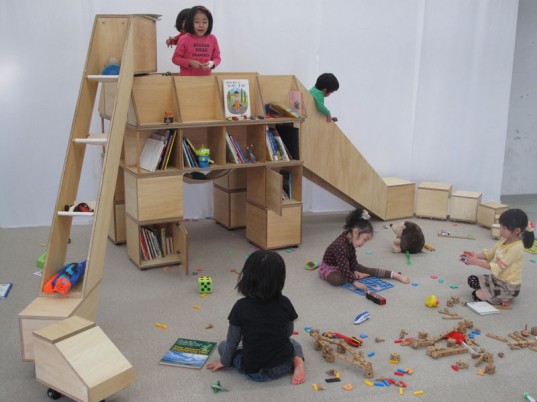
Bookshelf/Playground combo makes putting your toys away fun

Casasaurus

My mom always told me not to climb up my bookshelves when I was a kid; now I wish I was little again and could beg her to get me one of these. This is actually a great tool for learning, because it allows kids to think three dimensionally, in a playful way. Trying to decide which cubbies hold what items, and climbing, sliding, and thinking of an object as two things at once (a bookshelf AND a dinosaur) are great exercises for the brain at any age.

Casaurus, the senior thesis project of student designer Koichiro Hoshino from Tokyo University of the Arts. The designer’s dinosaur-shaped bookshelf includes plenty of space for a bookworm’s library, a tail-like slide for kids to whiz down, shelves made for climbing and small boxes that add length to the dino’s tail. Kids can also find a reading nook underneath the dino’s belly.

more via Koichiro Hoshino’s Casaurus is a Bookshelf and a Playground | Inhabitots.

community · creativity · culture · happiness · music · play · Social

Promoting public dancing through flash mobs!

A pillow fight that took place in Lausanne, Sw...
Flash mob pillow fight in Switzerland (neutral, yeah right!). Image via Wikipedia

Thanks again to the Seattle PI for bringing us great stories of spreading joy and happiness (see posts from earlier this week)!

If you were out and about in Seattle Sunday, you might have encountered more dancing and music than expected.

You can thank the TV show “Glee” and Seattle’s propensity for flash-mob participation for that.

“Glee” flash mobs broke out in several spots around the city Sunday afternoon. Here’s video of one of the best performances I’ve seen out of a bunch posted on YouTube.

Continue on to see the video (direct link below).

http://www.youtube.com/watch?v=RWr-wQ8kBOI&feature=player_embedded

This is such an awesome trend of seeing flash mobs of people performing public dancing and performance, from Michael Jackson’s Thriller to Glee to improv and beyond.

architecture · technology

Funny Shaped Buildings

There was an old woman who lived in a shoe…and a young woman who lived in a basket.
People enjoy oddly-shaped structures, especially if they are functional. But what is the point? What do they do for us? They make us laugh, inspire creativity and "out of the box" thinking, and make us think of things in new ways. Oh yeah, and provide shelter.

And, in some cases, provide free advertising (free other than the cost of the building).

Mental Floss put together a fun gallery of 10 buildings shaped like the products they offer. Above, the Kansas City Library garage with its facade of 22 giant book spines, including Catch-22, Invisible Man, and The Lord of the Rings. To the left, the headquarters of Newark, Ohio’s Longaberger Company makers of, you guessed it, maple baskets. "10 Buildings Shaped Like What They Sell"

Courtesy also of Boing Boing

brain · creativity · design · music

10 Ways to Boost Creativity

This list was compiled by the very talented Lori McNee (@lorimcneeartist) for The Top 10 Blog.

Lori is an internationally recognized professional artist who specializes in still life and landscape oil paintings. She shares valuable fine art tips, art business tips and social media advice on her superb blog FineArtTips.com.

Lori writes: Artists, writers, musicians and even bloggers have a common need to create. But, sometimes we hit a mind block and often find ourselves stressed, overwhelmed and unable to produce original ideas. This happens to me from time to time, so I decided share my top ten ways to boost your creativity.

1. Set aside a time and place.
2. Give yourself a break from technology. (um, but continue reading this blog for more ideas before you take a break!)
3. Try something new.

Read all of her ten tips and why here: http://www.thetop10blog.com/top-10-ways-to-boost-your-creativity/