creativity · culture · design · play

Crochet Vandals Do Graffiti Like Your Grandma : NPR

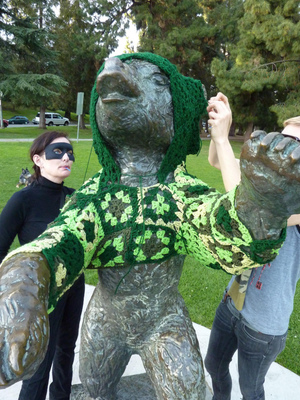
Captain Hook with bear shrug

I love this kind of public art! There was a tree in town that got a sweater a couple of years ago, and I’m so excited to see this is now becoming a “movement.”

“Captain Hook” is part of an international movement of so-called yarn bombers taking an old-school approach to street art. Unlike most street artists who travel with spray paint or markers, Captain Hook — as she asked NPR to call her — works with a crochet hook and yarn.

Her “walls” are public fixtures, like the bronze bear statue in L.A.’s Griffith Park that stands zombie-like with its paws out. “This is crochet on a statue,” she says, sitting in her Los Angeles apartment, a pile of granny squares in her lap. “This could be happening in 1725.”

more via Crochet Vandals Do Graffiti … Like Your Grandma : NPR.

behavior · brain · happiness · health · neuroscience · play · psychology

Want To Live To 100? Try To Bounce Back From Stress : NPR

Hint from featured profile Helen Reichert, who's 109? A sense of humor helps.

More and more research is finding that the ability to cope with stress and bounce back better correlates with long life. Just a reminder to take it easy…

Gerontologist and commentator Mark Lachs says one of the keys to a long, healthy old age is the ability to keep moving forward after life’s inevitable setbacks.

listen via Want To Live To 100? Try To Bounce Back From Stress : NPR.

One study found that 50 year olds with a negative outlook on life lived seven years shorter than those with a positive outlook.

What’s interesting is that more than avoiding stress it seems more important to have the ability to bounce back from it. So healthy coping mechanisms for handling stress, as well as a good attitude about life, seems to be more important than nutrition and exercise.

architecture · behavior · brain · design · emotion · environment · happiness · health · mental health · Nature · psychology

Using Nature Therapy in Prisons and Hospitals

I’m seeing lots of different examples of people using nature to help heal, from the physically injured to those with aggression issues cut off from the rest of the world.

For example, I was just listening to a program this weekend on the local NPR station about a biologist at Evergreen State College who is greenifying a local prison, as well as working with inmates to grow new prairie grass and frogs (I can’t find the original story but here’s some similar coverage):

The frog rearing program here pairs inmates with scientists from the Evergreen State College as part of the Sustainable Prisons Project. So far, the frogs grown at Cedar Creek Correctional Center are doing better than those grown by professional zoologists.

LIESL PLOMSKI, graduate student, The Evergreen State College says, “They have a lot more time here to care for the frogs that a zoo wouldn’t have. I mean they’re here all day with them, so they change the water frequently. They feed them more frequently than a zoo could ever do.”

And then this morning stumbled upon this story:

Henning Larsen Architects recently won an international design competition with their plans for the new Odense University Hospital in Denmark. Situated close to the city center amidst a scenic old-growth forest, the OUH will use the surrounding landscape as a way to heal its patients. The holistic facility features a light footprint that incorporates nature at every turn to create an environment replete with peace and serenity. Daylight floods in through the glass-lined buildings, and rainwater will be collected to feed the many ponds and surrounding landscape.

more via Denmark’s New Odense Hospital is a Healing City of Glass Amid the Forest | Inhabitat – Green Design Will Save the World.

I am blown away by all the different applications of nature into therapy and recovery practices.

community · design · family · health

Granny Pods Keep Elderly Close, At Safe Distance : NPR

His idea might seem strange, but “granny pods” are catching on.The granny pods real name is the MEDCottage, and its basically a mini mobile home that rents for about $2,000 a month. You park one in the backyard, hook it up to your water and electricity, and it becomes a free-standing spare room for Grandma and Grandpa.The concept is catching on all over the country, but nowhere more so than Virginia, where the state government has eased zoning restrictions on these high-tech hideaways, which go on the market early next year.The MEDCottage is homey on the outside, with taupe vinyl siding and white trim around French doors. Inside, it looks like a nice hotel suite, complete with kitchen and bathroom — and security cameras.

more via Granny Pods Keep Elderly Close, At Safe Distance : NPR.

community · environment · health

Healing Honey And The Beekeeping Craze : NPR

I’m far from home right now, and feeling it. I could use a touch of home…and for some reason honey seems very homey to me. Especially when it’s made at home! Don’t laugh, urban bee-keeping is becoming a big thing, as part of the local-vore, grow-your-own-food movement.

Beekeeping classes from Medina, Ohio, to the suburbs of Washington, D.C., and New York are seeing an unexpected shift in enrollment. Numbers are way up as thousands of novices take up the hobby. And who are these new beekeepers? Increasingly, they’re women.

“The surge has really been with younger, urban women,” explains longtime instructor Kim Flottum, who teaches beekeeping in Medina.

Flottum estimates that there are about 100,000 backyard beekeepers across the United States. Exact numbers are hard to pin down. But subscriptions to the publication Bee Culture are on the rise. And when Flottum published a how-to book — An Absolute Beginner’s Guide to Keeping Bees in Your Yard and Garden — 60,000 people snapped up copies. The book is aimed at making the hobby easier and using more lightweight equipment.

more via Healing Honey And The Beekeeping Craze : NPR.

behavior · brain

We are music-powered beings

It is amazing the power that music has on us. It can make us happy, cry, soothe depression, calm, enliven, and make us dance like idiots.

Babies are not immune to this, in fact there are some very famous dancing babies. Who can forget the kiddo dancing to Beyonce from a year ago?

Turns out this inclination to move and wiggle to music starts at an incredibly early age. NPR’s Science Friday showcased a study where babies where set up with headphones piping in very danceable beats. Infants would spontaneously start dancing to the beat. Sure, they weren’t all that great at it, but as the scientists point out, they’ve only been using their muscles for a few months here, so cut them some slack!

Click here to see the video

But I have never seen such a good demonstration of the power of music as with this little guy. Watch what happens right around 30 seconds and then again at 2:10.

anthropology · brain · creativity · Mental · neuroscience · psychology

The Evolving Minds Of Humans : NPR


Where do we get artistic ideas and inclinations? What is it about the brain that makes us like art? Neurologist Antonio Damasio writes about his ideas why in his new book, Self Comes to Mind.

In his new book, Self Comes To Mind, neurologist Antonio Damasio argues that consciousness gave humans an evolutionary advantage. Damasio describes the differences between self and mind, and traces the evolutionary path of the human brain.

Where do we get the ability to create works of art, to be moved by a piece of beautiful music or to feel bad when someone says something hurtful?

via The Evolving Minds Of Humans : NPR.

His main focus is on consciousness, but touches on the idea of creativity, new thinking, and artistic desires as part of our evolution as humans.

anthropology · architecture · behavior · community · Social

Radiolab explores the city!

What makes cities work? How do humans live in such HUGE tribes. More than half of us live in cities.

I’m a new city transplant. I’m not sure I’ll ever get used to it, but it’s a fascinating topic to explore.

There’s no scientific metric for measuring a city’s personality. But step out on the sidewalk, and you can see and feel it. Two physicists explain one tidy mathematical formula that they believe holds the key to what drives a city. Yet math can’t explain most of the human-scale details that make urban life unique. So we head out in search of what the numbers miss, and meet a reluctant city dweller, a man who’s walked 700 feet below Manhattan, and a once-thriving community that’s slipping away.

Thanks Jad and Robert.

Cities – Radiolab.

Uncategorized

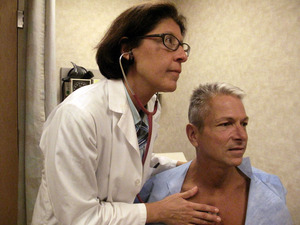
The Fading Art Of The Physical Exam : NPR

I played sports as a kid, and always had to start my school year with a doctor’s physical exam. Apparently that doesn’t happen much anymore.

Doctors are physically examining their patients less and less, and relying more on technology. Some doctors are bucking this trend and trying to revitalize the practice of listening and actually touching their patients.

As a woman, I am still poked and prodded on a semi-regular basis (yuck!), but I’ve never had to go in for something serious, and I’ve heard others complain about this phenomenon. I’m interested what the experience of others has been.

For centuries, doctors diagnosed illness using their own senses, by poking, prodding, looking, listening. From these observations, a skilled doctor can make amazingly accurate inferences about what ails the patient.

Technology has changed that. “We’re now often doing expensive tests, where in the past a physical exam would have given you the same information,” says Jason Wasfy, a cardiologist-in-training at Massachusetts General Hospital in Boston.

As a result, many doctors are abbreviating the time-honored physical exam — or even skipping it altogether.

more at The Fading Art Of The Physical Exam : NPR.

Social · technology · writing

Open Diary: Chronicling The Hidden World Of Girls : NPR

It’s not too late to submit! Be a part of the story on NPR’s Open Diary: Chronicling The Hidden World Of Girls.

one submission to the Flickr account

As part of the Hidden World of Girls project, we’re looking to create a database of intimate diary entries. With enough of them, they could form a comprehensive tapestry — from elation to depression — of life experiences. We already have a small collection on Flickr.

How Can You Help? Submit pictures or scans of your diary’s pages — or even the pages of your mother’s diaries or grandmother’s diaries.

How To Submit: Photos should be submitted through The Hidden World Of Girl’s Flickr group. Or if it makes things easier, just upload them anywhere and leave us a link to the picture in the comments section. We will be getting in touch with you through Flickr mail or through the e-mail address provided when you sign up for an NPR community account. On Flickr, you’ll know if you’ve submitted photos correctly if they show up here.

via Open Diary: Chronicling The Hidden World Of Girls : NPR.