This is an interesting follow-up/add-on to the RadioLab “Cities” episode I blogged about a couple of weeks ago. The Healing Cities Working Group of planners and health professionals in Vancouver, BC is working to create healthy environments in urban areas, particularly focusing on food and food sources.
It’s possible to interest public officials in the health impact of the built environment because Canada has nationalized health care.
“When you have a public health care system like we have in Canada, we all collectively pay the end-of-pipe costs,” said Holland. “So anything we have in our society that makes us unhealthy, we end up paying for it.” Of course, that’s true in the United States as well, but there is much less transparency and awareness of those costs because of the way our system is set up.
In Canada, Holland hopes to be able to involve doctors and public health authorities in the fight against sprawl and for more walkable and transit-oriented neighborhoods. Among the Healing Cities Working Group’s many planned initiatives is a partnership with health officials to advocate for more health-enhancing infrastructure and development at the local level.
Other studies have found that greener neighborhoods also decrease stress and make people more likely to walk or bike places. Where you live, what have you found works best for you personally to motivate you to get you outside, moving, and buying less insta-food?
My grandma and I had a pact that we’d both do our best to live to be 100. She died at 85 after a long, happy life, married to her best friend since 1st grade. Go Mommo! But I’m still in the running, so I’m always interested in how Centenarians live it up. And it seems to boil down to two things: luck, and keeping a good attitude about life.
Israeli physician Nir Barzilai and his staff at the Institute for Aging Research at the Albert Einstein College of Medicine in New York have asked hundreds of centenarians hundreds of questions, including details of their living circumstances, nutrition, alcohol consumption, smoking, physical activity, sleep, education, status, and spirituality — all in the hope of finding commonalities.
The results are sobering: “There is no pattern,” says Barzilai, 54. “The usual recommendations for a healthy life — not smoking, not drinking, plenty of exercise, a well-balanced diet, keeping your weight down — they apply to us average people, but not to them. Centenarians are in a class of their own.” He pulls spreadsheets out of a drawer, adjusts his glasses, and reads aloud: “At the age of 70, a total of 37 percent of our subjects were, according to their own statements, overweight; 37 percent were smokers, on average for 31 years; 44 percent said that they exercised only moderately; 20 percent never exercised.”
The women in my family tend to live a long time, although I don’t think anyone has made it to 100 yet. What is your family’s pattern for longevity? Were people healthy right before they died, or did they linger with illness?
The winners are in, and now you can reap the benefits!
The Apps for Healthy Kids competition is a part of First Lady Michelle Obama’s Let’s Move! campaign to end childhood obesity within a generation. Apps for Healthy Kids challenges software developers, game designers, students, and other innovators to develop fun and engaging software tools and games that drive children, especially “tweens” (ages 9-12) – directly or through their parents – to eat better and be more physically active.
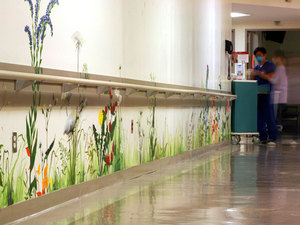
Being able to relax during medical treatments makes treatments more effective, as well as making better patients. Diane Brown is working to add a little art and light to a scary place: hospitals.
“While hospitals have become more physically welcoming in recent years, with new buildings designed by famous architects and lobbies filled with art, those changes rarely find their way to some of the hospital’s most difficult spaces — the rooms filled with machinery where treatment actually happens.
Diane Brown is trying to change that. She’s the founder of Rx Art, a nonprofit group dedicated to bringing art into the examination room and giving patients a way to escape their bodies’ sickness through their minds’ imagination.”
I played sports as a kid, and always had to start my school year with a doctor’s physical exam. Apparently that doesn’t happen much anymore.
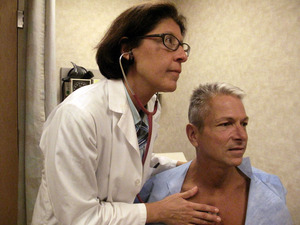
Doctors are physically examining their patients less and less, and relying more on technology. Some doctors are bucking this trend and trying to revitalize the practice of listening and actually touching their patients.
As a woman, I am still poked and prodded on a semi-regular basis (yuck!), but I’ve never had to go in for something serious, and I’ve heard others complain about this phenomenon. I’m interested what the experience of others has been.
For centuries, doctors diagnosed illness using their own senses, by poking, prodding, looking, listening. From these observations, a skilled doctor can make amazingly accurate inferences about what ails the patient.
Technology has changed that. “We’re now often doing expensive tests, where in the past a physical exam would have given you the same information,” says Jason Wasfy, a cardiologist-in-training at Massachusetts General Hospital in Boston.
As a result, many doctors are abbreviating the time-honored physical exam — or even skipping it altogether.
Pesticides used in industrial farming, lawns, and other urban greenery have been linked to all sorts of child development health issues, and now a study is suggesting one more. A study released in the May issue of Pediatrics Journal argues that there’s a connection between high exposure to common pesticides and increased risk for children developing attention deficit hyperactivity disorder, or ADHD.
Maryse Bouchard and colleagues looked at more than 1,100 children aged between 8 and 15. All of them had been sampled by the National Health and Nutrition Examination Survey (NHANES) between 2000 and 2004, and 119 had been diagnosed with ADHD. Bouchard’s team studied their urine samples for chemicals called dialkyl phosphates, which result from the breakdown of organophosphate pesticides used to protect fruits and vegetables.
For a 10-fold increase in one class of those compounds, the odds of ADHD increased by more than half. And for the most common breakdown product, called dimethyl triophosphate, the odds of ADHD almost doubled in kids with above-average levels compared to those without detectable levels [Reuters].
I posted this on my other blog, Art of Science, because it concerns the science behind pretty sounds, but it’s also important from an environmental enrichment perspective – in fact that’s what Julian Treasure does for a living – so I wanted to also post it here:
Listen to Julian Treasure’s TED talk about sound. [And really listen! Close your other computer screens, turn off the email “ping”s and listen.]
Treasure says our increasingly noisy world is gnawing away at our mental health — even costing lives. He lays out an 8-step plan to soften this sonic assault (starting with those cheap earbuds) and restore our relationship with sound.
Julian Treasure is the chair of Sound Agency, “a firm that advises worldwide businesses — offices, retailers, hotels — on how to use sound. He asks us to pay attention to the sounds that surround us. How do they make us feel: productive, stressed, energized, acquisitive?
Treasure is the author of the book Sound Business and keeps a blog by the same name that ruminates on aural matters (and offers a nice day-by-day writeup of TEDGlobal 2009). In the early 1980s, Treasure was the drummer for the Fall-influenced band Transmitters.” (Source: TED)
I have always been a HUGE proponent of physical exercise and play for health reasons and brain function, and now here’s more evidence of why physical play is sooooo important:
Animal studies had already established that, when given access to running wheels, baby rodents bulked up their brains, enlarging certain areas and subsequently outperforming sedentary pups on rodent intelligence tests. But studies of the effect of exercise on the actual shape and function of children’s brains had not yet been tried.
…
For budgetary and administrative reasons, school boards are curtailing physical education, while on their own, children grow increasingly sluggish. Recent statistics from the Centers for Disease Control and Prevention show that roughly a quarter of children participate in zero physical activity outside of school.
At the same time, evidence accumulates about the positive impact of even small amounts of aerobic activity. Past studies from the University of Illinois found that “just 20 minutes of walking” before a test raised children’s scores, even if the children were otherwise unfit or overweight, says Charles Hillman, a professor of kinesiology at the university and the senior author of many of the recent studies.
Just viewing nature can make us feel better. This has been found in several different situations, but perhaps none so profound as with Alzheimer patients. As reported by Claire Moore, ABC News:
Alzheimer’s is the most common form of senile dementia and is characterized by a buildup of plaques deposited in the brain. It affects up to 10 percent of adults over the age of 65 and 50 percent of those over 80.
Nationwide more than 4 million people have the disease. The Chicago-based Alzheimer’s Association that is sponsoring the congress estimates more than 12 million Americans will have Alzheimer’s by 2025 as baby boomers move onto their 70s and 80s.
Elizabeth Brawley has devoted her professional life to “designing for Alzheimer’s” — everything from handrails and chairs to lights and entire rooms that fit the needs of adults with dementia, a fatal condition most commonly caused by Alzheimer’s.
Her most recent project is the American Landscape Society of America Alzheimer’s Garden Project — a series of nine gardens designed to accommodate those with Alzheimer’s. “We know that just getting outside is good for you. For Alzheimer’s patients it can help reduce anxiety, improve sleep patterns and give the caregiver a break,” says Jack Carman, a landscape architect who is Brawley’s partner in the garden project.
Research has shown that sick and elderly people who were able to view trees and sky recovered faster — with fewer painkillers and complaints — than those left staring at brick walls. Numerous studies have also shown reductions in blood pressure, anxiety, pain and other symptoms of stress when patients were offered just a videotape or a photograph of a natural scene.
But so far there is very little research on how sunlight and being in a natural environment affect people with Alzheimer’s in particular. So Brawley, Carman and the Alzheimer’s Association are currently applying for government and private funding to study the five memory gardens they have completed in Oklahoma City, Muskegon, Mich., Hastings, Minn., New York City and Macon, Ga.
The first memory garden opened in July 1999 on a half acre park in Macon, Ga.
“So far, it’s been hugely successful because everyone from the community uses it. It’s not just for people with Alzheimer’s but it does provide them with a sanctuary,” said Mary Gatti, executive director of the Central Georgia chapter.
Although healing gardens are hardly a new idea, said Chapman — they’ve been discussed for the past 40 years by some researchers — the importance of an outdoor environment has been ignored to practitioners and nursing homes for too long.
The National Post also carried a story about the healing of gardening. There has also been research on ADHD kids and nature, as well as general mental wellness. More on this later, but the article also mentioned studies about how just viewing flowers makes us happier:
A behavioural research study conducted a few years ago at Rutgers University found the presence of flowers — at the bedside or outside a window — triggers happy emotions, heightens feelings of life satisfaction and affects social behaviour in positive ways that exceed what was previously believed.
An earlier study, conducted by health care design expert Roger Ulrich, compared the hospital records of patients recovering from gall bladder surgery and found those with a view of trees— rather than a view of a brick wall — spent less time in the hospital and required fewer and less-potent drugs to remain comfortable.
I think it’s wonderful how this is becoming more widespread and more accepted. The University of Washington, Seattle, offers a certificate degree in designing healing gardens.
A recent study of mummies found a significant number of the elite mummies (which most were) had clogged arteries, calcification of vessels, and other symptoms of heart disease and obesity.
This has been found before, but this is the largest study so far.
The BBC article I read suggested it was caused by the supposed large amounts of fatty meats being eaten by the elite.
However, as I suspected he might, Rafe said “There’s currently a bit of discussion on GNXP (Gene Expression). Michael Eades, auther of Protein Power, has published in the past showing that the Egyptian elite were in fact obese quite regularly, and attributes it to a diet that was very high in grains combined with a sedentary lifestyle, not the high in meat diet proposed in the BBC article.”
Quoted from Science Daily: “UC Irvine clinical professor of cardiology Dr. Gregory Thomas, a co-principal investigator on the study, said, ‘The findings suggest that we may have to look beyond modern risk factors to fully understand the disease.'”



 Mental Flowers